Saturday, December 13, 2025

Romance Didn’t Ghost You. The Algorithm Just Optimized You Out

Romance did not disappear overnight. It was not betrayed by technology, nor replaced by cynicism. It was quietly deprioritized. Somewhere between your profile photo and your last unanswered message, an algorithm ran a calculation and decided your presence no longer improved engagement metrics. You weren’t rejected. You were optimized out.

Artificial intelligence now sits at the center of modern dating, not as a tool, but as an invisible arbiter of human connection. It decides who is seen, who is suggested, who is delayed, and who quietly fades from view. What feels like personal failure is often systemic design. What feels like rejection is frequently automation.

To understand what AI has done to romance, we must look beyond convenience and confront consequence.

Ubiquity Without Awareness

AI is not an optional feature of online dating; it is the architecture. Every swipe, match, pause, and message trains the system. Machine learning models rank desirability, predict response likelihood, and curate visibility in real time. Yet users are never shown the rules. They experience outcomes without explanations, patterns without transparency.

This asymmetry matters. When people don’t understand the system judging them, they internalize its verdicts. A lack of matches becomes self-doubt. Silence becomes unworthiness. The algorithm’s silence feels personal—even when it is not.

A National Experiment in Pairing

At scale, AI-driven dating is no longer private. It influences marriage rates, birthrates, class mobility, and social cohesion. When algorithms reward similarity and familiarity, they reinforce existing divisions—racial, economic, ideological. When they reward engagement over fulfillment, they extend searching instead of resolving it.

This is not neutral matchmaking. It is a quiet national experiment in how intimacy is distributed, delayed, or denied. Over time, those patterns harden into norms, and norms reshape culture.

Emotional Costs Hidden in Code

Dating has always involved vulnerability, but AI compresses emotional highs and lows into rapid cycles. A match arrives instantly. Disappears instantly. Reappears never. The nervous system never catches up.

Ghosting, once a personal failing, becomes a structural feature. The system rewards novelty, abundance, and optionality. Closure has no economic value. Lingering dissatisfaction does. Emotional exhaustion is not a bug—it is a byproduct.

People leave these platforms not heartbroken, but hollow. Not rejected, but replaceable.

Romance as an Optimization Problem

AI reframes love as a solvable equation. Preferences become filters. Compatibility becomes probability. Desire becomes data. The mystery that once defined romance is flattened into metrics that can be tested, tweaked, and monetized.

Users learn quickly. They adjust photos, bios, tone, even personality to please the machine. Authenticity gives way to performance. Dating becomes less about being known and more about being selected.

In the process, people stop asking whether they like someone—and start asking whether the algorithm will.

Cultural Virality and Quiet Damage

The cultural conversation is already here. Memes joke about being “algorithmically unattractive.” Podcasts chronicle dating burnout. Articles lament the death of romance while ignoring the machinery behind it.

AI dating thrives in this contradiction: publicly mocked, privately relied upon. It has become the dominant gateway to intimacy while simultaneously eroding faith in it.

The Long Horizon

AI is not done with dating. Voice analysis, behavioral prediction, emotional modeling, and synthetic companionship are already emerging. The future will not ask whether AI belongs in romance—it will assume it does.

The real question is whether humans will retain agency, discernment, and patience in a system designed to remove friction, even when friction is where meaning lives.

The Moral Reckoning

Romance cannot survive on optimization alone. Love requires inefficiency. Misjudgment. Waiting. Risk. AI has no incentive to protect these qualities unless humans demand it.

The danger is not that machines will choose our partners. The danger is that we will accept their choices without reflection—mistaking convenience for wisdom and visibility for value.

Romance did not ghost us. We allowed it to be quietly deprioritized.

And if love is to remain human, then humans must once again insist on choosing—even when the algorithm suggests otherwise.


Thursday, December 11, 2025

Army Experts Team With European Partners on Arctic Nutrition Research

As the U.S. military and its adversaries shift focus to the Arctic, working with partner nations in cold-weather regions to make sure our warfighters can survive those extremes has never been more important.

Five soldiers in cold-weather clothing and with rifles slung over their shoulders walk through a snow-covered landscape.

Over the past decade, the U.S. Army Research Institute of Environmental Medicine's Military Nutrition Division has collaborated with the Norwegian Defense Research Establishment, known as FFI, to conduct research on nutrition that service members need to be productive in extreme cold.

One of the division's primary roles is to go into the field with warfighters during operations and training activities to better understand their physiological requirements. Since Norwegian military personnel often train in the Arctic, USARIEM researchers have, on several occasions, joined FFI on those missions to collect data.

"We've been there to study energy demands and warfighter eating behavior," said Dr. James McClung, the Military Nutrition Division chief. "[In extreme cold], there's a significant reduction in the physiological cue to eat, even though adequate nutrition is required."

A person in cold-weather clothing points a weapon over the edge of a snow-covered trench in a winter landscape.

Over the course of more than a decade, an MND team conducted four studies in the Arctic on warfighter nutritional health "to better understand individual differences, whether those be sex, body composition or other factors on energy metabolism in the cold," McClung said.

In 2013, MND and FFI researchers evaluated the physical and biological functions of various volunteer warfighters. They followed that in 2015, 2022 and 2025 with studies that required soldiers to test various prototypes of supplemental snack bars; a few of the studies were conducted within the Arctic Circle.

"During these training exercises, they move very far on skis carrying a lot of weight," said Dr. Emily Howard, an MND nutrition physiologist who took part in the Norway studies. "The best part … is seeing the things we study here being implemented in person. You can actually see what they're consuming in that environment, how they're consuming it and gaining some additional insight."

If researchers observed various effects on the soldiers, such as negative energy balance — when a person can't eat enough to maintain their performance — they worked to adjust the nutrition in the rations they were receiving to overcome those problems.

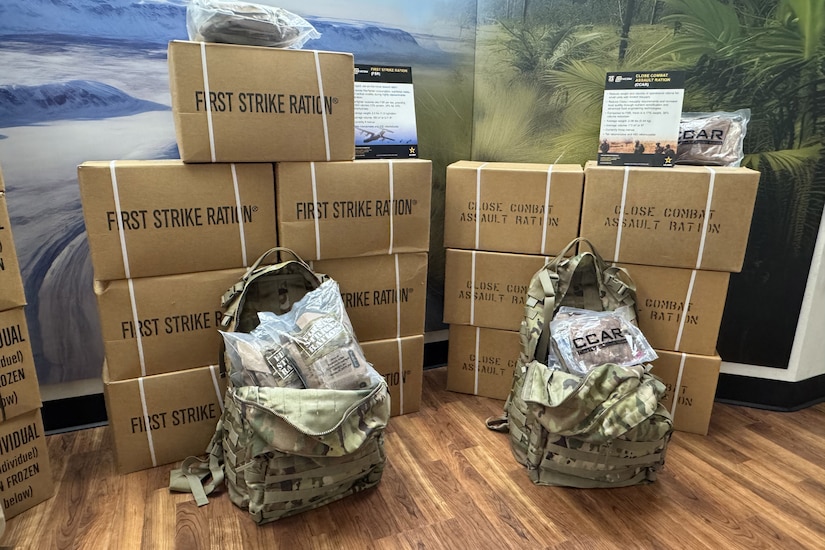
Two camouflage backpacks filled with food packages sit on the floor, in front of cardboard boxes.

The research, which has been years in the making, helped to inform a more energy-dense ration known as the close combat assault ration, which recently replaced the first strike ration for U.S. combat troops.

FFI researchers have also joined MND experts in studies at the labs in Natick, Massachusetts.

"It's been a very productive collaboration, one that allows us to answer really important questions for the warfighter," Howard said.

Dietary Supplements

The division has also worked with partner nations on dietary supplement research after NATO formed a research task group in 2021 to study their use in military personnel across the U.S., France, the United Kingdom and Slovenia.

"One of the primary findings [in a recent study] is that dietary supplement use is greater in military personnel as compared to civilians," McClung said. "In fact, across the nations, on average, more than 60% of warfighters utilize dietary supplements."

Plastic bottles containing various nutritional supplements are lined up for sale on store shelves.

According to the study, service members' reasons for using dietary supplements were also different than civilians, with military personnel mostly using them for recovery and to maintain physical and cognitive performance and body composition standards.

"Items like protein and amino acids are very popular [among military personnel], whereas in civilian communities, the use of multivitamin-type supplements for health and well-being are more common," McClung said.

In the U.S., dietary supplements aren't regulated in the same way as pharmaceuticals, so there's no system for determining whether the ingredients on a product label are actually in the product. To better protect warfighters from harmful substances, the War Department has a dietary supplement and substance program called Operation Supplement Safety. The program recommends third-party certification, which verifies the contents of dietary supplements to ensure the labels match what's in the product and that it's free of contaminants.

McClung said USARIEM also developed a survey tool that the NATO community has agreed to use once it's translated across nations. It will help share data as they work to better understand dietary supplement use.

Standardizing Physiological Requirements

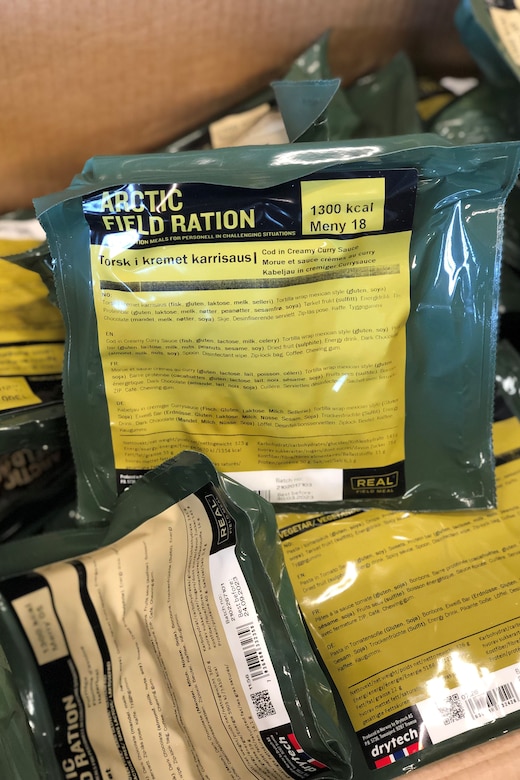
A box is filled with plastic-wrapped food rations with labels that read, "Arctic Field Ration."
USARIEM is also part of a NATO agreement to standardize warfighter physiological requirements across its nations. The agreement is akin to a cross-nation version of the departmentwide Army Regulation 40-25, which outlines nutrition requirements for combat rations and garrison feeding. It allows U.S. meals, ready-to-eat rations and other rations to be used by partner nations during NATO activities, and vice versa.

McClung noted that there's been discussion with NATO partners about using a product like the performance readiness bar to limit stress fractures in new recruits.

"Stress fractures are very common injuries in basic combat training and can result in injury to 7[%] to 20% of our recruits," he said. "NATO partner nations also experience elevated rates of stress fracture during basic combat training."

A standardization agreement is also under development for garrison feeding, which, during NATO operations, is often provided by the host nation. However, cultural differences can mean that warfighters may not always like the food they're being provided, which can lead them to consume less energy than what's required to perform appropriately.

"These types of standardization agreements are really critical in that we're assuring we can provide … the nutritional requirements of our American and partner warfighters," McClung said. "We continue to meet on a regular basis to incorporate new research findings into the requirements."

Tuesday, December 9, 2025

The War Department Unleashes AI on New GenAI.mil Platform

The War Department today announced the launch of Google Cloud's Gemini for Government as the first of several frontier AI capabilities to be housed on GenAI.mil, the Department's new bespoke AI platform. This initiative cultivates an "AI-first" workforce, leveraging generative AI capabilities to create a more efficient and battle-ready enterprise. Additional world-class AI models will be available to all civilians, contractors, and military personnel, delivering on the White House's AI Action Plan announced earlier this year.

This past July, President Donald Trump instituted a mandate to achieve an unprecedented level of AI technological superiority. The War Department is delivering on this mandate, ensuring it is not just ink on paper. In response to this directive, AI capabilities have now reached all desktops in the Pentagon and in American military installations around the world.

The first instance on GenAI.mil, Gemini for Government, empowers intelligent agentic workflows, unleashes experimentation, and ushers in an AI-driven culture change that will dominate the digital battlefield for years to come. Gemini for Government is the embodiment of American AI excellence, placing unmatched analytical and creative power directly into the hands of the world's most dominant fighting force.

"There is no prize for second place in the global race for AI dominance," said Emil Michael, Under Secretary of War for Research and Engineering. "We are moving rapidly to deploy powerful AI capabilities like Gemini for Government directly to our workforce. AI is America's next Manifest Destiny, and we're ensuring that we dominate this new frontier."

The launch of GenAI.mil stands as a testament to American ingenuity, driven by the AI Rapid Capabilities Cell within the War Department's Office of Research & Engineering. Their achievement directly embodies the Department's core tenets of reviving the warrior ethos, rebuilding American military capabilities, and re-establishing deterrence through technological dominance and uncompromising grit.

"We are pushing all of our chips in on artificial intelligence as a fighting force. The Department is tapping into America's commercial genius, and we're embedding generative AI into our daily battle rhythm." Secretary of War Pete Hegseth remarked, "AI tools present boundless opportunities to increase efficiency, and we are thrilled to witness AI's future positive impact across the War Department."

The Department is providing no-cost training for GenAI.mil to all DoW employees. Training sessions are designed to build confidence in using AI and give personnel the education needed to realize its full potential. Security is paramount, and all tools on GenAI.mil are certified for Controlled Unclassified Information (CUI) and Impact Level 5 (IL5), making them secure for operational use. Gemini for Government provides an edge through natural language conversation, retrieval-augmented generation (RAG), and is web-grounded against Google Search to ensure outputs are reliable and dramatically reduces the risk of AI hallucinations.

GenAI.mil is another building block in America's AI revolution. The War Department is unleashing a new era of operational dominance, where every warfighter wields frontier AI as a force multiplier. The release of GenAI.mil is an indispensable strategic imperative for our fighting force, further establishing the United States as the global leader in AI.

Friday, December 5, 2025

Navy Successfully Removes USS Arizona Platform Concrete

Two people wearing hard hats attach chains to a large concrete slab in the water. Several other people in similar attire stand on platforms, observing the two people in the water. There is a large floating, white structure in the background.

The Navy, in coordination with the Pearl Harbor National Memorial, successfully completed the removal of significant portions of two World War II-era mooring platforms from the USS Arizona at Pearl Harbor, Hawaii, Oct. 3. 

The Navy Mobile Diving and Salvage Unit 1, advised by the Navy's Supervisor of Salvage and Diving and supported by local contractors, removed the majority of the 80-year-old concrete platforms in a month's time.

Five people ride in a boat toward a platform in the water. A large crane is lifting a metal object from the platform. There is a large floating white structure in the background with an American flag flying from the top.
At the completion of the project, the team effectively reduced the weight bearing on the Arizona's deck with only minimal portions remaining on both platforms to avoid disturbance or damage to the structure of the ship, including features of the ship that are believed to be embedded in the concrete.

The Navy began these salvage operations Sept. 3, after two years of thorough planning, analysis and preparation with stakeholders to ensure compliance with relevant laws, regulations and policies. Navy staff prioritized operational safety and adherence to environmental best management practices while fully respecting the ship's sacred status as a war grave. 

"I'm very proud of the combined team," said Navy Capt. Lee Shannon, commander of Task Force Arizona. "A great deal of effort from dozens of subject matter experts, both on and off the water, resulted in a successful salvage operation, which included [crews] working 12 to 14 hours every day to complete the [mission]."

The two platforms, estimated to have a combined weight of more than 150 tons, were originally erected to aid in the salvage of guns and munitions from the Pennsylvania-class battleship after the Dec. 7, 1941, attack on Pearl Harbor that marked the beginning of the United States' involvement in World War II.

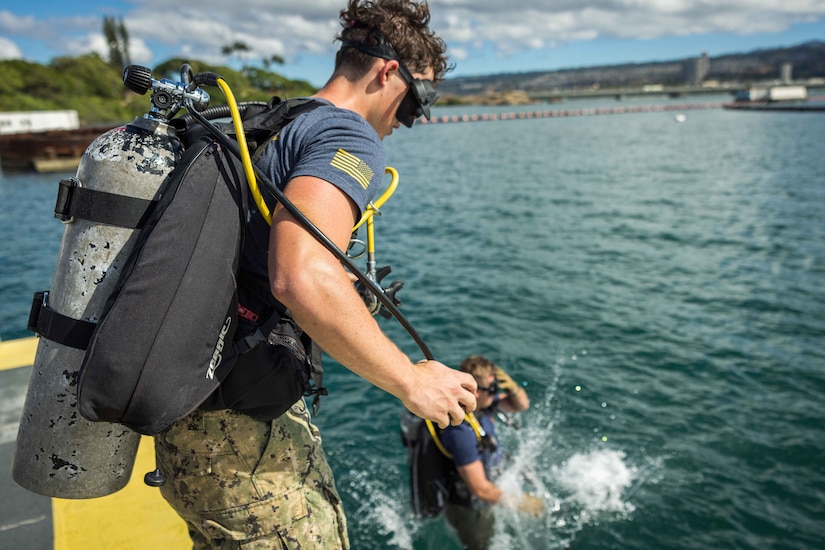
Two people in scuba-diving equipment jump into the water.

With the aid of a crane barge and a diamond wire saw, the sailors, War Department civilians and contractors safely removed the concrete portions. Salvage unit sailors methodically made cuts in the concrete, and contractors used the crane to lift the concrete segments from Pearl Harbor onto the barge. 

"Our No. 1 priority was to protect the USS Arizona for the future," said Navy Cmdr. Matthew Englehart, U.S. Pacific Fleet diving and salvage officer. "As the ship's historic structure continues to age, the sheer weight of these concrete platforms posed a significant threat of collapsing through the decks. This proactive operation successfully removed over 100 tons of that burden, relieving the stress on the memorial and preserving its integrity while honoring the sanctity of the site. It was a privilege to lead this effort and safeguard this vital piece of American history."

A crane sitting on a barge moves metal pillars into the water. There is a large floating white structure in the background, with an American flag flying from the top.

Bill Manley, Navy Region Hawaii environmental director, said preserving and protecting the USS Arizona, while also preventing harm to the environment, were the Navy's top priorities throughout the platform removal process.

"Navy experts in marine resources, water quality, historic preservation and environmental review worked closely to provide proactive, comprehensive support to ensure the operation's success," he said.

Two people wearing reflective vests and hard hats pull on ropes attached to a large concrete slab hanging from chains. Another person in similar attire stands next to the concrete slab. There is a large military ship docked in the background.

The USS Arizona Memorial is located in Pearl Harbor and marks the resting place of more than 900 sailors and Marines killed aboard the ship during the attack, as well as survivors of the attack who were later laid to rest there. The memorial, built in 1962, is accessible only by boat and rests above the sunken remains of the battleship. Since 1980, the National Park Service has managed the memorial.


Tuesday, December 2, 2025

War Department Asks Industry to Make More Than 300K Drones, Quickly, Cheaply

The War Department requested information earlier this week to gauge industry's willingness and ability to make some 300,000 drones quickly and inexpensively — a concrete effort by Secretary of War Pete Hegseth to directly meet the "drone dominance" goals laid out by the president. 

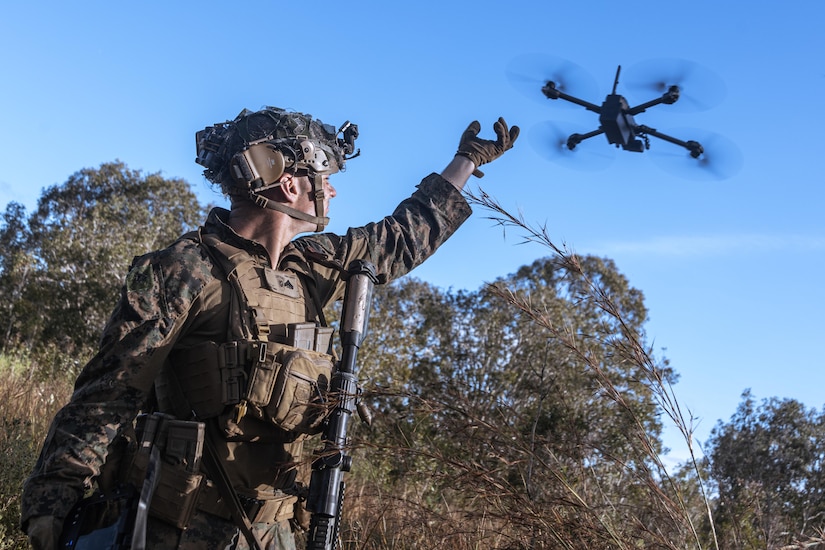
A Marine in tactical gear reaches up towards a drone flying above a forest setting during the day.

On June 6, President Donald J. Trump signed the "Unleashing American Drone Dominance" executive order outlining how the United States would up its drone game in both the commercial and military sectors, including how it would deliver massive amounts of inexpensive, American-made, lethal drones to U.S. military units to amplify their combat capabilities. 

Hegseth followed up in July with the "Unleashing U.S. Military Drone Dominance" memorandum, in which he laid out his plan for how the department would meet the president's intent. 

Part of the secretary's plan included participating with other parts of government in building up the nascent U.S. drone manufacturing base by approving hundreds of American products for purchase by the department, powering a "technological leapfrog" by arming combat units with the very best of low-cost American-made drones, and finally, training as the department expects to fight. 

"Next year I expect to see [drone] capability integrated into all relevant combat training, including force-on-force drone wars," the secretary said. 

At that time, Hegseth said, he had already advanced American drone dominance by stripping away regulations that hindered the military's adoption of small drones and shifting the necessary authorities away from the department's bureaucracy and into the hands of unit commanders. 

"This was the first step in the urgent effort to boost lethality across the force," Hegseth said in a video posted today to social media. 

Now the War Department is moving out in a new way on the drone dominance initiative, Hegseth said. 

"The second step is to kickstart U.S. industrial capacity and reduce prices, so our military can adequately budget for unmanned weapons," the secretary said. 

He noted that, with help from Congress, the department will initially focus on small attack drones. 

"Drone dominance is a billion-dollar program funded by President Trump's Big Beautiful Bill," Hegseth said. "It is purpose-built on the pillars of the War Department's new acquisition philosophy: a stable demand signal to expand the U.S. drone industrial base by leveraging private capital, paired with flexible contracting built for commercial companies, founded by our best engineers and entrepreneurs." 

A stable demand signal means the War Department will make concrete plans to buy lots of drones, on a regular schedule, over a long period of time. When that happens, American industry will step up to the plate to satisfy the department's needs, including by investing in and building out its own capacity to produce in the long term. 

The request for information released to industry this week spells out a plan that'll begin early next year, when the department will, over the course of two years, and within four phases, offer $1 billion to industry to build a large number of small unmanned aerial systems capable of conducting one-way attack missions. 

The first of those four phases, called "gauntlets," runs from February to July 2026. During that time, 12 vendors will be asked to collectively produce 30,000 drones at a cost of $5,000 per unit, for a total of $150 million in department outlays. 

Over the course of the next three gauntlets, the number of vendors will go down from 12 to five, the number of drones ordered will increase from 30,000 to 150,000, and the price per drone will drop from $5,000 to $2,300. 

"Drone dominance will do two things: drive costs down and capabilities up," Hegseth said. "We will deliver tens of thousands of small drones to our force in 2026, and hundreds of thousands of them by 2027." 

Through the drone dominance program, $1 billion from the Big Beautiful Bill will fund the manufacture of approximately 340,000 small UASs for combat units over the course of two years. 

After that, it's expected that American industry's interest in building drones as a result of the program will have strengthened supply chains and manufacturing capacity to the point that the military will be able to afford to buy the drones it wants, in the quantity it wants, at a price it wants, through regular budgeting. 

Equipment is only part of the game, the secretary said. Doctrine — how the warfighter fights — is also critical. 

"I will soon be meeting with the military services to discuss transformational changes in warfighting doctrine," Hegseth said. "We need to outfit our combat units with unmanned systems at scale. We cannot wait. The funding provided by the Big Beautiful Bill is ready to be used to mount an effective sprint to build combat power. At the Department of War, we are adopting new technologies with a 'fight tonight' philosophy — so that our warfighters have the cutting-edge tools they need to prevail." 

Following the end of the Cold War, Hegseth said, U.S. defense spending dropped precipitously, and as a result, there was also a consolidation of defense contractors from hundreds to just dozens. The department, he said, budgeted for quality rather than quantity — and for 30 years got what it needed. 

"However, we now find ourselves in a new era," he said. "An era of cheap, disposable battlefield drones. We cannot be left behind — we must invest in inexpensive, unmanned platforms that have proved so effective." 

Drone dominance, he said, is how the U.S. will meet the drone challenge posed by other nations. 

"One of my priorities is rebuilding our military," Hegseth said. "We can't do that by doing business the same way we have in the past. We cannot afford to shoot down cheap drones with $2 million missiles. And we ourselves must be able to field large quantities of capable attack drones."