Human space flight presents itself with a myriad of unique challenges. A wide variety of factors and logistics must be considered just to make a mission happen and even more to make a mission successful. Ultimately, all of the logistics, planning and training will go unnoticed after a successful launch, but that is the point.
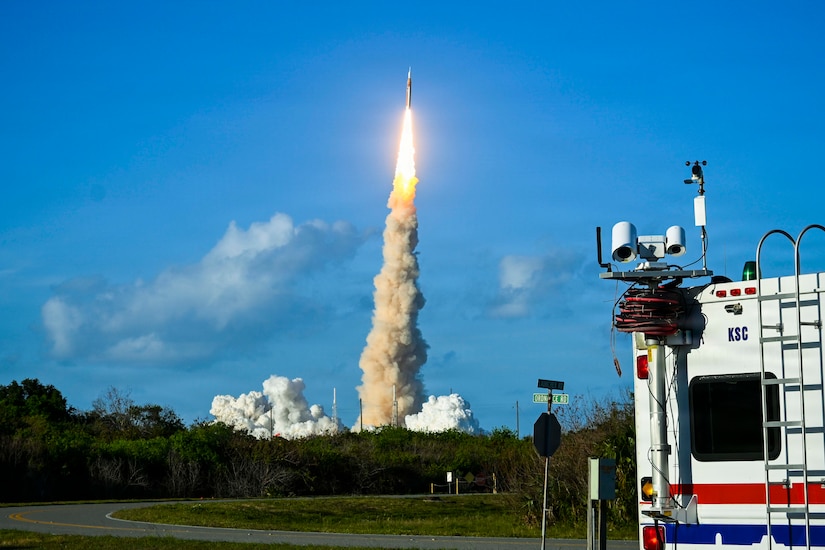
As the federal government's only medicolegal death investigation system, the Armed Forces Medical Examiner System may provide services to other federal agencies, including manned space flight missions conducted by NASA.
"AFMES has a memorandum of understanding with NASA," explained Kate Grosso, AFMES medicolegal death investigator. "As a result of that MOU, we are responsible for maintaining a plan and the personnel who are capable of responding to contingency operations as well as providing our subsequent forensic pathology services."
To fulfill that mission, AMFES provides an on-site triage team to support crewed launch days, most recently for the Artemis II mission, NASA's first crewed flight beyond low Earth orbit since 1972.
"We're there to provide technical advice on contingency planning as the launch date progresses," Grosso said. "We're also there as part of the triage team with other medical personnel in case a contingency does occur."
The investigators are present during these crewed launches with a number of other contingency planners and personnel that represent different agencies, including NASA medical officers, Kennedy Space Center medical support teams and other regional medical units. They assist in working through logistics of contingency responses and mass fatality management, providing critical insight into what a medicolegal response would entail.
"We conduct a lot of training with NASA and KSC support partners," Grosso explained. "At every launch day, we do a just-in-time training before the launch. This maintains proficiency in an immediate launch environment and refreshes our role as immediate recovery response, decontamination and hazmat, and then triage of casualties and fatalities."
All of this training is done the same day as the launch. A launch medical readiness brief is conducted and includes all support partners involved. They are provided with a detailed timeline of expectations, the location of triage support and their activities and the just-in-time training.
"All that can be minus seven hours before launch time," Grosso said. "So, oftentimes our launch days can be upwards of 12 hours depending on whether it's a scrub or whether it launches. There is a lot of coordination before we even get out to the triage site that's occurring on the same day as the launch."
Even after a successful launch, a post-launch training exercise is conducted to maintain proficiency. Response support teams break down the entire process and discuss what would happen in the case of a contingency.
During these crewed launches, one of the most challenging details is jurisdiction.
"As far as our medicolegal support, jurisdiction is one of the largest wickets that we have to get through," Grosso explained. "Working through jurisdictional authority in a pre-mission planning phase is a huge component of what we're doing. One example of this is understanding the ascent track from Kennedy Space Center can extend all the way from Florida to Ireland within a matter of minutes. As a result, you're dealing with an entire East Coast response and foreign partners as well. So, a lot of that complicated logistical work figures into how we consider what our response is going to look like and what kind of engagement we have to have."
In 2003, when the Space Shuttle Columbia disaster occurred, it had one of the largest debris fields in mishap investigation history, stretching across Texas and Louisiana, covering nearly 2,000 square miles, involving multiple jurisdictions. The investigation was federalized as AFMES took primary authority for the cases, but those pre-mishap relationships were crucial to recovering roughly 82,000 pieces of debris and the identification of all seven crew members.
"We consider all of the civilian offices, coroner's offices and medical examiner systems that could potentially be involved in recovery efforts," Grosso said. "There is a lot of coordination with our civilian and federal counterparts and routine communication, often in-person engagements as well, to make sure that everybody understands what our authority is, what we would need to do in the event that an investigation is not federalized, and how we can support our civilian counterparts as well. We're not actually training anybody on how to do our jobs, rather we are integrated within a training process in which we are showcasing the capabilities that we have and the work that we would do; we advise on the scope of our work and how that fits into their process."
All AFMES medicolegal death investigators are American Board of Medicolegal Death Investigation certified, meaning they are highly trained with a certain number of investigative hours. Not only that but they have significant professional experience in their field beyond just AFMES, specifically aviation mishap investigation and mass fatality management which can be crucial knowledge for manned space flight missions.
"Aside from our codified federal responsibility and our MOU with NASA, AFMES is uniquely positioned to support NASA as an acknowledged authority on aerospace pathology and mishap response," Grosso said. "You can see a thousand aviation mishaps and every single one is unique in its own way. I think crewed spaceflight is so unique and so far, it's still uncommon enough, that every incident requires its own level of care. We have a very unique skill set and we understand what our stakeholders need and can anticipate the questions we'll need to answer as part of these investigations."
For as well prepared as the AFMES investigators are, they will be the first to say they hope their services are never needed.
"It's a strange juxtaposition," Grosso said. "I understand that I have a job to do and that my job is very specific, but I really try hard not to pedal in the tragedy of it. I am always so enthused when things go off the way that they do because I never want to be needed. I'm grateful for the opportunity to see it every time. It is viscerally, psychically and emotionally, a very powerful experience to watch the culmination of years of effort and work and training go into a successful launch. I'm grateful for the opportunity to be able to see it and equally grateful that I can walk away from it, knowing that I was not needed."


 Posts
Posts


No comments:
Post a Comment