Thursday, April 2, 2026

Department of War Forges Landmark Agreement to Triple PAC-3 Seeker Production, Bolstering the Arsenal of Freedom

The Department of War, in partnership with Boeing and Lockheed Martin, today announced a landmark framework agreement to triple the production capacity of seekers for the Patriot Advanced Capability-3 (PAC-3®) Missile Segment Enhancement (MSE). This agreement marks a pivotal step in executing President Trump and Secretary Hegseth's vision to build the Arsenal of Freedom, accelerate the delivery of critical capabilities to the warfighter, and create thousands of jobs across the defense industrial base. 

This seven-year agreement with Boeing, a crucial supplier for the PAC-3 missile, directly supports the recently announced agreement with prime contractor Lockheed Martin to more than triple the output of the PAC-3 MSE all-up round. It is a direct application of the Department's new Acquisition Transformation Strategy, which prioritizes engaging directly with key suppliers at all levels of the industrial base. 

This approach ensures the entire supply chain — not just the primes — have the stability and long-term demand signals necessary to invest in new facilities, tooling, and workforce development. 

The seeker, produced by Boeing, provides active measurement data used for PAC-3 MSE missile guidance to ensure precision intercepts. By securing this long-term commitment for seeker production, the Department is mitigating chokepoints and ensuring the industrial base can scale to meet the operational demands of the warfighter.

"To build a true Arsenal of Freedom, we must strengthen every link in the chain," said Michael Duffey, Under Secretary of War for Acquisition and Sustainment. "This agreement with Boeing is a direct reflection that speed, volume, and a resilient supply chain are paramount. We are moving beyond the old model and forging direct partnerships with critical suppliers to ensure the entire defense industrial base is postured to expand production and deliver the decisive capabilities our warfighters need at speed and scale."
 
This initiative is a core component of the Department's broader effort to place the acquisition system on a "wartime footing," prioritizing speed and flexibility to outpace adversaries. By providing clear, stable, and long-term demand signals and fostering collaboration across the industrial base, the Department of War is ensuring that both the final products and the intricate supply networks that build them are robust, responsive, and ready.

Army and Navy Continue Tests of Hypersonic Missile

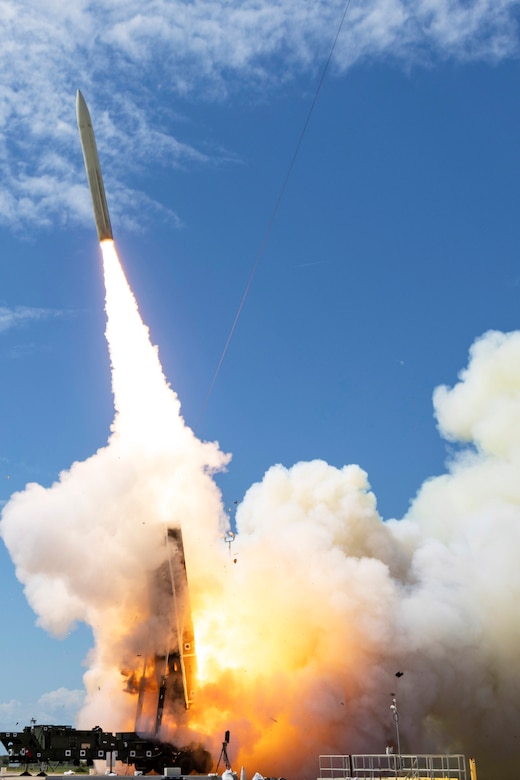
A missile launches during daytime, leaving plumes of smoke and flames behind it as it rises into a blue sky.
The U.S. Army's Portfolio Acquisition Executive Fires, in partnership with the U.S. Navy's Portfolio Acquisition Executive Strategic Systems Programs, conducted a successful launch of a common hypersonic missile from Cape Canaveral Space Force Station, Florida, on March 26, 2026.

The Army and Navy partnership to field a common hypersonic missile across land- and sea-based platforms supports the National Defense Strategy by accelerating timelines, reducing costs, and delivering a highly survivable capability to defeat time-sensitive, heavily defended, and high-value targets at speeds exceeding Mach 5.

Space Launch Delta 45 Supports Artemis II Historic Mission

Yesterday evening, NASA's Artemis II mission successfully launched from the Eastern Range at Cape Canaveral Space Force Station, Florida, with four astronauts bound for lunar orbit. This historic moment would not have been possible without the dedication and commitment of Space Launch Delta 45 personnel. 

A rocket takes off, with fire and smoke plumes beneath it. The launch pad is adjacent to a wooded area next to a body of water.

There are many steps involved in ensuring a safe and successful launch. From oversight of range operations to planning potential emergency response, members of SLD 45 aim to guarantee all launches from the Eastern Range keep the launch vehicle, range personnel and the local community safe. 

The mission starts before the launch countdown begins. Members of the SLD 45 team are responsible for analyzing specific payloads, launch vehicles and their proposed trajectories to compute hazard zones. These zones span land, sea and air and are a crucial to ensuring no person or vehicle is operating within a specified distance of the pad. 

"Each hazardous area reflects hours of trajectory analysis, debris analysis and coordination across multiple agencies," said Emma Cusano, SLD 45 flight safety analyst and aerospace engineer. "When it comes to launch, safety is our No. 1 priority, regardless of whether it is crewed or not."

Prior to launch, the SLD 45 Office of Emergency Management coordinates with state and local leaders to develop plans for an anomaly. Taking the hazard zones into account, the office proactively decides on where roadblocks should be placed, how traffic will flow and where emergency response vehicles will be staged in case of necessary response.

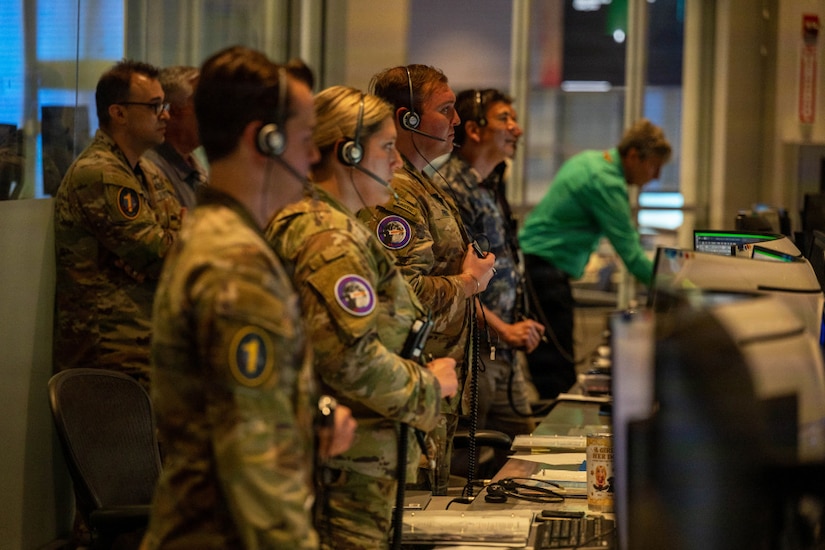
Several people wearing camouflage military uniforms and headsets stand in front of computer screens. A man in the background is dressed in civilian clothing.

"We are committed to doing everything we can in the planning phase to ensure we are ready to execute our emergency response plans," said Air Force Master Sgt. Robert Ridgway, SLD 45 installation emergency manager. "Having effective plans in place is necessary for both ensuring the safety of the local community and the astronauts in the capsule."

The Office of Emergency Management oversees and activates the launch emergency operations center. The operations center's primary function is to survey and respond to any and all potential dangers a launch could pose to Cape Canaveral Space Force Station. Because of the inherently volatile nature of spaceflight, the center remains staffed during launch to act as a node for disseminating emergency information and direction.

To safely get the launch vehicle from the pad to orbit, the 1st Range Operations Squadron and the 45th Weather Squadron are key players in each mission. The 1st Range Operations Squadron is responsible for performing real-time command and control of the Eastern Range. The team continuously analyzes telemetry data, weather and numerous other factors to determine whether a launch is safe to proceed.

The 45th Weather Squadron supplements the squadron in its uninterrupted investigation of current and future conditions. Weather plays a crucial role in safety and launch success as inclement conditions can damage rockets and payloads. Examining the weather helps to advise SLD 45 personnel on the console.

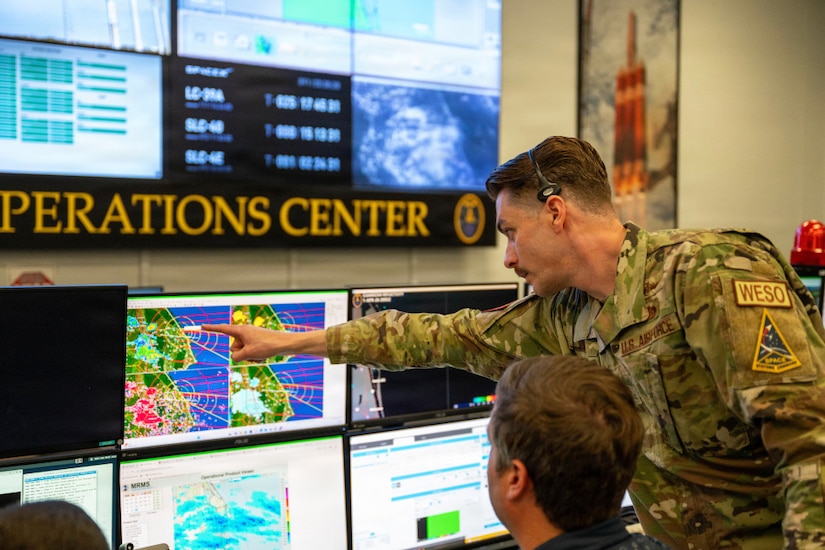
A standing man wearing a camouflage military uniform points to a computer screen. Another man is seated while looking at the same computer monitor.

"Access to space would not be possible without the contributions of SLD 45 and its oversight of the Eastern Range," said Space Force Col. Joyce Bulson, SLD 45 deputy commander for operations. "These contributions enabled more than 100 launches in 2025, and we aim to only increase the pace."

South of Cape Canaveral Space Force Station, the 45th Logistics Readiness Squadron postures airfield support to facilitate the Air Force Detachment 3's human spaceflight recovery team, which plays the role of overseeing rescue forces at Patrick Space Force Base, Florida.

"I am extremely proud of the members of SLD 45 and their continued determination in executing the mission. These professionals train day in and day out to guarantee space access," said Space Force Col. Brian Chatman, SLD 45 commander. "They are the driving force to maintaining U.S. presence and superiority in the space domain."

In addition to the components already mentioned that support launch, SLD 45 includes many more teams and organizations that enable space launch from the Eastern Range. As the pace of launches and mass to orbit increases, SLD 45 personnel remain committed to safety and mission success.