Showing posts with label defense industrial base. Show all posts

Tuesday, July 14, 2026

War Department Changes Cybersecurity Maturity Model Certification Requirements

The War Department today announced the suspension of the Cybersecurity Maturity Model Certification phase two requirements, initially scheduled to take effect in November, and launched a comprehensive review of the entire CMMC program.

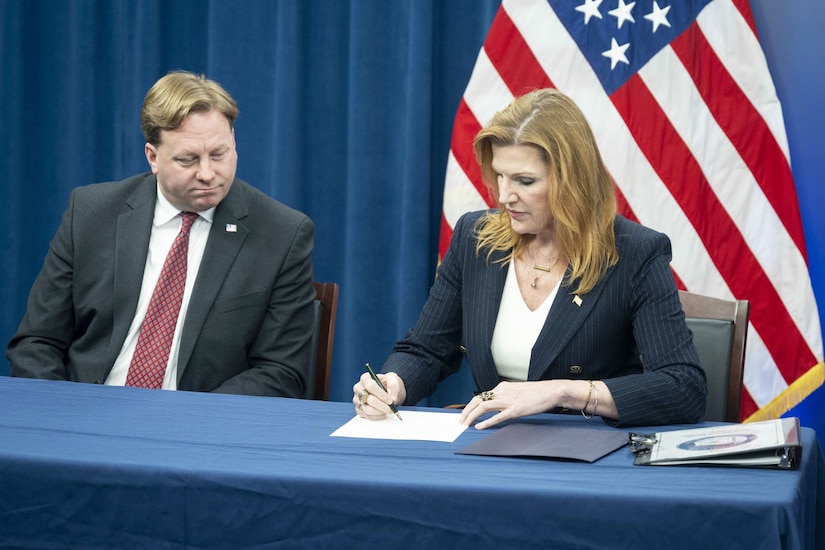
A woman in business attire signs a document while sitting at a table as a man in similar attire sits next to her; behind them is an American flag.

While the change eliminates costly and time-consuming bureaucracy, said Kirsten Davies, War Department chief information officer, it doesn't weaken the focus on cybersecurity.

"The Department of War is taking decisive action to clear bureaucratic roadblocks and revitalize our defense industrial base in support of Secretary of War Pete Hegseth's directive to aggressively scale warfighter readiness," Davies said. "[But] I want to be clear, across the Department of War and our defense industrial base, investing in and dynamically maintaining robust cybersecurity remains a critical, nonnegotiable priority."

Companies interested in doing business with the department, Davies said, will still need to comply with cybersecurity requirements and safeguard government information according to regulations. Companies will also need to continue to meet requirements under CMMC phase one.

"We're taking this step today because reindustrializing America is a key and critical component of Secretary Pete Hegseth's vision for the arsenal of freedom across the department," Davies said.

Ensuring America's warfighters have the tools they need means ensuring the defense industrial base is agile and able to accelerate production when needed, she said, adding that for many small businesses, the bureaucratic requirements of CMMC keep them from being agile and drive them away from doing business with the department.

"The data we are seeing, including recent reports from the Small Business Administration, makes one thing clear: the current CMMC requirements, including the future planned requirements, are creating prohibitive compliance costs and unacceptable bureaucratic burdens, especially to small businesses," Davies said.

The War Department also announced the creation of a CMMC review and reform task force, which has 60 days to conduct a top-to-bottom review of the CMMC program.

"This task force will serve as the central hub for synthesizing industry feedback from our public request for information — which will be released today," Davies said. "Using these insights, the task force will recommend realistic, scalable security measures that prioritize speed-to-capability and lower barriers for small and nontraditional businesses, while still providing insights on [defense industrial base] cybersecurity and operational resilience."

Michael Duffey, undersecretary of war for acquisition and sustainment, said reform of the CMMC program is an important move toward getting the defense industrial base ready to produce things the War Department needs at the speed the department needs them.

"Rebuilding our military's competitive edge starts with a simple reality: we must put our acquisition system on a wartime footing," Duffey said. "We cannot expect our industries to build at the speed of relevance if they are drowning in peacetime paperwork and administrative bureaucracy."

By suspending onerous CMMC phase two requirements, he said, more private-sector businesses — especially small businesses — will choose to pursue doing important work for the department.

"This is about unleashing the arsenal of freedom," Duffey said. "For too long, overly burdensome cybersecurity regulations have acted as a barrier to entry, locking out the very startups, small businesses and nontraditional manufacturers across the country who drive American innovation. By pausing phase two implementation, we are keeping more companies in the DIB who would otherwise be forced out of the market at a time when we need them most."

The CMMC program, first announced in early 2020, was designed to ensure that private-sector companies working with the War Department could demonstrate their ability to securely handle sensitive government information. The program used a system of private-sector, department-approved assessors to evaluate a private company's cybersecurity compliance.

Davies said the number of available assessors is not large enough to conduct all the evaluations needed in time for the upcoming November deadline.

Tuesday, July 7, 2026

Department of War Invests $16M for 45nm Silicon-on-Insulator Qualification

The Department of War announced today a July 2, 2026, investment of $16 million in Defense Production Act (DPA) Title III funds to BAE Systems. The investment will expand the domestic production capability for radiation-hardened microelectronics (RHM) necessary for national defense. This investment supports the Secretary of War's priorities to reestablish deterrence and rebuild the military by investing in key defense industrial base capabilities that increase supply chain resilience.

"Radiation-hardened microelectronics are critical for DoW missile, space, and strategic systems," said Assistant Secretary of War for Industrial Base Policy, the Honorable Michael Cadenazzi. "This project ensures qualified products are available to the DoW."

These DPA Title III funds will enable BAE Systems to create, maintain, protect, and expand domestic industrial base processing and production capabilities and capacity that are essential for RHM components. Specifically, the project will reestablish BAE Systems' RH45® Storefront capability for trusted Radiation Hardened by Design 45nm Application Specific Integrated Circuit and Application Specific Standard Product offerings. Once reestablished, BAE Systems' RH45® Storefront will be a self-sustaining hub where customers can access a range of standard processing products and resources to develop and produce their own custom chips.

"This effort ensures that 45nm silicon-on-insulator technology remains available to DoW systems," added Mr. Jeffrey Frankston, Acting Deputy Assistant Secretary of War for Industrial Base Resilience, who oversees the Warfighting Investment, Resourcing, and Execution (WIRE) directorate. "This provides cost-avoidance, so programs are not forced to redesign and requalify their systems."

This is one of five DPA Title III investments totaling $102.6 million made by the WIRE directorate since the beginning of Fiscal Year 2026. For more information on the WIRE directorate, please visit: https://www.businessdefense.gov/ibr/wire.html.

About the Office of the Assistant Secretary of War for Industrial Base Policy (OASW(IBP)

The OASW(IBP) works with domestic and international partners to forge and sustain a robust, secure, and resilient industrial base enabling the Warfighter, now and in the future. OASW(IBP) also uses a new Defense Industrial Base Consortium Other Transaction Agreement (DIBC OTA) to solicit new ideas for research or prototype project solutions for critical supply chain resiliency focus areas. This OTA underscores the Department's ongoing dedication to safeguarding the integrity of our crucial supply chain and promptly giving our Warfighters the materials and technologies they need to accomplish their missions. To learn more about the DIBC OTA, please visit: https://www.dibconsortium.org.

Thursday, June 25, 2026

Department of War Launches Interactive Investment Intelligence Center Tracking Transformative Industrial Base Revitalization

The Department of War's (DoW) Office of the Assistant Secretary of War for Industrial Base Policy (OASW (IBP)) announced today the launch of an Investment Intelligence Center interactive public website (https://www.businessdefense.gov/investments.html). The site provides unprecedented visibility into DoW's efforts to secure and expand domestic supply chains, mapping over $6.7B in Defense Production Act (DPA) and Industrial Base Analysis and Sustainment (IBAS) investments made since 2015.

"A resilient defense industrial base requires transparent partnerships between the government and the private sector," said Assistant Secretary of War for Industrial Base Policy Hon. Mike Cadenazzi. "By openly mapping our DPA and IBAS investments, we are sending a clear demand signal to industry and private capital markets about our most critical national security priorities."

The Intelligence Center provides a centralized, interactive dashboard for users to explore DoW's work across the United States harnessing American innovation and mitigating critical supply chain vulnerabilities. By providing a clear geographic and sector-based view of historical investments, the tool enhances transparency for congressional stakeholders, defense analysts, and private sector partners.

The three different visualizations – interactive map, Mekko chart, and keyword portfolio search – enable filtering by technology sector, year, location, and funding mechanism. Together, they deliver a comprehensive view of DoW's trajectory toward onshoring critical manufacturing and reduced reliance on adversarial supply chains.

Industry partners, researchers, and the public are encouraged to explore the IBP Investment Intelligence Center at: https://www.businessdefense.gov/investments.html

About the Office of the Assistant Secretary of War for Industrial Base Policy (OASW(IBP))

The OASW(IBP) works with domestic and international partners to forge and sustain a robust, secure, and resilient industrial base enabling the warfighter, now and in the future.

Thursday, April 2, 2026

Department of War Forges Landmark Agreement to Triple PAC-3 Seeker Production, Bolstering the Arsenal of Freedom

The Department of War, in partnership with Boeing and Lockheed Martin, today announced a landmark framework agreement to triple the production capacity of seekers for the Patriot Advanced Capability-3 (PAC-3®) Missile Segment Enhancement (MSE). This agreement marks a pivotal step in executing President Trump and Secretary Hegseth's vision to build the Arsenal of Freedom, accelerate the delivery of critical capabilities to the warfighter, and create thousands of jobs across the defense industrial base. 

This seven-year agreement with Boeing, a crucial supplier for the PAC-3 missile, directly supports the recently announced agreement with prime contractor Lockheed Martin to more than triple the output of the PAC-3 MSE all-up round. It is a direct application of the Department's new Acquisition Transformation Strategy, which prioritizes engaging directly with key suppliers at all levels of the industrial base. 

This approach ensures the entire supply chain — not just the primes — have the stability and long-term demand signals necessary to invest in new facilities, tooling, and workforce development. 

The seeker, produced by Boeing, provides active measurement data used for PAC-3 MSE missile guidance to ensure precision intercepts. By securing this long-term commitment for seeker production, the Department is mitigating chokepoints and ensuring the industrial base can scale to meet the operational demands of the warfighter.

"To build a true Arsenal of Freedom, we must strengthen every link in the chain," said Michael Duffey, Under Secretary of War for Acquisition and Sustainment. "This agreement with Boeing is a direct reflection that speed, volume, and a resilient supply chain are paramount. We are moving beyond the old model and forging direct partnerships with critical suppliers to ensure the entire defense industrial base is postured to expand production and deliver the decisive capabilities our warfighters need at speed and scale."
 
This initiative is a core component of the Department's broader effort to place the acquisition system on a "wartime footing," prioritizing speed and flexibility to outpace adversaries. By providing clear, stable, and long-term demand signals and fostering collaboration across the industrial base, the Department of War is ensuring that both the final products and the intricate supply networks that build them are robust, responsive, and ready.

Wednesday, March 25, 2026

Department of War Secures Agreement on THAAD Seeker Production, Quadrupling Output to Bolster America's Missile Defense

The Department of War, in partnership with BAE Systems and Lockheed Martin, today announced a framework agreement to quadruple the production of seekers for the Terminal High Altitude Area Defense (THAAD) interceptor. This agreement ensures the nation's industrial might is positioned to deliver on President Trump and Secretary Hegseth's mandate to build the Arsenal of Freedom. 

The agreement follows the recent announcement with Lockheed Martin to quadruple THAAD interceptor production. By securing the industrial base for the missile's seeker, the Department of War is moving beyond deals with prime contractors and is actively architecting the resurgence of America's defense industrial capacity across the entire supply chain. 

This agreement provides BAE Systems with the stability required for long-term investment, guaranteeing that this critical component in the supply chain is delivered at speed and scale to deter and defeat any adversary. 

"Securing our supply chain is just as critical as our partnership with the prime contractors," said Michael Duffey, Under Secretary of War for Acquisition and Sustainment. "This agreement with BAE Systems sends a clear, stable, long-term demand signal. We are providing the certainty our partners need to invest, expand, and hire. This is how we place the industrial base on a wartime footing."

By locking in this critical component, the Department of War is ensuring that the nation's capacity to build and deploy this vital defensive weapon will outpace any adversary's threat to the United States or its allies. This is the Arsenal of Freedom in action, built to ensure peace through undeniable strength.

This initiative is a powerful demonstration of the Department's revitalized Acquisition Transformation Strategy, put into practice by the work of the Munitions Acceleration Council. The Council is executing its mandate to dismantle barriers, forge stronger industry partnerships, and build enduring production capacity. By locking in the THAAD seeker supply, the Department is transforming to a new way of doing business, focused on speed, volume, and delivering a decisive overmatch against any threat.

Monday, February 9, 2026

DOW Addresses Material Obsolescence Through Reverse Engineering Training

The Department of War (DOW) announced today a two-year investment totaling nearly $1.8 million made in the Great Plains Innovation Network (GPIN) of Manhattan, Kansas for a reverse engineering activity for obsolescent defense-critical parts missing technical data packages.  This announcement was awarded on August 27, 2025, but this announcement was delayed due to the government shutdown. The project, funded through the Office of the Assistant Secretary of War for Industrial Base Policy (OASW(IBP))'s Industrial Base Analysis and Sustainment (IBAS) Program, will culminate with updated engineering documentation for manufacturability and low-rate initial production opportunities for at least three prototypes of critical obsolescent assemblies.

"This is an important effort as some of our most important legacy systems are to some degree unsustainable as the original equipment manufacturers are no longer in our industrial base," said the Assistant Secretary of War for Industrial Base Policy Michael Cadenazzi.  "At the end of the project, the United States will have a more resilient and competitive supply chain as a result of the collaboration we've made possible between GPIN and Kansas State University, and others across the Midwest as they forge new partnerships." 

GPIN will partner with Kansas State University (KSU) to train interns and non-traditional defense contractors on the process of generating technical data packages (e.g., bills of material, computer aided design models, and quality documentation) for defense-critical parts and components for which technical data no longer exists.  This will open more competitive opportunities across the defense industrial base (DIB) to a wider pool of performers by enabling them to bid on parts and assemblies' contracts with known data, while limiting design workaround requirements to support the manufacture of various platforms. 

Some companies working in the DIB have gone out of business and left no technical data packages behind to support future defense manufacturing needs.  This investment supports the Secretary of War's priority of Rebuilding the Military by leveraging the Defense Logistics Agency's parts catalog to target high-demand parts and assemblies that are no longer procurable to design data packages that will support future defense-critical manufacturing needs.   

Since the IBAS Program's inception in 2014, the Innovation Capability and Modernization (ICAM) Office has invested over $2.6 billion across 204 projects to restore domestic manufacturing capacity and capability.  ICAM is part of OASW(IBP)'s Manufacturing Capability Expansion and Investment Prioritization (MCEIP) Directorate within the Office of the Deputy Assistant Secretary of War for Industrial Base Resilience.  For more information on MCEIP, please visit: https://www.businessdefense.gov/ibr/mceip/index.html.

About the Office of the Assistant Secretary of War for Industrial Base Policy (OASW(IBP))

The OASW(IBP) works with domestic and international partners to forge and sustain a robust, secure, and resilient industrial base enabling the warfighter, now and in the future.  The OASW(IBP)'s Innovation Capability and Modernization (ICAM) Office, which manages the IBAS Program, provides DOW with key capabilities to achieve the strategic aims of Department priorities and Presidential Executive Orders.  These call for a strong, resilient, responsive, and healthy national industrial base that can respond at-will to national security requirements.