Friday, August 3, 2018

Air Mobility Command Chief Looks Toward Supplying Forces From Space


By Jim Garamone, DoD News, Defense Media Activity

WASHINGTON -- Deliveries from space are going to happen, and the Defense Department must be ready to capitalize on the capability when it happens, the commander of the Air Force’s Air Mobility Command told the Defense Writers Group here today.

Air Force Gen. Carlton D. Everhart II said he is looking to space to enhance the American military’s global mobility and move at the speed of war.

Air Mobility Command needs rapid access to space, the general said, and he is working with private corporations to examine the ways forward. “I just had a visit with SpaceX and Virgin Orbital,” he said. “They tell me they can get around the globe in 30 minutes with a Big Falcon Rocket.”

Using the rocket, the command could deliver 150 metric tons for less than the cost of a C-5 Galaxy transport jet delivery, he said.

Space is a new frontier for transportation, and private companies are developing technologies that are driving the costs of launches down, the general said. “What happens if we pre-position cargo in space?” he asked. “I don’t have to use terrestrial means [to deliver it]. I can position it in space and have an automatic vehicle go up and come back down.

“I want to get around the globe quickest so I can affect that adversary,” he continued. “It is in its infancy stages, … but I want to put mobility people in Space Command so they can learn space and I want space folks in Mobility Command. If we don’t do this and we stay in the air domain, Air Mobility Command will become irrelevant.”

Concepts Ready in Five Years

The general said he believes that the concepts can be ready within the next five years. “Within five years after that, it will be happening,” he told the defense writers.

AMC has a future concept section that is looking closely at the capability, Everhart said, and Air Force personnel are already looking to develop a concept of operations for mobility in space.

Air Mobility Command is an integral part of U.S. Transportation Command and is a crucial enabler for all services and combatant commands. The United States is a superpower because the American military can deploy anywhere in the world and sustain those forces.

Air Mobility Command is a $46 billion enterprise with 1,100 aircraft and 124,000 total- force airmen, including civilians. “The world is our [area of responsibility],” the general said.

The big grey planes with the American flag on the tail are a visible sign of U.S. capabilities, Everhart said. “I call it grey-tail diplomacy,” he added. “The American flag on the tail tells our friends we’re there to help and tells our enemies to watch out.”

Face of Defense: Navy Postgraduate Student Begins NASA Internship


By Matthew Schehl, Naval Postgraduate School

MONTEREY, Calif. -- A Naval Postgraduate School student has boldly gone where no NPS physics student has gone before.

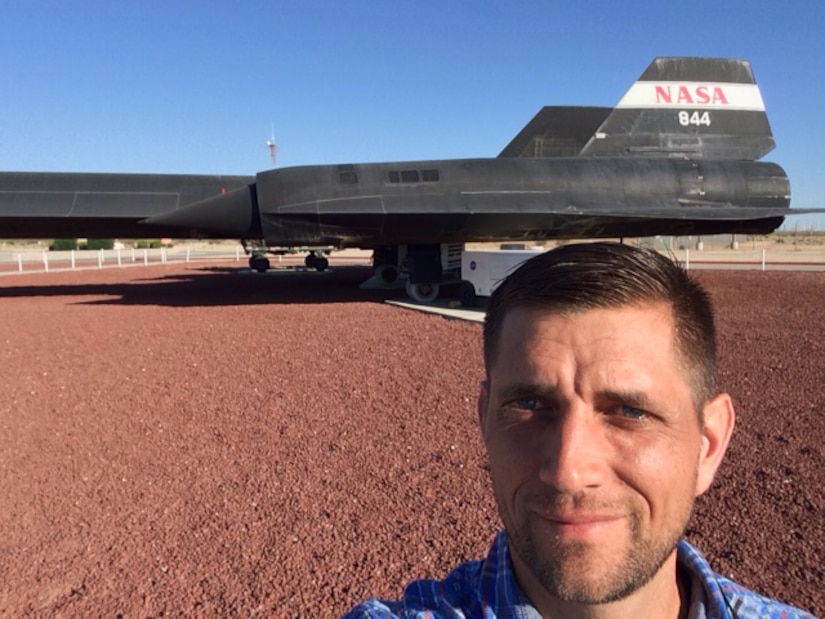
Navy Lt. Todd Coursey embarked recently on a quarter-long summer internship with NASA at its Armstrong Flight Research Center in Edwards, California, to supplement his applied physics curriculum. He is the first such student to do so, and his internship has the potential to significantly expand NPS’ research horizons.

“Todd took a quantum leap in going to NASA,” said NPS physics professor Ray Gamache. “I don’t think anyone has ever done this before. It’s a great idea: go to another place that’s completely unknown and work there, assess, understand how things work; this is just priceless.”

Over his three-month internship, Coursey and his NASA team are experimenting with various materials for a new generation of fiber optic cables which optimize performance at cryogenic temperatures.

In providing real-time monitoring of a range of key engineering data, the fiber optic sensing systems which will employ these can revolutionize not only future rocket bodies, but aircraft, energy and transportation infrastructure, and medical surgeries, according to NASA.

“We’re basically dropping different kinds of coated fiber optic sensing cables into a small cryochamber -- about the size of a fire extinguisher -- and then reading the raw data to see which ones are most effective and efficient,” Coursey explained. “From there they’ll do the systems development and look at incorporation.”

Hard-Earned Opportunity

The internship is a natural continuation of Coursey’s studies at NPS.

His graduate work in applied physics -- his thesis will be on the acoustic detection of drones -- will be amplified by his hands-on experience at NASA, says NPS physics professor Frank Narducci, who is providing Coursey with directed study so the internship can satisfy the optics requirement of his curriculum.

“When Coursey first approached me with this opportunity at NASA, I asked him,‘How is it that you have an entire quarter when you don’t have to be here?’” Narducci said. “When students come to NPS, their class matrix is pretty packed; it’s very hard to get any wiggle room. But Todd, knowing that this was a possibility in his future, front-loaded some of his courses so that he could clear out the summer.”

Yet the singular course load is hardly a cake-walk.

With his master’s research looming over him, Coursey voraciously works through the readings Narducci assigns in addition to the work he is doing at NASA.

“I suspect when they’re doing their tests it’s not even ‘nine-to-five’ to begin with,” Narducci said. “If you’re doing experimental physics and the experiment is working, you just keep working, you keep taking as much data as you can because when you’ve turned things off and come back tomorrow, nothing’s going to work ... Experimental physics is always like that.”

Cultural Experience

Coursey embraces the challenge, however, and remains deeply engaged with his work and studies.

“When you come to NPS, you’re there obviously for the academic work, but it’s another thing to get experience,” he said. “Coming to NASA is a great way to learn about what other organizations are doing, how they’re approaching problem-solving internally and how the project teams are put together.”

Coursey added, “So it’s not just academics that I’m learning here. I’m learning a lot about the culture at NASA, which I think would do really well to bring back to the Navy.”

In a way, the NASA internship represents a sort of homecoming for Coursey. Growing up in nearby Palmdale, California, test flights of the SR-71 Blackbird, the F-117 Nighthawk and the B-2 Spirit operating out of Edwards Air Force Base were a staple of his childhood.

Most salient to him, however, were NASA’s space shuttle landings.

“It used to land out here on the dry lake beds before they moved it over to Florida,” he recalled. “As it came in, there was a huge double sonic boom, almost like an earthquake. It was surreal: right outside my window there’s a huge compass rose burnt into the desert floor which the space shuttles would use to navigate when they would come in. It’s still there.”

The space shuttle landings left an indelible mark on Coursey’s imagination which propelled an interest in physics throughout his life -- and Navy career.

‘Moon Shot’

While conducting research on the Internet, he came across NASA’s complex aircraft program called the Preliminary Research Aerodynamic Design to Lower Drag, intended to eventually be the first in-air rover on Mars.

“I said, ‘Oh, cool! They have a [unmanned aircraft] shop that’s in tune with what I’m doing at NPS,’” he said. “Maybe I can go out there and check it out and see what they’re doing.”

Coursey contacted NASA and arranged a day-long tour while home on leave last summer. While there, he noticed they had interns. Intrigued, he returned to NPS.

“I talked to the physics department, my project officer and my academic advisor to see if working at NASA over the summer was a possibility,” he said. “They were full-throttle very excited about it and said if it works, they’d fully support me.”

It did work. Coursey applied for the NASA internship program, with Gamache writing a letter of recommendation and Narducci agreeing to conduct the independent study. Coursey was accepted and began his work at NASA in mid-June.

“This was my moon shot,” Coursey said, referring to President John F. Kennedy’s 1962 speech declaring America’s ambition to land a man on the moon. “I was out here. I knew they had interns. And without the support of NPS, this wouldn’t have come through.”

Opening Doors

For the NPS physics department, Coursey’s initiative presented a win-win scenario.

“It was very forward-looking on his part,” Narducci said. “We can do all the book-learning we want, but it never works that way in real life.

“We always teach the ideal, ‘Well, in a perfect world, if you do the experiment in a vacuum, it always works that way,’” he continued. “Now he’s in an environment where things are not perfect, where the question becomes, ‘How do we make this work, anyway?’ And that’s extremely valuable.”

When Coursey graduates in December, NPS will have produced a more experienced, better-prepared student. The internship also opens the door to future collaboration between NPS and NASA, Narducci said.

“We’ve got people doing a similar type of work,” he said. “Now he’s established that connection for us.”

Seeking interdisciplinary collaboration has become the norm in applied physics, but Coursey has taken this to the next level, Gamache said.

“What Todd did, that no one else has done, is to take that jump. Not just to the Navy, but to NASA,” he said. “Todd may see that the structure of how they run their scientists and projects is completely different from the way that we do it in the [Department of Defense,] and so he’ll have a base of understanding of other government agencies outside of the Navy.

“Wherever he goes after this, he’ll be able to share these different concepts and different ideas with them; it’s a very much a synergistic effect,” Gamache added.

After he completes his internship in August, Coursey will share his experience with the NPS community. On Sept. 28, he’ll spearhead the physics department’s Fall Quarter Colloquium Series, which will be open to the general public.

“I think it’ll be great because all of a sudden one of our speakers in the colloquium series is not ‘the world-renowned expert in X, Y or Z’, but one of us,” Narducci said. “I think he will have a lot to tell us about his work at NASA.”

For his part, Coursey is grateful for the opportunity to work at NASA.
“I’m just fortunate to be here, and I hope that I can share what I’ve done here and allow other students to pursue something like it,” he said.

Wednesday, August 1, 2018

Three Members of Notorious International Cybercrime Group “Fin7” In Custody for Role in Attacking Over 100 U.S. companies


Victim Companies in 47 U.S. States; Used Front Company ‘Combi Security’ to Recruit Hackers to Criminal Enterprise

Three high-ranking members of a sophisticated international cybercrime group operating out of Eastern Europe have been arrested and are currently in custody facing charges filed in U.S. District Court in Seattle, announced Assistant Attorney General Brian A. Benczkowski of the Justice Department’s Criminal Division, U.S. Attorney Annette L. Hayes for the Western District of Washington and Special Agent in Charge Jay S. Tabb Jr. of the FBI Seattle Field Office.

According to three federal indictments unsealed today, Ukrainian nationals Dmytro Fedorov, 44, Fedir Hladyr, 33, and Andrii Kopakov, 30, are members of a prolific hacking group widely known as FIN7 (also referred to as the Carbanak Group and the Navigator Group, among other names).  Since at least 2015, FIN7 members engaged in a highly sophisticated malware campaign targeting more than 100 U.S. companies, predominantly in the restaurant, gaming, and hospitality industries.  As set forth in indictments, FIN7 hacked into thousands of computer systems and stole millions of customer credit and debit card numbers, which the group used or sold for profit.

In the United States alone, FIN7 successfully breached the computer networks of companies in 47 states and the District of Columbia, stealing more than 15 million customer card records from over 6,500 individual point-of-sale terminals at more than 3,600 separate business locations.  Additional intrusions occurred abroad, including in the United Kingdom, Australia, and France.  Companies that have publicly disclosed hacks attributable to FIN7 include such familiar chains as Chipotle Mexican Grill, Chili’s, Arby’s, Red Robin and Jason’s Deli.  Additionally in Western Washington, FIN7 targeted other local businesses.

“The three Ukrainian nationals indicted today allegedly were part of a prolific hacking group that targeted American companies and citizens by stealing valuable consumer data, including personal credit card information, that they then sold on the Darknet,” said Assistant Attorney General Benczkowski.  “Because hackers are committed to finding new ways to harm the American public and our economy, the Department of Justice remains steadfast in its commitment to working with our law enforcement partners to identify, interdict, and prosecute those responsible for these threats.”

“Protecting consumers and companies who use the internet to conduct business – both large chains and small ‘mom and pop’ stores -- is a top priority for all of us in the Department of Justice,” said U.S. Attorney Hayes.  “Cyber criminals who believe that they can hide in faraway countries and operate from behind keyboards without getting caught are just plain wrong.  We will continue our longstanding work with partners around the world to ensure cyber criminals are identified and held to account for the harm that they do – both to our pocketbooks and our ability to rely on the cyber networks we use.”

“The naming of these FIN7 leaders marks a major step towards dismantling this sophisticated criminal enterprise,” said Special Agent in Charge Tabb.  “As the lead federal agency for cyber-attack investigations, the FBI will continue to work with its law enforcement partners worldwide to pursue the members of this devious group, and hold them accountable for stealing from American businesses and individuals.”

Each of the three FIN7 conspirators is charged with 26 felony counts alleging conspiracy, wire fraud, computer hacking, access device fraud, and aggravated identity theft.

In January 2018, at the request of U.S. officials, foreign authorities separately arrested Ukrainian Fedir Hladyr and a second FIN7 member, Dmytro Fedorov.  Hladyr was arrested in Dresden, Germany, and is currently detained in Seattle pending trial.  Hladyr allegedly served as FIN7’s systems administrator who, among other things, maintained servers and communication channels used by the organization and held a managerial role by delegating tasks and by providing instruction to other members of the scheme.  Hladyr’s trial is currently scheduled for Oct. 22.

Fedorov, a high-level hacker and manager who allegedly supervised other hackers tasked with breaching the security of victims’ computer systems, was arrested in Bielsko-Biala, Poland.  Fedorov remains detained in Poland pending his extradition to the United States.

In late June 2018, foreign authorities arrested a third FIN7 member, Ukrainian Andrii Kolpakov in Lepe, Spain.  Kolpakov, also alleged to be a supervisor of a group of hackers, remains detained in Spain pending the United States’ request for extradition.

According to the indictments, FIN7, through its dozens of members, launched numerous waves of malicious cyberattacks on numerous businesses operating in the United States and abroad.  FIN7 carefully crafted email messages that would appear legitimate to a business’ employee, and accompanied emails with telephone calls intended to further legitimize the email. Once an attached file was opened and activated, FIN7 would use an adapted version of the notorious Carbanak malware in addition to an arsenal of other tools to ultimately access and steal payment card data for the business’ customers. Since 2015, FIN7 sold the data in online underground marketplaces. (Supplemental document “How FIN7 Attacked and Stole Data” explains the scheme in greater detail.)

FIN7 used a front company, Combi Security, purportedly headquartered in Russia and Israel, to provide a guise of legitimacy and to recruit hackers to join the criminal enterprise.  Combi Security’s website indicated that it provided a number of security services such as penetration testing.  Ironically, the sham company’s website listed multiple U.S. victims among its purported clients.

The charges in the indictments are merely allegations, and the defendants are presumed innocent until proven guilty beyond a reasonable doubt in a court of law.

The indictments are the result of an investigation conducted by the Seattle Cyber Task Force of the FBI and the U.S. Attorney’s Office for the Western District of Washington, with the assistance of the Justice Department’s Computer Crime and Intellectual Property Section and Office of International Affairs, the National Cyber-Forensics and Training Alliance, numerous computer security firms and financial institutions, FBI offices across the nation and globe, as well as numerous international agencies. Arrests overseas were executed in Poland by the “Shadow Hunters” from CBŚP (Polish Central Bureau of Investigation); in Germany by the LKA Sachsen - Dezernat 33, (German State Criminal Police Office) and the Polizeidirektion Dresden (Dresden Police); and in Spain the Grupo de Seguridad Logica within the Unidad de Investigación Technologica of the Cuerpo Nacional de Policía (Spanish National Police)..

This case is being prosecuted by Assistant U.S. Attorneys Francis Franze-Nakamura and Steven Masada of the Western District of Washington with assistance from Trial Attorney Anthony Teelucksingh of the Justice Department’s Computer Crime and Intellectual Property Section.