Thursday, July 23, 2026

The Department of War today announced the publication of the Fiscal Year (FY) 2025 update to the list of foreign institutions engaging in problematic activities, as required by Section 1286 of the FY19 National Defense Authorization Act (NDAA).

This update is a vital component of the Department's ongoing mission to highlight and counter unauthorized technology transfer to foreign countries of concern. The FY25 list formally identifies 130 academic and research institutions located in China, Russia and Iran. These institutions have been confirmed to engage in activities that increase the likelihood of U.S. government-funded research and development efforts being misappropriated. Such misappropriation enables adversarial government interference that directly threatens America's national security and scientific integrity.

"The Department of War is strengthening its commitment to protect taxpayer-funded research and preserving the integrity of the American scientific enterprise," said Emil Michael, Under Secretary of War for Research and Engineering.

The Department advises strict caution for domestic researchers, academic institutions and industry partners when considering collaboration, funding or data-sharing engagements with any institution named on this list. This aligns with recent directives from Under Secretary Michael establishing stricter requirements to protect fundamental research from malign foreign influence and intellectual property theft.

The Department will continue to update the list at least once a year or as appropriate based on emerging intelligence and threat assessments. The FY25 Section 1286 list is available here.

DOW Awards a Nearly $7 Billion Oracle Agreement to Accelerate the Arsenal of Freedom

Consolidating software procurement eliminates costly redundancies, accelerates modernization, and is projected to save American taxpayers at least $441 million.

Today, the Department of War (DoW) announced a historic up to 10-year, near $7 billion Enterprise Software Agreement (ESA) with Oracle, further advancing the Arsenal of Freedom. Negotiated by the Department of the Navy, this first-ever, direct award contract with Oracle for the Department's on-premises Oracle usage serves to consolidate licensing and will improve visibility of enterprise usage and spend in support of optimizing the Department's technology budgets. By consolidating fragmented, one-off information technology purchases into a unified, single award contract, the agreement is projected to deliver at least $441 million in savings to U.S. taxpayers over its lifecycle.

"By fundamentally improving how we procure on-premises Oracle capabilities, we are driving at least $441 million in taxpayer savings while rapidly and effectively serving our warfighters," said Honorable Kirsten A. Davies, Chief Information Officer for the Department of War. "This nearly $7 billion agreement with Oracle strengthens our digital ecosystem, supporting our warfighters with secure, scalable technology to dominate current and future missions."

"For the Department of the Navy, this agreement supports faster delivery of secure, scalable software from the shore enterprise to the tactical edge for our Navy and Marine Corps teams," said Barry Tanner, Performing the Duties of the Department of the Navy Chief Information Officer. "Reducing fragmented procurement and advancing enterprise standardization will strengthen interoperability, reduce cybersecurity risk, and help us focus resources on resilient capabilities that can scale, integrate, and endure in contested conditions."

Structured with a five-year base period and a five-year option period, this ESA supports the entire DoW, as well as the Coast Guard and the Intelligence Community.

Wednesday, July 22, 2026

Pentagon's Special Ops Office to Host Rapid Tech Innovation Event

The fourth and final line of effort in the 2026 National Defense Strategy calls for the supercharging of the defense industrial base; and within that effort is a call to grow nontraditional vendors. 

To that end, the War Department's Office of the Assistant Secretary of War for Special Operations and Low-Intensity Conflict will host a one-day "accelerator" event, July 24, in the national capital region, in which representatives from more than a dozen companies will have the opportunity to pitch innovative solutions across nine areas related to the military's special operations community. 

The event comes as the office is seeking ways to rapidly innovate technologies and get them into the hands of warfighters quicker than the traditional acquisition avenues. 

"Traditionally, in acquisition, there's a lot of work and energy around the government figuring out what it needs and then telling industry to just build what it thinks it needs; and this is flipping the script on that," explained Bonnie Evangelista, the office's acquisition director for the Secretariat for Special Operations.   

Rather, she said, the office is working to identify what the mission needs and then identify what industry-driven solutions already exist on the market that can meet that. 

"That is a complete 180 from [a traditional] acquisition perspective," Evangelista said, noting that the state of battlefield technology is rapidly changing in a matter of hours and days rather than years and decades as in the past. 

The method the office incorporates into fielding these new technologies is likened to a "critical triangle," wherein warfighters are put in direct contact with private-sector innovators, as well as acquisition industry experts who understand the fiscal and contractual aspect of getting the new technology into the field.   

"We are doing this accelerator event specifically to highlight the might of that triangle coming together to leverage, and kind of put pen to paper on what [Secretary of War Pete Hegseth] is talking about [regarding] empowering the warfighter [and] creating faster spirals to get technology into the field — and doing that in a very, very short time frame," said Carmella Teeter, deputy assistant secretary of war for special operations analysis, resources and capabilities.   

Whereas many traditional acquisition processes can take three or more years to get from awarding of a contract to putting the new technology into the field, the goal for getting any innovative approach or capability that the office selects for acquisition into the field is six months or less, with contracts being awarded the day of the event.  

To get participants for the accelerator event, the team called for short proposal submissions, asking each applicant for a two-page white paper proposal on how they would address certain challenges. 

Soon, the office received nearly 700 applications, which were eventually narrowed down to 15 organizations being invited to the July 24 event. 

During the day of the event, participants will give an initial presentation consisting of an oral presentation, technical brief and government question-and-answer session. 

Any project selected during the first phase — or gate — will be awarded an initial $10,000, with the eligibility to be invited to the second gate of the event and potentially be awarded an additional $50,000 if the technology meets government mission requirements. 

Those companies that pass the second gate will then proceed to the third gate, which is prototype delivery, followed by the final gate of production.  

"[The accelerator] is very focused on trying to break down those barriers to entry that we see in particular with small businesses and the startups," Teeter said, adding that the goal is to cut bureaucracy and create synergy by way of the aforementioned critical triangle.  

Teeter said that what ultimately drives projects like the upcoming accelerator event is the necessity to remember that the warfighters deserve to have the best technology at their disposal, and as quickly as possible. 

"We owe that to these people that are going to be asked to solve the impossible problems," she said. "We owe them unfair advantage on the battlefield, and that's what this is all designed to do: to give our warfighters unfair advantage by making sure that we remember from all the way up to the senior levels here in the [War Department] that their voice and their comfort level with that technology is the thing that we care about most; and we want to empower them to have a say in their future with that."   

If the upcoming event ultimately proves successful, Teeter said she could envision similar events also permeating throughout the department. 

Department of War Partners With the Genesis Mission to Proliferate AI for Science

The Department of War is a dedicated partner in the Genesis Mission, a national effort to leverage artificial intelligence to accelerate scientific discovery. Led by the White House, the Department is committing substantial resources and technical expertise to its success. The Department is on track to commit over $200 million in funding across Fiscal Year (FY) 2026 and over $1.3 billion in FY 2027 to advance critical National Science & Technology Challenges.

The Department of War plans to leverage the Genesis Mission American Science and Security Platform, built by the Department of Energy (DOE), which will connect data, compute, scientific instrumentation and AI tools to accelerate scientific discovery and technological innovation. The Department is providing decades of validated aeronautic, hydrodynamic, acoustic and sensor data directly into the platform via the Genesis Mission Platform. This integration will ultimately enable automated design loops, decision superiority and scaled breakthroughs in national security research.

A cornerstone of the Department of War's financial commitment is the Digital Biosecurity Forge (DB-FORGE) project, a high-performance computing environment developed in partnership with Lawrence Livermore National Laboratory. This represents a significant investment, starting with $30 million in FY 2026 and projected to scale to $150 million in FY 2027. In addition to this flagship project, the Department is aligning funding across its broader research and development portfolio, including efforts in biomanufacturing, human health and biosecurity policy. This ensures the Department's contributions are robust, well-resourced and fully integrated with the Genesis Mission's AI for science capabilities.

"President Trump has mandated that the United States be the dominant global leader in AI, and the Genesis Mission represents an unprecedented opportunity to unlock our nation's scientific might," said Under Secretary of War for Research and Engineering Emil Michael. "The Department of War is scaling investments across AI, quantum computing and biotechnology to turn our decades of data into a catalyst for scientific discovery to support the American warfighter."

The Genesis Mission provides a collaborative opportunity for government and industry partners to advance the Department of War's efforts to increase and accelerate technological advances to defend the Homeland, deter adversaries and supercharge the defense industrial base.

Tuesday, July 21, 2026

Large-Scale Cybersecurity Exercise Focuses on Operational Technology

This year's iteration of the War Department's longest-running unclassified cyber defense exercise is largely focused on operational technology, military cyber professionals said today during a virtual media roundtable.

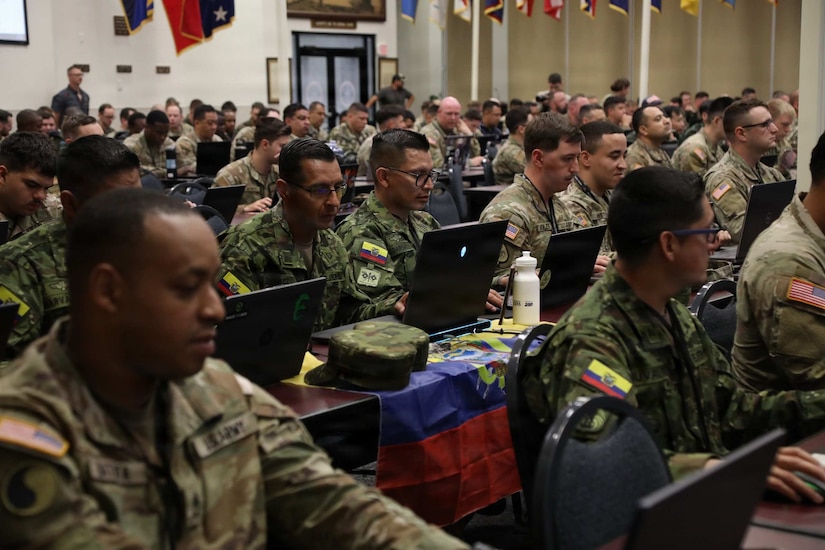
Dozens of people in various styles of camouflage military uniforms sit at tables in a large room working on computers.

Hosted by the National Guard Bureau, the roundtable was part of Cyber Shield 2026 — a training event that brings together more than 1,000 participants from 44 states and territories, as well as 23 countries, in Little Rock, Arkansas, July 12-25. It's designed to develop, train and exercise cyber forces in the areas of computer network internal defense measures and cyber incident response. 

Whereas information technology focuses on the management of data, networks and software, operational technology refers to the control and monitoring of physical machinery, industrial equipment and operational processes. 

One reason operational technology security has become increasingly important this year, and in recent years, is that remote work has become much more prevalent since the 2020 COVID-19 pandemic, said Army Brig. Gen. Russell E. McGuire, National Guard Bureau vice director of cyber operations. 

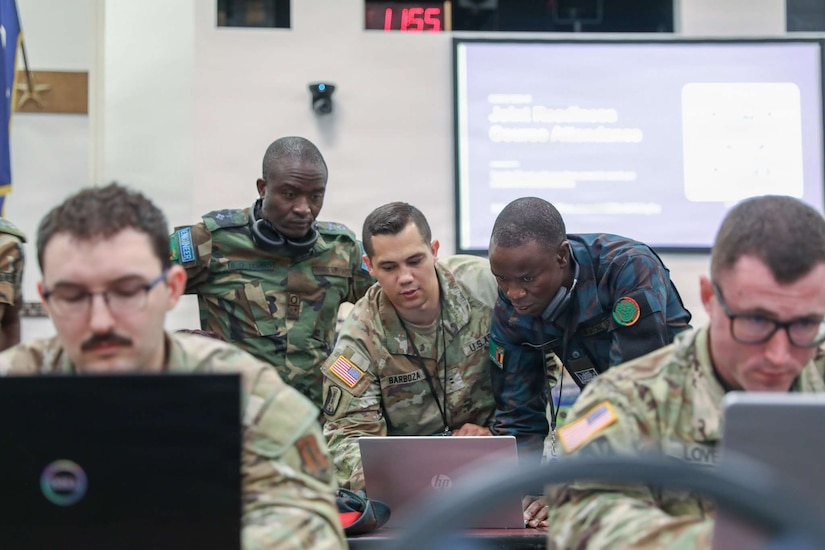
man wearing a camouflage military uniform sits at a table and looks at a computer. Numerous other men and women in similar attire do the same in the background.

"Pre-pandemic, most of our workforce went to office buildings. … As we transitioned to remote work, it created tremendous vulnerabilities," he said.  

Beyond IT professionals working remotely during the pandemic, McGuire said some critical infrastructure employees wanted remote access, which forced companies to connect IT systems to operational technology, thereby creating a new security risk. 

Each year, the exercise focuses on different areas of critical infrastructure, which often relies on operational technology; this year's focus is the electric grid. 

"As you look to sectors of target, there is a need to continue to come back to the electric sector, as attacks on the electric sector impact all sectors instantaneously," said Tim Conway, a fellow and technical director at the SANS Institute, which provides cybersecurity training, certifications and research to the War Department.   

Three men wearing camouflage military uniforms stand and look at a computer in a large room.

One way the exercise combats threats to operational technology is by simulating real-world cyberattacks with SANS NetWars — a series of hands-on interactive learning exercises. 

Roughly 400 participants are taking part in this year's NetWars, contributing their own time during the weekends and in the evenings, McGuire said. 

"This is time they could be hanging out, catching a movie [or] relaxing, but the knowledge that they build just being in that room with these other experts, competing with each other is what makes this such a great exercise for them to take back to their units [and] their jobs, and that's why they keep coming back and growing each year," he added. 

Members of the Army and Air National Guard have participated in Cyber Shield annually since the event's inception in 2013.

Friday, July 17, 2026

Department of War Invests $7.1M to Enhance Space Solar Cell Coverglass Manufacturing

The Department of War announced today a July 7, 2026, investment of $7.1 million in Defense Production Act (DPA) Title III funds to Martin Materials Solutions LLC (Martin Materials Solutions). The investment will establish and scale domestic supply of space solar cell coverglass manufacturing in Twinsburg, Ohio. Used on every satellite, solar cell coverglass protects sensitive solar cells by providing radiation shielding, selective wavelength filtering, and defense against micrometeorites, while ensuring structural stability. This investment supports the Administration's goal to increase key space industrial base capabilities as articulated in the December 18, 2025, Executive Order 14369 - Ensuring American Space Superiority.

"Space-qualified coverglass is a critical component for ensuring the longevity and efficiency of a satellite's power system," said Assistant Secretary of War for Industrial Base Policy, the Honorable Michael Cadenazzi. "A robust domestic manufacturing capability secures our national space assets and ensures the continuity of our orbital missions."

These DPA Title III funds will enable Martin Materials Solutions to scale and de-risk advanced manufacturing processes which are needed to ensure the U.S. domestic supply of critical space solar technology. This project will enable Martin Materials Solutions to fully establish a sustainable manufacturing operation, expanding current capability in terms of modern manufacturing and test equipment, specialized personnel, additional raw material, and facilities for the design, development, and manufacture of coverglass.

This is one of six DPA Title III investments totaling $109.7 million made by the WIRE directorate since the beginning of Fiscal Year 2026. Recipient cost shares total $1.1 million in FY 2026. For more information on the WIRE directorate, please visit: https://www.businessdefense.gov/ibr/wire.html.

About the Office of the Assistant Secretary of War for Industrial Base Policy (OASW(IBP))

The OASW(IBP) works with domestic and international partners to forge and sustain a robust, secure, and resilient industrial base enabling the Warfighter, now and in the future. OASW(IBP) also uses a new Defense Industrial Base Consortium Other Transaction Agreement (DIBC OTA) to solicit new ideas for research or prototype project solutions for critical supply chain resiliency focus areas. This OTA underscores the Department's ongoing dedication to safeguarding the integrity of our crucial supply chain and promptly giving our Warfighters the materials and technologies they need to accomplish their missions. To learn more about the DIBC OTA, please visit: https://www.dibconsortium.org.

Thursday, July 16, 2026

Department of War Announces Landmark Agreements With New Entrants to Accelerate Low-Cost, Air-Launched Cruise Missiles

The Department of War (DoW) today announced framework agreements with three industry partners to complete testing and qualification of the Family of Affordable Mass Missiles (FAMM) Air Force program. Through agreements with Anduril, CoAspire, and Zone 5, the DoW will accelerate rapid validation of a new family of low-cost, air-launched cruise missiles – capabilities that will strengthen the Arsenal of Freedom.

The agreements are a direct outcome of several Acquisition Transformation Strategy initiatives, including stabilizing demand signals, procuring industry-driven solutions, and maximizing flexible contracting.

"The Arsenal of Freedom of the 21st Century requires doing business differently," said Michael P. Duffey, Under Secretary of War for Acquisition and Sustainment. "Today's announcement showcases the Acquisition Transformation Strategy in action, expanding the defense industrial base, fielding capabilities faster, and attracting private investment to fund innovation and increase manufacturing output."

A key feature of these deals is the establishment of seven-year, multi-year agreements which, subject to congressional appropriations and enactment of all necessary authorizations, will be awarded upon the successful validation and competitive selection of the munitions. The Department was granted 5-year authorization for FAMM in the Fiscal Year 2026 National Defense Authorization Act (NDAA) and is actively seeking congressional approval in the FY27 NDAA and Appropriations Bill for a 7-year multi-year procurement program to provide stability to new entrants.

Offering both lugged and palletized variants, the FAMM provides the Air Force with flexible logistics, handling, and deployment options. These variants will be acquired under a single, combined competition.

The Department's procurement strategy for FAMM is a unique model balancing competition, stability and long-term demand signals to scale production.

The multi-year approach utilizes firm-fixed-price contracting with a minimum quantity floor. Shares are split among all qualified vendors to ensure multiple production lines are positioned to surge.

Contractors that meet or exceed production schedules will be eligible for additional procurement quantities – pending congressional appropriations – fostering a competitive environment that rewards efficiency and speed. The Department will also preserve competition opportunities for new vendors to be onboarded for additional quantities and new capabilities in the future as technology continues to advance.

The FAMM program centers acquisition on speed, with the program first appearing in the Air Force's FY26 budget proposal. The DoW leverages new ways of doing business to rapidly accelerate the development and fielding of capability through a focus on testing and delivering stable, long-term demand signals to incentive investment.

FAMM builds on the Department's recent Low-Cost Containerized Missiles (LCCM) announcement, which is the ground-launched variant of affordable cruise missiles. Together, these programs will deliver lethal, low-cost munitions for warfighters to deter and defeat adversaries.

This initiative is a collaborative effort involving the Department of War's Munitions Acceleration Council, the Economic Defense Unit, and the Air Force, all focused on a singular goal of scaling weapons production to meet operational demands and ensure long-term industrial capacity.

The Department of War's Office of Strategic Capital Introduces National Security Fund Finance Program

The Department of War's Office of Strategic Capital (OSC) is pleased to announce the introduction of the National Security Fund Finance (NSFF) program, which aims to provide capital support to credit funds addressing shortages, gaps, and vulnerabilities in critical minerals vital to United States national security.  OSC's mission is to advance these strategic interests by providing direct loans and deploying other financial tools, with the NSFF program acting as the fund-level financing solution to accomplish that goal.

The One Big Beautiful Bill Act, signed into law by President Donald J. Trump, provided funding for OSC to support critical minerals and materials. The NSFF program will provide loans to qualified investment fund managers, who will combine OSC loans with private capital to invest in portfolio companies focused on addressing U.S. national security shortages related to critical minerals and materials.

"The NSFF program clearly advances OSC's goal of crowding-in private capital to address shortages that are vital to U.S. national security. Paired with private capital, NSFF will drive significant investment to address gaps and vulnerabilities in our U.S. critical minerals industry. OSC is taking decisive action to restore our domestic critical minerals supply chain, revive our industrial base, and rebuild our military to achieve President Trump's goal of peace through strength," said David A. Lorch, Director of the Office of Strategic Capital and Senior Advisor to Deputy Secretary of War Steve Feinberg.

OSC is scheduled to issue a formal Notice of Funding Opportunity (NOFO) imminently. The application link will be posted on OSC's website, accompanied by an official press release on the Department's website. The NOFO application period will open upon its official publication.

"President Trump has led the way in leveraging the strength of the United States' world-leading capital markets," said Emil Michael, Under Secretary of War for Research and Engineering. "The Office of Strategic Capital's NSFF program represents another tool that will establish true U.S. independence in the critical minerals supply chain."

Tuesday, July 14, 2026

Department of War Issues Final FY26 APFIT Awards, Surpassing $2 Billion Milestone and Debuting Software Capabilities

The Department of War today announced a new round of awards under the Accelerate the Procurement and Fielding of Innovative Technologies (APFIT) program, marking a major milestone as the program surpasses $2 billion in total awards since its inception.

This latest cohort builds on APFIT's proven track record of rapidly transitioning cutting-edge technologies into operational use, delivering over 100 unique capabilities to date to the warfighter at speed and scale.

"APFIT has fundamentally reshaped how the Department of War accelerates the transition of innovative technologies to the warfighter," said Emil Michael, Under Secretary of War for Research and Engineering. "Our adversaries are not waiting, and neither will we. By scaling the APFIT program past $2 billion, we are equipping the Joint Force with the lethal capabilities to guarantee dominance on the battlefield."

By aligning funding with near-term operational needs, APFIT has enabled the rapid deployment of mission-critical systems across mission areas including autonomous systems, electronic warfare, expeditionary manufacturing, counter-Unmanned Aerial Systems (c-UAS), resilient communications, contested logistics and resilient energy.

A defining feature of APFIT's success has been its ability to bring emerging innovators into the national security ecosystem, expanding the defense industrial base by partnering with small, non-traditional, and venture-backed companies. APFIT has provided a pathway for innovative companies to deliver impactful solutions without the traditional barriers of defense acquisition.

The final round of FY 2026 procurement selections include*:

  • Advanced Navigation for UAS and Launched Effects, $11.24 million, U.S. Army
  • Assured Position, Navigation, and Timing (PNT) Device at Scale, $43.00 million, U.S. Army
  • Autonomous Low-Profile Vehicle (ALPV) Liberty, $32.58 million, U.S. Marine Corps
  • Beyond Line-of-Sight Link (BLink), $15.55 million, U.S. Pacific Command
  • Counter for All-Domain Operations, $28.00 million, U.S. Army
  • Dragonfly – Electronic Warfare Sensor, $24.17 million, U.S. Special Operations Command
  • Drake Counter-Unmanned Aircraft System (C-UAS), $11.35 million, U.S. Navy
  • DYNAMO Expeditionary Power, $20.50 million, U.S. Air Force and U.S. Marine Corps
  • Expeditionary Multi-Band Protected Communications, $15.86 million, U.S. Navy
  • Forward Operations Resilient Grid & Energy Environment (FORGE), $14.72 million, U.S. Army
  • Harbinger Open-Architecture Mass Munitions, $30.20 million, U.S. Strategic Command
  • High-Energy Density Fuel, $23.00 million, U.S. Marine Corps
  • Kinetic Electronic Safe and Arming Devices and Payloads, $12.98 million, U.S. Marine Corps
  • Low Collateral Effects Interceptor & Multi-Mission UAS, $17.50 million, U.S. Air Force
  • Mira Highly Maneuverable Spacecraft, $19.75 million, U.S. Space Command
  • Optical Navigation Kits, $13.00 million, U.S. Space Force
  • Persistent Subsea Autonomous Profiler (PSAP), $30.80 million, U.S. Navy
  • Self-Detoxifying Metal Organic Framework Suits for Chemical and Biological Protection, $23.67 million, Defense Threat Reduction Agency
  • Tactical Airborne Communications Kit (TACKit), $12.04 million, U.S. Air Force
  • Unruly Portable, One-Way Attack Unmanned Aerial System, $31.00 million, U.S. Special Operations Command
  • Vehicle Protection Active Terahertz Sensor (VPATS), $12.00 million, U.S. Army
  • Wallabee – Low size, weight, and power (SWaP) Sensing System, $11.30 million, U.S. Northern Command
  • WaterCube, $10.30 million, U.S. Transportation Command
  • XSTAT Injectable Hemorrhage Control Devices for Life-Threatening Bleeding, $11.42 million, Defense Health Agency

*Does not include classified selections.

The inaugural APFIT software award selections include:

  • ARCHER AI Platform for Decision Advantage, $10.00 million, U.S. Pacific Command
  • Cybergenome AI Binary Analysis Software, $10.00 million, U.S. Cyber Command
  • Intelligence and Operations Threat Planning Tool, $15.20 million, U.S. Air Force
  • Machine Assisted Information Sharing (MAIS) System for Rapid Intelligence Disclosure, $10.00 million, U.S. Space Command
  • Operator Tactical Intranet Systems (OTIS) Tactical Assault Kit, $17.00 million, U.S. Special Operations Command
  • SCEPTER AI-Based Course of Action Generation, $10.00 million, U.S. Southern Command

This award cycle further expands APFIT's reach into software-only capabilities, reflecting the Department's focus on delivering adaptable, continuously improving systems. By enabling the rapid deployment of updates and enhancements, these efforts equip commanders with tools that evolve at the speed of relevance to ensure dominance across all domains of warfare.

The latest round of awards reflects continued momentum under APFIT, building on previous cohorts that have already delivered measurable operational outcomes. These include systems now actively supporting combatant commands, enhancing situational awareness and enabling decision superiority at the tactical edge.

With more than $2 billion invested to date, APFIT stands as a core component of the Department's innovation strategy, demonstrating what is possible when speed, scale and strategic focus converge. The Department will continue to expand the program's reach, identify high-impact technologies and partner with industry to deliver the next generation of mission-ready capabilities.

War Department Changes Cybersecurity Maturity Model Certification Requirements

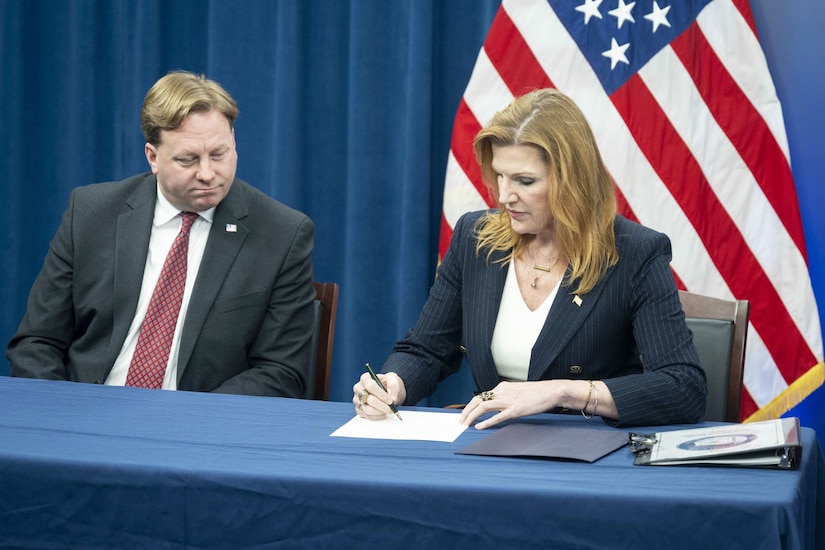
The War Department today announced the suspension of the Cybersecurity Maturity Model Certification phase two requirements, initially scheduled to take effect in November, and launched a comprehensive review of the entire CMMC program.

A woman in business attire signs a document while sitting at a table as a man in similar attire sits next to her; behind them is an American flag.

While the change eliminates costly and time-consuming bureaucracy, said Kirsten Davies, War Department chief information officer, it doesn't weaken the focus on cybersecurity.

"The Department of War is taking decisive action to clear bureaucratic roadblocks and revitalize our defense industrial base in support of Secretary of War Pete Hegseth's directive to aggressively scale warfighter readiness," Davies said. "[But] I want to be clear, across the Department of War and our defense industrial base, investing in and dynamically maintaining robust cybersecurity remains a critical, nonnegotiable priority."

Companies interested in doing business with the department, Davies said, will still need to comply with cybersecurity requirements and safeguard government information according to regulations. Companies will also need to continue to meet requirements under CMMC phase one.

"We're taking this step today because reindustrializing America is a key and critical component of Secretary Pete Hegseth's vision for the arsenal of freedom across the department," Davies said.

Ensuring America's warfighters have the tools they need means ensuring the defense industrial base is agile and able to accelerate production when needed, she said, adding that for many small businesses, the bureaucratic requirements of CMMC keep them from being agile and drive them away from doing business with the department.

"The data we are seeing, including recent reports from the Small Business Administration, makes one thing clear: the current CMMC requirements, including the future planned requirements, are creating prohibitive compliance costs and unacceptable bureaucratic burdens, especially to small businesses," Davies said.

The War Department also announced the creation of a CMMC review and reform task force, which has 60 days to conduct a top-to-bottom review of the CMMC program.

"This task force will serve as the central hub for synthesizing industry feedback from our public request for information — which will be released today," Davies said. "Using these insights, the task force will recommend realistic, scalable security measures that prioritize speed-to-capability and lower barriers for small and nontraditional businesses, while still providing insights on [defense industrial base] cybersecurity and operational resilience."

Michael Duffey, undersecretary of war for acquisition and sustainment, said reform of the CMMC program is an important move toward getting the defense industrial base ready to produce things the War Department needs at the speed the department needs them.

"Rebuilding our military's competitive edge starts with a simple reality: we must put our acquisition system on a wartime footing," Duffey said. "We cannot expect our industries to build at the speed of relevance if they are drowning in peacetime paperwork and administrative bureaucracy."

By suspending onerous CMMC phase two requirements, he said, more private-sector businesses — especially small businesses — will choose to pursue doing important work for the department.

"This is about unleashing the arsenal of freedom," Duffey said. "For too long, overly burdensome cybersecurity regulations have acted as a barrier to entry, locking out the very startups, small businesses and nontraditional manufacturers across the country who drive American innovation. By pausing phase two implementation, we are keeping more companies in the DIB who would otherwise be forced out of the market at a time when we need them most."

The CMMC program, first announced in early 2020, was designed to ensure that private-sector companies working with the War Department could demonstrate their ability to securely handle sensitive government information. The program used a system of private-sector, department-approved assessors to evaluate a private company's cybersecurity compliance.

Davies said the number of available assessors is not large enough to conduct all the evaluations needed in time for the upcoming November deadline.

Monday, July 13, 2026

Department of War Announces $25 Million Investment With ReElement Technologies to Expand U.S. Critical Minerals Refining Capacity

The Department of War's Economic Defense Unit (EDU) in partnership with the Office of the Under Secretary of War for Acquisition and Sustainment (OUSW(A&S)) today announced a $25 million investment with ReElement Technologies Corp. to expand domestic refining capacity for rare earth elements and other defense-critical minerals at the company's Marion, Indiana facility. This investment will strengthen the U.S. industrial base by securing domestic access to materials essential for advanced defense systems, aerospace components, and secure communications.

"Strengthening our domestic refining capacity for rare earth elements and other critical minerals is a national security imperative," said HON Michael Cadenazzi, Assistant Secretary of War for Industrial Base Policy. "Executed by the Economic Defense Unit (EDU) and financed by the OASW(IBP) Industrial Base Fund, this investment actively rebuilds a domestic, mine-to-magnet supply chain. This effort guarantees the joint force has reliable access to the critical materials required for advanced defense systems."

The Department of War is funding equipment, installation, and working capital to help ReElement expand its production lines. The effort will focus on processing end-of-life magnets and other recycled materials to produce high-purity rare earth oxides, yttrium, gadolinium, germanium, and gallium.

The effort reflects the successful partnership between OUSW(A&S) and EDU. The ability to identify industrial bottlenecks, combined with commercial-sector best practices, enables the rapid execution of agreements that continue to enhance national security and military might.

"Critical minerals are fundamental to sustaining our warfighting capacity," said George K. Kollitides II, Director of the Economic Defense Unit. "The Economic Defense Unit was created to act quickly and decisively to address economic vulnerabilities and strengthen our military advantage. This agreement helps secure domestic capacity, protect the industrial base behind the warfighter, and ensure the United States has reliable access to the materials that make deterrence credible and military advantage possible."

The agreement includes robust safeguards to protect U.S. interests, including restrictions on transactions with foreign entities of concern. This $25 million investment reflects the Department's performance-driven approach: pairing targeted government support with private-sector execution to move critical industrial capabilities from concept to production at the speed of relevance.

Friday, July 10, 2026

Department of War Publishes Fourth Release of Unidentified Anomalous Phenomena Files on WAR.GOV/UFO


 July 10, 2026

Statement Attributable to Assistant to the Secretary of War for Public Affairs and Chief Pentagon Spokesman Sean Parnell:

Today, the Department of War is publishing the fourth release of declassified and historical Unidentified Anomalous Phenomena (UAP) files as part of the Presidential Unsealing and Reporting System for UAP Encounters (PURSUE). The collection continues to be housed on WAR.GOV/UFO, and the Department will release additional files on a rolling basis.

The Department of War and our agency partners are actively working on the next release of UAP files. The fourth release of UAP files are available now on WAR.GOV/UFO.

Wednesday, July 8, 2026

Joint Interagency Task Force 401 Publishes Counter-Drone Handbook

Joint Interagency Task Force 401 recently published a practical handbook designed to aid audiences across government, industry and academia in building a shared understanding of the drone threat and the basic principles of protecting against illicit drones.

The task force developed the guide, titled "Small Drones, Big Problems: A First Principles Approach to Countering-UAS," as part of its mission to synchronize counter-unmanned aircraft systems efforts across the War Department and federal interagency partners.

A drone sits on the ground during daytime, with another drone in the background.

The handbook also establishes a common vocabulary and incorporates the latest information about UAS, including lessons learned from operations in the Middle East and on battlefields in Europe. It explains how adversaries can use drones, outlines the key components of a layered drone defense and examines the factors that enable successful counter-UAS operations.

"It is crucial to build a common foundation for counter-drone efforts as we work with the entire government and interagency partners to respond to this growing threat," said Army Maj. Joe Amoroso, deputy chief of strategic initiatives for JIATF 401. "This guide shares vital first principles and direct feedback from warfighters employing [counter]-UAS systems so the entire community has the means, methods and concepts for countering the defining threat of our time."

The handbook emphasizes a layered approach as the most effective defense against illicit drones, with a variety of tools available to counter threats. It reinforces the importance of capabilities that go beyond technological solutions, including training for warfighters that equips them with the knowledge and permissions they need to respond to drone threats in real time.

Through this publication, JIATF 401 continues its mission to expand counter-UAS capability to warfighters at home and abroad.

"While there is no silver bullet to protect against drones, the threat can be mitigated if we are proactive, work with partners across the government and build a layered defense," said Army Brig. Gen. Matt Ross, task force director. "We have faced novel challenges before, and we should not be intimidated by this one. We should lean in and take every possible step to prepare ourselves to dominate on the modern battlefield."

Tuesday, July 7, 2026

Department of War Invests $16M for 45nm Silicon-on-Insulator Qualification

The Department of War announced today a July 2, 2026, investment of $16 million in Defense Production Act (DPA) Title III funds to BAE Systems. The investment will expand the domestic production capability for radiation-hardened microelectronics (RHM) necessary for national defense. This investment supports the Secretary of War's priorities to reestablish deterrence and rebuild the military by investing in key defense industrial base capabilities that increase supply chain resilience.

"Radiation-hardened microelectronics are critical for DoW missile, space, and strategic systems," said Assistant Secretary of War for Industrial Base Policy, the Honorable Michael Cadenazzi. "This project ensures qualified products are available to the DoW."

These DPA Title III funds will enable BAE Systems to create, maintain, protect, and expand domestic industrial base processing and production capabilities and capacity that are essential for RHM components. Specifically, the project will reestablish BAE Systems' RH45® Storefront capability for trusted Radiation Hardened by Design 45nm Application Specific Integrated Circuit and Application Specific Standard Product offerings. Once reestablished, BAE Systems' RH45® Storefront will be a self-sustaining hub where customers can access a range of standard processing products and resources to develop and produce their own custom chips.

"This effort ensures that 45nm silicon-on-insulator technology remains available to DoW systems," added Mr. Jeffrey Frankston, Acting Deputy Assistant Secretary of War for Industrial Base Resilience, who oversees the Warfighting Investment, Resourcing, and Execution (WIRE) directorate. "This provides cost-avoidance, so programs are not forced to redesign and requalify their systems."

This is one of five DPA Title III investments totaling $102.6 million made by the WIRE directorate since the beginning of Fiscal Year 2026. For more information on the WIRE directorate, please visit: https://www.businessdefense.gov/ibr/wire.html.

About the Office of the Assistant Secretary of War for Industrial Base Policy (OASW(IBP)

The OASW(IBP) works with domestic and international partners to forge and sustain a robust, secure, and resilient industrial base enabling the Warfighter, now and in the future. OASW(IBP) also uses a new Defense Industrial Base Consortium Other Transaction Agreement (DIBC OTA) to solicit new ideas for research or prototype project solutions for critical supply chain resiliency focus areas. This OTA underscores the Department's ongoing dedication to safeguarding the integrity of our crucial supply chain and promptly giving our Warfighters the materials and technologies they need to accomplish their missions. To learn more about the DIBC OTA, please visit: https://www.dibconsortium.org.

Monday, July 6, 2026

Launch Your Cyber Career: Department of War Cyber Apprenticeship Applications Now Live!

Earn While You Learn and Defend the Nation's Digital Frontlines on USAJOBS

The U.S. Department of War (DoW) Office of the Chief Information Officer launched today one the most highly anticipated apprenticeship programs in modern defense history: applications for the DoW Cyber Apprenticeship Program (Cyber RAP) are now officially open on USAJOBS.

This groundbreaking initiative represents a critical step in forging a new generation of elite cyber professionals dedicated to defending the nation's digital frontlines and supporting the warfighter.

The application window for this round of applicants is now open and closes on July 17, 2026. Interested candidates will start their journey on USAJobs at: https://www.usajobs.gov/job/875318000.

Following its initial preview in late April, the program went "viral" across social media platforms, capturing the public's imagination and generating an unprecedented 70,000 + inquiries from candidates nationwide. This overwhelming surge highlights a massive, untapped demand for alternative, skills-based training pathways into national security roles.

"To maintain our decisive advantage and support the warfighter on the modern battlefield, the Department of War must recruit differently," said the Honorable Kirsten Davies, Chief Information Officer. "President Trump and Department of War Secretary Hegseth have issued a clear mandate to advance skills-based hiring. This program bypasses traditional academic gatekeeping to value what truly matters: raw aptitude, patriotic drive, and hands-on capability over traditional academic credentials. By unlocking this untapped potential, we are actively forging America's elite cyber workforce of the future from the ground up."

This pilot is a 12-month paid program designed to rapidly develop and employ cyber professionals within the DoW. Apprentices will receive rigorous, competency-based education that blends online learning, immersive hands-on labs, and on-the-job training under the guidance of senior DoW mentors. Successful completion provides industry-recognized certifications and direct pathways into high-demand DoW civilian cyber roles, such as Cyber Defense Analysts and Incident Responders. These professionals will be on the front lines, ensuring the cybersecurity of DoW operations and the broader Defense Industrial Base (DIB).

The Department of War is committed to skills-based hiring, offering pathways for talented Americans from all educational backgrounds. No prior professional cyber experience is required—only the raw aptitude and desire to learn. Applicants must be U.S. citizens, at least 18 years of age, able to obtain and maintain a Secret security clearance, and deeply committed to a cyber career.

To accommodate different agency missions and standards, the program offers two distinct developmental pathways. The core Technical Specialist Pathway focuses on rapid, hands-on technical skill acquisition for general DoW civilian cyber roles and explicitly does not require a college degree. Alternatively, the Defense Manpower Data Center (DMDC) Agency Pathway is tailored for specialized placements within the DMDC and requires candidates to hold an accredited degree to meet that specific agency's qualification standards.

For more information on the program and eligibility requirements, applicants can visit the DoW Cyber Apprenticeship Webpage or contact the program office at osd.mc-alex.dod-cio.mbx.cyber-rap@mail.mil.

Sunday, July 5, 2026

DOW Launches BuildFreedom.US, Announces $10M Skilled Trades Investment With Mike Rowe and Forge the Next-Generation Industrial Workforce

The Department of War today announced the launch of the Build Freedom workforce development initiative. Under Secretary of War for Acquisition and Sustainment Michael P. Duffey will present a $10 million investment to skilled trades advocate Mike Rowe to support the mikeroweWORKS Foundation Scholarship program.

"On behalf of everyone at the mikeroweWORKS Foundation, I'm honored to accept this donation from BuildFreedom.US. Every penny will be spent on training the next generation of skilled workers for a long list of essential jobs - specifically the hundreds of thousands of good jobs currently open in the defense industrial base," said Mike Rowe, CEO of the mikeroweWORKS Foundation. "Closing America's skills gap has become a matter of national security, and initiatives like BuildFreedom.US are precisely what our country needs to meet the demands of a rapidly evolving workforce. I'm excited to participate in this effort and looking forward to helping thousands of Americans get the training they need to start a meaningful career in the skilled trades."

Created through the Office of the Assistant Secretary of War for Industrial Base Policy's Industrial Base Analysis and Sustainment (IBAS) Program, BuildFreedom.US is a national initiative designed to address critical talent shortages across the defense industrial base. The program unites government, industry, and educational institutions to increase awareness of purpose-driven careers and provide scholarships for Americans pursuing high-paying, AI-proof jobs in the skilled trades.

"America's strength has always been forged by people who build, manufacture, and innovate," said Michael P. Duffey, Under Secretary of War for Acquisition and Sustainment. "BuildFreedom.US will bridge talent with opportunity to build meaningful careers, ensuring our workforce is ready for the challenges of tomorrow."

This announcement marks a significant milestone in expanding workforce pathways for students, young adults, veterans, and transitioning service members. By empowering the next generation of American builders, makers, and innovators, the Department of War aims to directly bolster the nation's manufacturing capacity, economic resilience, and long-term national security.