May 6, 2021
|
BY C. TODD LOPEZ
, DOD News
With more nations using space for both commercial and defense
purposes, there must be rules that allow everybody to operate safely —
and to be able to identify what's going to be considered a threat, say
defense leaders.
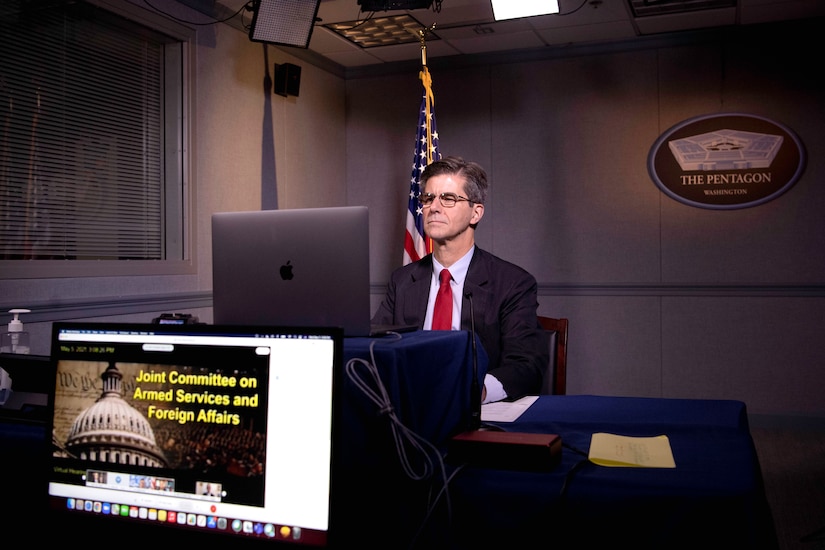
"There are many benefits to having common guidelines for space
operations," John D. Hill, who is performing the duties of the assistant
secretary of defense for space policy, said. He testified yesterday
before the House Armed Services Committee.
"Among these are a safer, more sustainable, more stable and more
predictable space operating environment for all space operators," he
continued. "Importantly for [the] DOD, such an operating environment can
also facilitate indications and warnings of hostile intentions and
hostile acts."
Right now, Hill said, the DOD's policies and practices for its operations in space serve as a model for space behavior.
"[The] DOD models responsible behavior through our routine space
operations, and [the] DOD works carefully to ensure that our space
operations are consistent with international measures the United States
supports, with relevant domestic and international law, including the
law of armed conflict, and the inherent right of self-defense," he told
lawmakers.
Further development of internationally agreed-upon rules for
operations in space will benefit both the Defense Department and
commercial space operations, Hill said.
"From the DOD perspective, United States leadership and the
development of a rules-based order for space activities reap benefits
for U.S. civil, commercial, scientific and national security space
operators," he said. "As space activities worldwide become more prolific
and more varied, voluntary non-binding international norms, standards
and guidelines of responsible behavior can benefit U.S. national
security and foster a conducive environment for growing global space
activities."
Right now, said Space Force Lt. Gen. Stephen Whiting, the commander
of Space Operations Command, the U.S. is already very transparent about
its activities in space. One example of that is the U.S.-run website,
space-track.org, which makes available space situational awareness
services and information.
"Given our imperative to help keep the domain safe, our command ...
has for many years, with the support of Congress, been providing orbital
conjunction assessments to any space owner and operator around the
globe, while also making available space-track.org to foster openness and transparency in the tracking of tens of thousands of objects on orbit," Whiting said.
Having agreed-upon internationally accepted rules for space
operations is increasingly important now, Whiting said, given recent
examples of the increased weaponization of space.
In 2007, he said, the Chinese conducted a test to demonstrate their
ability to destroy an orbiting satellite with a kill vehicle launched
from the ground. And the Chinese, he said, have continued to demonstrate
a willingness to showcase capabilities to interfere with assets already
in space.
"We continue to see the Chinese building satellites like the Shijian
17, which is a Chinese satellite with a robotic arm that could be used
to grapple U.S. or allied satellites," he said. "We know they have
multiple ground laser systems which could blind or damage our satellite
systems."
The Russian can also interfere with space-based assets, he said.
"Russia has several ground-based lasers that can jam or blind our
satellites and it's probable [that] they'll field more later this
decade," he said.
The Russians have also launched satellites, such as Kosmos 2519 and
Kosmos 2542, both of which demonstrated abilities to interfere with
other assets in space. Kosmos 2542, launched in late 2019, Whiting said,
was able to synchronize its orbit with a U.S. satellite. When the U.S.
moved that satellite, the Russian satellite synchronized its own orbit a
second time.
"Russia is a sophisticated space actor, so they must have known what
they were doing, and obviously we do not support weapons tests near our
satellites," Whiting said. "But let me be clear, even with this
weaponization of space, we do not want a war to extend into space, and
we want to do everything possible to deter that."




 Posts
Posts

