Thursday, March 22, 2018

FBI Tech Tuesday: Building a Digital Defense Against Online Vehicle Sale Frauds


Welcome to the Oregon FBI’s Tech Tuesday segment. This week, building a digital defense against frauds involving the online sale of vehicles and equipment.

This fraud can involve the sale of anything from cars and trucks to RV’s, boats, and outdoor gear. Since 2014, the FBI’s Internet Crime Complaint Center has recorded about 27,000 reports of this kind of scam costing victims more than $54 million in losses.

Here’s how it works. You are online—perhaps searching for a new car. You come across an ad for something you really like, and the price listed is really good. You e-mail or text back and forth with the supposed seller—getting photos and information about the purchase. You question why the price is so much below market value, and the scam artist has an easy answer. Perhaps he received it in a divorce settlement or inherited it from a deceased relative. In some cases, he may say that he is moving soon or is in the military and is getting deployed quickly.

The fraudster may also appear legitimate by claiming a relationship with a reputable company, such as eBay, or a third party, which provides a “buyer protection program.” He will send you an e-mail—purportedly from this third party who is managing the transaction. This is all designed to make you feel good about this deal, when in reality this cyber thief is setting you up. The e-mail tells you to call a toll free number, and the call taker will walk you through how you will transfer the money. In many cases, the call taker tells you to purchase prepaid gift cards, provide those card codes to the middle man, and then simply wait for delivery of your item.

Of course, the car, RV, or boat never shows up—and the alleged seller is long gone, not answering phone calls, e-mails, or texts.

Here’s what you can do to protect yourself:


  •     If the price is well below market value—take that as a warning.
  •     Research the item and the seller thoroughly, including the seller’s name, e-mail address, and phone numbers.    Research any third party businesses that the seller recommends and confirm that that business is legit. Remember that the fraudster will attempt to make himself and these third parties look real by spoofing names, websites, and e-mail addresses.
  •     Always verify eBay and PayPal purchases directly through the Web sites, as many scammers send fake e-mail invoices to falsify payment or shipment of items.
  •     Avoid sellers who refuse to meet in person or who will not allow you to physically inspect the car or item ahead of time.
  •     Ask for the vehicle’s VIN and license plate number as well as the name of the person who is the current registered owner. Research that information through your state licensing agency or online databases if possible.

Bottom line: Always remember that if the deal appears too good to be true, it probably is.

If you have been victimized by this online scam or any other cyber fraud, be sure to also report it to the FBI’s Internet Crime Complaint Center at www.ic3.gov or call your local FBI office.

Anoka-Hennepin 8th Graders Win National FBI Safe Online Surfing Internet Challenge


Eighth-grade students from four Anoka-Hennepin School District middle schools won the National FBI Safe Online Surfing (FBI-SOS) award for schools with more than 100 participants. The eighth graders in Steven Burrill’s computer explorations classes at Jackson, Northdale, Oak View, and Roosevelt Middle Schools scored a composite score of 92.75 percent to win the December 2017 award.

Open to all public, private, and home schools nationwide, the FBI-SOS initiative is a free, age-appropriate, competitive, and fun online program that promotes cyber citizenship and teaches students in third through eighth grades how to recognize and respond to online dangers—like Internet predators and cyberbullying—and covers topics such as social networking and gaming safety. Every month during the school year, the FBI recognizes the top-scoring schools in each of its three size categories, based on the number of students participating from each school.

For the month of December 2017, a total of 291,657 students in 12,201 classes at 4,768 schools in 51 states and U.S. territories participated in the FBI-SOS Program. In December, when the 267 eighth graders at four Anoka-Hennepin middle schools posted their composite national-winning score, a total of 96,718 students took the exam nationwide to compete for the three awards.

FBI Minneapolis Acting Special Agent in Charge Robert C. Bone II will present a certificate to Mr. Burrill and some of his students during an “awards celebration” at 6:30 p.m. on Monday, March 26, 2018, at the start of the Anoka-Hennepin School Board meeting. The board meeting is open to the public and will be held at the Sandburg Education Center, 1902 Second Avenue, Anoka, Minnesota.

The FBI-SOS Internet Challenge was developed with the assistance of the National Center for Missing & Exploited Children and with the input of teachers and schools. Anyone—young or old, in the U.S. or worldwide—can complete the activities on the FBI-SOS website. The testing and competition, however, are only open to students in grades 3-8 at public, private, or home schools in the United States or its territories.

Wednesday, March 21, 2018

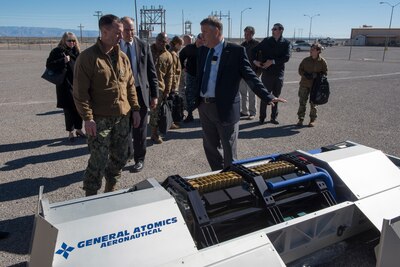
Senior DoD Official Discusses Future of Directed Energy Weapons


By Marine Corps Sgt. David Staten DoD News, Defense Media Activity

WASHINGTON, March 21, 2018 — As stated in the National Defense Strategy, the United States needs to invest and accelerate the modernization of key capabilities to build a more lethal force.

Michael D. Griffin, the undersecretary of defense for research and engineering, today spoke to more than 500 senior leaders from the U.S. government and defense industry to explore the impact of integrating directed energy capabilities into the national security enterprise at the 2018 Directed Energy Summit at the Ronald Reagan Building and International Trade Center here.

Directed energy weapon systems employ lasers, microwaves and particle beams against enemy targets.

Griffin has been in this arena since the 1980s and worked for the first three directors of the original missile defense agency.

“Directed energy was then in our view an important part of our future portfolio because only directed energy could offer the kind of extended magazine, if you will, the extended range, speed of light delivery of the kill,” Griffin said. “It was the only way that in the long run you could see yourself competing with the threat and coming out on top.”

Directed energy has gone through a lot of evolutions over the years, Griffin added.

For many years, he said, the Congress and national policy fundamentally did not support the development of directed energy as a warfighting tool.

“So I think that has changed,” he said. “When I have discussions on the Hill, there is very much -- a lean-forward posture now.”

China is flexing its muscles in the Indo-Pacific region and Russia is resurgent, Griffin told the audience.

“You don't build islands in the South China Sea and militarized them with benign intentions,” he said. “You don't get on TV and brag about your 4,000-mile intercontinental hypersonic nuclear delivery system with benign intentions.”

Superpower Competition

Griffin said there’s a recognition that superpower competition is again on the rise, and the United States must modernize its military if it wants to maintain its position of global preeminence.

“We will not win in a man-to-man fight,” Griffin said. “We have to have the technological leverage. That realization was responsible for the creation of my office, to elevate the role of technology maturation and deployment and I believe it is responsible for the renewed interest in directed energy weapons.”

And, directed energy is more than big lasers, the undersecretary said.

The undersecretary asked his audience to consider directed energy systems such as high-power microwaves, different laser designs and particle beam weapons.

“Each of these systems has its own advantages and each has its own disadvantages,” he said. “We should not lose our way as we come out of the slough of despondence in directed energy into an environment that is more welcoming of our contributions. We should not lose our way with some of the other technologies that were pioneered in the ’80s and early-’90s and now stand available for renewed effort.”

In his capacity as undersecretary for research and engineering, Griffin said he is going to be very welcoming of other approaches that may not have had a lot of focus in recent years or decades.

Directed Energy Venues

There are four venues, he said, in which directed energy can serve: land, air, sea and space.

He urged the audience to not forget that because the technologies are fundamental and can be applied across those domains, all of which are important to them.

The basing strategies, the warfighting tactics, techniques, procedures, the logistics support requirements, the manpower that is needed for support, all of these things are different and are required to be different because of the different venues in which they will have to operate, he added.

“I would urge us not to think that one size fits all,” Griffin said. “I would urge us not to think that there can be a lead service for directed energy. I would urge us to not willow the competition down too quickly. I would urge us to keep a lot of arrows in our quiver as we go forward figuring out how we're going to translate directed energy technologies into warfighting systems that are going to defend this country and our allies.”

America should also take advantage of the brain power that traditional U.S. allies and partners can offer in the development of these technologies so they can be developed together, the undersecretary said.

“The United States will always be stronger for its alliances, he said.

Griffin told a story about when he worked for NASA during the Reagan administration. He had the opportunity as the administrator of NASA to become familiar in great detail with the 14-nation partnership that put the international space station together. At first he was suspicious of the partnership but later understood how misguided he was.

“I came to believe that we got much more out of the international collaboration on the space station than we ever gave up in terms of revealing of our own capabilities and technologies,” the undersecretary said.

“The way to technical superiority is to run faster and work harder and not to try to wall off our own capabilities,” Griffin said. “So, as we explore directed energy technologies, where there are opportunities, I will be looking for careful and measured but still very real cooperation with our allies and partners. I think in the long run that will benefit us.”