Thursday, May 21, 2020

Mandeville Resident and Former Department of Energy Contractor Sentenced to 3 Years Probation for Accessing Government Computer System without Authorization and Recklessly Causing Over $23,000 Worth of Damage


NEW ORLEANS –  U.S. Attorney Peter G. Strasser announced that GARY PETER SIMON, JR., age 56, a resident of Mandeville, Louisiana, was sentenced on May 19, 2020 to (3) three years probation by United States District Judge Greg G. Guidry after previously pleading guilty to intentionally accessing a protected computer without authorization and recklessly causing damage resulting in loss of more than $5,000 during one year, in violation of 18 U.S.C. '' 1030(a)(5)(B) and 1030(c)(4)(A).  SIMON was also ordered to perform 200 hours of unpaid community service, pay a $100 special assessment fee, and restitution to the victim in the amount of $23,200.

According to court documents, The Strategic Petroleum Reserve Office (SPRO) was a component of the Department of Energy that was responsible for, among other things, overseeing and maintaining the readiness of the United States’ stockpile of emergency crude oil, which was stored along the coastline of the Gulf of Mexico.  DOE SPRO operated a restricted cloud-based computer system to handle a variety of functions, including documenting daily activity.  SIMON, who was employed as a contractor for DOE SPRO from September 2007 until August 2018, worked in the Emergency Management Directorate and was responsible for, among other things, IT management of SPRO network applications.  He was one of two individuals who knew the username and password of the Administrative Account.

After SIMON resigned from his contracting agency, in about August 2018, he was no longer authorized to access the DOE SPRO computer systems.  Nevertheless, on about October 21, 2018, SIMON intentionally accessed the DOE SPRO cloud-based system remotely without authorization.  After SIMON accessed the system, he altered and deleted various files.  As a result of the intrusion and subsequent manipulation of protected data, operators were unable to access their log views on the computer system, and they could not annotate work they completed electronically.  The computer system remained compromised for approximately 2-3 hours after the discovery of the unauthorized access. Thereafter, SIMON used the account of a current SPRO employee without that employee’s authorization, to make changes to log views and to attempt to delete audit log files.   SIMON’S actions resulted in loss to the DOE, in the form of costs associated with responding to the offense, conducting a damage assessment, and restoring data, program, system, and information to its pre-offense condition, in the amount of approximately $23,200.

U.S. Attorney Strasser praised the work of the Federal Bureau of Investigation in investigating this matter.  Assistant United States Attorney Jordan Ginsberg, supervisor of the Public Corruption Unit, is in charge of the prosecution.

Data Drives DOD, DLA Decisions on COVID-19 Medical Supplies


May 21, 2020 | BY Beth Reece , Defense Logistics Agency

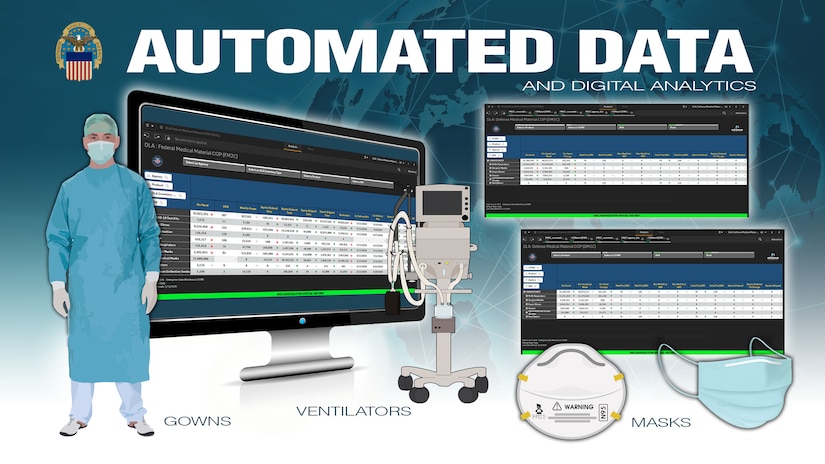
Automated supply-and-demand data on personal protective equipment needed in the COVID-19 response is giving Defense Department officials a unified picture of stock levels and requirements across DOD and federal agencies, the Defense Logistics Agency's metrics integration chief said.

"Open reporting on orders, shipments, back orders and expected delivery dates lets leaders know whether there's enough material on hand to meet requirements for the next 30 to 60 days," Sean Ahrens said, adding that the data can drive informed decisions to adjust orders if necessary.

DLA began sharing daily status reports on personal protective equipment like masks and ventilators with DOD in April for inclusion in Advana, a digital analytics platform the department developed last year to track everything from finance to readiness.

The tool is now being used to track stocks of key medical items owned by DLA, the military services and geographic combatant commands, as well as federal agencies like the U.S. Department of Health and Human Services and Federal Emergency Management Agency. The data needed to assess the department's personal protective equipment posture would otherwise be scattered, said Navy Capt. Diana Dalphonse, chief of the Strategic Initiative Group's Strategy Branch for the Joint Chiefs of Staff Logistics Directorate.

"It gives leaders a quick snapshot of what we have and what we need both in the United States and internationally," she said. "If DOD as a whole appears short on a certain item, leaders can collaborate with [the Department of Health and Human Services] and [the Federal Emergency Management Agency] to get allotted additional supplies," she said.

Test swabs are among the items DOD has received from federal agencies because of the data, which has also shown areas where DLA and DOD have ample supply despite shortages by federal agencies.

"For example, DOD has some availability of N95 respirators, and we were able to issue 20 million to HHS and FEMA to support the national effort," Dalphonse added. "By seeing our entire posture of medical supplies, we're able to view gaps and risks as we work to solve low stock levels supporting national efforts."

DLA employees anticipated greater demand for medical supplies in February and started compiling data on 17 items the agency provided during the 2014 Ebola pandemic in Africa. Ahrens began sharing that data with DOD in daily spreadsheets but said he expects it to be electronically fed into Advana soon via DLA's Enterprise Data Warehouse, which presents real-time metrics on key weapons systems and platforms along with the DLA Service Readiness Dashboard. 

Accurate data on ownership and location of the supplies became critical as worldwide demand grew and multiple federal agencies relied on the same vendors to produce millions of items, Ahrens added. Supporting concurring requests from HHS and FEMA also complicated data management.

Advana users can customize views with different data sets, which include breakouts by location, ownership and order and delivery status. Details on pandemic and war reserve stocks owned by DHS are also available.

"With high demand for so much stuff nowadays, you really need to have an accurate picture of everything available to make informed decisions on whether to tap into reserve stocks," Ahrens said.

DLA employees have access to data on personal protective equipment in the DLA Dashboard and can view the same details now in Advana. That helps them understand the types of information being analyzed at the secretary of defense and joint staff levels, Ahrens continued.

The agency is also working with DOD to duplicate the data share in future disaster support efforts such as in hurricane response.

For Some, Teleworking May Continue as Post-COVID-19 Option


May 21, 2020 | BY C. Todd Lopez , DOD News

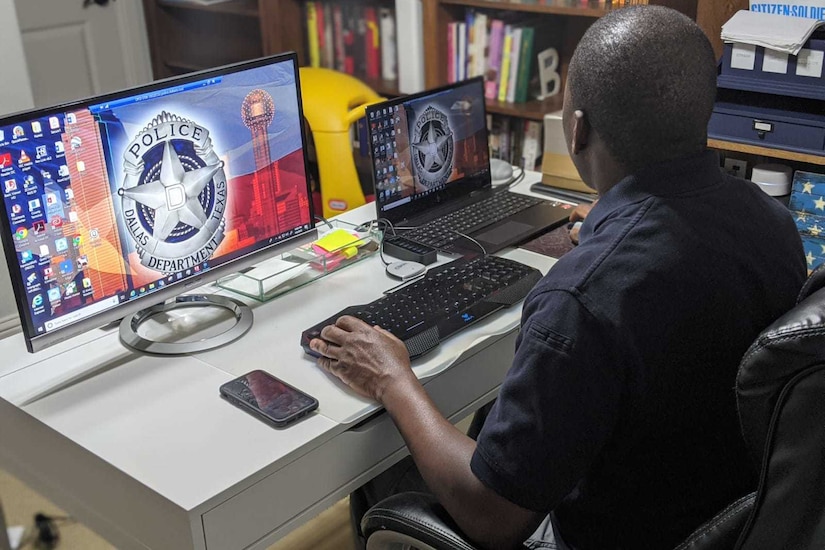
In April, the Defense Department's chief information officer said some of the tools and infrastructure put in place to support the rise of telework due to COVID-19 might remain after the pandemic subsides. Now, department leaders say, it is possible telework itself may live on.

"We've learned a lot of lessons about the ability to telework, and how we keep our productivity up," Matthew Donovan, undersecretary of defense for personnel and readiness, said during a briefing today at the Pentagon.

"I think moving forward ... as we step through a phased approach on reopening, ... we're going to continue to maximize the teleworking. We've made a lot of progress with making sure that the network capacities are available and people have access to the materials and documents that they need from a teleworking location."

Also included in discussion of a military rebound from COVID-19 was the status of the aircraft carrier USS Theodore Roosevelt, which has been at port in Guam since late March as a result of the pandemic. The ship is now once again underway, said Jonathan Rath Hoffman, assistant to the secretary of defense for public affairs.

"We're proud to say that the USS Teddy Roosevelt is underway today," he said.  "The ship left Naval Base Guam and entered the Philippine Sea to conduct carrier qualification flights for the embarked Carrier Air Wing 11. We wish the very best to the Roosevelt and her crew."

Aboard, Roosevelt's crew is practicing better social distancing effort to ensure continued crew health and safety, Hoffman said.

"We're concerned for any additional outbreaks, but we have learned a lot over the last couple months," he added.

As a result, he said, the ship is operating with a reduced crew to ensure additional spacing between crew members. The crew is wearing masks and gloves, and will have increased COVID-19 testing. Additionally, Hoffman said, the ship will have longer dining hours to ensure that fewer individuals are in the dining facilities at the same time.

"There's a bunch of different lessons learned that they've taken and that they're using," he said. "No one is going into this believing that this is the last we've seen of coronavirus. But they're trying to be very diligent and very careful and thoughtful in how they move forward and be very assertive in confronting the virus whenever they see it."

Hoffman said the Roosevelt has no change in its mission — it will pick up where it left off in late March. The carrier air wing is being recertified, which should take up to two weeks to complete, he added.

"They're recertifying the flight deck, recertifying the crew," Hoffman told reporters. "It's something that happens after a ship has been in port for an extended period of time. At that point, the ship will return to Guam, pick up the remaining crew members who are still quarantined and who are still recovering from COVID. They'll get back on the ship, and then the ship will move out for the rest of its mission, ... the tour that it started earlier this year."