Tuesday, September 15, 2020

Space Force Chief: U.S. Doesn't Want War in Space, Must be Prepared for It

Sept. 15, 2020 | BY C. Todd Lopez , DOD News

The United States doesn't want to engage in warfare in space, but like in all domains, the U.S. military must be prepared for such a conflict, and that'll take a lot of preparation and change, Chief of Space Operations Gen. John W. Raymond, said.

He said the U.S. does not want to get into a conflict that begins or extends into space. 

"We want to deter that from happening. However, if deterrence fails, a war that begins or extends into space will be fought over great distances at tremendous speeds," Raymond said.

The chief of the newly-created Space Force spoke during a presentation that was part of the 2020 Air Force Association Air, Space and Cyber Conference, held this year virtually as a result of the COVID-19 pandemic.

A man in military uniform stands behind a lectern.

To plan for warfare at the speeds and distances required to operate in space, the  Space Force must be lean, agile and fast. The new military service has been working on all of those things since it stood up in December, Raymond said.

A big part of the leaning effort, he said, is the reduction of bureaucracy.

"Since establishment, we've been in the business of slashing bureaucracy, delegating authority and enhancing accountability at every crossroad," Raymond said. "My opinion: big organizations are slow. We must move at speed to outpace the threats that we face."

The general said the Space Force, in an effort to reduce bureaucracy, implemented a large-scale reorganization that involved removing two echelons of command, including a numbered Air Force and an O-6-level command.

"We've also reduced the size of our planned staff at the Pentagon," Raymond said. "Back when we started, the Pentagon staff was going to be over 1,000 people. That was the initial plan. We've slashed that by 40%. We're shortening the distance between decision makers and you, the experts, conducting our mission."

Also part of eliminating bureaucracy, Raymond said, is a hard look at the agencies that exist now that are involved in acquisition for the space enterprise. He said Congress has identified some 65 different organizations involved in space-related acquisition.

A rocket launches against a blue sky.  Flames and smoke billow out underneath.

The Space Force chief said there is a mandate for change, adding that we must bring unity of effort across the department, reduce duplication of effort, all while slashing costs, and increasing our speed. 

"If we get this right, we will be the envy of the other services, because we are not tied to business of the past," Raymond said.

The Space Force is also proposing a new acquisition system for space, something Raymond said Congress agrees with.

"We've already begun implementing that," he said. "We've already delegated the head of contracting authority down from the Pentagon staff to the acquisition experts in the field. We know from experience this kind of delegation speeds up acquisition decisions, and makes us better partners for the industry."

Partnership is also key, both inside the Defense Department and outside. Partnerships with the intelligence community, sister services, the total force and space allies are all being looked at for development, Raymond said.

As part of partnership development, he said the Space Force established a chief partnership office at the Space and Missile System Center, and that team is working to expand space partnerships with nations such as Australia, Canada, Japan, New Zealand, the United Kingdom, France and Germany.

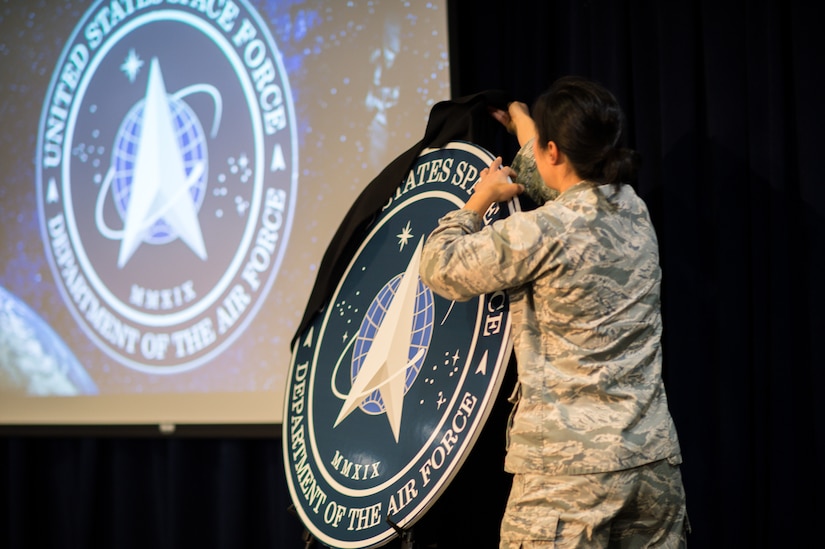
An airman pulls a black sheet off an easel that holds a circular cutout featuring the seal of the U.S. Space Force.

Right now, he said, Space Force is working with Norway, for instance, to host American payloads on Norwegian space launches. That combined effort, he said, will save the U.S. about $900 million and also put those capabilities into space sooner. The U.S. is also working with the Japanese to put U.S. capabilities into Japanese satellites.
"These efforts improve our capabilities, and they strengthen our partnerships between our great nations," he said.

Raymond also drew attention to verbiage on a display at the World War II memorial in Washington, D.C. On the floors of both the north and south pavilions are etched the words "Victory on Land, Victory at Sea, Victory in the Air." Now, he said, those three domains are no longer enough to ensure victory. Today's security environment, he said, requires even more of American warfighters.

"I am not confident that we can achieve victory or even compete in a modern conflict, without space power," he said. "I am not willing to lose in order to learn. Today the Space Force in answering that call to compete, forging a warfighting service that is always above."

Friday, September 11, 2020

Remarks by General John E. Hyten to the Joint Artificial Intelligence Symposium and Exposition

 Sept. 9, 2020

Gen. John E. Hyten

GENERAL JOHN E. HYTEN:  Greetings.  It’s General John Hyten.  I’m vice chairman of the Joint Chiefs of Staff.  Thank you very much for allowing me to be with you today talking about artificial intelligence.  It is a subject of much interest in the world.  It’s been a subject of my interest for quite a while now, and I’m going to share some thoughts with you today about that subject.

So thanks very much for this conference.  Thanks to the JAIC for holding this conference.  I really hope to get across and visit the JAIC before long, but COVID has gotten in the way of that.  COVID is also the reason why we’re having to do this virtually.  This would be much better as a conversation, because I think this is a subject where we need to learn from each other and delivering a speech, a lecture, whatever you want to call this through a video is not the best way to talk about artificial intelligence.  Nonetheless, I’m going to do my best to deliver some things for you to think about as we go forward.

So the first thing I want to do when I’m talking about artificial intelligence is I want to share with you a quote, and it’s one of my favorite quotes.  It’s from John Kennedy.  Now, the quote is about space, and most people in the audience know that I’m a space officer, have been a space officer for a lot of years.  But what you may not know is that’s not how I started my Air Force career.  I started my Air Force career as a software engineer, and I was a software engineer and a – and a programmer, and that was how I started my Air Force career.  But I moved quickly into space because space has been my passion for a long time.

So I’m going to share a quote with you, a quote that John Kennedy gave in 1962 at Rice University.  It’s not maybe his most well-known quote, but it says a lot and I just want you to think about artificial intelligence in context of this instead of space.  But the quote goes like this:  “We set sail on this new sea because there is new knowledge that must be gained, and new rights to be won, and they must be won and used for the progress of all people.  For space science, like nuclear science and technology, has no conscience of its own.  Whether it will become a force for good or ill depends on man, and only if the United States occupies a position of preeminence can we help decide whether this new ocean will be a sea of peace or a new terrifying theater of war.”

So that was about the space program.  And that speech was part of the speech that actually generated the excitement in this country and said we’ll land a man on the Moon by the end of the decade, which we did.  It started the Apollo Program.  It got my dad involved in the Saturn Program.  It got me excited about space.  It generated a lot of things.  But in it, the president – President Kennedy at the time – talked about whether it will be a sea of peace or a theater or war, whether it will be for good or ill, and it’s dependent on man.

And if you think about artificial intelligence, we’re being asked that question today:  Is it going to be a force of good or a force of ill?  And it’s all up to us.  We get to make that decision because, simply put, it’s just technology, but it’s technology that the world understands is critically important.  And because the world understands, that means our competitors, our adversaries, understand that being able to use and apply artificial intelligence in future military operations is going to be critical to the success of those operations.

So we have to figure out how to lead the world in doing that.  And we have some challenges as we walk forward into that, challenges because much of the work that is being done in artificial intelligence, much of the technology, much of the research and development is not being done by the Department of Defense.  I’ve got to be involved in tremendous research and development over my career.  I’ve seen from the very beginning the development of satellite-based navigation, GPS; satellite-based timing, GPS.  I’ve seen the development of an integrated circuit, an integrated circuit really built by our laboratories, our DOD laboratories.  And we are investing enormous amounts of taxpayers’ dollars in looking at the research that will be required for us to leverage artificial intelligence, and that’s important.

But as much as we’re investing, it’s orders of magnitude larger in the industrial sector.  I was talking to one of our industry partners last week, talking about their research-and-development budget, and their research-and-development budget was measured in the billions.  That’s one company, measured in the billions.  If you look at all of the companies and how much is being invested, our numbers pale in comparison.  The great inventions are going to come out of industry.

I was – I was in Silicon Valley visiting a small artificial intelligence company.  They label themselves an artificial intelligence company.  And I saw artificial intelligence algorithms already running, working through the data challenges that they have, applying this in a real business model and delivering capability in the commercial sector.  It already exists.  We have to be able to take advantage of not only that industry, but the research that’s going on on that side.  We have to be able to partner with them.

And I tell you, we don’t like to do that in the Department of Defense.  We like to think we’re still the big dog in the room, and in this case we are not.  Well, at best we’ll be a minority partner in the research that has to go on, but it doesn’t mean that we can’t deliver very, very critical capabilities.  We’ll focus on applying the research and development of others into the military business, because that’s not what they do; that’s what we do.

But we have to get out of our own way in many cases and apply the research and development of others to our problems, which means we have to partner with them.  Which means there has to be a business case that we – that we partner with them with because other businesses don’t just do things out of the goodness of their heart.  Many are operated by great Americans.  Many love operating in this country, want to make sure this country succeeds.  But they’re a private business.  They have to be able to make money.  So we have to figure out how to partner with them, allow them to make money, and then apply the technologies into our side.

And again, we don’t like to do this.  We like to control things.  We like to have a focus on our research-and-development budget, how those things are going on.  That is – that is not enough to make sure that we can get the job done, so we have to look at research and development a little bit different.

And then we have to look at all elements of artificial intelligence and we have to look at them effectively.  And there’s basically seven building blocks of artificial intelligence.  I’m going to spend a few minutes talking about each one just so you understand what they are.  So the seven are algorithms, data, software, computing, ethics, engagement with industry, and international cooperation.  Those are the seven building blocks that we have to be able to deal with.

And I tell you, when people come into my office – whether it’s government people, industry people, whoever it is – it’s like, all they talk about is algorithms.  And don’t get me wrong, algorithms are critical.  Algorithms are important.  But algorithms, to me, are actually one of the easier problems to solve.  We have to invest in developing the algorithms, but there’s industry partners out there that already have functioning algorithms that can take massive amounts of data, apply the algorithms to the data, and learn from that – allow the machine to learn from that, allow it to grow as we go through that.  We have to figure out how to do that and take advantage of those algorithms, develop our own algorithms.  But algorithms without the other building blocks are useless, especially when it comes to data and computing.

So of the seven building blocks I talked about just a while ago, the two most important are data and computing.

We have to make sure we focus on data.  So I’ve talked a little bit about algorithms.  Again, we need to invest in algorithm development.  We need to understand what those are.  We need to make sure we apply them to the mission space that we have.  But we really need to spend a lot of time focusing on data.  And there’s really two different pieces of the data, and it’s actually related to computing as well.

The first thing we need to think about when it comes to data is gathering all the data that exists so we can take advantage of it.  There is so much data that’s out there, and much of that data that we gather in the Department of Defense we actually throw away.  We just ignore it because it’s irrelevant.  Or the data is in the wrong format, therefore it’s unusable to our structure.  All of those things are untrue.

I watched a company in California take data in a format that they’d never seen before and they did not try to reformat the data.  They just taught the machine how to look at the data, understand the data, put it in their construct so they could apply their algorithms to that data, and with a couple weeks and just a couple hundred thousand dollars they delivered a capability that just – that just blew me away because their focus was on the data that existed.  How do I – how do I learn from that data?  How do I understand that data?  How do I take it?  So the structure and the format, we’ve tried for years to mandate a structure, to mandate a format.  That’s not the critical piece.  We have to understand how it is structured, how it is formatted.  We have to understand and be able to explain to others how to do that.  But machines can learn from that now if we just teach the machine to look for the right kind of data.  So we have to build that existing data architecture out and understand what that is from the existing data that is already out there in enormous amounts.

And then we have to look at data from a new perspective.  Call it data discovery.  And in many cases, the machine that we’re talking about – the machine that will be performing artificial intelligence, the machine that will be learning as we go through this – that machine can drive sensors all by itself.  That machine, that computer, can have sensors built into it, and it can gather that real time, discover new information – discover that information, translate it into data, put that data in the system, and learn from that data.  So when you integrate the sensing capability with the data, now, if you apply computing in the right way, you can accomplish just amazing things.

So you see, computing, algorithms, and data together are all part of the same puzzle.  They can’t be looked at separately.  They have to be looked at together.  And there’s two kinds of data – data that exists and data that can be discovered – and we have to figure out how to work in both of those.  And then the computing has to be powerful enough and fast enough to manipulate the data quickly, to pull the right information so that we can deliver the kind of capabilities that we need as we go forward to the future.  That’s what we’re going to get out of machine learning.  That’s what we’re going to get out of artificial intelligence.

So embedded in all that is the third element, and I kind of skipped over that.  I skipped over it intentionally.  I talked about algorithms.  I talked about data.  I talked about computing.  But the third element is software, because software is actually the magic that is going to make all this happen.  Somebody has to sit down and write the code, figure out how to make all of this work together, how to make sure we can look at the code and pull those things out.  The software developers of the future will be – will be the most important element of this from a skill set because that is the art.  The data is kind of an enabling capability.  The computer is the machine.  The algorithms are the magic.  But the software that puts it all together is going to be the key.

And when you look at software in the Department of Defense, oh my gosh, we develop software in archaic, ridiculous, 20th-century ways that never worked.  And I’ve been through so many different software-development approaches inside the Department of Defense.  I was part of the Ada Initiative, where the Department of Defense thought it would be a brilliant idea to develop our own programming language so that we could lead the world and teach ourselves how to write a common programming language.  Well, guess what?  The Department of Defense does not lead the world in software development.  The rest of the world has gone past us so many ways.  And the developers are completely different.

When we put a software-development team together, what do we do?  We build it like – we build it like a tank.  We build it like a ship.  We build it like an airplane or a satellite.  We put together hundreds of people and we put together these giant engineering teams and try to put them together.  That is not the way software is built in today’s day and age.  I have – I have relatives, I have friends, I have a number of classmates and others that are heavily involved in the software-development business, and they would never have a software-development team with 500 people.  We have software-development teams with 500 people all over the department.  It’s crazy.  You have to be nimble.  You have to be fast.  And you can’t be nimble and fast if you have to integrate the work of 500 different programmers.  It’s literally impossible, and we will chase that to the end of the ages and never be able to get to the answer.  And you’re seeing that happens in weapons system after weapons system, where we wait year after year for the software to deliver.  And we have to figure out how to do that across our enterprise.

But when it comes to AI, we had better figure out how to do it in a modern, quick way.  Now, I use the word “quick” because it’s really about speed.  In order for us to stay abreast of our adversaries and move ahead of our adversaries, we have to be able to move faster than our adversaries.  And right now the United States, actually, as a whole does pretty well.  If you go to Silicon Valley or Seattle or Cambridge, or even here in the Washington, D.C. area, or you go to Austin, or you go to any area where software development is a key piece – and our nation moves unbelievably fast.  If you go in the AI industry, unbelievably fast.  If you go in the Department of Defense, unbelievably slow.  Unbelievably slow.  And for the life of me I cannot figure out how we change that culture, that understanding, to move in a different direction towards the future.

Now, I tell you, I have the term “culture” and I just used it.  And I used it for a reason, because many of you think that’s the Department of Defense culture – that that’s just the way it is, and we have to figure out how to deal with the culture.  But I had a boss of mine once who, when I gave a magnificent speech about the difficulty of culture and changing culture, looked at me – and I was a general officer – and he said:  So, John, what is your rank?  I said, general officer.  And he said, well, what is your duty title.  I said, commander.  He said, well, how come you just don’t decide what it is your want to do, tell your people you want to do it, and you’ll be amazed that people will actually try to do this.

So what I’m asking this community – this community in artificial intelligence, this community in the Department of Defense – is to understand that speed is the critical piece of this entire process.  We have to figure out how to move fast in this area, and putting together teams of hundreds of people writing code all at the same time will never allow us to move fast.  We have to put together small teams, small teams that are integrated at the – at a broad strategic level that we move quickly with.  We develop products.  If they work, we use them quickly.  If they don’t work, we throw them away and we move on.

It’s a completely different way of doing business, and we have to be able to do that because if we can’t right-code that way we’ll never fully embrace what artificial intelligence is doing.  And the key is you have to understand what artificial intelligence is, in China, in Russia.  But China in particular.  They have identified that as a critical issue, along with quantum, along with space and cyber and a number of different areas.  But artificial intelligence is a key piece, and they’re moving incredibly quickly.  They’re educating themselves in China, they’re educating themselves in the United States, and they’re moving unbelievably fast.  And if doesn’t matter how far ahead you are; if somebody’s running faster than you are, they’re eventually going to pass you in the race.  And you have to consider that we are in a competition right now, and the goal of a competition is to win – not to lose, to win.  Which mean we have to move fast and we have to move fast again.  But we are challenged right now in figuring out how to move fast.

So everybody in this crowd should be excited about working in the AI world.  They should be excited about the potential of machine learning.  They should be excited about the ability to integrate computing and data and algorithms and software to develop capabilities that can provide the United States enormous advantages as we move into the future.  But if we continue to do business the way we’ve been doing, we will not be successful.  We have to do business differently.  So I ask for your help in figuring out how to do that.

Then the fifth element.  The fifth element is ethics, because there’s a lot of challenges about what do we do with artificial intelligence in warfare.  And one of the first times I spoke in public about artificial intelligence it was at Halifax, at the defense conference in Nova Scotia, and I was on an evening panel – not really a panel, but just two of us, Eric Schmidt of Alphabet/Google and me, standing up, talking about the ethics of artificial intelligence in warfare.  And if you’re sitting next to or standing next to Eric Schmidt talking about that topic, you have to realize that you are by far not the smartest person in the room; he is.  How, then, do I make the point?

And so I decided to start with the John Kennedy quote I started with earlier because I think that describes exactly what we’re talking about.  And what it describes is it’s choice.  Just like every other technology this country has developed, it all goes back to – every technology that’s ever been applied to warfare, from the rifle to the tank to the airplane to the satellite, whether it’s a force of good or a force of ill depends on man.  It depends on how we use it.  And it will be the same way for artificial intelligence.

So my broad ethical look at artificial intelligence is that artificial intelligence should never be used to start a war, ever.  Those decisions can only be made by humans.  So the men and women that lead our country – the men and women that lead the country, they have to make the decision whether the country will use armed force to achieve our political objectives.  And if we’re attacked, I guarantee you that we will use armed force to stand up for our – for our nation.  We have always done that and we always will.  So the decision to go into a conflict cannot be based on artificial intelligence; it has to be based on human intelligence and the human decision process.

But once we’ve made the decision, then we have to be all in to achieve our objectives, all in to achieve victory in that conflict.  And that comes from, in many ways, applying all technologies to our advantage, which means applying artificial intelligence as well.  And we should not shy away from that.  We should embrace that, understand it.  And if it gives us an advantage we need to figure out how to use it, use it in the right way, make sure we use it within the elements of the law of armed conflict, which should not be difficult to do.  We’ve figured it out with every other technology we’ve ever built, and we’ll figure it out with artificial intelligence as well.  It is just another technology.

And then we have to make sure we engage with industry, and it’s a different industry in many cases.  I talked about that earlier when I talked about the research-and-development challenges, but the industry here is fundamentally different than the industry that we’ve dealt with forever.  It’s not just the Lockheeds, the Northrops, and Boeing.  They’ll be involved in this, don’t get me wrong, but it’s different companies.  And you have to reach out to those companies that actually do this and actually understand it, and you have to partner with them.  You have to figure out how to contract with them, how to build those capabilities, how to bring them in.  And many of them don’t like doing business with the Department of Defense because we are difficult to deal with.  The paperwork that we make a contractor fill out in order to do business with this department is just outrageous in many cases.  But we have to figure out how to do that.

So you have to figure out how to, one, cut through the red tape, but if there is red tape that has to be done figure out how to do it, because we need the full breadth of industry.  Because I remember five years ago people said by 2020 China would be ahead of us in artificial intelligence.  I don’t think they are.  I don’t think they’re ahead of us here in 2020.  But it’s not necessarily because of the work that’s going on in the JAIC.  That’s part of it, but it’s the work that’s going on across this entire country.  All of our industry is involved in that, and that’s what’s keeping our advantage.  So we, the Department of Defense, have to figure out how to leverage all of industry.

And then we have to figure out how to do this with our allies and our partners.  And our allies and partners have to be with us every step of the way because whatever conflict we get into in the future, wherever it happens, whenever it happens, the one – the biggest advantage the United States has is that we go in with friends, we go in with our allies and partners.  And so we can’t close the door right from the beginning to our allies and partners.  We have to bring them in, make sure they understand exactly what they’re doing.  They’re also investing large amounts in artificial intelligence.  We have partnerships with many of them already developed and we’re – and we’re moving ahead with pace, which is good.  But we have to figure out how to take advantage of that friendship, that alliance, those partners, in order to make sure that when we move forward in the future we’re ready to do it together.

Right now we’re about to deliver to the secretary of defense a new Joint Warfighting Concept.  That Joint Warfighting Concept will be delivered by the end of the year.  And so I know that the – many of the folks here in the Pentagon, folks on the Joint Staff get nervous when I say we’re about ready to deliver because it’s not done yet and we’re still going through the experimentation phase.  But if we’re going to deliver in December, which we’ve promised the secretary we’d do, we have to actually deliver a product and we have to make decisions on what that product’s going to be.  We have to experiment, understand, and learn, but we’re going to deliver that.  And December is only about four months away, so we’re about there.  And we’re starting to understand what that really is.

And the amazing thing about that Joint Warfighting Concept is it – the fundamentals of it is it eliminates all the lines on the battlefield that we’ve dealt with our entire lives.  So for almost 40 years in the military, I’ve dealt with fire-support coordination lines and forward edge of the battle area and all of these lines.  I’ve dealt with killboxes.  I’ve dealt with all these structures where we say this is the area that the Navy can operate in, this is the area that the Air Force can operate in, this is the area the Army can operate in.  And those lines are going to go away because we’re going to be able to bring fires from all domains, including space and cyber, kinetic and non-kinetic.  We’ll be able to bring fires from all domains seamlessly.

And the speed which we do that will overwhelm and adversary – overwhelm an adversary and hopefully create the environment where we no longer have to worry about fighting that war because an adversary will look at us and say I never want to enter into war with the United States.  That is deterrence, having a capability that prevents the war from happening.  And goodness knows we never want to have a war with China or a war with Russia or a war with any nuclear-armed adversary, and the only way to avoid that is to have such strength that is demonstrated to our adversaries that they will not challenge us.  We can do that.

And you can see that if we go into a future where there are no lines on the battlefield, and we have ubiquitous all-domain command and control and logistics that go seamlessly from place to place, from service to service, and it all happens in enormous speed, holy cow, that is the world where an adversary will not challenge us.  Therefore, we have to figure out how are we going to do that.  And I’d tell you I can’t figure out in my mind how to do that without artificial intelligence.  And when I talk about that, the Joint Warfighting Concept, I realize we left off a critical element because it actually should be a Combined Joint Warfighting Concept, because we have to bring on our allies and partners.

So it has to be enabled by artificial intelligence.  We have to be able to use machine learning to create that environment.  An all-domain command-and-control concept has to have all those pieces together, and we have to have our allies and partners with us.  That’s the key to moving forward.

And how many times in this remark – and you can go back and look at the tape if you want, since it’s taped – how many times have I said, that’s the key?  At least five times I’ve said that’s the key because all of these things have to be linked together.  All of this has to come together.  But when it does, that’s when we have a concept that will deter our adversaries and prevent major-power conflict.

So I’m going to read that quote to you one more time but I’m going to change one word.  So:  “We set sail on this new sea because there is new knowledge to be gained, and new rights to be won, and they must be won and used for the progress of all people.  For artificial intelligence, like nuclear science and technology, has no conscience of its own.  Whether it will become a force for good or ill depends on man, and only if the United States occupies a position of preeminence can we help decide whether this new ocean will be a sea of peace or a new terrifying theater of war.”

We want peace on this planet.  We want peace to be the world that our children live in.  That’s the world we want.  That’s what we need to use all of our capabilities for, and artificial intelligence is one of those.

So I look forward to working together with you to achieve this kind of vision.  This is a complicated process.  Hopefully, today I’ve given you a few things to think about as you begin this conference or as you continue this conference.  And again, as you see me in the hallways, or feel free to send me an email, because this shouldn’t be just a speech; this should be a discussion.  And I look forward to that discussion continuing.  Thank you very much.

Thursday, September 10, 2020

Defense Department Official Says 'Victory Garden' Approach Could Aid AI Effort

 Sept. 10, 2020 | BY C. Todd Lopez , DOD News

Americans bolstered the war effort during World War II by planting "victory gardens." Every citizen's small contribution to the war effort added up to a lot of support. The same can be done to further the Defense Department's efforts to advance artificial intelligence, said the acting director of the Joint Artificial Intelligence Center.

A man sits in front of a microphone.

"The first step in doing this involves thinking critically about the work that you do," said Nand Mulchandani yesterday during the opening session at the DOD AI Symposium. "Can you do it more efficiently? Can you rethink it? Could it benefit from automation, analytics or predictive capabilities? Is it 'data-rich?' If so, it might be a perfect candidate to build your own AI victory garden around."

Mulchandani said DOD employees can plant "technological seeds" by learning more about AI, defining areas within their own work environment where AI could help solve problems, developing business strategies to implement AI capabilities, organizing and preserving data, starting an AI project, and sharing lessons learned from their own AI efforts with others across the department.

Several service members wearing face masks check the contents of a case  of canned goods.

"The good news is that you'll have support from the JAIC and the AI community that we’re building across the government, industry and academia," Mulchandani said.

The JAIC was begun in 2018 to accelerate DOD's adoption and integration of AI. From the start, Mulchandani said, the JAIC was meant to serve as an AI center of excellence and to provide resources, tools and expertise to the department.

Two service members wearing aviation headgear crouch to look at a map.

Today, the JAIC is involved in pathfinder technology projects, coordinating with industry and academia on AI, training and education, AI governance and policy, testing and evaluation, international engagement, and AI ethics implementation.

While the mission of the JAIC is broad and far-reaching, Mulchandani said the JAIC alone can't make AI happen across the department.

A soldier is down on one knee in a field.

"This is a massive effort and is one that the JAIC embraces because we understand that all of these initiatives will help create the conditions for us to achieve victory with AI," he said. "But we cannot do this alone ... no single organization can tackle the challenges of fielding AI on their own — it will take our entire community."

Artificial Intelligence Community Growing, Transitioning

 Sept. 10, 2020 | BY Jim Garamone , DOD News

The Defense Department's artificial intelligence community has moved from being "AI pioneers to being AI practitioners," Nand Mulchandani, the acting director of the Pentagon's Joint Artificial Intelligence Center, said.

Mulchandani spoke today to Pentagon reporters about the changes artificial intelligence will mean to DOD.

... I can clearly tell you that what we're seeing here is the building of a community that is mobilizing to get things done."
Nand Mulchandani, acting director, Pentagon's Joint Artificial Intelligence Center

U.S. officials call artificial intelligence a game-changer for the military. Russia and China  are also investing in AI to tap into the great power competition that dominates the AI strategic landscape. 

The JAIC director noted that China is using AI to facilitate facial recognition for population control and erecting the "great firewall" to censor the internet. "Our focus is on partnership with American industry," he said. 

The JAIC wants to get AI-enabled capabilities into the hands of service members at the tactical edge as soon as possible. To that end is the development of an AI community. A community is a great precursor to the adoption of any technology that seeps into general use, Mulchandani said. "And I can clearly tell you that what we're seeing here is the building of a community that is mobilizing to get things done."

On the technology front, JAIC is developing the joint common foundation. This will make it easier for AI developers to work with DOD. The office is also developing solutions for joint warfighting operations.

Three people sit at a table.

The office is less than two years old, but still many JAIC products are now in prototype, in testing, or in production. One JAIC product helps U.S. Special Operations Command predict engine failures. Another is helping fire officials fight the catastrophic blazes in California. U.S. Northern Command is using JAIC products to predict supply chain and logistics issues. "We're also making great progress in AI governance, and in implementing AI ethical principles from acquisition, development, testing and evaluation," Mulchandani said.

AI is "just tech," he said. "We need to get good at acquiring, deploying and operating software at scale for us to be successful. The JAIC is executing across a broad front of AI from products to policy work; ethics and international relations; acquisition to training and education to our engagement with customers across the DOD."

The DOD is sponsoring a defense forum for AI partnership next week. Allies and partner nations from more than 10 nations will participate. "This initiative embodies American leadership in AI and demonstrates the importance … that the department places in shaping our defense cooperation for this new era," Mulchandani said.

All of the initiatives are aimed at delivering AI-enabled capabilities to warfighters at the tactical edge, he said. "We want to do this with confidence that the systems will work, and will follow ethical and policy guidelines," the director said.

General Says Algorithms Make AI Work, But Other Components Are Also Important

 Sept. 10, 2020 | BY David Vergun , DOD News

Artificial intelligence can be tremendously beneficial for society. However, AI in the hands of America's adversaries could pose a national security threat, the vice chairman of the Joint Chiefs of Staff said in prepared remarks.

Therefore, the Defense Department has a keen interest in taking the lead in AI research and development, said Air Force Gen. John E. Hyten, who spoke yesterday at the 2020 Department of Defense Artificial Intelligence Symposium and Exposition. 

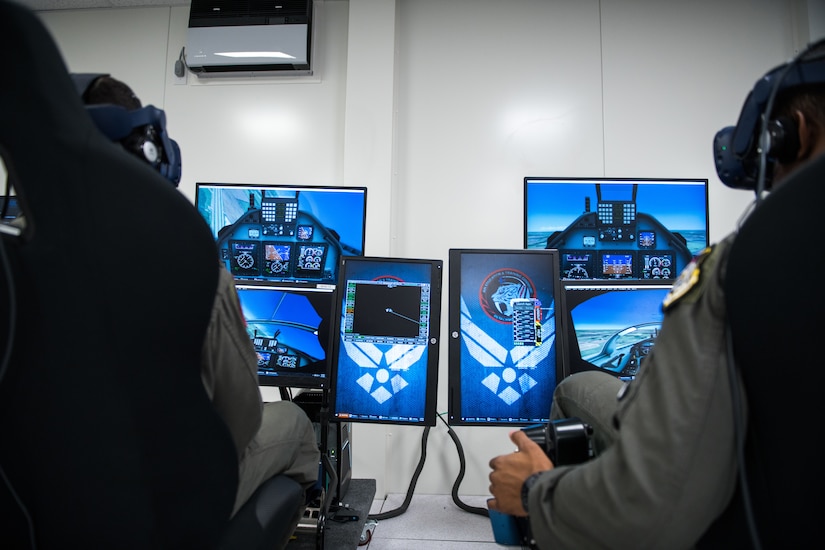
Airmen operate an aircraft simulator.

When most people think about how AI is created, they think it's all about the algorithms, he said. While algorithms are critical, they are just one of the seven building blocks that comprise AI, the others being data, software, computing, ethics, engagement with industry and international cooperation.  

"Algorithms, to me, are actually one of the easier problems to solve," Hyten said. "But algorithms without the other building blocks are useless, especially when it comes to data and computing."

The department has an enormous amount of data in a number of different structures and formats, he said, noting that this is not necessarily a problem.

"I watched a company in California take data in a format that they'd never seen before and they did not try to reformat the data," he said. "They just taught the machine how to look at the data, understand the data, put it in their construct so they could apply their algorithms to that data, and with a couple of weeks and just a couple hundred thousand dollars they delivered a capability."

The amazing thing about AI, Hyten said, is that the computer can have a variety of sensors connected to it that can collect real-time data, learn from the data and discover new information.

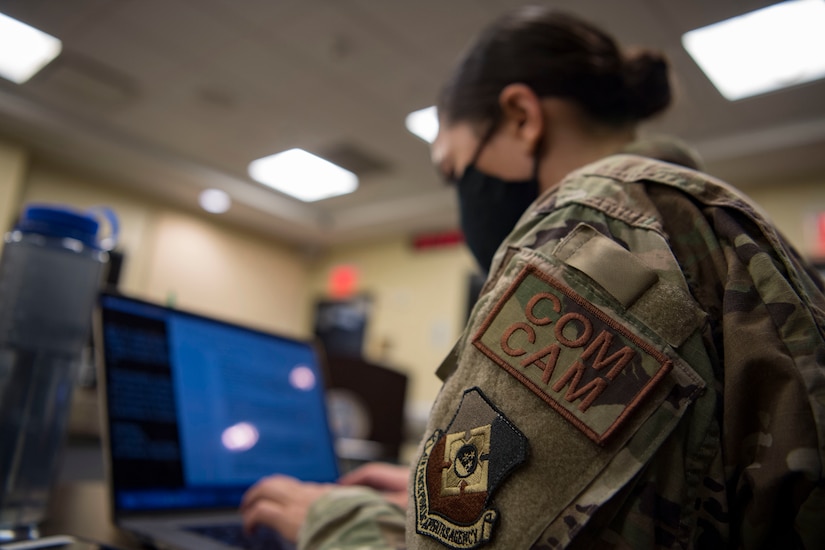
A Woman works on a computer.

When you integrate the sensing capability with the data, now, if you apply computing in the right way, you can accomplish just amazing things," Hyten added. "So you see, computing, algorithms and data are all part of the same puzzle. They can't be looked at separately. They have to be looked at together."

To process and manipulate all of the data that exists and that is to be discovered into something useful for the warfighter requires a fast and powerful computer, he said.

Algorithms are another critical component, he said. 

"The data is kind of an enabling capability. The computer is the machine. The algorithms are the magic. And the software that puts it all together is going to be the key," Hyten said.

The department is not good at software development, he said.

"When it comes to AI, we had better figure out how to do it in a modern, quick way," he said. "In order for us to stay abreast of our adversaries and move ahead of our adversaries, we have to be able to move faster than our adversaries."

One way the department can move faster in software development is to put together small and nimble teams instead of having hundreds of people writing code at the same time on a single project, he suggested.

Ethics also plays an important part in AI development because ''there's a lot of challenges about what we do with artificial intelligence in warfare,'' he said.  

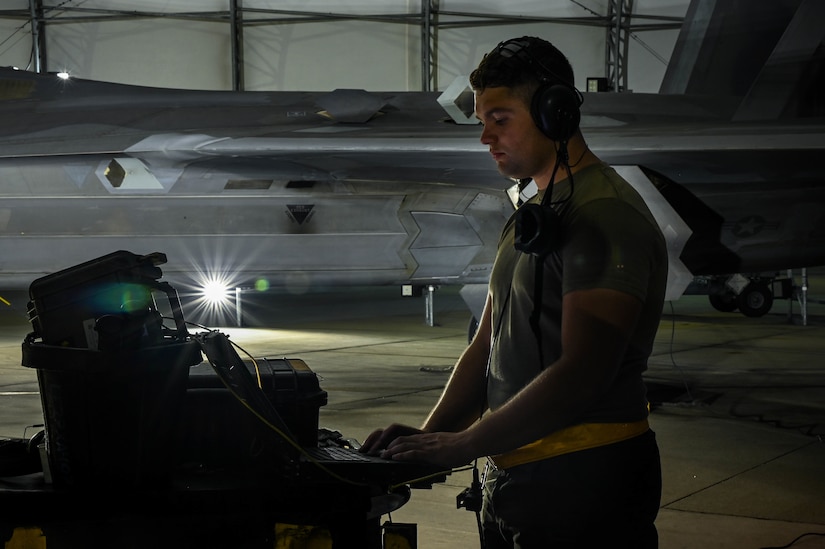
A man stands at a computer with a large aircraft in the background.

Decisions about whether or not to engage in armed conflict should always be made by this nation's leaders, not by AI, he said. If leadership decides to use armed forces to achieve political objectives, then AI should be fully utilized as a tool of warfare under the control of humans.

Since the commercial sector is leading so far out in front with AI development, it is incumbent on the department to engage with industry and cut through the red tape and paperwork, Hyten said.

Allies and partners are also investing heavily in AI, so it's essential, as well, to reach out to friends and bring them aboard as partners, he said.

"We want peace on this planet. We want peace to be the world that our children live in. That's the world we want. That's what we need to use all of our capabilities for, and artificial intelligence is one of those," Hyten concluded. 

Innovative Biocontainment Unit Shows Promise

Sept. 10, 2020 | BY JOYCE CONANT, ARMY

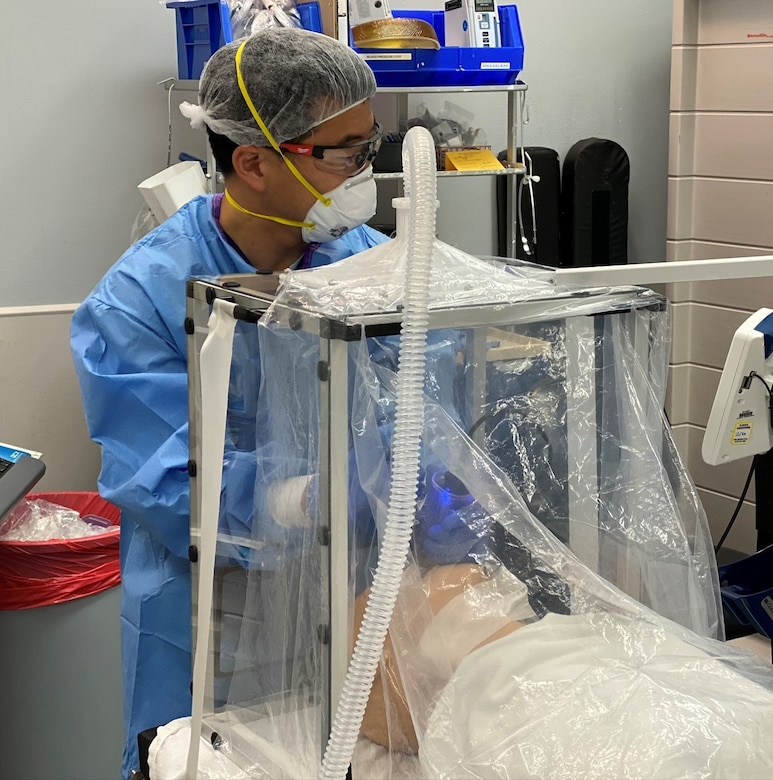
The Army partnered with the University of Pittsburgh Medical Center to create a biocontainment unit that could help healthcare workers caring for COVID-19 patients.

Researchers from the Army Combat Capabilities Development Command's Army Research Laboratory and the university created an individual biocontainment unit that uses negative pressure to suction the air from around a patient to filter out viral particles. This prevents environmental contamination and limits exposure to SARS-CoV-2.

A man in full medical protective gear works with a simulated patient in a biocontainment unit.

''Outside of the current pandemic, the IBU could be rapidly deployed to isolate patients with any respiratory illness.'' said study co-author Dr. David Turer, a plastic surgeon who recently completed his residency at UPMC. ''It's easy to see this technology used to contain influenza, MERS, or tuberculosis, particularly in places lacking advanced hospital infrastructure.''

The device and the results of safety testing are described in a study published today in the Annals of Emergency Medicine. This research was first reported by the Army in April during an effort to identify solutions to help combat the spread of COVID-19.

At that time, initial approaches to minimize viral spread involved the use of plexiglass barriers, such as intubation boxes, to limit health care worker exposure when inserting a breathing tube down a patient's throat. While these barriers may mitigate exposure to larger droplets, the research team hypothesized that they do little to stop the spread of smaller, aerosolized viral particles.

Army researcher and study co-author Dr. Cameron Good and Turer, along with a team of colleagues, developed prototype individual biocontainment units and tested them by performing simulated medical procedures. Using validated techniques adopted from the medical research laboratory community, they tested the IBU and a plexiglass intubation box for their ability to contain virus-sized particles from a simulated COVID-19 patient.

''Greater than 99.99% of the virus-sized aerosols were trapped by the IBU and prevented from escaping into the room,'' Good said.  ''When we tested the passive intubation box, we observed more than three times the aerosol concentration outside the box—where the health care provider is located—than inside the box. It is not safe to use these intubation boxes without actively filtering the air.''

A simulated COVID patient is enclosed in a biocontainment unit.

The Food and Drug Administration recently revoked an emergency use authorization for passive plexiglass intubation barriers and mandated the use of negative pressure systems, such as the IBU, to prevent viral spread.

The team is actively developing a portable vacuum and filter system that can run on a battery pack for use in austere environments where energy resources are limited, which is of particular interest for military and humanitarian applications.

''The ability to isolate COVID-19 patients at the bedside is key to stopping viral spread in medical facilities and onboard military ships and aircraft, particularly to limit transmission through close quarters or shared ventilation systems,'' Good said.

The FDA is considering a recently submitted emergency use authorization. Once granted, hospitals and military units will be able to use IBUs immediately to protect health care workers caring for COVID-19 patients and to prepare for future surges.

''None of this would have been possible without the extremely dedicated clinicians and engineers who rapidly designed, built, tested and validated the equipment,'' Good said. ''I want to thank Dr. Robert Turer [the brother of Dr. David Turer] from Vanderbilt University Medical Center; Nick Karlowsky from Filtech, Inc.; Dr. Lucas Dvoracek, Dr. J. Peter Rubin and Dr. Jason Chang from UPMC; and Ben Schilling and Dr. Heng Ban from the University of Pittsburgh. It truly takes a team.''

(Joyce Conant is assigned to the Army Research Laboratory).

DOD CIO Remarks DOD Artificial Intelligence Symposium and Exposition

 Sept. 10, 2020

As prepared for delivery by Honorable Dana Deasy, DoD Chief Information Officer

Greetings Ladies and Gentlemen, I’m Dana Deasy, the Chief Information Officer for the Department of Defense. It’s my distinct pleasure to be with you this morning to kick off day two of the inaugural Department of Defense AI Symposium. Yesterday you heard from Secretary of Defense Mark Esper and Vice Chairman of the Joint Chiefs of Staff, General John Hyten, about the important role that artificial intelligence will play in transforming the Department of Defense for the digital era. Secretary Esper, General Hyten and thought leaders in the National Security community have emphasized that artificial intelligence will change the character of military operations – meaning how we fight and the technological innovations that our warfighters will use to prevail on tomorrow’s battlefields.

The Department of Defense is undergoing an important transformational period in our history by taking the conceptual applications of artificial intelligence and harnessing this emerging technology to advance our security and prosperity. The Department’s vision for artificial intelligence is guided by the National Defense Strategy, which describes “an increasingly complex security environment with technological challenges from adversaries in every domain.” This evolving security landscape has serious implications for America’s national security. This is why Secretary Esper and DoD leadership have made it a strategic imperative to accelerate artificial intelligence and deliver tangible solutions for the warfighter to preserve our nation’s strategic military advantage.

When I assumed the duties as the Chief Information Officer over two years ago, I knew the Department needed a much broader and bolder digital modernization strategy that could serve as the engine of the National Defense Strategy. The DoD Digital Modernization Strategy provides a framework to harness the full potential of artificial intelligence to transform our military for the challenges it will face in the 21st century and beyond.

The Digital Modernization Strategy ties together the technological capabilities of cloud, data, artificial intelligence, command and control, and cybersecurity into a common ecosystem. These capabilities are closely interconnected and each enables the other in very important ways. In other words, we cannot deliver AI at scale without cloud, cyber, and a strategic approach to how we manage and utilize the Department’s vast data resources. This is why artificial intelligence has to fit into the broader digital modernization ecosystem to effectively deliver at scale and with speed to meet the strategic imperative laid out by Secretary Esper and the National Defense Strategy.

So how do we deliver on this strategic imperative of fielding Artificial Intelligence? A key component of our strategy is the Joint Artificial Intelligence Center, or JAIC.  The JAIC is the cornerstone of the Department’s efforts to adopt and scale artificial intelligence. Yet shaping the JAIC organization that exists today required strategic vision, creativity, and innovation. There was no “how to” manual for standing up an AI fielding organization in the Department of Defense.

The evolution of the JAIC is a journey that is still in the making and we are generating positive momentum from our early days as AI pioneers toward a mature organization of AI practitioners.    

So let’s take a few moments to reflect back on how far we’ve come in the development of the JAIC organization. Like many ideas and concepts in the Department, the establishment of the JAIC began with a memo signed by then Secretary of Defense Patrick Shanahan who directed us to establish an “AI start-up organization” dedicated to fielding artificial intelligence capabilities in the near-term – or as some like to call it – an “AI now” organization. We knew the Department needed a common foundation to share tools and data and we knew we needed to identify national mission initiatives to develop AI applications across a broad and diverse set of organizational and military requirements. Most importantly, we knew that we needed an organization that was dedicated to scaling artificial intelligence across a vast and geographically dispersed DoD enterprise of military services and combatant commands. You see where I’m going with this. This is really about bringing the Department together and providing a framework to deliver enterprise level solutions for Artificial Intelligence. You can have 1001 little blossoms of AI, but if these capabilities are not scaled, they won’t be effective in achieving the DoD’s objectives and strategic imperative for artificial intelligence. The establishment of the JAIC helped us get at this scaling challenge. We had a vision of what we wanted the JAIC to look like and how we wanted it to operate. What we didn’t have back then was staff, a budget, and a place for people to work.

Now fast-forward two years to the present and we have an organization that is starting to deliver real AI solutions for the warfighter while leading the Department in AI ethics and governance. The JAIC is staffed with more than 200 talented military, civil-service, and government contractors who are passionate about fielding artificial intelligence and working with a great sense of urgency to make AI real and tangible for the warfighter. This diverse team is made up of some of the best and brightest technical minds that we recruited from private industry, the federal government, and academia to join forces with our uniformed military personnel who represent every service to include the National Guard and the Coast Guard. The JAIC ‘s budget went from 89 million dollars in Fiscal Year 19 to 268 million dollars in Fiscal Year 20 and we plan to spend more than 1.6 billion dollars over the next few years thanks to strong bipartisan support from Congress and DoD leadership.  

And the JAIC is already generating early returns on investment in its mission initiatives, ranging from predictive maintenance to business process transformation. The JAIC recently delivered an innovative “engine health model” predictive maintenance capability that is being utilized by Black Hawk helicopter maintainers from the U.S. Army’s Special Operations Aviation Regiment. 

Under Business Process Transformation, the JAIC is delivering language-processing AI applications to the Washington Headquarters Service and the DoD’s administrative and financial management teams.  These capabilities are automating the review of thousands of documents and memos for consistency, accuracy, and compliance, thus increasing speed and efficiency while reducing manual, laborious processes.  

And to tackle the Department’s scaling challenge, the JAIC is laying the groundwork for the Joint Common Foundation, an AI development environment that will broaden opportunities for AI developers across the Department to build and deliver AI capabilities in a secure DevSecOps infrastructure.

These early projects are providing valuable lessons learned as the JAIC places more focus on the tactical edge to develop AI solutions in support of Joint Warfighting Operations. Our initial focus is creating decision support tools for front-line commanders that will be critical in an evolving operational environment where speed, precision, and agility are paramount for success. To these ends, the JAIC is developing an “operations cognitive assistant” capability that enhances human-machine teaming to drive faster and more efficient decision-making, through AI-enabled predictive analytics. Our goal is to nest these capabilities under the Joint All-Domain Command and Control concept, or JADC2, to provide a more cohesive and synchronized operational framework for the Joint Force.

While we develop and deliver these important near-term projects, we have to be ready for the contingencies of a changing and unpredictable operating environment.  This is why I believe the true long-term success of the JAIC will depend on how the organization adapts and delivers real-world solutions when the strategic landscape and priorities change. 

A perfect example of this is the “Project Sal-us” initiative, an AI project named appropriately after the Roman goddess of health and well-being, that delivered rapid and impactful results during the recent Federal COVID-19 response. Working alongside a team of private industry partners, the JAIC developed a predictive-logistics AI-dashboard platform for the U.S. Northern Command that enabled National Guard teams to assist states and municipalities with mitigating panic buying and managing supply chains. That project went from concept to code in a matter of weeks.  More importantly, it demonstrated the JAIC’s ability to support the emergent needs of a combatant commander and deliver real AI solutions during a national emergency. 

And while delivering AI is the essence of the JAIC organization, it’s not all the organization is doing for the DoD.  There were a lot of things we could have focused on when we stood up the JAIC – yet we purposely placed an early emphasis on AI ethics because we knew it would be a foundational element for all that we do with AI delivery. Our objective is to field AI and help our nation prevail on tomorrow’s battlefield…yet the way we win matters!  This is precisely why the JAIC policy team is leading a far-reaching initiative that brings together thought leaders from across the Department through the Responsible AI Subcommittee to develop and standardize procedures for implementing the AI ethical principles that were adopted by Secretary Esper earlier this year.   

Our efforts with implementing AI ethical principles have gained the attention of our international partners. Accordingly, the JAIC’s international engagement team is leading a robust and ongoing dialogue with allies from NATO, the European Union, and the Indo-Pacific about how we can shape our security cooperation and defense partnerships for the digital era to include discussions on AI ethics. To this end, next week the JAIC will facilitate the first ever “Partnership for Defense” international dialogue that will bring together more than 10 nations to discuss the responsible use of AI for their respective militaries.

 The JAIC is also capitalizing on partnerships at home.  Just last month, the JAIC began a partnership with the Department of Energy to support the “First Five Consortium” that is leveraging the innovation of private industry, academia, and the interagency to develop AI solutions for humanitarian disaster response.

These are all very exciting advances for the JAIC organization and demonstrate how far we’ve come in the last two years in making AI real. Yet we realize from this vast audience and AI ecosystem listening today that the success of fielding AI capabilities extends far beyond the JAIC. There is important work going at organizations such as DARPA, the Defense Innovation Unit, the Defense Digital Services, and our partners in R&E. These organizations on the front end of the AI development cycle provide an important symbiotic relationship for the JAIC and AI developers on the tactical edge. If we are to deliver on our important mandate of adopting and scaling artificial intelligence across the U.S. military, we will need to come together as a cohesive and complimentary AI ecosystem.

We simply cannot achieve success without working together. And it will be extremely important that we broaden our coalition to include the private sector and academia.

The Department wants to create leverage by harnessing the innovation and expertise of the American tech industry. The government is fairly good at creating policy and frameworks to achieve mission outcomes. However, we cannot scale artificial intelligence without the technical expertise and resources that the private sector provides. Over the past year, we’ve been conducting industry outreach with the nation’s leading tech companies - large, small, traditional, and non-traditional companies - who have expressed interest in working with the JAIC and the DoD to field AI capabilities. This shows not only the interest, but also the momentum we are creating with the support of our private sector partners. As a result of our ongoing outreach with the American tech industry, the JAIC is now working with more than 120 companies serving as prime and sub-prime vendors for its AI projects.

With the many tech firms represented here today and those contracted to develop AI projects for the DoD, I truly believe we have turned the corner for a new era of cooperation between the DoD and American tech. To those in the audience representing the private sector, we appreciate the contributions that you are making to national security. Make no mistake; you are the lynchpin for success in transforming the DoD through AI.

 Our esteemed colleagues in academia also have an important role. You are the thought leaders who will help keep the Department navigating our technological journey in the right direction. There are some critics who suggest that China is the intellectual and technical leader in the AI space. Those critics underestimate the talent and innovative spirit of our nation’s private sector and academic institutions. No one can match the intellectual power of American academia and tech in the field of artificial intelligence. This is one of the reasons I’m confident the United States will continue to lead in artificial intelligence for many years to come.     

And with American leadership, I also feel confident about the future of our alliances and partnerships that I spoke about earlier. For our international partners in the audience today, we look forward to working with you to shape the future of Defense cooperation. Interoperability is paramount for allies and partners - and we want to ensure our militaries can operate efficiently together as we embrace the technological transformations that will shape our future force.  

 So all of these exciting developments beg the question – where do we go from here to capitalize on this initial success? As General Hyten mentioned yesterday, we have to be “nimble and quick” as we adopt and scale AI.  To hasten AI adoption, there’s simply no substitute for rolling up our sleeves and getting to work on these hard problems. For those of you attending today’s breakout sessions, this is your opportunity to take AI to the next level for the Department of Defense. 

The great Alan Turing once said; “we can only see a short distance ahead, but we can see plenty that needs to be done.” We know there’s much work to be done. But you all are making history with your hard work, drive, and dedication to get us there. Together, we will solve one of the most impactful national security challenges of our time in bringing AI to the Department of Defense at speed and at scale. Thank you for your time today - and let’s go make AI real!