Showing posts with label archeology. Show all posts

Monday, September 3, 2012

Ancient Maya Practiced Forest Conservation


Image 1: This temple in Tikal, labeled "Temple 1" by researchers, was built by the ancient Maya somewhere between 682 and 734 A.D., and was possibly completed after Jasaw Chan K'awiil's death. It was the second temple built in the area.

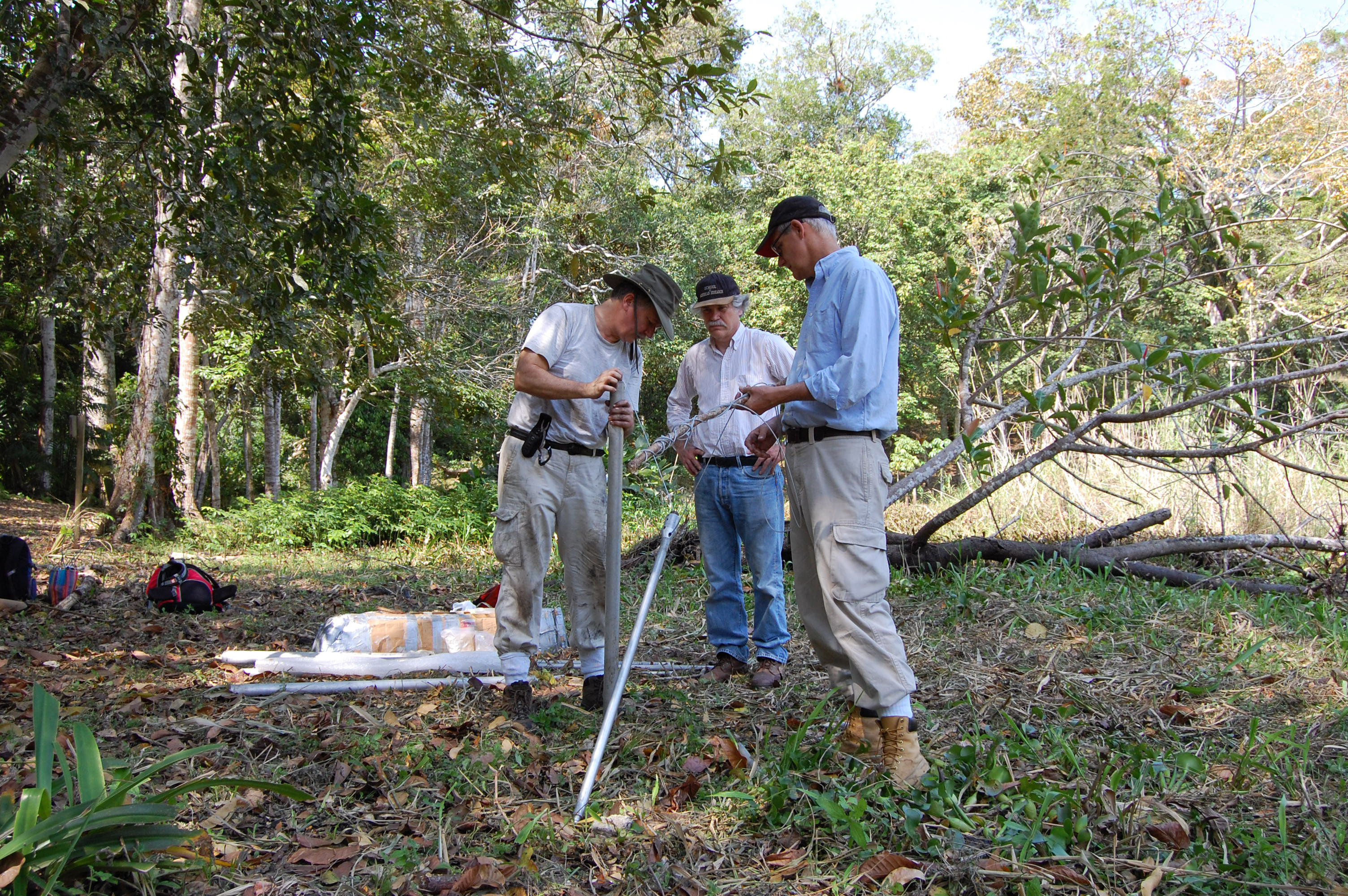
Image 2: Nick Dunning, Vern Scarborough and David Lentz (l-r) take a soil core to measure the depth of one of several large reservoirs that surround the site of Tikal, the ancient Maya city. Lentz was principal investigator for a National Science Foundation-supported study at the site.

Image 3: This temple in Tikal, labeled "Temple 5" by researchers, was built by the ancient Maya somewhere between 768 and 780 A.D.

More About These Images
David Lentz, a biology professor at the University of Cincinnati (UC), received a grant from the National Science Foundation (NSF) to study the interaction between the ancient Maya of Tikal and their local environment.
Lentz's research found that the Maya practiced forest conservation early on. They were not allowed to cut down certain forests of virgin timber--some of which were over 200 years old--which the researchers dubbed the "sacred groves." "From our research we have learned that the Maya were deliberately conserving forest resources," says Lentz. "Their deliberate conservation practices can be observed in the wood they used for construction and this observation is reinforced by the pollen record." But later, the Maya abandoned this practice.

When Jasaw Chan K'awiil took over as ruler during the Late Classic period, the Maya rebuilt the city of Tikal. This rebuilding included construction of enormous temples that required large, straight trees whose wood could withstand the weight of tons of heavy stone. Lentz found that the Maya used the sacred groves for this purpose but soon ran out of timber, which came from the Manilkara zapota (or sapodilla) tree. Sapodilla wood is soft when first cut but once it dries it's as hard as iron, making it an ideal building material for the temples. Once the sapodilla were gone, the Maya began using inferior wood from the Haematoxylon campechianum (logwood or ink wood) trees. Logwood trees, which grow in swamps, are hard like iron from start to finish. The archways to the temples built using logwood were less ornate because the tree grows crooked and is not as lofty as the sapodilla.
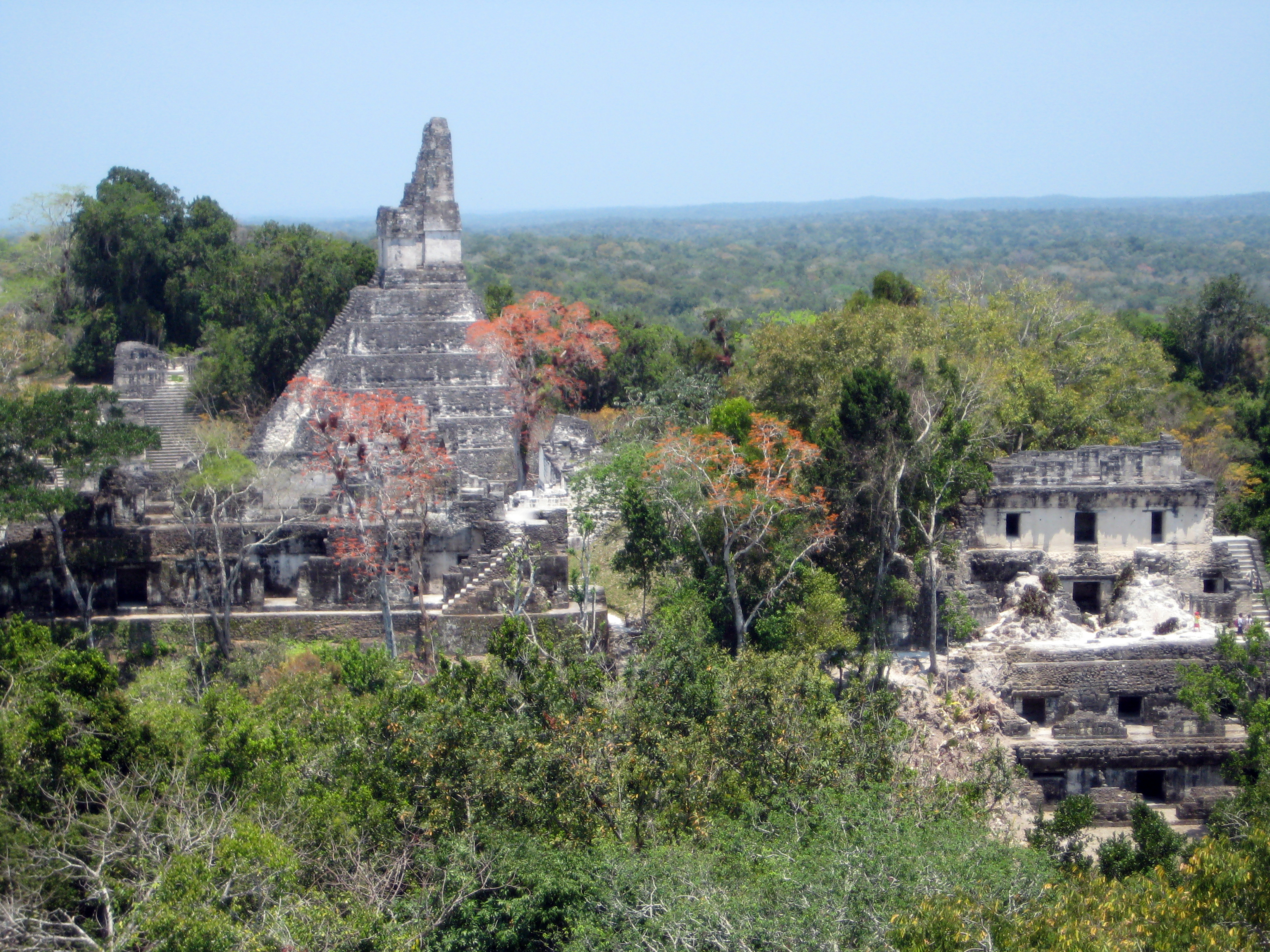
The earlier temples (labeled 1 through 4 by the researchers) are quite large. The beams over the doorways (called Lintels) of Temple 4 are the largest of them all, whereas Temples 5 and 6 are much smaller. But Lentz found that for Temple 3, the last temple built, the Maya went back to using sapodilla. Lentz believes they may have replanted the sacred groves after cutting them down (after 40 years, you would have a tree large enough to use for building). Also, Lentz says, things began going downhill for the Maya at this point. "Perhaps they reasoned that the gods didn't like the new style of temple and they needed to return to the construction style of earlier, and more prosperous, times."

To learn more about this research, see the UC news story UC Scientists Determine That Ancient Maya Practiced Forest Conservation 3,000 Years Ago. [Research supported by NSF grant BCS 08-10118.]

(Date of Image: February/March 2009)

Credit: Department of Biological Sciences, University of Cincinnati

Monday, March 26, 2012

Archaeologists Unearth Artifacts at Luke AFB


By Senior Airman C.J. Hatch
 56th Fighter Wing Public Affairs

Archaeologists here recently unearthed an ancient dwelling — just one of thousands of artifacts found here that date back as far as 3,000 B.C.

The excavation was part of the site preparation, including mitigation of surface archaeology and testing for subsurface archaeology, for a large solar array on the south side of the base,

“This site could be of importance to Arizona and the Phoenix valley,” said John Hall, the senior project director with Statistical Research, which is doing the excavation. “We had some of the artifacts dated and this site is almost 1,000 years older than any other site in the Phoenix valley.”

Since October 2010, the excavation team has found thousands of artifacts around the area to help them get an idea of how the people here lived.

“We believe the people to be nomadic,” Hall said. “We found storage holes filled with stone tools and other things. The stone used clearly comes from a river, very different from the stone around Luke.”

One of the things about the site archeologists found interesting was that it dated to the poorly understood Middle and Late Archaic periods of the Phoenix Basin and south-central Arizona between 3,000 and 1,000 B.C.

“The things we have found here will allow a very detailed examination of these ancient life ways,” Hall said. “This is an unprecedented opportunity not included in the more than 100 years of documented archaeological work in and around the Phoenix Basin.”

Archeologists have long studied the Hohokam of the Phoenix valley — one of three major prehistoric archaeological traditions of the American Southwest — including they way they lived, the farming they did and the plants they grew. The Hohokam occupied the valley and much of southern Arizona from 1 to 1450 A.D. The Hohokam grew corn, beans, squash and agave. They also built hundreds of miles of canals throughout the valley to irrigate their agricultural fields. This site has offered a new perspective into the lives of people thousands of years before that.

“This site is 2,000 years older than the Hohokam; these people could be their ancestors,” Hall said. “They were from a time before agriculture, before maze was brought up from Mexico. This will help us understand lots of things. We can get a better idea of how people got food before farming. We can narrow down the time frame when maize was brought from the south. We have 5,000 years of history right here to help us understand things. This could change our understanding of the prehistoric people of the valley.”

The location of Luke AFB attracted the Native Americans who lived here 5,000 years ago as well as the Air Force in the 1940s.

“The land here is in a great location,” Hall said. “You have the White Tank Mountains and the Aqua Fria River both right here close by. There was food and water at hand, and we think they may have moved between the foothills and the river over their course through the valley.”

The land being excavated is located by the south end of the runway and was not being used for anything before the solar array was planned. Luke AFB officials plan to build the solar array to help offset energy costs.

“We have land here that was not being utilized because of the noise from the end of the runway,” said 1st Lt Chris Warshaw, of the 56th Civil Engineer Squadron. “We have a perfect spot for a solar array that could generate almost 50 percent of the electricity the base consumes.”

The solar array is still planned to be built, but it will take longer than initially planned due to the mitigation phase.

“We need to thank Luke,” Hall said, “because if the base had not been here, the land probably would have been dug up years ago to make room for houses or farms.”

Thursday, January 19, 2012

Studying Human Origins in South Africa (Image 2)

Curtis Marean of Arizona State University collects geologic samples along the coast of Pinnacle Point, a sea cliff on the south coast of South Africa. On-going archaeological research in the area has yielded evidence of early human use of shellfish and other marine resources and the use of fire. The cave has been the focus of intense excavation work since 2000.

The fieldwork and laboratory work for this project have been funded by grants from the National Science Foundation (NSF) since 1999 (grants BCS 99-12465, BCS 01-30713 and BCS 05-24087).

To learn more about this research, see the NSF Discovery story from October 2007, Seafood Makes Waves: Humans Leave Homez. (Date of Image: May 2007)

Credit: South African Coast Paleoclimate, Paleoenvironment, Paleoecology, Paleoanthropology Project (SACP4), Arizona State University; Curtis W. Marean, Director

Studying Human Origins in South Africa (Image 1)

Cave 13B is one of several caves overlooking the Indian Ocean along the coastline of Pinnacle Point, a sea cliff on the south coast of South Africa. Inside the cave, Curtis Marean of Arizona State University and a team of archeologists uncovered evidence of early human use of shellfish and other marine resources dating to the Middle Pleistocene. The cave is the focus of intense excavation work and has been since 2000.

A later study of the cave in 2009 found evidence that early modern humans used fire in a controlled way to increase the quality and efficiency of stone tools, possibly a sign of the evolution of human brain power.

The fieldwork and laboratory work for this project have been funded by grants from the National Science Foundation (NSF) since 1999 (grants BCS 99-12465, BCS 01-30713 and BCS 05-24087).

To learn more about this research, see the NSF Discovery story from October 2007, Seafood Makes Waves: Humans Leave Home. (Date of Image: May 2007)

Credit: South African Coast Paleoclimate, Paleoenvironment, Paleoecology, Paleoanthropology Project (SACP4), Arizona State University; Curtis W. Marean, Director

Thursday, December 8, 2011

Earliest Known Bug-Repellant Plant Bedding Found at South African Rock Shelter

What were the daily lives of modern humans like more than 50,000 years ago?

Rare finds such as early ornaments, cave drawings and Middle Stone Age engravings are the subjects of a good deal of anthropological study and they provide clues. But in today's journal Science, an international team of researchers report another find that could give additional insight. What's more, it could place the use of herbal medicines much earlier than previously known.

Lyn Wadley of the University of the Witwatersrand, in Johannesburg, South Africa, along with a team of archeologists, botanists and paleobotonists, recently dug up and analyzed the earliest known plant bedding at Sibudu, a South African rock shelter in Northern KwaZulu-Natal.

The plant bedding is 77,000 years old and 50,000 years older than the earliest reports of preserved bedding. It provides an intriguing look at the behavioral practices of early modern humans in Southern Africa.

"Domestic activities, like preparing and destroying plant bedding, can provide important information," said Wadley, an honorary professor at the Institute for Human Evolution at Witwatersrand.

Plant bedding is not as well known as other anthropological artifacts, but Wadley says it has the ability to provide information about changing settlement patterns and even demography.

Archeologists refer to plant bedding as a type of floor preparation constructed from plant layers. The discoveries in Sibudu suggest plant bedding there probably was used as a surface for working and sleeping, similar to how it is used in the region today.

At Sibudu, which has been undergoing digging since 1998, researchers found at least 15 layers of sediment containing plant bedding, dated between 77,000 and 38,000 years ago.

The bedding consists of centimeter-thick layers of compacted stems and leaves of sedges and rushes, extending over at least one square meter and up to three square meters of the excavated area. Some of the fossilized leaves bear perfectly preserved anatomical details like vein patterns in leaf blades and pores found in leaf and stem epidermises, called venation and stomata.

"Since leaves can simply be used to add comfort to sedge bedding we were even more surprised when we discovered that the leaves used have insecticidal properties," said Wadley. She surmised they probably were used to repel mosquitoes from the site, which is near the UThongathi River.

Marion Bamford, a botanist with the Bernard Price Institute for Palaeontological Research at Witwatersrand, identified the sedges as belonging to a plant called Cryptocarya woodii, or River Wild-quince. C. woodii contains chemicals that have insecticidal and larvicidal properties.

The chemicals have different effects on different insects. "For some insects there is a ‘knock-down' effect," said Wadley. "Others are repelled and the breeding rate is interfered with amongst some insects."

C. woodii is in the same family as the Bay leaf, which has culinary use, but is also suitable for storing in grains to repel insects that would eat them.

The research included examining blocks of sediment from the site that had been undisturbed for thousands of years to determine their contents. Paul Goldberg and Francesco Berna, National Science Foundation-supported archaeological scientists at Boston University, analyzed thin sections of sediment that preserved the original contextual integrity of the deposits at the millimeter to centimeter scale.

Their micromorphological analysis found evidence of individual human activities, including the construction of hearths and bedding and the maintenance of occupational surfaces through the sweep out of hearths.

"I don't think we would have had this confirmation, or at least impetus, if we hadn't had done the original thin section work," said Goldberg. "We were able to recognize several different types of deposits that are only centimeters thick. Among them were layers composed mainly of phytoliths, some of which were clearly sedges," he said.

Phytoliths are minute particles formed of mineral matter by a living plant and fossilized in rock. In this case, researchers found fossilized sedge particles.

"We could also observe in thin section some pieces of clay that was likely attached to the roots of the sedges from where they were taken down at the stream below the site," said Goldberg.

In addition, the team's analysis confirmed the repeated burning of plant bedding. Most likely, "the bedding was burnt to rid it of pests--insects and perhaps rodents--and to clean up decaying organic material," said Wadley.

"Since sites are usually simply abandoned when they become fusty, the implication is that people wanted to reuse Sibudu regularly, and more regularly than would be allowed by natural processes of decay to clean the site.   Burning was probably a more effective way to get rid of insects than the use of herbs."

According to Wadley, the discovery is particularly well timed, since future work at the site may be in jeopardy.  Local officials plan to construct a large housing tract near the Sibudu rock shelter that Wadley says would irreparably damage the site and prevent future excavation. She and her colleagues hope this discovery will emphasize the importance of Sibudu as an irreplaceable cultural resource for South Africa and the rest of the world.

Christine Sievers with the School of Geography, Archaeology and Environmental Studies at Witwatersrand and Christopher Miller with the Institute for Archaeological Sciences at the University of Tübingen in Germany also contributed to this research.
 
-NSF-