Showing posts with label california institute of technology. Show all posts

Monday, September 3, 2012

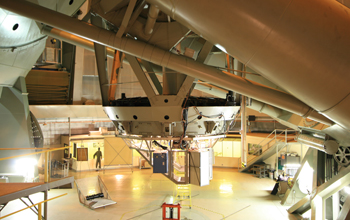
Side View of 200-inch Hale Telescope, Palomar Observatory


A side view of the 200-inch Hale Telescope at the California Institute of Technology's Palomar Observatory. For calibration and size comparison, this image was taken standing at the bottom of the telescope and viewing from the side.

For a number of years, astronomers at the California Institute of Technology's Palomar Observatory have been using the High Performance Wireless Research and Education Network (HPWREN) as the data transfer cyberinfrastructure to further scientists' understanding of the universe. Recent applications include the study of some of the most cataclysmic explosions in the universe, the hunt for extrasolar planets and the discovery of our solar system's tenth planet.

HPWREN is supported under National Science Foundation grants OCI 00-87344 and OCI 04-26879. For more information, visit the HPWREN website.

(Date of Image: 2003)

Credit: High Performance Wireless Research and Education Network (HPWREN)/http://hpwren.ucsd.edu

Thursday, July 19, 2012

Exploring the Quantum World


Researchers at JPL and Caltech have developed an instrument for exploring the cosmos and the quantum world.

This new type of amplifier boosts electrical signals and can be used for everything from studying stars, galaxies and black holes to exploring the quantum world and developing quantum computers. An amplifier is a device that increases the strength of a weak signal.

One of the key features of the new amplifier is that it incorporates superconductors--materials that allow an electric current to flow with zero resistance when lowered to certain temperatures. For their amplifier, the researchers are using titanium nitride and niobium titanium nitride, which have just the right properties to allow the pump signal to amplify the weak signal.

Although the amplifier has a host of potential applications, the reason the researchers built the device was to help them study the universe. The team built the instrument to boost microwave signals, but the new design can be used to build amplifiers that help astronomers observe in a wide range of wavelengths, from radio waves to X-rays.

Image Credit: NASA/JPL-Caltech

NASA'S Spitzer Finds Evidence for an Exoplanet Smaller than Earth


J.D. Harrington
Headquarters, Washington
202-358-5241
j.d.harrington@nasa.gov
 
Whitney Clavin
Jet Propulsion Laboratory, Pasadena, Calif.
818-354-4673
whitney.clavin@jpl.nasa.gov

WASHINGTON -- Astronomers using NASA's Spitzer Space Telescope have detected what they believe is a planet two-thirds the size of Earth. The exoplanet candidate, called UCF-1.01, is located a mere 33 light-years away, making it possibly the nearest world to our solar system that is smaller than our home planet.

Exoplanets circle stars beyond our sun. Only a handful smaller than Earth have been found so far. Spitzer has performed transit studies on known exoplanets, but UCF-1.01 is the first ever identified with the telescope, pointing to a possible role for Spitzer in helping discover potentially habitable, terrestrial-sized worlds.

"We have found strong evidence for a very small, very hot and very near planet with the help of the Spitzer Space Telescope," said Kevin Stevenson from the University of Central Florida in Orlando. Stevenson is lead author of the paper, which has been accepted for publication in The Astrophysical Journal. "Identifying nearby small planets such as UCF-1.01 may one day lead to their characterization using future instruments."

The hot new planet candidate was found unexpectedly in Spitzer observations. Stevenson and his colleagues were studying the Neptune-sized exoplanet GJ 436b, already known to exist around the red-dwarf star GJ 436. In the Spitzer data, the astronomers noticed slight dips in the amount of infrared light streaming from the star, separate from the dips caused by GJ 436b. A review of Spitzer archival data showed the dips were periodic, suggesting a second planet might be blocking out a small fraction of the star's light.

This technique, used by a number of observatories including NASA's Kepler space telescope, relies on transits to detect exoplanets. The duration of a transit and the small decrease in the amount of light registered reveals basic properties of an exoplanet, such as its size and distance from its star. In UCF-1.01's case, its diameter would be approximately 5,200 miles (8,400 kilometers), or two-thirds that of Earth. UCF-1.01 would revolve quite tightly around GJ 436, at about seven times the distance of the Earth from the moon, with its "year" lasting only 1.4 Earth days. Given this proximity to its star, far closer than the planet Mercury is to our sun, the exoplanet's surface temperature would be more than 1,000 degrees Fahrenheit (almost 600 degrees Celsius).

If the roasted, diminutive planet candidate ever had an atmosphere, it almost surely has evaporated. UCF-1.01 might therefore resemble a cratered, mostly geologically dead world like Mercury. Paper co-author Joseph Harrington, also of the University of Central Florida and principal investigator of the research, suggested another possibility; that the extreme heat of orbiting so close to GJ 436 has melted the exoplanet's surface.

"The planet could even be covered in magma," Harrington said.

In addition to UCF-1.01, Stevenson and his colleagues noticed hints of a third planet, dubbed UCF-1.02, orbiting GJ 436. Spitzer has observed evidence of the two new planets several times each. However, even the most sensitive instruments are unable to measure exoplanet masses as small as UCF-1.01 and UCF-1.02, which are perhaps only one-third the mass of the Earth. Because knowing the mass is required for confirming a discovery, the paper authors are cautiously calling both bodies exoplanet candidates for now.

Of the approximately 1,800 stars identified by Kepler as candidates for having planetary systems, just three are verified to contain sub-Earth-sized exoplanets. Of these, only one exoplanet is thought to be smaller than the Spitzer candidates, with a radius similar to Mars, or 57 percent that of Earth.

"I hope future observations will confirm these exciting results, which show Spitzer may be able to discover exoplanets as small as Mars," said Michael Werner, Spitzer Project Scientist at NASA's Jet Propulsion Laboratory (JPL) in Pasadena, Calif. "Even after almost nine years in space, Spitzer's observations continue to take us in new and important scientific directions."

JPL manages Spitzer for NASA's Science Mission Directorate in Washington. Science operations are conducted at the Spitzer Science Center at Caltech in Pasadena. Caltech manages JPL for NASA.

For more information about Spitzer, visit http://www.nasa.gov/spitzer.

- end -
Monday, June 25, 2012

NASA Hosts First Multi-Center Social Media Event for Mars Landing


John Yembrick / Jason Townsend
Headquarters, Washington
202-358-0359
john.yembrick@nasa.gov / jason.c.townsend@nasa.gov

WASHINGTON -- NASA is inviting its social media followers to the first-ever multi-center NASA Social on Aug. 3 to preview the landing of the Mars Science Laboratory's Curiosity rover on Aug. 6 EDT (Aug. 5 PDT). NASA Socials are in-person meetings with people who engage with the agency through Twitter, Facebook, Google+ and other social networks.

Events will be held simultaneously at six NASA field centers, including Ames Research Center in Moffett Field, Calif.; Glenn Research Center in Cleveland; Goddard Space Flight Center in Greenbelt, Md.; Johnson Space Center in Houston; and, Langley Research Center in Hampton, Va. Each center will be connected via a multi-center NASA Television simulcast with NASA's Jet Propulsion Laboratory (JPL) in Pasadena, Calif., during its NASA Social, which was previously announced. JPL, a division of the California Institute of Technology, Pasadena, manages the Mars Science Laboratory (MSL) mission for NASA.

Participants will learn about the Mars Science Laboratory mission and their respective NASA field center. They are encouraged to share their experience with others through their favorite social networks. Along with discussing MSL and Mars, participants will get a unique behind-the-scenes look at the center and the diverse work of the agency through tours and presentations with scientists, engineers and managers. The events also will provide guests the opportunity to interact with fellow social media users, space enthusiasts and members of NASA's social media team.

Registration for the five new NASA Socials opens at noon EDT, Friday, June 29, and closes at noon Tuesday, July 3. NASA randomly will select participants from online registrations. People may register for NASA Socials to be held at multiple locations, but selectees will be chosen for one event only. Each field center's social and number of guests allowed varies. For more information on each center's activities and rules pertaining to NASA Social registration, visit http://www.nasa.gov/social.

It is anticipated that Curiosity will land at Mars' Gale crater at approximately 1:31 a.m. EDT Aug. 6 (10:31 p.m. PDT Aug. 5). During the two-year prime mission, the rover will investigate whether the selected area of Mars offered environmental conditions favorable for microbial life or if evidence of it existed. For more information on the Mars Science Laboratory/Curiosity mission, visit http://www.nasa.gov/msl.

The public can follow the mission on Facebook and Twitter at http://www.facebook.com/marscuriosity and http://www.twitter.com/marscuriosity.

For information about connecting and collaborating with NASA, visit http://www.nasa.gov/connect.

- end -

Tuesday, June 12, 2012

NuSTAR Headed To The Stars


NASA’s Nuclear Spectroscopic Telescope Array, or NuSTAR, is now perched atop its Pegasus XL rocket, strapped to the plane that will carry the mission to an airborne launch. Launch is scheduled for June 13, no earlier than 8:30 a.m. PDT (11:30 a.m. EDT).

The plane — the L-1011 “Stargazer” aircraft — is now at Vandenberg Air Force Base in central California. It is scheduled to fly to Kwajalein Atoll in the central Pacific Ocean from June 5 to 6. About an hour before launch, the plane will lift off from the island, and drop NuSTAR and its rocket over the ocean. The rocket will then ignite, carrying NuSTAR to its final orbit around Earth’s equator.

NuSTAR will be the first space telescope to create sharp images of X-rays with high energies, similar to those used by doctors and dentists. It will conduct a census for black holes, map radioactive material in young supernovae remnants, and study the origins of cosmic rays and extreme physics around collapsed stars.

NuSTAR is a Small Explorer mission led by the California Institute of Technology in Pasadena and managed by NASA’s Jet Propulsion Laboratory, also in Pasadena, for NASA’s Science Mission Directorate in Washington. The spacecraft was built by Orbital Sciences Corporation, Dulles, Va.  Launch management and government oversight for the mission is the responsibility of NASA’s Launch Services Program at the Kennedy Space Center in Florida.

(Story provided by NASA)