Showing posts with label military space. Show all posts

Wednesday, September 9, 2026

Hegseth Attends First Space Academy Commission Meeting

Secretary of War Pete Hegseth traveled to NASA's headquarters in Washington today where he attended the first meeting of the presidential commission on the U.S. Space Academy. 

President Donald J. Trump called for the development of a space academy via an Aug. 28 executive order. The order states that the space domain is critical to national security and that the nation must prepare the next generation of space professionals — including those in the military — in order to defend national interests. 

The commission, which is chaired by NASA Administrator Jared Isaacman, brings together senior leaders from the War Department, the Office of Management and Budget, and the National Security Council. 

During his brief remarks at the meeting's outset, Hegseth praised Isaacman and Air Force Secretary Troy Meink — both of whom attended — as well as President Trump for their leadership in getting the counsel assembled and on the path toward developing a space academy. 

"We are full speed ahead on this partnership on the United States Space Academy and the need for it. The president's been a leader in this domain from the beginning: the Space Force in the first term, [the] Space Academy in the second term," Hegseth said. 

Trump established the Space Force, which falls under the Department of the Air Force, Dec. 20, 2019, when the National Defense Authorization Act for Fiscal Year 2020 was signed into law. 

Hegseth went on to say that space is a domain that the U.S. can't just be "good at." 

"We need to dominate [in space]; and it's not just what we do at the War Department — it's what we do across government, at NASA, in private industry, in collaboration at every echelon," he said. "And so, we see this academy as a key component of ensuring we don't just lead, but we dominate." 

During his opening statement, Isaacson said that the U.S. is currently in another space race, namely with China and Russia, and that "success and failure comes down to months, not years." 

"This is why I think President Trump created the Space Force in his first term … and why now he has charged us to create the United States Space Academy: to make sure we have this training ground for the next generation of technicians, engineers, operators, pilots and astronauts to serve the needs of NASA, as well as the Space Force and other government agencies," he said. 

"Having an academy where we can train the next generation of space professionals — whether it be civilian or military — is just critically important," Meink said during his remarks. "So, we are really looking forward to working with [NASA] to make sure that happens, as well as just the increasing partnership we have [with] NASA across the board. ... I'm really looking forward to [the collaboration]."  

Per the executive order, the committee has until late December of this year to submit a report to the president proposing key details for the establishment of the academy.

Friday, September 4, 2026

One Year In, U.S. Space Command Headquarters Relocation Moving Expeditiously to 'Rocket City, USA'

On Sept. 2, 2025, President Donald J. Trump announced the relocation of U.S. Space Command's headquarters from Colorado Springs, Colorado, to Redstone Arsenal in Huntsville, Alabama. Since then, USSPACECOM's rapid footprint expansion in the region highlights the command's commitment to an expeditious transition while remaining laser-focused on its no-fail mission.

Today, more than 140 uniformed and civilian personnel assigned to the command's headquarters perform their jobs from three facilities across the Arsenal. This element represents approximately 10% of the organization's total manpower.

USSPACECOM's presence in Alabama includes dedicated relocation support functions, but has also expanded to personnel who directly contribute to the combatant command's mission, which was previously carried out exclusively from Colorado Springs.

Earlier this year in April, the Intelligence Directorate established its Joint Intelligence Support Element. The team, which fulfills global intelligence requirements daily, is the first staff directorate to support operations from Northern Alabama.

Speaking to media last month while in Huntsville for a keynote at the Space and Missile Defense Symposium, the commander of USSPACECOM, Gen. Stephen Whiting, said he expected the growth to continue at the same sustained pace.

"Now, about 11 months since the President made his announcement, we have over 113 people," Whiting told reporters on August 12. "We're on our way to 200 people by the end of this year…and half of our staff here in 2028."

To support this growth, the command is offering financial incentives to its current civilian workforce for retention and mission continuity, while also increasing its visibility and hiring efforts across Northern Alabama and ensuring personnel resources and services are available.

The command's transition team on Redstone, alongside the headquarters' Logistics and Engineering (J4) and Digital Superiority (J6) directorates, works closely with Redstone Arsenal's Garrison leadership to establish interim workspaces while developing plans for the future, purpose-built command and control facility (C2F). Many of the facilities made available during this phase were generously provided by current tenant units, including the Missile Defense Agency, the Missile and Space Intelligence Center, the FBI, and the U.S. Army Space and Missile Defense Command.

Securing $147.5 million in fiscal year 2026 funding enabled the command to establish a secure digital infrastructure, immediately supporting the command's growing staff on Redstone. Crucially, this digital foundation guarantees uninterrupted global command and control as operations scale to support ultimately more than 900 headquarters staff by fiscal year 2028.

This funding, secured through coordination with the office of the Assistant Secretary of the Air Force Financial Management & Comptroller and the Office of the Secretary of War-Comptroller, ensures the command will operate seamlessly from interim facilities until the final C2F is operational.

The speed with which the transition is progressing, Whiting said, highlights how effectively various entities across the Department of War are working together.

"Thanks to the incredible support shown to the command, to include the Department of the Air Force, Army Contracting Command, and Team Redstone – alongside communities in both Colorado and Alabama, our team has remained laser focused on sustaining full mission execution while keeping our headquarters relocation moving on-time and on-budget," he said. "It is a testament to the professionalism and dedication of our people that we accomplished this while advancing national interests on-orbit alongside allies and partners and delivering space effects to the Joint Force."

Maj. Gen. Terry L. Grisham, director of USSPACECOM's Redstone Transition Team and long-time Huntsville resident, echoed Whiting's sentiment.

"This isn't just a move; it's a clear demonstration of this command's commitment to executing the President's directive with the speed and decisiveness our mission demands," Grisham said.

The Department of the Air Force's support was critical as USSPACECOM's executive agent, providing financial, civil engineering, administrative, logistical, and service integration support.

"This transition is key to accelerating how we deliver space capabilities to joint warfighters," said Secretary of the Air Force Troy Meink. "By streamlining our footprint, focusing on faster MILCON processes for our interim and future facilities, and working closely with our partners, we're ensuring U.S. Space Command has the speed, integration, and agility needed to maintain superiority. And this lift is all possible because our workforce has shown incredible resilience and dedication in mission continuity."

While the command has driven progress on the ground, Other Transactional Authorities (OTAs) included in the National Defense Authorization Act accelerated the timeline by utilizing an agile, progressive design-build process. This legislative backing secured $57 million this fiscal year specifically dedicated to the planning and design of the permanent C2F, streamlining traditional acquisition timelines to keep the construction schedule on track.

Over the last year, USSPACECOM has validated its capacity to carry out an expeditious relocation, while simultaneously delivering military spacepower to warfighters around the globe without interruption, including during operations INHERENT RESOLVE, ABSOLUTE RESOLVE and EPIC FURY.

"Over the past year, the Department of War has carried out the President's direction to relocate U.S. Space Command with speed and common sense, identifying and leveraging every opportunity to cut through red tape and bureaucracy in order to get the job done," Secretary of War Pete Hegseth said. "As we continue to execute this move, we do so with the same unrelenting focus on sustaining America's dominance in space and expanding our lethality in all warfighting domains."

Within 24 hours of President Trump's announcement last year, USSPACECOM representatives were on the ground engaging with local community leaders to establish relationships and develop a way forward. As the command continues to transition to its permanent home in Alabama, its momentum remains underpinned by the support of Congress, partnerships spanning the entire Department of War, and the Colorado Springs and Huntsville-Madison communities.

Thursday, August 13, 2026

Azimuth Program Immerses Cadets in Space Force Missions

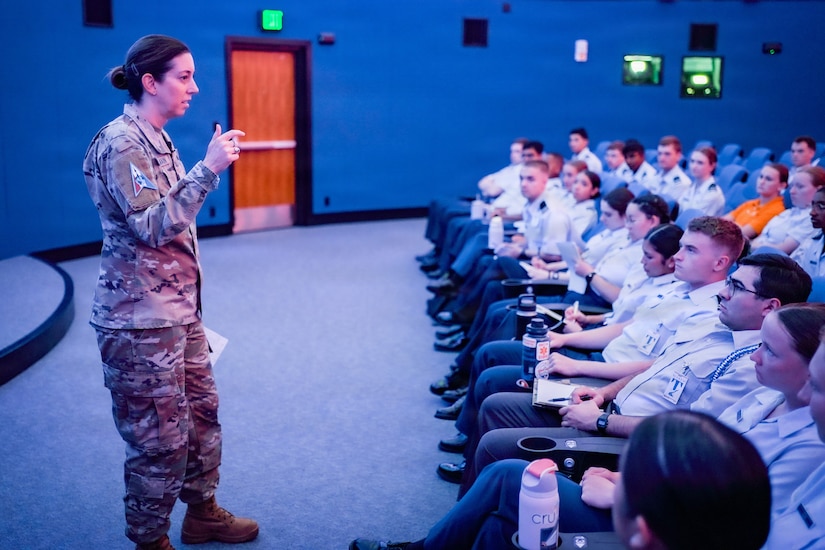
A woman wearing a camouflage military uniform stands at the front of an auditorium and speaks to people dressed in military dress uniforms who are seated.

Approximately 300 cadets participated in the Space Force's Azimuth program throughout the summer at the U.S. Air Force Academy in Colorado Springs, Colorado, where they gained exposure to its missions, organizations and guardian culture.

The program serves cadets already selected to commission into the Space Force and those considering Space Force career opportunities. It also introduces future officers from other services and Canada to the role of space capabilities in joint and coalition operations.

Detachment 1, Space Delta 1, hosted three sessions of the three-week pre-commissioning program, with most of the cadets hailing from either the academy or an Air Force ROTC detachment.

"Through classroom instruction, operational visits, hands-on experiences and capstone exercises, cadets gain the knowledge and perspective to arrive at their first assignment better prepared to contribute," said Space Force Maj. Sarah Dawdy, the detachment's chief of staff. "More importantly, we want them to understand where they fit into the bigger picture and arrive at their first assignment ready to learn, contribute and lead."

The Azimuth program directly supports the Space Training and Readiness Command's mission to prepare combat-ready forces to fight and win in a contested, degraded and operationally limited space environment. By prioritizing the deliberate development and education of these cadets early in their careers, Starcom is actively shaping the next generation of space warfighters.

The curriculum progressed from foundational instruction to operational exposure, culminating in an exercise requiring cadets to apply what they had learned.

During the first week, cadets learned about the Space Force's organization, missions, threat environment, space weather, international partnerships and access to space.

They reinforced those lessons through hands-on electives involving cyber operations, imagery analysis and satellite operations. Other activities included neutral buoyancy training and high-powered rocketry.

The second week moved cadets from the classroom to operational units in Colorado at Schriever, Peterson and Buckley Space Force Bases as well as other mission locations.

"The operational visits are always a highlight because cadets get to see the mission firsthand and interact directly with guardians doing the job every day," Dawdy said. "Apollo Dagger, the space policy game and the hands-on electives also give them the opportunity to apply what they've learned and see how it all comes together."

Cadet Austin Smith, Michigan State University Air Force ROTC, said the program provided additional exposure to the space mission.

"For me, Azimuth has been absolutely wonderful," Smith said. "It's been the ability to actually see Space Force competencies, Space Force career fields and Space Force life in a way that I never would have been able to if I didn't have this opportunity."

During the final week, cadets participated in Apollo Dagger, a capstone exercise conducted alongside a special warfare orientation course.

Participants served as a space planning cell supporting special operations forces during scenarios focused on electromagnetic warfare, orbital warfare and missile warning. They developed mission products and space domain awareness information in support of operational planning.

This year's program placed greater emphasis on operational missions, mission planning and the Space Force's role within the joint force and the international community. It also covered the military, political and economic implications of decisions involving space operations.

While addressing cadets, Space Force Col. Krista St. Romain, Delta 1 commander, challenged them to embrace the responsibility of serving in the space domain.

"There are new opportunities for each one of you, should you choose to become a guardian," St. Romain said.

She went on to explain that space comes with its own unique set of challenges, requiring solution-oriented recruits with an eye for problem-solving.

"Don't just identify a problem," St. Romain said. "Who's going to solve it? We're moving fast and those are the individuals we're looking for in the Space Force."

Industry representatives also discussed how the commercial space sector contributes to national security and future capabilities.

"Azimuth wouldn't be possible without the tremendous support from across the Space Force and our partners," Dawdy said. "Operational units and organizations, academia and industry partners volunteer their time to mentor and educate."

The program concluded with a post-course assessment, end-of-course survey and closing ceremony for each group.

"Whether they commission into the Space Force or another service, we want them to understand how space capabilities support and enable the joint force," Dawdy said. "For those becoming guardians, we want them to have a solid foundation they can build on."