Showing posts with label texas a and m university. Show all posts

Wednesday, August 15, 2012

Studying Life in Underwater Caves (Images 4 and 5)


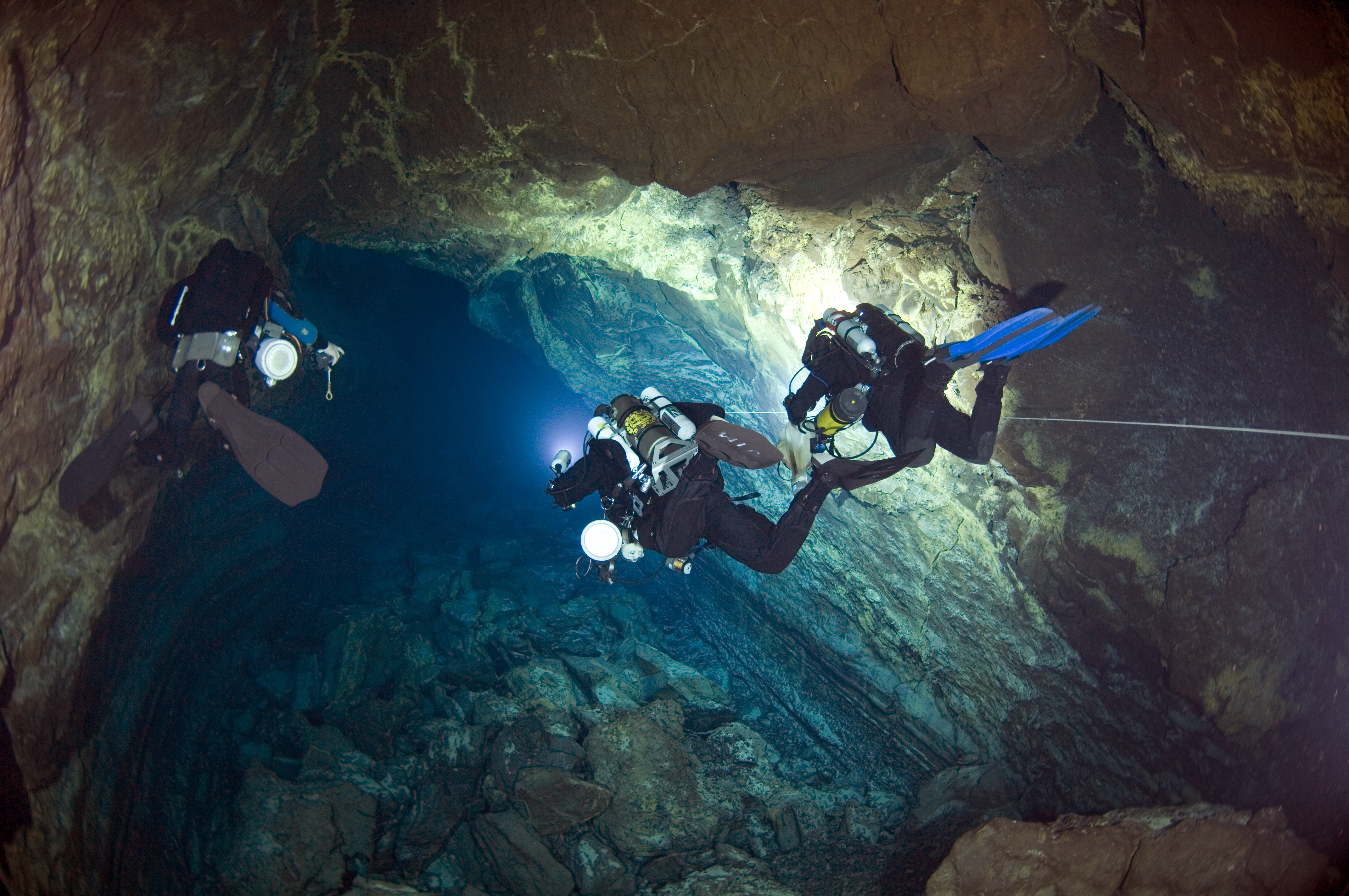
Cave divers Terrence Tysall, Jim Rozzi and Thomas Iliffe (left to right) diving in a submarine lava tube cave in the Canary Islands.

Tom Iliffe , a Texas A&M University at Galveston professor of marnie biology, is seen here diving with a Megalodon closed circuit rebreather in the Atlantida Tunnel, Lanzarote, Canary Islands.

Underwater caves such as this were the focus of a National Science Foundation-supported expedition--"Survey of Anchialine Cave Fauna of the Bahama Islands" (grant DEB 03-15903)--led by Iliffe, a professor of marine biology at Texas A&M University at Galveston.

Anchialine (a Greek word meaning "near the sea") caves are coastal and form in limestone or volcanic rock. They flood with seawater and include the longest submerged caves on Earth. Many previously unknown species of higher taxa live in these caves. Most do not have eyes or pigment since they live in perpetual darkness.

To learn more, see the Texas A&M news story Texas A&M marine experts take discoveries to new underwater heights; or visit Iliffe's website, Here. [Ref. Koenemann, S. M. Ziegler and T.M. Iliffe (2008). Pleomothra fragilis n. sp. (Remipedia) from the Bahamas, with remarks on morphologic reductions and postnaupliar development. Journal of Crustacean Biology, 28(1):128-136.]

(Date of Images: March 2008)

Credit: Jill Heinerth

Tuesday, August 14, 2012

Studying Life in Underwater Caves (Images 1-3)


Image 1
Dean's Blue Hole on Long Island in the Bahamas. At more than 200 meters deep, it's the deepest blue hole cave in the Bahamas.

The underwater cave was the focus of a National Science Foundation-supported expedition--"Survey of Anchialine Cave Fauna of the Bahama Islands" (grant DEB 03-15903)--led by Thomas Iliffe, a professor of marine biology at Texas A&M University at Galveston.

Anchialine (a Greek word meaning "near the sea") caves are coastal and form in limestone or volcanic rock. They flood with seawater and include the longest submerged caves on Earth. Many previously unknown species of higher taxa live in these caves. Most do not have eyes or pigment since they live in perpetual darkness.

Image 2
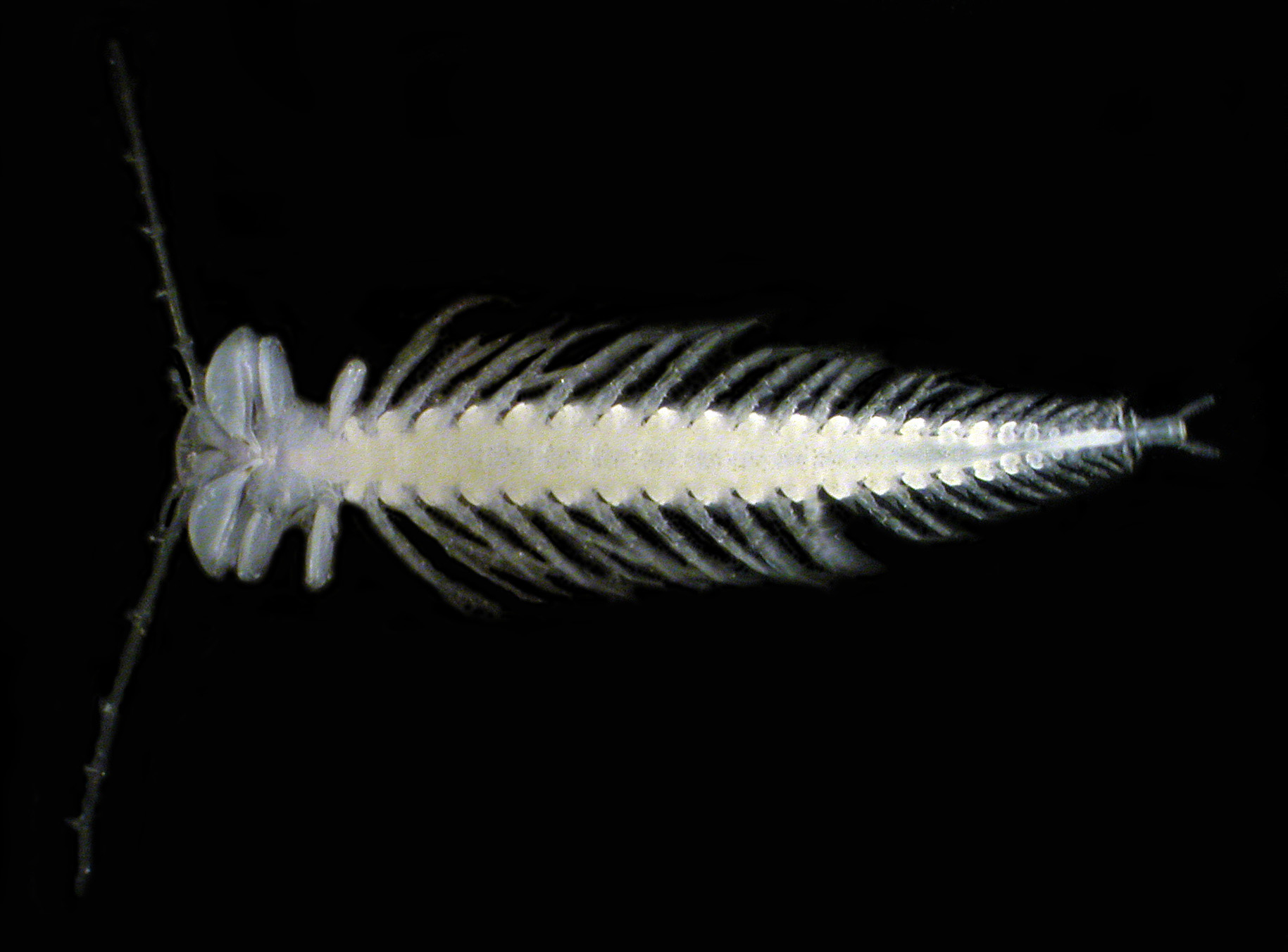
This species of remipede, Pleomothra fragilis, newly described in 1989, was found in Oven Rock Cave in the Exuma Cays, Bahamas.

Remipedes are a primitive class of crustacean believed to be one of the oldest crustacean groups on Earth, possibly dating back 200 million years to the time of the dinosaurs. Remipedes look similar to centipedes and have hollow-tip fangs for injecting venom. They are hermaphrodites.

Image 3
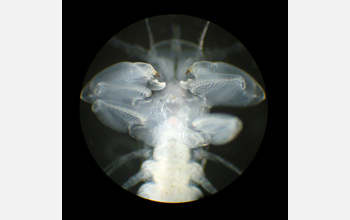
This species of remipede, Pleomothra fragilis, newly described in 1989, was found in Oven Rock Cave in the Exuma Cays, Bahamas.

Remipedes are a primitive class of crustacean believed to be one of the oldest crustacean groups on Earth, possibly dating back 200 million years to the time of the dinosaurs. Remipedes look similar to centipedes and have hollow-tip fangs for injecting venom. They are hermaphrodites.

These pictures were taken by Thomas Iliffe, a professor of marine biology at Texas A&M University at Galveston. Iliffe was awarded a grant by the National Science Foundation in 2003 to study anchialine caves in the Bahamas (grant DEB-0315903). Anchialine (a Greek word meaning "near the sea") caves are coastal and form in limestone or volcanic rock. They flood with seawater and include the longest submerged caves on Earth. Many previously unknown species of higher taxa live in these caves. Most do not have eyes or pigment since they live in perpetual darkness.

To learn more, see the Texas A&M news story Texas A&M marine experts take discoveries to new underwater heights; or visit Iliffe's website, Here. [Ref. Koenemann, S. M. Ziegler and T.M. Iliffe (2008). Pleomothra fragilis n. sp. (Remipedia) from the Bahamas, with remarks on morphologic reductions and postnaupliar development. Journal of Crustacean Biology, 28(1):128-136.]

(Date of Image: 2005)

Credit: Tamara Thomsen

Friday, June 29, 2012

NASA Awards Five Universities Funding For Learning Opportunities


Sonja Alexander/Joshua Buck
Headquarters, Washington     
202-358-1600
sonja.r.alexander@nasa.gov / jbuck@nasa.gov
 
Rachel Kraft/Kelly Humphries
Johnson Space Center, Houston
281-483-5111
rachel.h.kraft@nasa.gov / kelly.o.humphries@nasa.gov
 
WASHINGTON -- NASA has awarded five one-year U.S. National Laboratory education cooperative agreements to provide hands-on science and engineering opportunities for college and university students. Experiments proposed in two of the projects will be flown on the International Space Station in the near future.

Students at the University of Southern Mississippi in Hattiesburg, Miss., will study the feasibility of incubating organisms in a simulated Martian environment. Undergraduate student teams at Purdue University in West Lafayette, Ind., will use the Capillary Fluid Experiment hardware to investigate fluid physics in microgravity and work on the project with students at North Carolina Agriculture and Technical State University in Greensboro, N.C.

Three universities will use funding for ground-based experiments. San Jacinto Community College in Houston will coordinate a challenge for college students to train in underwater robotics and coach middle school science classrooms to build and operate underwater robots. Texas A&M University in College Station, Texas, will train students in project management in conjunction with HUNCH, which is short for high school students united with NASA to create hardware. Graduate students at the University of Houston will provide systems engineering expertise to HUNCH participants.

The agency solicited proposals in February in areas within the International Space Station's National Laboratory Education Project and is awarding about $863,000 collectively to the five institutions. The project strengthens the link between the unique venue of the space station and science, technology, engineering and mathematics (STEM) education. It serves as a resource to enable education activities aboard the space station and in the classroom, through the web and on mobile media.

For more information about NASA's education programs, visit http://www.nasa.gov/education.

For more information about the U.S. National Laboratory on the International Space Station, visit http://go.nasa.gov/issnatlab.

For more information about NASA and agency programs, visit http://www.nasa.gov.

- end -

Friday, February 24, 2012

Students Shaping America's Next Spacecraft

Students from Texas A&M University visited the Orion Medium Fidelity Mockup as part of the SSANS, or Students Shaping America's Next Spacecraft, program. The students, who are Industrial Engineering majors at Texas A&M, partnered with the Orion Program on two senior design projects: Orion Lighting System hardware for the Orion Full-scale Mockup and the Orion Budget and Planning Project. During their visit on Feb. 22, 2012, the students presented their work as part of the Preliminary Design Review at the Johnson Space Center in Houston. While at the center, they had an opportunity to see the Orion mockups and tour center facilities.

Image Credit: NASA

Thursday, January 12, 2012

Sub-scale Drogue Chute Testing

Dr. Anita Sengupta and Donn Liddle of NASA are pictured in the low speed wind tunnel at Texas A&M University, which is being used for testing of a scale model of the Orion spacecraft and its parachute system.

Image credit: NASA/James Blair

Monday, January 9, 2012

Scientists Look to Microbes to Unlock Earth's Deep Secrets

Of all the habitable parts of our planet, one ecosystem still remains largely unexplored and unknown to science: the igneous ocean crust.

This rocky realm of hard volcanic lava exists beneath ocean sediments that lie at the bottom of much of the world's oceans.

While scientists have estimated that microbes living in deep ocean sediments may represent as much as one-third of Earth's total biomass, the habitable portion of the rocky ocean crust may be 10 times as great.

Yet biologists know very little about this ecosystem. The Integrated Ocean Drilling Program (IODP) Mid-Atlantic Ridge Microbiology Expedition set out to change that.

An international team of scientists sailing onboard the research vessel JOIDES Resolution recently returned from installing observatories beneath the seafloor in "North Pond"--a remote area in the middle of the Atlantic Ocean.

Scientists hope that data collected from these subseafloor observatories (known as CORKs, or Circulation Obviation Retrofit Kits), along with studies of rock and sediment samples collected during the expedition, will help to shed light on the role tiny subseafloor microbes play in shaping Earth's oceans and crust.

Led by co-chief scientists Wolfgang Bach of the University of Bremen in Germany and Katrina Edwards of the University of Southern California, the expedition began in Bridgetown, Barbados, on Sep. 16, 2011, and concluded in Ponta Delgada in the Azores on Nov. 17, 2011.

Two CORKs were successfully installed, and sediment and basalt core samples were recovered. CORK observatories are designed to remain in place for up to ten years.

The North Pond subseafloor observatories will allow active experiments to be conducted below the bottom of the ocean for as much as five years after deployment.

Scientists from the expedition plan to return to these observatories with the first of many submersible expeditions in early 2012.

"The innovative and novel experiments and observations from this expedition promise to greatly advance our understanding of the nature and extent of microbial life in the most widespread of environments--the Earth's ocean crust," says Jamie Allan, program director for IODP at the U.S. National Science Foundation (NSF). NSF co-funds IODP.

In the coming months and years, researchers hope to answer three main questions:

1.What is the nature of subseafloor microbial communities, and what is their role in the alteration of relatively young ocean crust?

2.Are these communities unique, particularly in comparison with seafloor and sedimentary communities?

3.Where do microbes in the igneous ocean crust come from (sediment, rock, seawater or another source)?

IODP is an international research program dedicated to advancing scientific understanding of the Earth through drilling, coring, and monitoring the subseafloor.

IODP is supported by two lead agencies: NSF and Japan's Ministry of Education, Culture, Sports, Science and Technology.

Additional program support comes from the European Consortium for Ocean Research Drilling, the Australia-New Zealand IODP Consortium, India's Ministry of Earth Sciences, the People's Republic of China's Ministry of Science and Technology and the Korea Institute of Geoscience and Mineral Resources.

JOIDES Resolution is a scientific research vessel managed by the U.S. Implementing Organization of IODP (USIO). Texas A&M University, Lamont-Doherty Earth Observatory of Columbia University, and the Consortium for Ocean Leadership comprise the USIO.

For more information about IODP Expedition 336--Mid-Atlantic Ridge Microbiology, please see IODP's webpage.

-NSF-
Tuesday, April 26, 2011

ONR Supports Competition, Seeks to Spur Interest in STEM Careers

By Geoff Fein, Office of Naval Research Public Affairs

ARLINGTON, Va. (NNS) -- Co-sponsored by the Office of Naval Research (ONR), the 14th annual National Ocean Sciences Bowl (NOSB) will bring together students from 25 high schools from across the country to compete April 28-May 1 at Texas A&M University.

ONR's sponsorship of the event supports two goals -- backing an effort to advance student interest in oceanographic research and encouraging America's youth to pursue careers in the science, technology, engineering and math (STEM) disciplines.

"The National Ocean Science Bowl provides high school students with the opportunity to learn about the ocean and its importance to climate, weather and the economy," said Dr. Joan Cleveland, acting deputy division director of ONR's Ocean Sensing and Systems Division.

Over the course of the four-day event, NOSB tests students' knowledge of the ocean through a question and answer (Q&A)-style competition. Teams initially are organized into five divisions for a round robin competition. The top three teams from each bracket, along with the top fourth place finisher overall, will advance to a double elimination tournament. After two losses, teams are eliminated until a winner emerges.

"Seventy-nine percent of former competitors that responded to a survey chose to major in a STEM field in college," Cleveland said. "We hope that some of them go on to become ONR investigators."

Since the competition's inception in 1998, ONR and several governmental agencies, nonprofit organizations, colleges and universities have provided support to the Consortium for Ocean Leadership, the organization behind NOSB. ONR contributes $200,000, roughly 10 percent of the annual $2 million in grants raised, to hold the event. Other contributors include the National Oceanic and Atmospheric Administration, the event's largest sponsor, and the Oceanographer of the Navy.

In addition to its financial support, ONR will also send a Navy reservist to Galveston, Texas, to judge the competition and the finals, Cleveland said.

NOSB has four primary goals: to broaden students' and teachers' awareness of the latest scientific research on the oceans; to help teachers use oceanography as a tool for cross-disciplinary science education; to provide oceanographic research programs outreach opportunities to students; and to boost participation by minorities, women and disadvantaged students.

Over two weekends in February and March, 300 schools and more than 2,000 students participated in 25 regional competitions. First place teams from each area earned a trip to the national finals. Teams that place first through fourth at the national event win an award trip.

For a complete list of the 2011 NOSB finals teams go to www.nosb.org/.>
About the Office of Naval Research

The Department of the Navy's Office of Naval Research (ONR) provides the science and technology necessary to maintain the Navy and Marine Corps' technological advantage. Through its affiliates, ONR is a leader in science and technology with engagement in 50 states, 70 countries, 1,035 institutions of higher learning and 914 industry partners. ONR employs approximately 1,400 people, comprising uniformed, civilian and contract personnel, with additional employees at the Naval Research Lab in Washington, D.C.