Showing posts with label Naval Research Laboratory. Show all posts

Wednesday, November 18, 2026

Naval Research Lab Completes First INSPYRE Field Campaign

A man in casual attire and a helmet stands next to a truck observing a forest fire in the distance as a large plume of smoke fills the sky.

The fire was in Siberia. Its smoke had crossed thousands of miles, drifting over the Arctic, across Alaska and then over northern Canada. For scientists working on the first Injected Smoke and Pyrocumulonimbus Experiment field campaign, that distance meant an opportunity. 

For David Peterson, a research meteorologist at the U.S. Naval Research Laboratory in Monterey, California, and principal investigator for INSPYRE, the campaign represented the culmination of years spent studying how wildfire smoke enters and moves through the upper atmosphere. 

"I've been fascinated by weather since I was a kid, and I never really grew out of it. I went on to study meteorology in college, and for the past decade, I've been studying these extraordinary storms that are generated by wildfires," he said. "There's still so much we don't understand about them, and I think that's what makes the work so exciting. The more we discover, the more questions we find." 

Using aircraft furnished with scientific equipment, an NRL-led team intercepted the Siberia-generated plume over three consecutive days, collecting direct measurements of smoke carried high into the atmosphere. The observations will help researchers address a gap in atmospheric forecasting: predicting where the smoke plume travels, at what altitude, and how it changes the air surrounding it. 

An aircraft lands on a runway with mountains in the distance.

The sampling capped the 2026 field deployment of the NASA-funded experiment, which lasted three months. The campaign studied pyrocumulonimbus clouds, or fire-generated thunderstorms. These can produce lightning that ignites additional fires, winds that spread flames, and hail and violent downdrafts that threaten low-flying aircraft. 

The mission relied on a NASA ER-2 aircraft, which flew above active weather systems with instruments that observed storms from high altitude, and a U.S. National Science Foundation Gulfstream V aircraft, which took samples directly from inside the smoke plumes. The aircraft logged more than 100 flight hours each, completing 16 and 17 flights, respectively.  

They observed fires from Arizona to Canada and followed transported smoke as far as Alaska. A ground team also deployed mobile radar and lidar systems near active fires. 

The mission operations center was based at Rocky Mountain Metropolitan Airport in Broomfield, Colorado. The ER-2 aircraft operated from the Montana Air National Guard base at Great Falls International Airport. 

On the ER-2, equipment measured terrestrial gamma-ray flashes associated with lightning activity inside fire-generated storms. Other instruments measured the size and intensity of the fire fronts, smoke plume dynamics and the surrounding atmospheric conditions. 

The view from a plane as a large plume of smoke fills the sky.

"We know that large and intense wildfires tend to generate their own weather, and now we finally have direct measurements of it," Peterson said. 

The measurements address a central challenge for INSPYRE. Researchers have long observed smoke from satellites, but satellite imagery cannot reveal everything inside a plume. Scientists must make assumptions about particle size and how particles absorb or reflect sunlight. Those properties help determine the plume's effects on the atmosphere and on light passing through it. 

For Peterson, replacing some of those assumptions with comprehensive measurements was one of the campaign's most important achievements. 

During the Siberian plume sampling, both aircraft observed the smoke, with some flights coinciding with satellite overpasses. The ER-2 also descended to about 38,000 feet to sample the plume directly. Researchers can now compare measurements taken inside the smoke with observations from above and use them to improve atmospheric models. 

Together, the observations gave Peterson and his team a rare view of the same smoke event from multiple perspectives. 

"We were able to follow the smoke as it moved across the [region]," Peterson said. "That gives us a chance to connect what happened at the fire with what we eventually measured thousands of miles away." 

For the Navy, locating a large smoke plume is only part of the challenge. Predictions of its altitude and particle properties matter for visibility, aviation and optical systems. The NRL supplied additional ER-2 flight-hour funding to support measurements relevant to those needs. 

"From a Navy perspective, lasers, satellite communication and targeting cameras will be affected by these smoke plumes," Peterson said. "If you're shooting a laser through a smoke plume or a dust plume, it degrades how the systems work." 

An aerial view of flames shooting up and smoke filling the sky from a forest fire.
Smoke fills the sky from a forest fire in the background as a truck in the foreground with equipment on top monitors the fire.
Closer to the fires, the campaign revealed how quickly conditions can change. 

Peterson often compares fire-generated clouds to giant chimneys that can propel smoke into the stratosphere, much like a volcanic eruption. 

At a fire in Utah, researchers observed a cloud pushing smoke to about 36,000 feet without meeting the team's working definition of a pyrocumulonimbus. The case raised a practical question about whether other types of fire-driven clouds can produce large smoke plumes high in the atmosphere that matter for forecasting. 

"You can see it literally growing in front of you as you're moving toward it," Peterson said, describing the fire-driven convection he saw firsthand aboard a smoke-plume flight. 

That moment captures the challenges fire behavior can bring. A cloud that appears ordinary from a distance can rapidly become an efficient pathway for smoke to reach the upper atmosphere. 

A graphic shows smoke coming from a forest fire turning into large clouds; arrows and descriptions of how the smoke travels are overlaid on the photo.

Instrument teams are now checking and processing the data. Research groups will examine fire behavior, cloud development and transported smoke, while preparing for a second deployment in 2027. 

For Peterson, the next phase is as important as the flights themselves. The team must determine which observations can improve models, identify where current forecasts diverge from reality and translate the campaign's measurements into tools that can support operational decisions.

Friday, January 30, 2026

Breakthroughs in Testing Solid-Fuel Ramjets Advance Research

Scientists at the U.S. Naval Research Laboratory are developing the next generation of solid-fuel ramjet propulsion, addressing one of the field's most persistent challenges: understanding and predicting what happens inside an operating combustor. 

NRL scientists have figured out how to "see inside" one of the most extreme engines ever built, turning guesswork into knowledge and making future long-range, high-speed flight more achievable than ever before.

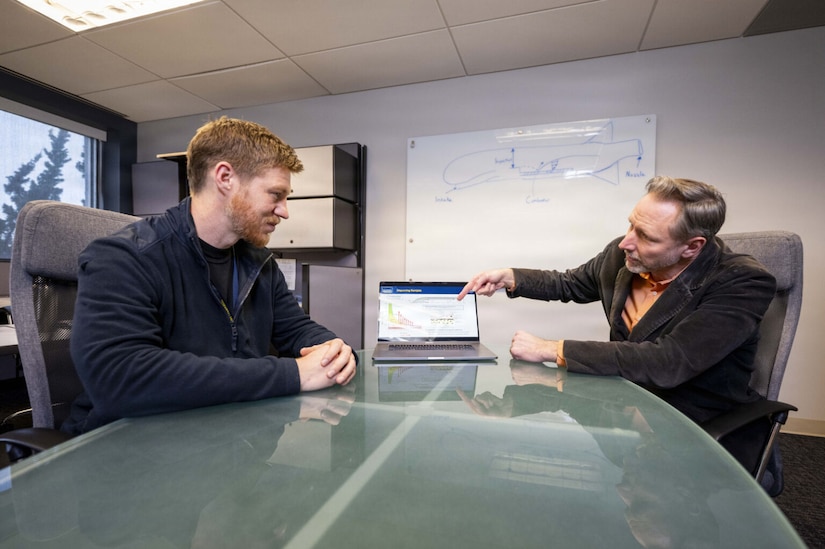
Two men wearing civilian attire sit at a conference table. The man to the right points at a laptop on the table as the other man looks on.

A solid-fuel ramjet is an air-breathing engine that uses solid fuel rather than liquid, offering high energy density and mechanically simple propulsion by burning the fuel with oxygen from the air to produce thrust. By drawing oxygen from the atmosphere rather than carrying an oxidizer on board, solid-fuel ramjets can carry more fuel in the same volume and fly farther than traditional rocket systems. 

"If you replace all the oxidizer and instead use oxygen from the air to burn your fuel, you can increase range by up to 200 to 300% in the same form factor," said Brian Bojko, a combustion scientist at NRL. 

Despite that promise, widespread adoption has been slowed by the extreme internal environment of solid-fuel ramjets, where high temperatures, soot and rapidly evolving flow structures prevent traditional probes from accessing critical data. Unlike liquid or gaseous fuels, solid fuels release energy through surface regression and often produce a complex mixture of combustion products, making it far more difficult to control burning rates and predict performance. This is why understanding and predicting what happens inside an operating combustor is so important. 

"In solid-fuel ramjets, you don't have direct control over the mass flow rate like you do with liquid systems," Bojko explained. "The heat from combustion actually drives the gasification of the solid fuel, so pressure, temperature and airflow all feed back into how the engine behaves." 

Without detailed measurements of flame temperature, fuel regression and fuel-vapor transport, designers have historically relied on trial-and-error approaches.  

"A lot of the design has been kind of Edisonian," Bojko said. "You take a guess, test it and iterate. But without seeing the physics inside the combustor, it's hard to know if you're getting the right answer for the right reason." 

At the same time, computational approaches such as Reynolds-Averaged Navier–Stokes and Detached Eddy Simulation have been limited by a lack of high-quality experimental data for validation. 

RANS, DES and`Large Eddy Simulation represent increasing levels of physical realism in turbulence simulation, where more turbulent structures are directly resolved rather than modeled. Moving from RANS to DES to LES brings simulations closer to the true flow physics, especially for unsteady flows, but at a significantly higher computational cost. Reynolds-Averaged Navier–Stokes models capture most of the turbulence and are computationally efficient but less accurate for unsteady flows. Detached Eddy Simulation resolves large turbulent structures while modeling smaller ones, balancing accuracy and cost. LES resolves most turbulent motion directly, offering the highest accuracy at the highest computational expense.

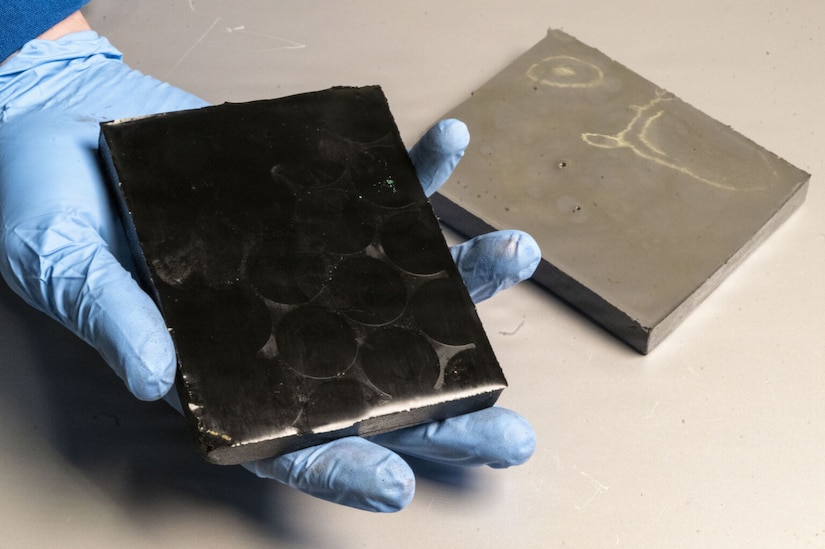
A person holds a black block in a gloved hand. A gray block is on a table nearby.

"With only a few pressure or temperature points, you can match a simulation to an experiment and still be wrong," Bojko said. "Optical access lets us validate the flame structure, recirculation zones and combustion species directly."

Seeing Flame Temperature in Real Time 

To address these gaps, researchers employed optical diagnostics capable of operating in the harsh, particle-laden environment of a solid-fuel ramjet combustor. Measuring flame temperature is especially important, Bojko said, because models often assume combustion efficiency rather than measure it. 

"These diagnostics give us new data we simply didn't have before," said David Kessler, a senior computational scientist at NRL. "They allow us to measure gas-phase species and temperatures in an environment where traditional probes just don't work." 

The chemistry behind how solid fuels decompose and feed the flame is just as important as measuring the flame itself, according to researchers. As heat from the flame feeds back into the fuel surface, the solid polymer undergoes phase change and chemical breakdown, releasing a complex mixture of gaseous hydrocarbons that sustain combustion.

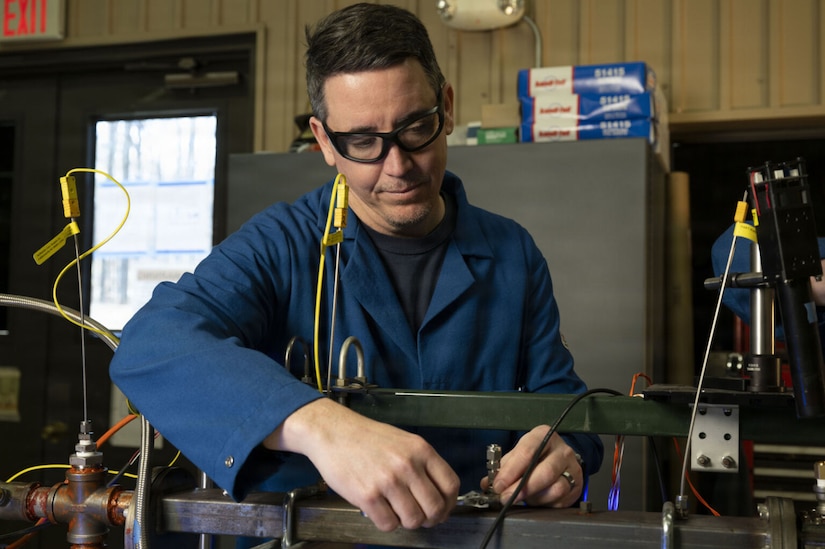
A man wearing a lab coat tightens the bolt on a device that has multiple wires and metal bars attached to it.

"You have this continuous feedback loop," said Brian Fisher, a combustion research engineer at NRL. "The flame heats the fuel, the fuel decomposes into gas-phase species, and those species then mix with the air and keep the flame going. It's a coupled thermal, chemical and fluid-dynamic process, and that's what makes solid-fuel ramjets both powerful and challenging to predict."

Mapping Fuel Regression and Validating Models 

Understanding how quickly the solid fuel surface recedes, known as fuel regression, is critical because it directly governs thrust and performance. The team combined experimental diagnostics with high-fidelity simulations to resolve heat feedback to the fuel surface, a key driver of regression. 

"One of the biggest things you need to capture is the heat transfer back to the solid fuel," Bojko said. "RANS can give you an OK answer, but it doesn't resolve the fundamental processes as well as DES or Large Eddy Simulation. Those higher-fidelity approaches cost more computationally, but they give you a much better picture of what's happening."

Visualizing Fuel Vapor Before It Burns 

For the first time, the researchers also visualized fuel vapor released from the solid surface before ignition, revealing how complex hydrocarbon species mix and evolve prior to combustion. Solid-fuel ramjets commonly use hydroxyl-terminated polybutadiene, a long-chain polymer that breaks down into many different gaseous species. 

"When HTPB decomposes, you don't know what species are coming off the surface, and those species dictate the combustion mechanism," Bojko said. "They change with temperature, pressure and heat flux, so being able to characterize them is critical to understanding the underlying mechanisms across different flight conditions." 

In parallel, NRL researchers are investigating advanced composite fuels designed to increase the energy density of solid fuel in the same volume. 

"We're interested in adding energetic additives, like metal particles, into polymer fuels to increase their energy density," said Clayton Geipel, a combustion research engineer at NRL. "As the fuel burns, those particles are released into the flame and ignite, giving you more energy from the same volume of fuel. That directly translates into greater potential range for future systems." 

"You want to jam as much energy content into that block of fuel as you can while still having a reasonable rate of combustion; that's the challenge," said Albert Epshteyn, materials scientist at NRL. 

Although metals can have slightly lower energy per unit mass than hydrocarbons, their much higher density allows more total energy to be packed into the same volume, a critical advantage for compact, long-range systems.

Reducing Risk and Accelerating 

Together, these diagnostics and simulations transform solid-fuel ramjet combustion from a largely inferred process into a measurable, predictable system. The validated models allow researchers to conduct design iterations computationally before moving to costly experiments. 

"Our main objective is to reduce risk," Bojko said. "If we have validated computational models, we can do design iterations much more efficiently in terms of cost and time and narrow down the physics before we ever go to full-scale testing." 

Kessler emphasized the broader impact. 

"NRL is developing technologies that help accelerate the transition of solid-fuel ramjets, technology that can significantly increase the range of next-generation high-speed systems," he said. 

Building on that foundation, the team is now focused on bridging the gap between small-scale laboratory experiments and real-world propulsion systems.

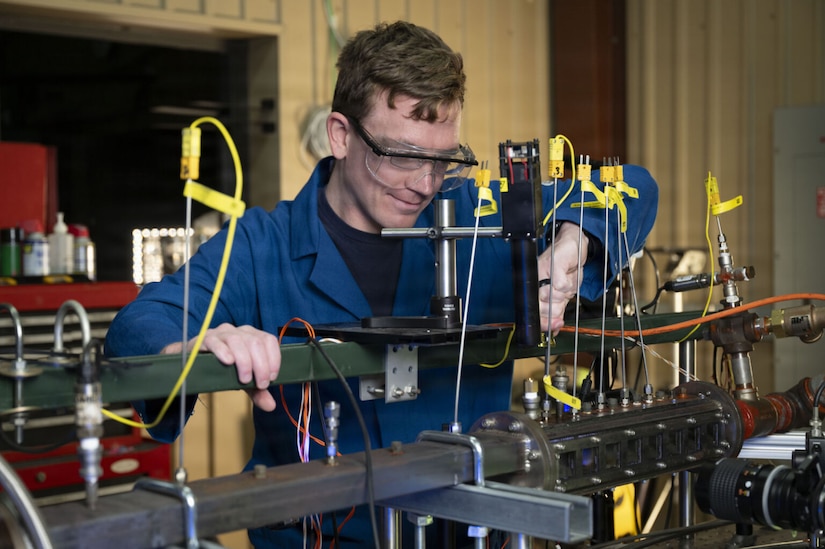
A man dressed in a lab coat and goggles, holds a metal bar on a device that has other metal bars and wires protruding from it.

"All of our work right now happens at small-scale facilities in idealized, optically accessible geometries," Geipel said. "That's what allows us to make detailed measurements, but there are still important questions about how those results apply to a full-scale, enclosed ramjet." 

While small-scale experiments reveal detailed physics, scaling those results to full-size engines remains a central uncertainty in the field. The next phase of the research will focus on extending these validated tools and models to larger, more representative test configurations. This intermediate step preserves diagnostic access while introducing greater geometric and physical realism. That progression is designed to ensure the physics and chemistry observed in the lab translate reliably to operational propulsion systems. 

By integrating optical diagnostics, detailed chemistry and validated simulations across multiple scales, the research provides the propulsion community with tools to reduce uncertainty, shorten development timelines and enable future high-speed air-breathing propulsion technologies.