Space Launch Delta 45 Emergency Management personnel partnered with the Florida Army National Guard's 44th Weapons of Mass Destruction Civil Support Team during a multiday training exercise at Patrick Space Force Base July 28, and at Kennedy Space Center July 30, both in Florida.
This marks the second time Space Launch Delta 45 has hosted the 44th Weapons of Mass Destruction Civil Support Team to strengthen emergency response capabilities through realistic training scenarios.
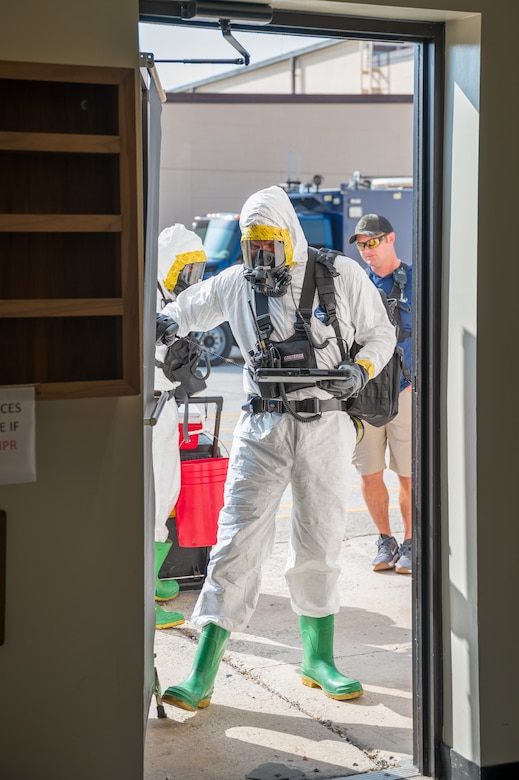
The 44th Weapons of Mass Destruction Civil Support Team is a specialized unit of Army and Air Force personnel that includes full-time Florida Army National Guard soldiers and four airmen. The team supports civil authorities during chemical, biological, radiological, nuclear and high-yield explosive incidents that exceed the capabilities of local hazardous materials response agencies. The team's mission focuses on protecting public health and safety while supporting local, state and federal agencies during intentional or unintentional domestic emergencies.
The 44th Weapons of Mass Destruction Civil Support Team is organized into specialized sections that work together to support incident commanders during hazardous materials emergencies. A command element coordinates operations and provides on-scene leadership, while survey teams enter contaminated areas to collect samples, conduct testing and identify hazardous agents. Decontamination personnel establish entry and exit control points to process responders entering and leaving the hot zone safely. A dedicated medical team stands ready to treat personnel who become ill or are exposed.
The unit also operates a secure mobile command post equipped with encrypted communications and a mobile analytical laboratory capable of fully characterizing unknown chemical, biological or radiological hazards in the field.
"Public safety is our No. 1 priority," said Army Lt. Col. David Deitz, 44th Weapons of Mass Destruction Civil Support Team commander. "We are committed to answering every alert and showing up wherever necessary in order to support local and federal agencies in CBRNE matters."
Joint training brought together Space Force and National Guard personnel to rehearse coordinated responses to a simulated chemical incident, allowing both organizations to improve communication and response procedures. During this exercise, participants established a decontamination corridor before survey teams entered the simulated hazardous area to identify chemical agents, collect samples and assess potential threats.
For Space Launch Delta 45 Emergency Management personnel, the exercise provided an opportunity to strengthen relationships and receive specialized hands-on training with the response team and gain valuable experience alongside experts who routinely support hazardous materials incidents across Florida. This partnership also introduces airmen and guardians to potential career opportunities with the civil support team following military service.
"Working with our local partners to facilitate this training helps them remain proficient in their field," said Air Force Master Sgt. Robert Ridgway, Space Launch Delta 45 Emergency Management Flight noncommissioned officer in charge. "This joint collaboration aids in improving both teams' procedures for more effective emergency response. Many of our 45th [Civil Engineer Squadron Emergency Management] personnel are exposed to this as a future career opportunity following their service."
Training together in realistic scenarios will continue to strengthen their partnership, and ensure both organizations remain prepared to respond rapidly to CBRNE incidents in support of local communities, mission partners and the nation's busiest spaceport.


 Posts

