Showing posts with label Defense Production Act. Show all posts

Tuesday, July 7, 2026

Department of War Invests $16M for 45nm Silicon-on-Insulator Qualification

The Department of War announced today a July 2, 2026, investment of $16 million in Defense Production Act (DPA) Title III funds to BAE Systems. The investment will expand the domestic production capability for radiation-hardened microelectronics (RHM) necessary for national defense. This investment supports the Secretary of War's priorities to reestablish deterrence and rebuild the military by investing in key defense industrial base capabilities that increase supply chain resilience.

"Radiation-hardened microelectronics are critical for DoW missile, space, and strategic systems," said Assistant Secretary of War for Industrial Base Policy, the Honorable Michael Cadenazzi. "This project ensures qualified products are available to the DoW."

These DPA Title III funds will enable BAE Systems to create, maintain, protect, and expand domestic industrial base processing and production capabilities and capacity that are essential for RHM components. Specifically, the project will reestablish BAE Systems' RH45® Storefront capability for trusted Radiation Hardened by Design 45nm Application Specific Integrated Circuit and Application Specific Standard Product offerings. Once reestablished, BAE Systems' RH45® Storefront will be a self-sustaining hub where customers can access a range of standard processing products and resources to develop and produce their own custom chips.

"This effort ensures that 45nm silicon-on-insulator technology remains available to DoW systems," added Mr. Jeffrey Frankston, Acting Deputy Assistant Secretary of War for Industrial Base Resilience, who oversees the Warfighting Investment, Resourcing, and Execution (WIRE) directorate. "This provides cost-avoidance, so programs are not forced to redesign and requalify their systems."

This is one of five DPA Title III investments totaling $102.6 million made by the WIRE directorate since the beginning of Fiscal Year 2026. For more information on the WIRE directorate, please visit: https://www.businessdefense.gov/ibr/wire.html.

About the Office of the Assistant Secretary of War for Industrial Base Policy (OASW(IBP)

The OASW(IBP) works with domestic and international partners to forge and sustain a robust, secure, and resilient industrial base enabling the Warfighter, now and in the future. OASW(IBP) also uses a new Defense Industrial Base Consortium Other Transaction Agreement (DIBC OTA) to solicit new ideas for research or prototype project solutions for critical supply chain resiliency focus areas. This OTA underscores the Department's ongoing dedication to safeguarding the integrity of our crucial supply chain and promptly giving our Warfighters the materials and technologies they need to accomplish their missions. To learn more about the DIBC OTA, please visit: https://www.dibconsortium.org.

Tuesday, February 24, 2026

Securing Rare Earth Elements a National Security Imperative, Official Says

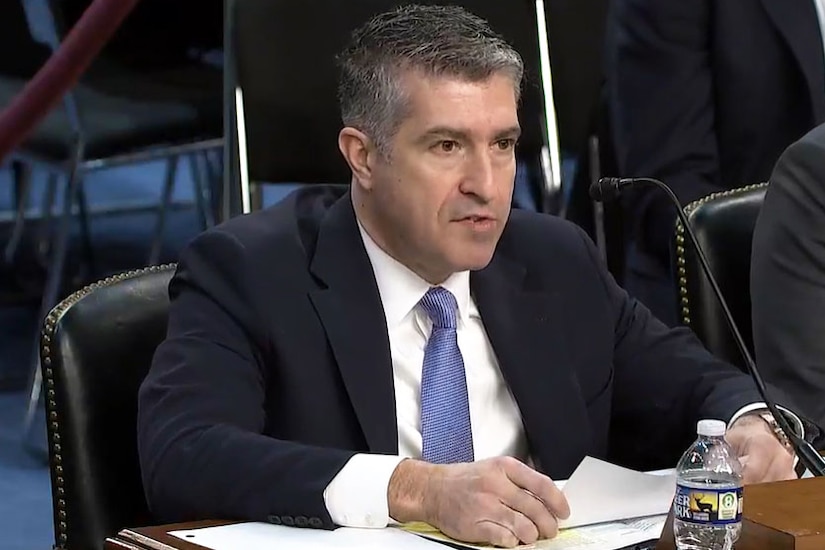
Securing a resilient supply chain for critical minerals is fundamental to national security and the economy, said Michael P. Cadenazzi Jr., assistant secretary of war for industrial base policy, who testified today at a Senate Armed Services Committee hearing in Washington.

A man wearing business attire sits at a table and speaks into a microphone.

He noted that there is a growing demand for U.S. capabilities from allies and partners, such as fifth-generation aircraft, precision-guided munitions, satellite constellations and next-generation naval vessels. Cadenazzi said those capabilities all depend on a reliable supply of rare earth elements, including gallium antimony and germanium, as well as dozens of others.

"For decades, we have outsourced and offshored mining and processing, creating a strategic vulnerability of the highest order. Today, our primary strategic competitor, China, controls the global supply chain for numerous critical minerals," he said.

On heavy rare earths alone, China controls 95% of global output, with the United States importing almost 100% of what it uses, 90% of that coming from China.

"This control provides Beijing with the ability to weaponize these supply chains, threatening to disrupt our defense industrial base and compromise military readiness in a crisis; this is not a theoretical risk. It is a clear and present danger to our national security," Cadenazzi said.

A military fighter aircraft flies against a blue sky.

To address this vulnerability, the War Department developed a comprehensive, multiyear strategy designed to create a secure, resilient and sustainable supply chain ecosystem, Cadenazzi said.

Included in that approach is a commitment to reshore and onshore the production of critical minerals. Congress provided funding to do this, he said, utilizing the Defense Production Act.

Cadenazzi said his office partners with colleagues in the Office of Strategic Capital to offer loans, loan guarantees and debt financing options to bring mineral supply chains to friendly shores.

"Through these tools, we are sending a clear and sustained demand signal to the industrial base. We are working across the entire value chain, from mine to front line, to build our resilience," he said.

A silvery metal disc sits atop a sparkly blue surface. Metal shavings stand on edge.

Although DOW prioritizes domestic production, Cadenazzi said no single nation can achieve complete self-sufficiency. Therefore, the supply chain includes allies and America's closest partners.

The department is also aggressively investing in research and development to mitigate demand for the most heavily contested minerals.

"Our scientists at [the Defense Advanced Research Projects Agency] and other service research labs are pioneering the development of next-generation materials and novel manufacturing techniques that can reduce or eliminate the need for certain rare earths and other critical inputs," Cadenazzi said.

He noted that other DOW strategies include funding the development of advanced recycling technologies to recover rare earth from systems and materials being retired, and modernizing the national defense stockpile to ensure it serves as an effective buffer against near-term supply chain shocks.

"We are conducting a rigorous, data-driven analysis of our strategic requirements for 21st-century contested environments and [we] are taking action to acquire materials that face the most acute supply chain risks," Cadenazzi said.

Thursday, November 20, 2025

Department of War Awards $29.9 Million to Create a U.S. Domestic Supply of Gallium and Scandium

The Department of War announced today a $29.9 million a Defense Production Act (DPA) Title III award to ElementUS Minerals, LLC (ElementUSA). ElementUSA will use this award to enable the development of a demonstration facility in Gramercy, Louisiana to separate and purify gallium and scandium from existing industrial waste.  The company will also conduct initial development work at their Critical Resource Accelerator in Cedar Park, Texas.

This investment uses funds from the Additional Ukraine Supplemental Appropriations Act of 2022. It also supports the Administration's goal to increase the production of processed critical minerals and other derivative products as articulated in the March 20, 2025, Executive Order 14241 - Immediate Measures to Increase American Mineral Production.

"Gallium and scandium are critical minerals essential to a wide range of defense manufacturing industries and equipment," said Assistant Secretary of War for Industrial Base Policy Mike Cadenazzi. "Developing domestic production of both is a DOW priority."

ElementUSA is a leading expert in recovering minerals and metals from industrial waste streams to create domestic supply chains of critical minerals necessary for national defense.  Using DPA Title III funds to construct the demonstration facility, the company will become one of the first U.S. producers of both gallium and scandium. Systems such as missile defense platforms, sensors, fighter aircraft, and hypersonic weapons all require these elements in their manufacture.  The company will use a proprietary process to separate and extract these critical minerals from over 30 million tons of mineral-rich bauxite residue, a byproduct of the alumina refining process.  As such, not only will ElementUSA create a domestic supply chain of critical minerals, but it will do so while cleaning up a waste product with no additional mining required.

"By enabling ElementUSA to recover gallium and scandium from processing waste, this award will support the DOW's work to expand the supply of critical minerals needed for numerous defense components and platforms," added Mr. Jeffrey Frankston, Acting Deputy Assistant Secretary of War for Industrial Base Resilience, which oversees the Manufacturing Capability Expansion and Investment Prioritization (MCEIP) directorate.  "Such awards are essential for reconstituting domestic capabilities, diversifying supply chains, reducing dependence on foreign sources, and enhancing national security."

This is one of 18 awards made by the DPA Purchases Office totaling $887.0 million in fiscal year 2025. Recipient cost shares total $88.0 million in FY 2025.  The MCEIP directorate oversees the DPA Purchases Office.


Friday, September 26, 2025

Department of War Awards $33.5 Million to Increase Solid Rocket Motor Capacity and Capability

Sept. 26, 2025

Today, the Department of War announced two Defense Production Act (DPA) Title III awards totaling $33.5 million to expand the solid rocket motor (SRM) industrial base. The awardees are Americarb. Inc. (Americarb) in Niagara Falls, New York and General Dynamics Ordnance and Tactical Systems (GD-OTS) in Lincoln, Nebraska. These awards support the Department of War's objectives to expand the munitions industrial base, bolster supply chain resiliency, and increase domestic production in strategic priority areas.

"To meet the evolving threats of tomorrow, we must expand our capacity to produce the critical subcomponents that underpin our munitions systems," said Under Secretary of War for Acquisition and Sustainment Michael Duffey. "By advancing resiliency in the solid rocket motor supply chain, we're not only strengthening our defense industrial base but also helping to ensure a reliable and scalable supply of the materials and components crucial to our national security."

Using DPA Title III funds, the two new awardees will strengthen SRM production capability by modernizing existing facilities and improving manufacturing processes:

  • DOW awarded Americarb $12.6 million to develop a solution for converting woven rayon fabric into carbonized rayon phenolic (CRP). CRP is a crucial polymeric ablative material utilized for insulating rocket nozzles in SRMs that are key for tactical missile, hypersonic, and strategic programs. Americarb will provide a prototype process and demonstrate the production of CRP to enhance DoD's supply chain resilience for this critical material.
  • DOW awarded GD-OTS $20.9 million to increase SRM nozzle production capacity and capability, becoming a new supplier for composite rocket nozzles and insulators. The main technologies supported by the investment are tape wrapping and high-rate material handling technologies. These technologies, supplemented with GD-OTS' wide knowledge base of composite processing, will focus on throughput and quality for nozzle fabrication. GD-OTS' ability to manufacture components in-house can bring overall system-level lead times down, increase industry annual production capacity, and assist in the replenishment of the nozzle supply chain.

This announcement brings the total number of DPA Title III awards made to the SRM industrial base under a recent Defense Industrial Base Consortium Other Transaction Agreement (DIBC OTA) solicitation to six, for a total of $87.3 million.

These are two of 16 investments made by the DPA Purchases Office totaling $811.5 million since the beginning of fiscal year 2025. These investments are complemented by $88 million in total recipient cost shares since the beginning of FY 2025. The DPA Purchases Office is overseen by the Manufacturing Capability Expansion and Investment Prioritization (MCEIP) directorate in the Office of the Assistant Secretary of War for Industrial Base Policy (OASW(IBP)).

About the Office of the Assistant Secretary of War for Industrial Base Policy (OASW(IBP)

The OASW(IBP) works with domestic and international partners to forge and sustain a robust, secure, and resilient industrial base enabling the warfighter, now and in the future. OASW(IBP) also utilizes a new Defense Industrial Base Consortium Other Transaction Agreement (DIBC OTA) to solicit new ideas for research or prototype project solutions for critical Supply Chain Resiliency Focus Areas. It underscores the Department's ongoing dedication to safeguarding the integrity of our crucial supply chain and furnishing our warfighters with materials and technologies promptly. To learn more about the DIBC OTA, please visit: https://www.dibconsortium.org.