Showing posts with label HPWREN. Show all posts

Monday, September 3, 2012

EarthScope GPS Station, Point Loma, Calif.


HPWREN (High Performance Wireless Research and Education Network) cyberinfrastructure has enhanced the science and public service applications of the EarthScope global positioning system (GPS) station at Point Loma, San Diego, Calif.

The Plate Boundary Observatory (PBO) GPS station P475 is a strategic site for the earthquake science community. PBO is a geodetic component of EarthScope, operated by UNAVCO, and funded by the National Science Foundation (NSF). EarthScope is a program that deploys thousands of seismic, GPS and other geophysical instruments to study the structure and evolution of the North American continent and the processes the cause earthquakes and volcanic eruptions.

To learn more about HPWREN, also supported by NSF, visit the HPWREN website. Further information about EarthScope is available Here.

(Date of Image: 2003)

Credit: High Performance Wireless Research and Education Network (HPWREN)/http://hpwren.ucsd.edu

Bottom-up View - Hale Telescope, Palomar Observatory


This view is looking from the bottom up at the 200-inch Hale Telescope at the California Institute of Technology's Palomar Observatory. The view shows the underside of the 200-inch mirror's cell with red cooling fans encircled by mechanical supports. These supports help the mirror retain its proper shape regardless of where the telescope is pointed. At the very center of the image is a bright spot, a reflection off of the telescope's secondary mirror some 50 feet above the primary mirror. Light from the camera flash passed up through the hole in the 200-inch mirror up to the secondary mirror and reflected back down to the camera. The photo was taken during an instrument change, catching the underside of the telescope in a rare moment with no camera attached to its lower (Cassegrain) focus.

For a number of years, astronomers at the California Institute of Technology's Palomar Observatory have been using the High Performance Wireless Research and Education Network (HPWREN) as the data transfer cyberinfrastructure to further scientists' understanding of the universe. Recent applications include the study of some of the most cataclysmic explosions in the universe, the hunt for extrasolar planets and the discovery of our solar system's tenth planet.

HPWREN is supported under National Science Foundation grants OCI 00-87344 and OCI 04-26879. For more information, visit the HPWREN website.

(Date of Image: 2003)

Credit: High Performance Wireless Research and Education Network (HPWREN)/http://hpwren.ucsd.edu

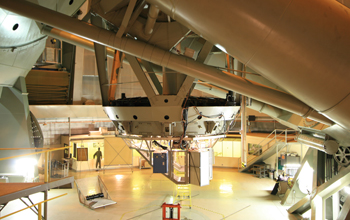
Side View of 200-inch Hale Telescope, Palomar Observatory


A side view of the 200-inch Hale Telescope at the California Institute of Technology's Palomar Observatory. For calibration and size comparison, this image was taken standing at the bottom of the telescope and viewing from the side.

For a number of years, astronomers at the California Institute of Technology's Palomar Observatory have been using the High Performance Wireless Research and Education Network (HPWREN) as the data transfer cyberinfrastructure to further scientists' understanding of the universe. Recent applications include the study of some of the most cataclysmic explosions in the universe, the hunt for extrasolar planets and the discovery of our solar system's tenth planet.

HPWREN is supported under National Science Foundation grants OCI 00-87344 and OCI 04-26879. For more information, visit the HPWREN website.

(Date of Image: 2003)

Credit: High Performance Wireless Research and Education Network (HPWREN)/http://hpwren.ucsd.edu