Showing posts with label jupiter. Show all posts

Thursday, June 28, 2012

Hubble, Swift Detect First-Ever Changes In An Exoplanet Atmosphere


J. D. Harrington
Headquarters, Washington
202-358-5241
j.d.harrington@nasa.gov
 
Lynn Chandler
NASA Goddard Space Flight Center, Greenbelt, Md.
301-286-2806
lynn.chandler-1@nasa.gov

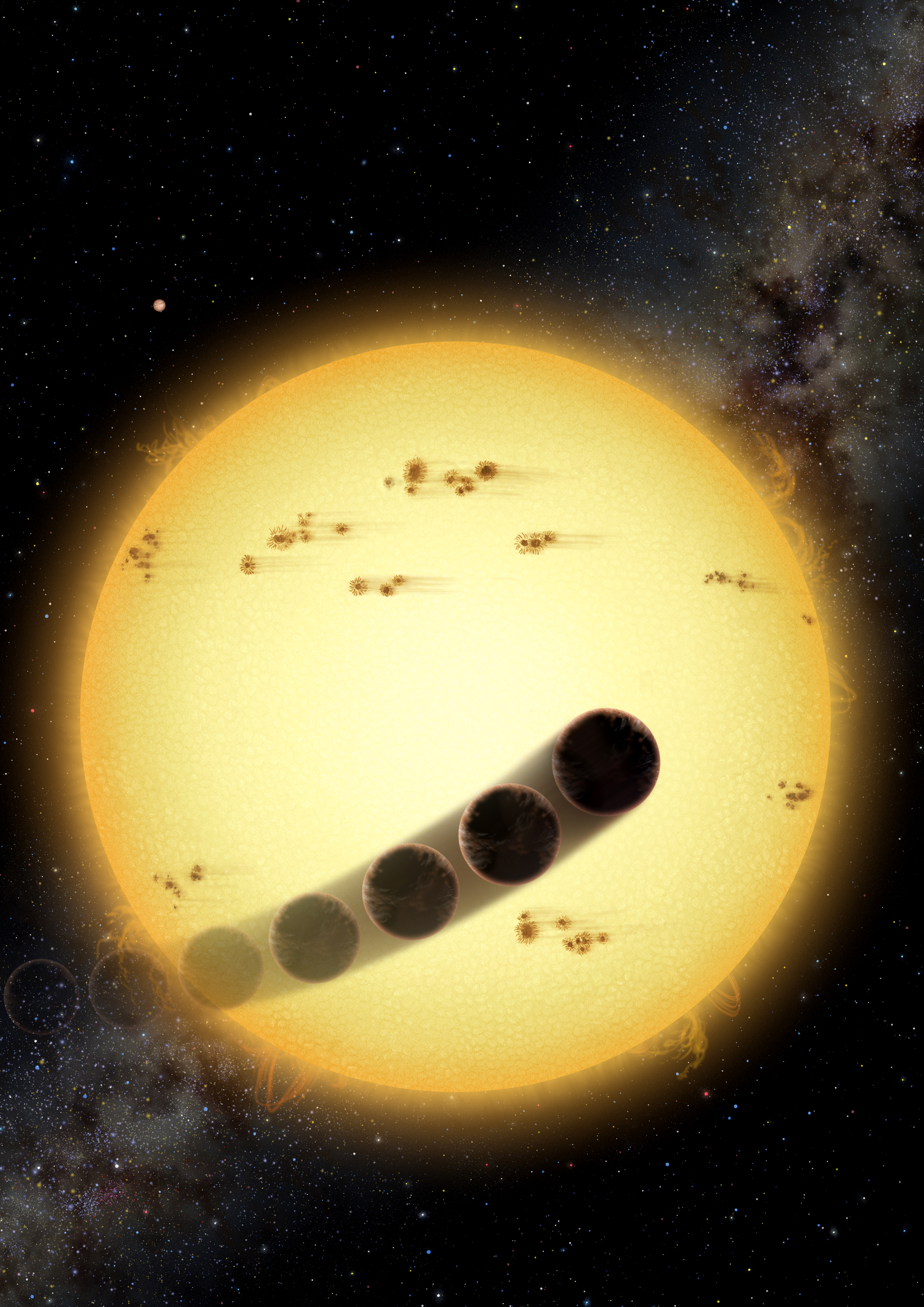
WASHINGTON -- An international team of astronomers using data from NASA's Hubble Space Telescope has made an unparalleled observation, detecting significant changes in the atmosphere of a planet located beyond our solar system.

The scientists conclude the atmospheric variations occurred in response to a powerful eruption on the planet's host star, an event observed by NASA's Swift satellite.

"The multiwavelength coverage by Hubble and Swift has given us an unprecedented view of the interaction between a flare on an active star and the atmosphere of a giant planet," said lead researcher Alain Lecavelier des Etangs at the Paris Institute of Astrophysics (IAP), part of the French National Scientific Research Center located at Pierre and Marie Curie University in Paris.

The exoplanet is HD 189733b, a gas giant similar to Jupiter, but about 14 percent larger and more massive. The planet circles its star at a distance of only 3 million miles, or about 30 times closer than Earth's distance from the sun, and completes an orbit every 2.2 days. Its star, named HD 189733A, is about 80 percent the size and mass of our sun.

Astronomers classify the planet as a "hot Jupiter." Previous Hubble observations show that the planet's deep atmosphere reaches a temperature of about 1,900 degrees Fahrenheit (1,030 C).

HD 189733b periodically passes across, or transits, its parent star, and these events give astronomers an opportunity to probe its atmosphere and environment. In a previous study, a group led by Lecavelier des Etangs used Hubble to show that hydrogen gas was escaping from the planet's upper atmosphere. The finding made HD 189733b only the second-known "evaporating" exoplanet at the time.

The system is just 63 light-years away, so close that its star can be seen with binoculars near the famous Dumbbell Nebula. This makes HD 189733b an ideal target for studying the processes that drive atmospheric escape.

"Astronomers have been debating the details of atmospheric evaporation for years, and studying HD 189733b is our best opportunity for understanding the process," said Vincent Bourrier, a doctoral student at IAP and a team member on the new study.

When HD 189733b transits its star, some of the star's light passes through the planet's atmosphere. This interaction imprints information on the composition and motion of the planet's atmosphere into the star's light.

In April 2010, the researchers observed a single transit using Hubble's Space Telescope Imaging Spectrograph (STIS), but they detected no trace of the planet's atmosphere. Follow-up STIS observations in September 2011 showed a surprising reversal, with striking evidence that a plume of gas was streaming away from the exoplanet.

The researchers determined that at least 1,000 tons of gas was leaving the planet's atmosphere every second. The hydrogen atoms were racing away at speeds greater than 300,000 mph. The findings will appear in an upcoming issue of the journal Astronomy & Astrophysics.

Because X-rays and extreme ultraviolet starlight heat the planet's atmosphere and likely drive its escape, the team also monitored the star with Swift's X-ray Telescope (XRT). On Sept. 7, 2011, just eight hours before Hubble was scheduled to observe the transit, Swift was monitoring the star when it unleashed a powerful flare. It brightened by 3.6 times in X-rays, a spike occurring atop emission levels that already were greater than the sun's.

"The planet's close proximity to the star means it was struck by a blast of X-rays tens of thousands of times stronger than the Earth suffers even during an X-class solar flare, the strongest category," said co-author Peter Wheatley, a physicist at the University of Warwick in England.

After accounting for the planet's enormous size, the team notes that HD 189733b encountered about 3 million times as many X-rays as Earth receives from a solar flare at the threshold of the X class.

Hubble is a project of international cooperation between NASA and the European Space Agency. Swift is operated in collaboration with several U.S. institutions and partners in the United Kingdom, Italy, Germany and Japan. NASA's Goddard Space Flight Center in Greenbelt, Md., manages both missions.

For images and video related to this finding, visit http://go.nasa.gov/Osbvfi.

For more information about Swift, visit http://www.nasa.gov/swift.
 
For more information about Hubble, visit http://www.nasa.gov/hubble.

- end -

Monday, March 19, 2012

Jet Streams On Jupiter Similar to Those on Earth


New movies of Jupiter are the first to catch an invisible wave shaking up one of the giant planet’s jet streams, an interaction that also takes place in Earth’s atmosphere and influences the weather.

The movies, made from images taken by NASA’s Cassini spacecraft when it flew by Jupiter in 2000, are part of an in-depth study conducted by a team of scientists and amateur astronomers led by Amy Simon-Miller at NASA’s Goddard Space Flight Center  in Greenbelt, Md., and published in the April 2012 issue of Icarus.

“This is the first time anyone has actually seen direct wave motion in one of Jupiter’s jet streams,” says Simon-Miller, the paper’s lead author. “And by comparing this type of interaction in Earth’s atmosphere to what happens on a planet as radically different as Jupiter, we can learn a lot about both planets.”

Like Earth, Jupiter has several fast-moving jet streams that circle the globe. Earth’s strongest and best known jet streams are those near the north and south poles; as these winds blow west to east, they take the scenic route, wandering north and south. What sets these jet streams on their meandering paths — and sometimes makes them blast Florida and other warm places with frigid air — are their encounters with slow-moving waves in Earth’s atmosphere, called Rossby waves.


In contrast, Jupiter’s jet streams “have always appeared to be straight and narrow,” says co-author John Rogers, who is the Jupiter Section Director of the British Astronomical Association, London, U.K., and one of the amateur astronomers involved in this study.

Rossby waves were identified on Jupiter about 20 years ago, in the northern hemisphere. Even so, the expected meandering winds could not be traced directly, and no evidence of them had been found in the southern hemisphere, which puzzled planetary scientists.

To get a more complete view, the team analyzed images taken by NASA’s Voyager spacecraft, NASA’s Hubble Space Telescope, and Cassini, as well as a decade’s worth of observations made by amateur astronomers and compiled by the JUPOS project.

The movies zoom in on a single jet stream in Jupiter’s southern hemisphere. A line of small, dark, V-shaped “chevrons” has formed along one edge of the jet stream and zips along west to east with the wind. Later, the well-ordered line starts to ripple, with each chevron moving up and down (north and south) in turn. And for the first time, it’s clear that Jupiter’s jet streams, like Earth’s, wander off course.

“That’s the signature of the Rossby wave,” says David Choi, the postdoctoral fellow at NASA Goddard who strung together about a hundred Cassini images to make each time-lapse movie. “The chevrons in the fast-moving jet stream interact with the slower-moving Rossby wave, and that’s when we see the chevrons oscillate.”

The team’s analysis also reveals that the chevrons are tied to a different type of wave in Jupiter’s atmosphere, called a gravity inertia wave. Earth also has gravity inertia waves, and under proper conditions, these can be seen in repeating cloud patterns.

“A planet’s atmosphere is a lot like the string of an instrument,” says co-author Michael D. Allison of the NASA Goddard Institute for Space Studies in New York. “If you pluck the string, it can resonate at different frequencies, which we hear as different notes. In the same way, an atmosphere can resonate with different modes, which is why we find different kinds of waves.”

Characterizing these waves should offer important clues to the layering of the deep atmosphere of Jupiter, which has so far been inaccessible to remote sensing, Allison adds.

Crucial to the study was the complementary information that the team was able to retrieve from the detailed spacecraft images and the more complete visual record provided by amateur astronomers. For example, the high resolution of the spacecraft images made it possible to establish the top speed of the jet stream’s wind, and then the amateur astronomers involved in the study looked through the ground-based images to find variations in the wind speed.

The team also relied on images that amateur astronomers had been gathering of a large, transient storm called the South Equatorial Disturbance. This visual record dates back to 1999, when members of the community spotted the most recent recurrence of the storm just south of Jupiter’s equator. Analysis of these images revealed the dynamics of this storm and its impact on the chevrons. The team now thinks this storm, together with the Great Red Spot, accounts for many of the differences noted between the jet streams and Rossby waves on the two sides of Jupiter’s equator.

“We are just starting to investigate the long-term behavior of this alien atmosphere,” says co-author Gianluigi Adamoli, an amateur astronomer in Italy. “Understanding the emerging analogies between Earth and Jupiter, as well as the obviously profound differences, helps us learn fundamentally what an atmosphere is and how it can behave.”

The Cassini-Huygens mission is a cooperative project of NASA, the European Space Agency, and the Italian Space Agency. NASA’s Jet Propulsion Laboratory, Pasadena, Calif., manages the mission for NASA’s Science Mission Directorate, Washington, D.C.

Monday, March 5, 2012

Jupiter From the Ground

This image of Jupiter and its moons Io and Ganymede was acquired by amateur astronomer Damian Peach on Sept. 12, 2010, when Jupiter was close to opposition. South is up and the "Great Red Spot" is visible in the image.

Ground-based astronomy will play a vital role in the success of NASA's Juno mission. Because Jupiter has such a dynamic atmosphere, images from amateur astronomers will assist the JunoCam instrument team predict what features will be visible when the camera's images are taken.

With its suite of science instruments, the Juno spacecraft will investigate the existence of a solid planetary core, map the planet's intense magnetic field, measure the amount of water and ammonia in the deep atmosphere and observe the planet's auroras.

Image Credit: NASA/Damian Peach

Friday, January 20, 2012

Hot Jupiter Orbiting Closely to Its Sun

A retrograde hot Jupiter--an extrasolar planet whose mass is close to or exceeding that of Jupiter. The transiting giant planet orbits very closely to its host star and in a direction opposite the stellar rotation. This peculiar configuration results from gravitational perturbations by another, much more distant planet (seen in the upper left). Some hot Jupiters have orbits that are elongated or highly inclined, with respect to the equator of the star, and some orbit counter to the star's spin direction, but they all have very close proximity to their host star. (Date of Image: unknown)
 
Credit: Lynette Cook

Wednesday, November 16, 2011

Jupiter-Io Montage

You’ll find more breathtaking images in the best NASA books written by real astronauts.

This montage of New Horizons images shows Jupiter and its volcanic moon Io, and were taken during the spacecraft's Jupiter flyby in early 2007. The image of Jupiter is an infrared color composite taken by the spacecraft's near-infrared imaging spectrometer, the Linear Etalon Imaging Spectral Array. The infrared wavelengths used highlight variations in the altitude of the Jovian cloud tops, with blue denoting high-altitude clouds and hazes, and red indicating deeper clouds. The prominent bluish-white oval is the Great Red Spot. The observation was made at a solar phase angle of 75 degrees but has been projected onto a crescent to remove distortion caused by Jupiter's rotation during the scan. The image of Io is an approximately true-color composite taken by the panchromatic Long-Range Reconnaissance Imager with color information provided by the Multispectral Visible Imaging Camera. The image shows a major eruption in progress on Io's night side, at the northern volcano Tvashtar. Incandescent lava glows red beneath a volcanic plume, whose uppermost portions are illuminated by sunlight. The plume appears blue due to scattering of light by small particles within it.

This montage originally appeared on the cover of the Oct. 12, 2007, issue of Science magazine.

Image Credit: NASA/Johns Hopkins University Applied Physics Laboratory/Southwest Research Institute/Goddard Space Flight Center

Tuesday, November 15, 2011

NASA Hosting Science Update About Jupiter's Icy Moon Europa

Dwayne Brown
Headquarters, Washington

Find out what real NASA astronauts teach you in the best NASA books!

WASHINGTON -- NASA will host a Science Update at 1 p.m. EST on Wednesday, Nov. 16, to discuss new theories concerning Jupiter's icy moon Europa. The event will be in NASA's James E. Webb Auditorium at 300 E St. SW in Washington.

NASA Television and the agency's website will broadcast the event live. Reporters may attend the event or ask questions from participating NASA centers or by phone. For dial-in information, reporters must contact Dwayne Brown at: dwayne.c.brown@nasa.gov with their name, media affiliation and telephone number by noon Wednesday.

Europa, which is slightly smaller than Earth's moon, is thought to have an iron core, a rocky mantle and an ocean of salty water beneath its frozen surface.

Briefing participants are:

- Britney Schmidt, postdoctoral fellow, Institute for Geophysics, University of Texas at Austin
- Tori Hoehler, astrobiologist and senior research scientist, NASA's Ames Research Center, Moffett Field, Calif.
- Louise Prockter, planetary scientist, Johns Hopkins University Applied Physics Laboratory, Laurel, Md.
- Tom Wagner, program scientist, cryospheric sciences, Earth Science Division, NASA Headquarters

For NASA TV streaming video, scheduling and downlink information, visit http://www.nasa.gov/ntv.

For more information about NASA and agency programs, visit http://www.nasa.gov. 

- end -

Monday, August 29, 2011

What’s Up for August 2011?

What's Up for August? The solar system's windy worlds.

Hello and welcome. I'm Jane Houston Jones at NASA's Jet Propulsion Laboratory in Pasadena, California.

Many of our planetary neighbors have significant atmospheres.

On Venus the atmosphere's much thicker than our own and blankets the planet with dense clouds, which can reach tornado-like speeds. On Mars it's much thinner, though there are periodic global dust storms and even dust devils.

The outer planets' atmospheres are worse than that.

Jupiter and Saturn's atmospheres are swirling with toxic gases like ammonia, and the temperatures and wind speeds are extreme. The Cassini spacecraft recently studied a huge storm on Saturn, which has been raging since last December. While it started as an isolated storm, the winds in Saturn's atmosphere have affected the tops of Saturn's clouds. The storm now completely encircles the planet, and can even be spotted in amateur telescopes.

In this false-color image the blue clouds are the highest and are thin. Yellow and white clouds are thick, high-altitude clouds. Green are intermediate. Red and brown are lower-altitude clouds but are not obscured by the other clouds.

The deepest blue shows a thin haze with no clouds below. The storm clouds are most likely made of water ice covered by crystallized ammonia, carbon and other contaminants.

But which planet is the windiest? Neptune.

The winds on Neptune blow at more than 1200 miles per hour. That's 2000 kilometers per hour.

Mission Control voice: Ignition. Lift off.

Jones: With the launch of the Juno spacecraft this month, we celebrate our return to Jupiter.

Juno will improve our understanding of our solar system's beginnings by revealing the origin and evolution of Jupiter.

The spinning spacecraft will use microwave antennas to observe how this windy world is moving far below its visible cloud tops. It will also probe Jupiter's interior to determine how deep, wind-driven cloud features, like the colorful bands and the Great Red Spot, reach into the planet.

Throughout August, Saturn is visible at sunset, and you can see Jupiter after midnight.

Both Neptune and asteroid Vesta are at opposition this month, but you'll need a telescope to see them.

You can read all about asteroids at solarsystem.nasa.gov/yss, for Year of the Solar System.

You can learn all about the Juno mission at http://www.nasa.gov/juno.

And you can learn all about NASA's missions at www.nasa.gov.

That's all for this month. I'm Jane Houston Jones.

Monday, August 8, 2011

NASA'S Juno Spacecraft Launches To Jupiter

Dwayne Brown
Headquarters, Washington     
 
DC Agle
Jet Propulsion Laboratory, Pasadena, Calif.
 
George Diller
Kennedy Space Center, Fla.

CAPE CANAVERAL, Fla. -- NASA's solar-powered Juno spacecraft lifted off from Cape Canaveral Air Force Station at 12:25 p.m. EDT Friday to begin a five-year journey to Jupiter.

Juno's detailed study of the largest planet in our solar system will help reveal Jupiter's origin and evolution. As the archetype of giant gas planets, Jupiter can help scientists understand the origin of our solar system and learn more about planetary systems around other stars.

"Today, with the launch of the Juno spacecraft, NASA began a journey to yet another new frontier," NASA Administrator Charles Bolden said. "The future of exploration includes cutting-edge science like this to help us better understand our solar system and an ever-increasing array of challenging destinations."

After Juno's launch aboard an Atlas V rocket, mission controllers now await telemetry from the spacecraft indicating it has achieved its proper orientation, and that its massive solar arrays, the biggest on any NASA deep-space probe, have deployed and are generating power.

"We are on our way, and early indications show we are on our planned trajectory," said Jan Chodas, Juno project manager at NASA's Jet Propulsion Laboratory (JPL) in Pasadena, Calif. "We will know more about Juno's status in a couple hours after its radios are energized and the signal is acquired by the Deep Space Network antennas at Canberra."

Juno will cover the distance from Earth to the moon (about 250,000 miles or 402,236 kilometers) in less than one day's time. It will take another five years and 1,740 million miles (2,800 million kilometers) to complete the journey to Jupiter. The spacecraft will orbit the planet's poles 33 times and use its collection of eight science instruments to probe beneath the gas giant's obscuring cloud cover to learn more about its origins, structure, atmosphere, and magnetosphere, and look for a potential solid planetary core.

With four large moons and many smaller moons, Jupiter forms its own miniature solar system. Its composition resembles a star's, and if it had been about 80 times more massive, the planet could have become a star instead.

"Jupiter is the Rosetta Stone of our solar system," said Scott Bolton, Juno's principal investigator from the Southwest Research Institute in San Antonio. "It is by far the oldest planet, contains more material than all the other planets, asteroids and comets combined and carries deep inside it the story of not only the solar system but of us. Juno is going there as our emissary -- to interpret what Jupiter has to say."

Juno's name comes from Greek and Roman mythology. The god Jupiter drew a veil of clouds around himself to hide his mischief, and his wife, the goddess Juno, was able to peer through the clouds and reveal Jupiter's true nature.

The NASA Deep Space Network, or DSN, is an international network of antennas that supports interplanetary spacecraft missions and radio and radar astronomy observations for the exploration of the solar system and the universe. The network also supports selected Earth-orbiting missions.

NASA's Jet Propulsion Laboratory, Pasadena, Calif., manages the Juno mission for the principal investigator, Scott Bolton, of Southwest Research Institute in San Antonio. The Juno mission is part of the New Frontiers Program managed at NASA's Marshall Space Flight Center in Huntsville, Ala. Lockheed Martin Space Systems, Denver, built the spacecraft. Launch management for the mission is the responsibility of NASA's Launch Services Program at the Kennedy Space Center in Florida.

For more information about Juno, visit http://www.nasa.gov/juno and http://missionjuno.swri.edu.

- end -

Friday, August 5, 2011

Juno Launches to Jupiter

George Diller/Launch Commentator: T minus 10… nine… eight… seven… six… five… four… three… two… one… ignition and liftoff of the Atlas V with Juno on a trek to Jupiter, a planetary piece of the puzzle on the beginning of our solar system.

Marty Malinowski/Ascent Commentator: Pitch and yaw roll program is in progress. Vehicle flight rates look good. Booster PU has gone (inaudible) short burn. SRB chamber pressures have plateaued. Now reporting all signatures look good. RD-180 operation is excellent at this point in the flight.

(Rumbling)

Marty Malinowski/Ascent Commentator: Mach 1. SRB chambers continue to roll off. Max Q. Boosters throttling up right on schedule, engine response looks good. Boost PU has gone on closed loop control. Looking for our SRB throttle down momentarily. Engine continues to operate well. And booster has throttled back. Looking for SRB burnout soon. Chamber pressures have plateaued on the SRBs. And beginning to roll off. And BECO has been satisfied. Vehicle is throttling back up to full thrust. And we have solids 1, 2, 3, 4, and 5 jettison. Visual indication that all solids have separated well.

Thursday, August 4, 2011

NASA Invites 150 Lucky Twitter Followers To Launch Of Jupiter-Bound Spacecraft

Stephanie L. Schierholz
Headquarters, Washington
 
Veronica McGregor
Jet Propulsion Laboratory, Pasadena, Calif.

WASHINGTON -- NASA has invited 150 followers of the agency's Twitter account to a two-day launch Tweetup Aug. 4-5. The event is expected to culminate in the lift off of the Jupiter-bound Juno spacecraft aboard an Atlas V rocket from the Cape Canaveral Air Force Station in Florida.

The launch window opens at 11:34 a.m. EDT on Friday, Aug. 5. The spacecraft is expected to arrive at Jupiter in 2016 to investigate the gas giant's interior, atmosphere and aurora. Juno's color camera will provide close-up images of Jupiter, including the first detailed glimpse of the planet's poles.

Attendees represent 28 states, the District of Columbia and five other countries: Canada, Finland, Norway, Spain and the United Kingdom. NASA randomly selected the participants from more than 1,200 online applicants.

Tweetup participants are coming from Alabama, Alaska, Arizona, California, Colorado, Delaware, District of Columbia, Florida, Georgia, Idaho, Illinois, Indiana, Louisiana, Maryland, Massachusetts, Michigan, Minnesota, Mississippi, New Hampshire, New Jersey, New York, North Carolina, Ohio, Oklahoma, Pennsylvania, Tennessee, Texas, Virginia, and Washington. They will share their Tweetup experiences with their followers through the social networking site Twitter.

Beginning at 10:30 a.m. on Thursday, Aug. 4, NASA will broadcast a portion of the Tweetup when participants get to talk with Waleed Abdalati, chief scientist at NASA Headquarters; Jim Adams, deputy director, Planetary Science, NASA Headquarters; Scott Bolton, Juno's principal investigator; Steve Levin, Juno project scientist; Juno Science Team members Toby Owen, Fran Bagenal, and Dave Stevenson; Steve Matousek, Juno proposal manager; Jan Chodas, Juno project manager; and Chris Brosious, chief systems engineer for Juno at Lockheed Martin. To watch the broadcast, visit http://www.ustream.tv/channel/nasatelevision.

Participants also will tour NASA's Kennedy Space Center and Cape Canaveral, including a close-up visit to the launch pad.

Reporters credentialed to cover the launch also may cover the NASA Tweetup at Kennedy's press site. Reporters interested in interviewing Tweetup attendees in advance should contact Stephanie Schierholz at 202-358-1100 or stephanie.schierholz@nasa.gov.

This is the first time NASA has invited Twitter followers to experience the launch of a planetary spacecraft. Previously, NASA invited groups to attend five space shuttle launches: Atlantis' STS-129, STS-132 and STS-135 missions, Discovery's STS-133 mission, and Endeavour's STS-134 mission.

To follow the Tweetup participants on Twitter as they experience the prelaunch events and Juno's liftoff, follow the #NASATweetup hashtag and the list of attendees at http://twitter.com/nasatweetup/juno-launch.

You can follow the Juno mission on Twitter at http://www.twitter.com/NASAJuno.

NASA's Jet Propulsion Laboratory in Pasadena, Calif., manages the mission. For more information about Juno, visit http://www.nasa.gov/juno.

To connect with NASA on Twitter and other social networking sites, visit http://www.nasa.gov/connect.

- end -

Thursday, July 28, 2011

NASA's Jupiter-Bound Juno Spacecraft Mated to Its Rocket

Trent J. Perrotto
Headquarters, Washington                                         
 
DC Agle
Jet Propulsion Laboratory, Pasadena, Calif.
 
George Diller
Kennedy Space Center, Fla.

CAPE CANAVERAL, Fla. -- NASA's Juno spacecraft completed its last significant terrestrial journey on Wednesday, with a 15-mile (25-kilometer) trip from Astrotech Space Operations in Titusville, Fla., to its launch pad at the Cape Canaveral Air Force Station. The solar-powered, Jupiter-bound spacecraft was secured into place on top of its rocket at 10:42 a.m. EDT (7:42 a.m. PDT).

Juno will arrive at Jupiter in July 2016 and orbit its poles 33 times to learn more about the gas giant's interior, atmosphere and aurora.  "We’re about to start our journey to Jupiter to unlock the secrets of the early solar system," said Scott Bolton, the mission's principal investigator from the Southwest Research Institute in San Antonio. "After eight years of development, the spacecraft is ready for its important mission."

Now that the Juno payload is atop the most powerful Atlas rocket ever made -- the United Launch Alliance Atlas V 551 -- a final flurry of checks and tests can begin and confirm that all is go for launch. The final series of checks begins Wednesday with an on-pad functional test. The test is designed to confirm that the spacecraft is healthy after the fueling, encapsulation and transport operations.

"The on-pad functional test is the first of seven tests and reviews that Juno and its flight team will undergo during the spacecraft's last 10 days on Earth," said Jan Chodas, Juno's project manager at NASA's Jet Propulsion Laboratory (JPL) in Pasadena, Calif. "There are a number of remaining prelaunch activities that we still need to focus on, but the team is really excited that the final days of preparation, which we’ve been anticipating for years, are finally here. We are ready to go."

The launch period for Juno opens Aug. 5, 2011, and extends through Aug. 26. For an Aug. 5 liftoff, the launch window opens at 11:34 a.m. EDT and remains open through 12:43 EDT.

JPL manages the Juno mission for principal investigator Scott Bolton. The Juno mission is part of the New Frontiers Program managed at NASA's Marshall Space Flight Center in Huntsville, Ala. Lockheed Martin Space Systems of Denver built the spacecraft. Launch management for the mission is the responsibility of NASA's Launch Services Program at the agency’s Kennedy Space Center in Florida. JPL is a division of the California Institute of Technology in Pasadena.

More information about Juno is available at http://www.nasa.gov/juno and http://missionjuno.swri.edu.

- end -