Showing posts with label library of congress. Show all posts

Monday, April 16, 2012

NASA, Library of Congress Select First Astrobiology Chair


Dwayne Brown
Headquarters, Washington     
202-358-1726
dwayne.c.brown@nasa.gov
 
Karen Jenvey
Ames Research Center, Moffett Field, Calif.
650-604-4789
karen.jenvey@nasa.gov

WASHINGTON -- NASA and the Library of Congress have announced the selection of David H. Grinspoon to be the first Baruch S. Blumberg NASA-Library of Congress Chair in Astrobiology.

The chair, selected through an international competition, is named for the late Nobel Laureate and founding director of the NASA Astrobiology Institute, Baruch "Barry" Blumberg. Applications are solicited by the Library of Congress and reviewed by a panel jointly established by the Library and NASA. The prestigious position was created in November 2011.

Grinspoon will be in residence for a year beginning November 2012 at the library's scholarly research organization, the Kluge Center, in Washington. He is the curator of astrobiology in the Department of Space Sciences at the Denver Museum of Nature and Science. Grinspoon is a well-known researcher in planetary science and the author of the award-winning book "Lonely Planets: The Natural Philosophy of Alien Life."

"Grinspoon's background as an astrobiology researcher, writer and communicator of science makes him an ideal choice," said Carl Pilcher, director of the Astrobiology Institute at NASA's Ames Research Center at Moffett Field, Calif. "This is certainly the start of what will become a great tradition of astrobiology chairs at the library."

Astrobiology is the study of the origins, evolution, distribution and future of life in the universe. It addresses three fundamental questions: How did life begin and evolve? Is there life elsewhere? What is the future of life on Earth and beyond? The institute's mission is to promote interdisciplinary research in astrobiology, train the next generation of astrobiologists and provide scientific and technical leadership for NASA space missions.

"Grinspoon is uniquely positioned to introduce the Library's unique multidisciplinary collections on the emerging subject to a wide and diverse public," said Librarian of Congress James H. Billington.

At the library, Blumberg was a founding member of the Scholar's Council, a 12-member group of distinguished scholars who advise the Librarian of Congress on matters of scholarship.

Blumberg was awarded the 1976 Nobel Prize in physiology or medicine for discovery of the Hepatitis B virus and development of a vaccine to prevent Hepatitis B infection. He was the founding director of the NASA Astrobiology Institute, serving from 1999 to 2002.

Grinspoon will examine choices facing humanity as we enter the Anthropocene Era, the epoch when human activities are becoming a defining characteristic of the physical nature and functioning of Earth. His research will include studies of the role of planetary exploration in fostering scientific and public understanding of climate change and the power of astrobiology as a model of interdisciplinary research and communication.

For more information about NASA's Astrobiology Program, visit
http://astrobiology.nasa.gov.

For more information about the Kluge Center of the Library of Congress, visit http://www.loc.gov/loc/kluge.

- end -

Thursday, December 1, 2011

NASA, Library of Congress Establish Honorary Astrobiology Chair

Steve Cole
Headquarters, Washington

Michael Mewhinney
Ames Research Center, Moffett Field Calif.

WASHINGTON -- NASA and the Library of Congress have established the Baruch S. Blumberg NASA-Library of Congress chair in Astrobiology at the Library's scholarly research organization, the John W. Kluge Center in Washington. The chair is named for the late Nobel Laureate and founding director of the NASA Astrobiology Institute, Baruch "Barry" Blumberg.

Astrobiology is the study of the origins, evolution, distribution and future of life in the universe. Astrobiology addresses three fundamental questions: How did life begin and evolve? Is there life elsewhere? What is the future of life on Earth and beyond?

Blumberg was awarded the 1976 Nobel Prize in physiology or medicine for discovery of the Hepatitis B virus and development of a vaccine to prevent Hepatitis B infection. He served as the NASA Astrobiology Institute director from 1999 to 2002. The institute's mission is to promote interdisciplinary research in astrobiology, train the next generation of astrobiologists, provide scientific and technical leadership for NASA space missions, and share astrobiology's discoveries with learners of all ages.

"Relationships with external research organizations are critical to NASA's success as a leader in science and technology," NASA Chief Scientist Waleed Abdalati said. "Opportunities like the Blumberg chair really help strengthen those relationships."

At the Library of Congress, Blumberg was a founding member of the Scholar's Council, a 12-member group of distinguished scholars which advises the Librarian of Congress on matters of scholarship.

"This collaboration between NASA and the Library of Congress is an unparalleled opportunity to broaden public discourse on the intersection of astrobiology and its societal implications," said NASA Astrobiology Institute Director Carl Pilcher of NASA's Ames Research Center at Moffett Field, Calif. "Astrobiology uses the tools of modern science to address questions with philosophical, ethical and theological implications. The chair will be able to use the vast resources of the Library of Congress to explore these issues."

An annual international competition will be held to select a chairperson, who will serve in residence at the Kluge Center for up to one year, beginning in fall 2012.

Likely research topics include the societal implications of discovering life beyond Earth, exploring whether life is rare in the universe, or the ways astrobiology influences and is influenced by culture.

"For many years, Barry worked in his inimitable and energetic way to connect scholars from astrobiology with those studying the humanities," said Librarian of Congress James H. Billington. "We are delighted to be moving forward with this important opportunity to examine the societal implications of this frontier field."

Applications for the chair will be solicited by the Library of Congress and reviewed by a panel jointly established by the library and NASA. The first selection will be announced in spring 2012.

For more information about the NASA Astrobiology Program and the NASA Astrobiology Institute, visit http://astrobiology.nasa.gov.

For more information about the Kluge Center of the Library of Congress, visit http://www.loc.gov/loc/kluge.
- end -

Monday, April 11, 2011

3-D Viewing for Civil War Photos!

This guest post is by Photography Curator Carol Johnson of the Library of Congress.

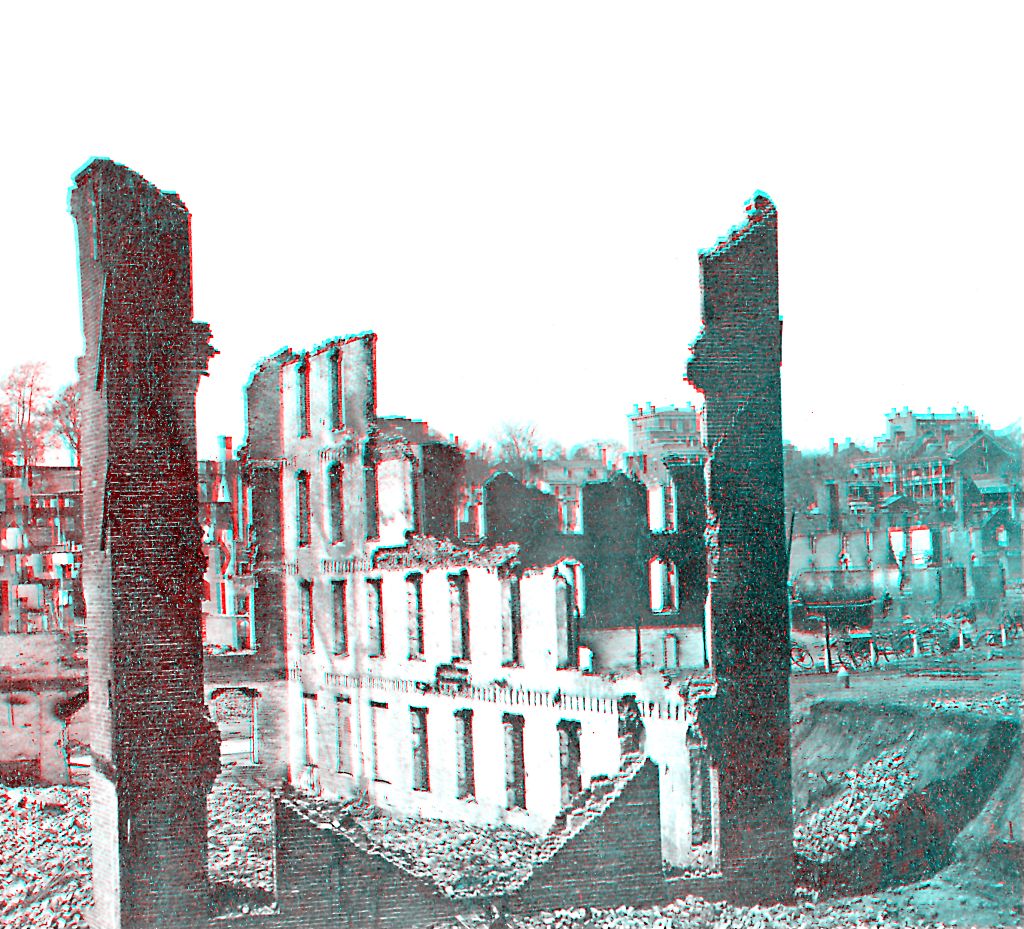
The sesquicentennial of the Civil War coincides with renewed interest in 3-D images for movies, cameras, and television. Although 3-D technology seems new, stereo photography first became popular around the time of the Civil War. In fact, many Civil War photographs were made specifically to be viewed in 3-D.

To bring the historical and modern 3-D methods closer together, the Library of Congress is featuring images of original Civil War stereographs in Flickr along with recently acquired digital anaglyphs made from several of the stereo views. Anaglyphs are those blurry images that pop into 3-D with the help of special glasses that have one red and one blue lens. The anaglyph below to the right shows General Ulysses S. Grant leaning over a bench to examine a map held by General George G. Meade at a council of war in 1864.
In addition to anaglyphs, the Flickr set features rare stereographs printed on cards and some of the Library’s unique original glass negative stereo plates. The hand-colored card at the top of the page shows wounded Union troops at Savage’s Station, Virginia, after the Battle of Gaines’ Mills in 1862.

While 19th-century photographic technology could rarely capture action shots of the war, many stereos show the careful preparation for battles, the aftermaths, and close-up scenes in camps and forts. Now through digital technology, you can zoom in to see details. So grab your 3-D glasses, or cross your eyes to free-view in 3-D, and see what you can find hidden in the depths of these detailed photos.

To see all of the Library’s Civil War stereograph glass negatives, please visit the Prints & Photographs Online Catalog. We’re also adding more stereograph cards each week until the whole collection is online!

And, don’t forget to look at the new collection of Civil War soldier portraits donated by the Liljenquist Family. The exhibition, The Last Full Measure, displays the original tintype and ambrotype photographs at the Library of Congress between April 12, 2011 and August 13, 2011.

The Library’s photo collections primarily document the Union forces because views of the Confederacy are scarce. Fewer photographers were working in the South and photographic supplies were very limited and extremely costly during the war.

The 3-D anaglyphs are being created and donated to the Library by Matt Raymond, its former director of communications.

Thursday, November 11, 2010

World War II ‘Scientific Manpower’

K-rations, better night vision binoculars, and synthetic rubber are just a few examples of innovations resulted from scientific research during World War II.  The story of science during World War II is one of partnerships and prolific research. On June 28, 1941, President Roosevelt issued Executive Order 8807which established the Office of Scientific Research and Development (OSRD) “for the purpose of assuring adequate provision for research on scientific and medical problems relating to national defense.”  In essence, the OSRD brought together the armed services, civilians, government agencies and industry to prioritize defense-related scientific research. It is important to note that the formation of OSRD happened before the U.S. officially entered the War on December 8, 1941.

Time was of the essence– research needed to be funded and completed at a rapid rate.  OSRD mobilized scientific manpower within the country and worked closely with the armed services and allies to identify improvements and inventions needed for national defense. It recruited and funded scientists from educational institutions, research laboratories and a number of industries to help with the war effort. The focus was on weapons, devices, and medicine that could be immediately used in the field by our troops and allies. Under OSRD contracts, these engineers, industrialists, and scientists undertook a wide array of scientific investigations and produced thousands of studies and reports.

The Library’s Technical Reports and Standards (TRS) Unit houses the treasure trove of scientific and technical information generated by OSRD.  There are over 40,000 hard copy reports, 400 reels of microfilm, and 68 bound volumes of the Summary of Technical Reports.  I randomly took an OSRD box off the shelf and peaked inside. What I found were the studies and reports on diet from Dr. Ancel Keys. Dr. Keys is best known for formulating K-rations (meals for soldiers) and for research on cholesterol. Have you heard of the Mediterranean Diet?  Dr. Keys was initiallyresponsible for promoting this low fat diet in the 1940’s.  Here in my hands were his early investigations on health and diet!

There are many more stories of scientific development in this collection, such as the story of RADAR or the mass production of penicillin. It is also the story of civilians, government, and business working together for a common purpose — the national defense. On this Veteran’s Day we honor and remember our soldiers, scientists and civilians who serve and sacrifice for the common good.

Sunday, October 17, 2010

Alexander Scourby’s Narration of King James Bible Now Available as a Digital Talking Book

The National Library Service for the Blind and Physically Handicapped (NLS), part of the Library of Congress, reached a milestone in its digital talking-book program with the reissue of the entire King James Version of the Bible, narrated by Alexander Scourby, on a single digital cartridge.

"The Holy Bible, Containing the Old and New Testaments" combines two titles from the NLS collection—"The Holy Bible, Containing the Old Testament" and "The Holy Bible, Containing the New Testament." Those titles have long been available from NLS as cassette books—on fifteen audiocassette tapes.

Scourby (1913–1985) possessed a voice described in a Time Magazine story of March 15, 1968, as "distinguished, melodic, mellifluous—the kind that makes people stop and listen." His performance credits on stage, screen, and radio ranged from Shakespeare to Superman, and from soap operas to commercials. He narrated more than 500 books during his lifetime, including classics in the NLS collection such as "The Odyssey," "Crime and Punishment," and "The Great Gatsby."

Of all those books, Scourby considered his narration of the King James Version of the Bible, which he recorded over four years in the 1950s, his proudest and most important achievement. "I really stand in awe in pondering that nothing else I have done has had such a powerful and positive impact on people as my recordings of the Bible," Scourby once said. Because of the recording’s popularity, he came to be known as "the Voice of the Bible."

"We are excited to be able to offer Alexander Scourby’s classic narration of the Bible to our patrons in this convenient digital format," NLS director Kurt Cylke said. "It is only one of 3,000 talking-book titles NLS has released on digital cartridges so far, but it is sure to be among the most popular. This marks another significant step in our transition to digital talking books."

National Audio Company in Springfield, Mo., produced and shipped 2,415 copies of "The Holy Bible, Containing the Old and New Testaments" to cooperating libraries, making it the most-ordered NLS title ever.

The new digital Bible may be navigated by testament, book, and chapter on NLS digital talking-book players or authorized commercial players.

"The Holy Bible, Containing the Old and New Testaments" also is available as a digital download to registered users of the NLS Braille and Audio Reading Download (BARD) Internet service. NLS patrons may still request the separate Old and New Testaments on audiocassettes.

NLS administers the free program that loans recorded and braille books and magazines, music scores in braille and large print, and specially designed playback equipment to residents of the United States who are unable to read or use standard print materials because of a visual or physical handicap. After distributing talking books on analog cassettes for nearly forty years, NLS began producing talking books on digital flash cartridges in 2008. Learn more about NLS at www.loc.gov/nls/.

Founded in 1800, the Library of Congress is the nation’s oldest federal cultural institution and the largest library in the world, with nearly 145 million items in various languages, disciplines, and formats. The Library serves the U.S. Congress and the nation both on-site, in its reading rooms on Capitol Hill, and through its award-winning website at www.loc.gov.