Showing posts with label 3D. Show all posts

Thursday, September 13, 2012

Students Create 3-D Objects in the Classroom


Image 1: A middle-school student at the Next Generation School in Champaign, Ill., creates a 3-D object with a classroom 3-D printer. Students in grades K-12 can "print" 3-D objects from computer-generated sources right in the classroom! The rapid prototyping or 3-D lithography process. The process is based on a research project that was headed by Nicholas Fang, an assistant professor in the Mechanical Engineering Lab at the University of Illinois at Urbana-Champaign, and developed at the Center for Nanoscale Chemical-Electrical-Mechanical Manufacturing Systems (NanoCEMMS) at the university. NanoCemms is a National Science Foundation (NSF) Nanoscale Science and Engineering Center.

Image 2: Chess pieces designed and built by students using a classroom 3-D printer at the University Laboratory School (Uni), a public laboratory school for academically talented students from the sub-freshman level (combined seventh and eighth grades) through high school. The new technology enables students in grades K-12 to "print" 3-D objects right in the classroom from computer-generated sources using a rapid prototyping or 3-D lithography process. The process is based on a research project that was headed by Nicholas Fang, an assistant professor in the Mechanical Engineering Lab at the University of Illinois at Urbana-Champaign, and developed at the Center for Nanoscale Chemical-Electrical-Mechanical Manufacturing Systems (NanoCEMMS). NanoCemms at Illinoise at Urbana-Champaign is a National Science Foundation (NSF) Nanoscale Science and Engineering Center.

The process uses UV sensitive monomer to do a form of 3-D printing called microstereo lithography. The studen'ts use a video projector with a UV output to create incredibly thin polymer layers (on the order of 400 nanometers) and build objects layer by layer. The activity demonstrates the basic challenges of nanoscale engineering and mechanical.

The 3-D printing process has already been used by hundreds of students in Illinois at all grade levels to turn mathematical models into objects that they can touch and feel.

To learn more about this technology, see the Illinois news story "Seeing" Means Understanding.

Nano-CEMMS provides a wide range of human resource development activities targeted toward increasing both the diversity of students involved with the center and educational opportunities at the K-12 and undergraduate levels, as well as providing graduate students with teaching experience in an emerging field. To learn more about the center, visit the Nano-CEMMS website. [Research supported by NSF grant CMMI 07-49028, awarded to John Rogers.]

(Date of Images: 2008-2010)

Credit: Joe Muskin, University of Illinois

Tuesday, August 14, 2012

The 3-D Structure of Human Genome Deciphered (Image 11)


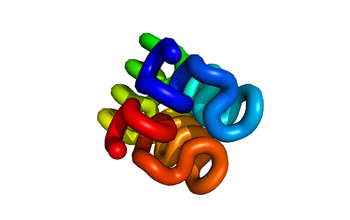
Discovered by Giuseppe Peano in 1890, Peano curves are one-dimensional curves that densely fill higher-dimensional space. A published 3-D map of the genome suggests that long stretches of DNA fold into Peano, curve-like structures.

A team of researchers from Harvard University, the Broad Institute of Harvard and the Massachusetts Institute of Technology (MIT), the University of Massachusetts Medical School, and MIT deciphered the 3-D structure of the human genome, paving the way for new insights into genomic function and expanding our understanding of how cellular DNA folds at scales that dwarf the double helix.

The research was supported in part by the National Science Foundation. To learn more, see the story in the online Harvard Gazette the A look inside Scientists have deciphered 3-D structure of the human genome.

(Date of Image: 2009)

Credit: Leonid A. Mirny and Erez Lieberman-Aiden

The 3-D Structure of Human Genome Deciphered (Images 9 and 10)


Discovered by Giuseppe Peano in 1890, Peano curves are one-dimensional curves that densely fill higher-dimensional space. A published 3-D map of the genome suggests that long stretches of DNA fold into Peano, curve-like structures.

A team of researchers from Harvard University, the Broad Institute of Harvard and the Massachusetts Institute of Technology (MIT), the University of Massachusetts Medical School, and MIT deciphered the 3-D structure of the human genome, paving the way for new insights into genomic function and expanding our understanding of how cellular DNA folds at scales that dwarf the double helix.

The research was supported in part by the National Science Foundation. To learn more, see the story in the online Harvard Gazette the A look inside Scientists have deciphered 3-D structure of the human genome.

(Date of Image: 2009)

Credit: Leonid A. Mirny and Erez Lieberman-Aiden

The 3-D Structure of Human Genome Deciphered (Images 7 and 8)


In this image, nearby regions on a chain of DNA are indicated using similar colors. The fractal globule has a hierarchical organization; regions nearby along the chain are also nearby in 3-D.

Image 8: Discovered by Giuseppe Peano in 1890, Peano curves are one-dimensional curves that densely fill higher-dimensional space. A published 3-D map of the genome suggests that long stretches of DNA fold into Peano, curve-like structures.

A team of researchers from Harvard University, the Broad Institute of Harvard and the Massachusetts Institute of Technology (MIT), the University of Massachusetts Medical School, and MIT deciphered the 3-D structure of the human genome, paving the way for new insights into genomic function and expanding our understanding of how cellular DNA folds at scales that dwarf the double helix.

The research was supported in part by the National Science Foundation. To learn more, see the story in the online Harvard Gazette the A look inside Scientists have deciphered 3-D structure of the human genome.

(Date of Image: 2009)

Credit: Leonld A. Mirny and Maxim Imakaev

The 3-D Structure of Human Genome Deciphered (Images 5 and 6)


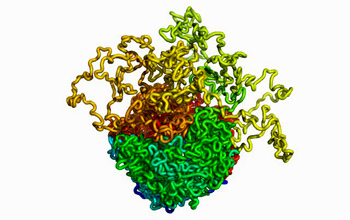
In Image 5, nearby regions on a chain of DNA are indicated using similar colors. The fractal globule has a hierarchical organization; regions nearby along the chain are also nearby in 3-D. Part of this globule is cut out. In the resulting cross-section, the internal spatial clustering is evident.

Image 6 shows the result of reversing the force constraining a subchain of a fractal globule. The subchain unravels easily because the globule lacks knots, making the subchain accessible.

A team of researchers from Harvard University, the Broad Institute of Harvard and the Massachusetts Institute of Technology (MIT), the University of Massachusetts Medical School, and MIT deciphered the 3-D structure of the human genome, paving the way for new insights into genomic function and expanding our understanding of how cellular DNA folds at scales that dwarf the double helix.

The research was supported in part by the National Science Foundation. To learn more, see the story in the online Harvard Gazette the A look inside Scientists have deciphered 3-D structure of the human genome. (Date of Image: 2009)

Credit: Leonid A. Mirny, Maxim Imakaev and Alexnader N. Mirny

The 3-D Structure of Human Genome Deciphered (Images 1 and 2)


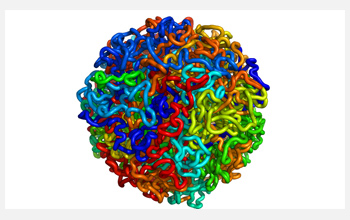
A contiguous stretch of DNA chain inside an equilibrium globule generates an extended, highly knotted shape.


In Image 2, nearby regions on a chain of DNA are indicated using similar colors. The equilibrium globule is highly entangled; regions nearby along the chain are far apart in 3-D.

A team of researchers from Harvard University, the Broad Institute of Harvard and the Massachusetts Institute of Technology (MIT), the University of Massachusetts Medical School, and MIT deciphered the 3-D structure of the human genome, paving the way for new insights into genomic function and expanding our understanding of how cellular DNA folds at scales that dwarf the double helix.

The research was supported in part by the National Science Foundation. To learn more, see the story in the online Harvard Gazette the A look inside Scientists have deciphered 3-D structure of the human genome.

(Date of Image: 2009)

Credit: X. Robert Bao, Leonid A. Mirny and Maxim Imakaev

Wednesday, July 11, 2012

NASA 3-D App Gives Public Ability to Experience Robotic Space Travel


Dwayne Brown
Headquarters, Washington  
202-358-1726
dwayne.c.brown@nasa.gov
 
DC Agle/Guy Webster
Jet Propulsion Laboratory, Pasadena, Calif.
818-393-9011/354-6278
agle@jpl.nasa.gov / guy.webster@jpl.nasa.gov

WASHINGTON -- A NASA-created application that brings some of the agency's robotic spacecraft to life in 3-D now is available for free on the iPhone and iPad.

Called Spacecraft 3D, the app uses animation to show how spacecraft can maneuver and manipulate their outside components. Presently, the new app features two NASA missions, the Curiosity rover that will touch down on Mars Aug. 6 at 1:31 a.m. EDT, and the twin GRAIL spacecraft Ebb and Flow currently orbiting the moon.

"With Spacecraft 3D and a mobile device, you can put high definition, three-dimensional models literally into the hands of kids of all ages," said Stephen Kulczycki, deputy director for communications and education at NASA's Jet Propulsion Laboratory (JPL) in Pasadena, Calif.

Spacecraft 3D is among the first of what are known as augmented-reality apps for Apple devices. Augmented-reality provides users a view of a real-world environment where elements are improved by additional input. Spacecraft 3D uses the iPhone or iPad camera to overlay information on the device's main screen. The app instructs users to print an augmented reality target on a standard sheet of paper. When the device's camera is pointed at the target, the spacecraft chosen by the user materializes on screen.

"Let's say you want to get an idea what our Curiosity Mars rover is all about," said Kevin Hussey, manager of visualization technology at JPL. "Like Hollywood directors sizing up their next shot, you move your camera-equipped iPad or iPhone in and out, up and down and the spacecraft perspective moves with you. It is a great way to study the 3-D nature of NASA spacecraft."

Spacecraft 3D also has a feature where you can take your own augmented-reality picture of the rover or GRAIL spacecraft. You can even make a self-portrait with a spacecraft, putting yourself or someone else in the picture.

"In the near future, we will incorporate the Cassini spacecraft, which is orbiting Saturn, the Dawn spacecraft, which is deep in the heart of the asteroid belt, and the Voyagers, which are right now at the very edge of our solar system," said Hussey. "Looking down the road, we've got a veritable solar system full of spacecraft to work with."

Spacecraft 3D currently is only available for Apple formats, but should be available on other formats in the near future.

The detailed computer models of the spacecraft used in Spacecraft 3D originally were generated for NASA's "Eyes on the Solar System" web application. Eyes on the Solar System" is a 3-D environment full of NASA mission data that allows anyone to explore the cosmos from their computer.

For more information on how to download the Spacecraft 3D app, visit http://itunes.apple.com/us/app/spacecraft-3d/id541089908?mt=8.

For more information about Eyes on the Solar System and NASA robotic missions, visit http://solarsystem.nasa.gov/eyes/.

For information on the GRAIL mission, visit http://www.nasa.gov/grail.

For information on Curiosity, visit http://www.nasa.gov/msl.

- end -

Friday, June 22, 2012

NASA Offers Web, Mobile Links to Follow Space Station and Mission Control


Joshua Buck
Headquarters, Washington                                   
202-358-1100
jbuck@nasa.gov
 
Kelly Humphries
Johnson Space Center, Houston
281-483-5111
kelly.o.humphries@nasa.gov

WASHINGTON -- NASA is using the Internet and smartphones to provide the public with a new inside look at what happens aboard the International Space Station (ISS) and in the Mission Control Center at the Johnson Space Center in Houston. Log onto the agency's Space Station Live! web page or download the companion ISSLive! mobile application to get up-to-the-minute information.

Groundbreaking research and technology development work is going on every day in the microgravity environment of space, and Space Station Live! allows users to see what the expedition astronauts do minute by minute. Streaming data from the space station lets the public see the latest information on temperatures, communications and power generation. Students and teachers can use the data to solve classroom problems in science, technology, engineering and mathematics, or to tour the space station and mission control operator consoles through virtual 3-D view models.

Space Station Live! includes a web experience and free mobile ISSLive! app for smart phones and tablet computers accessible on NASA's website. The app also is available through the Google Play and iTunes app stores.

Special features of the Space Station Live! web and mobile app experience include:
-- live streaming data from various space station systems
-- live streaming data from actual crew and science timelines with social media links
-- descriptions and educational material that describe how the space station works
-- educational lessons using the live content
-- 3-D virtual mission control
-- 3-D virtual space station using live streaming data to correctly position the sun, Earth, moon and the station's solar arrays
-- 3-D model of the space station with labels and colored by the international partner contributions to its assembly
-- links to NASA's five international partner space agencies' mission information.

To use Space Station Live!, visit http://spacestationlive.nasa.gov.

To download ISSLive! and other NASA mobile apps, visit http://www.nasa.gov/connect/apps.html.

For information about the International Space Station, visit http://www.nasa.gov/station.

- end -

Thursday, June 21, 2012

NASA Offers Web, Mobile Links to Follow Space Station and Mission Control


Joshua Buck
Headquarters, Washington                                   
202-358-1100
jbuck@nasa.gov
 
Kelly Humphries
Johnson Space Center, Houston
281-483-5111
kelly.o.humphries@nasa.gov

WASHINGTON -- NASA is using the Internet and smartphones to provide the public with a new inside look at what happens aboard the International Space Station (ISS) and in the Mission Control Center at the Johnson Space Center in Houston. Log onto the agency's Space Station Live! web page or download the companion ISSLive! mobile application to get up-to-the-minute information.

Groundbreaking research and technology development work is going on every day in the microgravity environment of space, and Space Station Live! allows users to see what the expedition astronauts do minute by minute. Streaming data from the space station lets the public see the latest information on temperatures, communications and power generation. Students and teachers can use the data to solve classroom problems in science, technology, engineering and mathematics, or to tour the space station and mission control operator consoles through virtual 3-D view models.

Space Station Live! includes a web experience and free mobile ISSLive! app for smart phones and tablet computers accessible on NASA's website. The app also is available through the Google Play and iTunes app stores.

Special features of the Space Station Live! web and mobile app experience include:
-- live streaming data from various space station systems
-- live streaming data from actual crew and science timelines with social media links
-- descriptions and educational material that describe how the space station works
-- educational lessons using the live content
-- 3-D virtual mission control
-- 3-D virtual space station using live streaming data to correctly position the sun, Earth, moon and the station's solar arrays
-- 3-D model of the space station with labels and colored by the international partner contributions to its assembly
-- links to NASA's five international partner space agencies' mission information.

To use Space Station Live!, visit http://spacestationlive.nasa.gov.

To download ISSLive! and other NASA mobile apps, visit http://www.nasa.gov/connect/apps.html.

For information about the International Space Station, visit http://www.nasa.gov/station.

- end -