Showing posts with label naval postgraduate school. Show all posts

Friday, January 30, 2026

Inaugural Marine Corps AI Fellowship Advances Workforce, Applications

As the Department of the Navy continues to operationalize artificial intelligence across the Navy and Marine Corps, high-profile systems such as unmanned platforms or large-scale information tools grab most of the headlines. But the power of AI extends well beyond these examples, supporting data analysis for complex problem-solving, process automation and decision-support tools at every level. 
 
The Marine Corps is advancing an implementation strategy to leverage AI across the force. A key component of this effort is the AI fellowship at the Naval Postgraduate School in Monterey, California. The new program enables Marines to apply AI capabilities directly to operational challenges, translating emerging technologies into practical, data-driven solutions for the fleet.
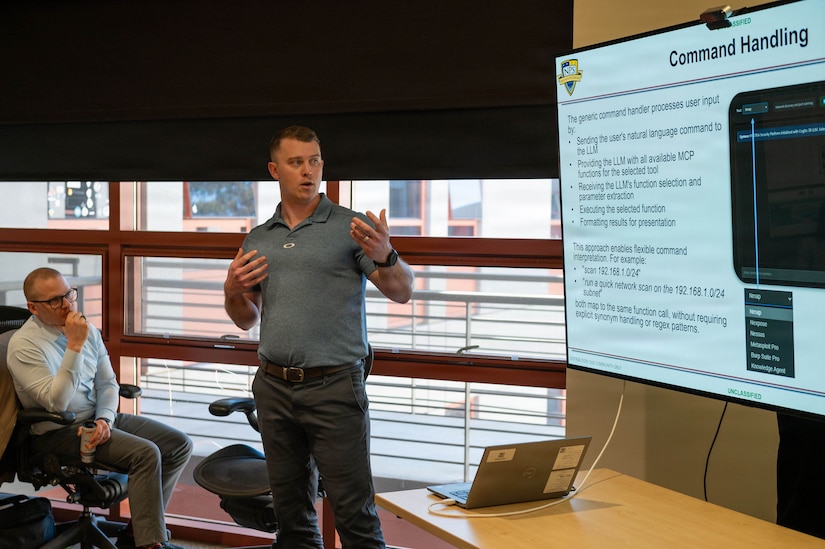
A man wearing casual business attire looks at a screen while speaking in a classroom. Another man, who is seated, watches and listens.

 
"When the fellowship opportunity presented itself, I realized that this is where AI could be appropriately inserted. Not to do our jobs for us, but to streamline our existing process and free our operators to work on more complex problems," said Marine Corps Capt. Stephen Steckler, a member of the inaugural cohort of AI fellows and an NPS graduate in computer science. 
 
Developed in alignment with existing AI strategy and the 39th Commandant's Planning Guidance, the fellowship program accelerates applied AI research while simultaneously developing the service's AI workforce. 
 
Launched in August 2025, program participants spent five months dividing their time between applied research and field experimentation on a use case each fellow has identified. The fellows received targeted AI instruction and mentorship from NPS faculty and industry experts to assist with hands-on research. 
 
Fast forward to early 2026, and the inaugural cohort of AI fellows returned to campus to present their findings to Marine Corps leaders and a cross-section of NPS professors, faculty, students and advisors.
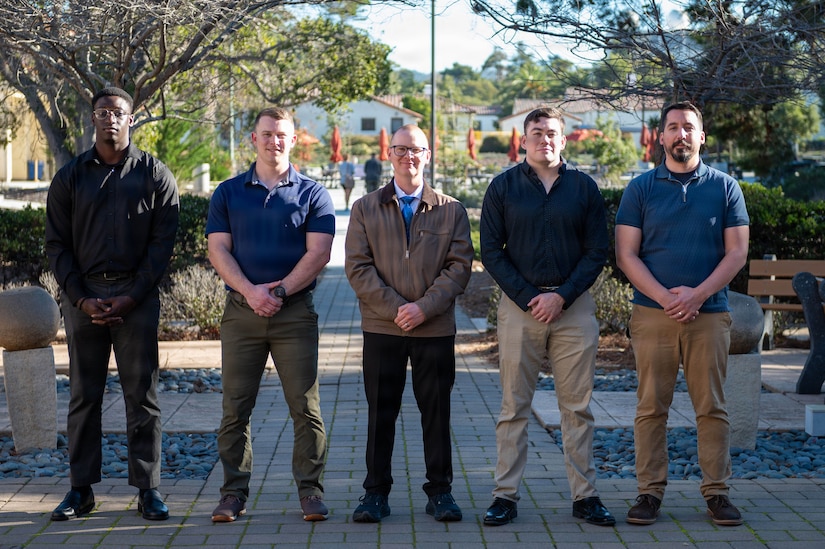
Five men dressed in casual attire stand shoulder to shoulder in a straight line while posing outdoors for a photo.

 
Christopher Paul, Marine Corps chairman for information at NPS, is program lead for this pilot of the AI fellowship, which he modeled after the Air Force Phantom Program at the Massachusetts Institute of Technology in Cambridge, Massachusetts. The program is structured to integrate operational insight with technical expertise, Paul said, leveraging Marines who are familiar with contemporary fleet challenges and understand the potential of AI. 
 
The use cases represented in this inaugural cohort demonstrate the far-reaching potential of AI, Paul said, and how it can be applied across the force to empower people and drive innovation. 
 
"One of our fellows, [Marine Corps] Cpl. Joe Sadler, down at Camp Pendleton, [California,] is in a battalion maintenance facility. He's looking to build a tool that's large language model-based that has an agentic shell that helps with the paperwork surrounding maintenance activities," Paul explained.  

With considerable time and effort spent outside of the actual maintenance, Sadler's idea has the potential to save significant time and effort, he said. 
 
Steckler's project is another example of using AI to help Marines do their jobs better and faster, Paul said.  

"He's at the Marine Corps Operational Test and Evaluation Activity where they get all kinds of new gear and prototype gear, and they have to perform different red teaming and penetration testing of the circuits and the onboard computer apparatus in that gear," Paul said. 
 
Steckler's project explored the use of edge-deployed large language models to automate and streamline Marine Corps cybersecurity operational testing. Developed for his command, the system is designed to operate in classified, air-gapped environments while integrating existing commercial security tools into a single, natural-language interface, reducing both analyst workload and training demands.  

With an overall accuracy rate of 93.3%, the project shows strong potential to reduce personnel requirements and testing timelines, with clear pathways for further development and operational adoption. 
 
In this testing, too much time is spent on applying known vulnerabilities and exploits, Paul said.  

"The vision is to build an AI tool that can automate a bunch of that process," he noted, leaving more time to "think of creative ways to attack or possibly penetrate that gear, so that those vulnerabilities can be patched, closed or avoided before the gear is ever fielded." 
 
While the issues the fellows set out to address were complex, the fellowship's goal is just as much about developing the Marine Corps' AI workforce as it is about the final product. And in just five short months, Steckler said, there were a handful of critical lessons learned that he is eager to share with the next cohort of fellows, who were also on hand for the program review on campus. 
 
"Scope your problem appropriately and pursue your rate-limiting factor aggressively," he said. "Whatever it is that you do not have up front and will take time to get, pursue immediately. With the professors and connections that NPS has, they can move mountains to get you what you need." 
 
While fellows conducted the initial research sprint, programs like the Marine Corps Software Factory provide a parallel pathway to operationalize this work beyond the academic environment. With fellows focused on research-driven prototyping rooted in operational challenges, the software factory works to translate these concepts into production-ready digital tools, reinforcing a broader ecosystem that enables Marines to move AI solutions from the classroom to command.
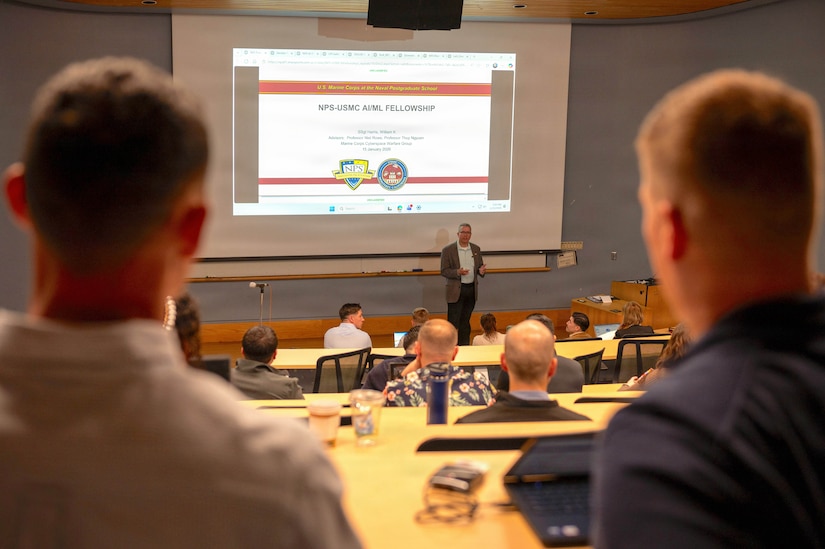
Two men with their backs to the camera stand in the back of a lecture hall watching a man with a projection screen behind him speak. There are also people seated at desks in the hall.

 
Together, these efforts create a continuum that links education, experimentation and deployment, ensuring innovation does not stall at the prototype stage. Guiding these efforts is Marine Corps Col. Pedro Ortiz, software factory liaison officer for AI and emerging technology, who was on hand to hear the fellows' presentations.  

Ortiz is a graduate of the Marine Corps doctorate technical program at NPS that is designed to build a cadre of highly technical Marine Corps officers to identify technological breakthroughs for warfighting applications and support senior leaders in strategy and long-range concept and capability development. 
 
"The projects presented today are a small and important sample of how Marines can implement AI solutions at their level," Ortiz said. "I can envision in the future that this program could produce prototypes that the Marine Corps Software Factory could then transform into production-level software for use across the Marine Corps." 
 
Central to the plan is the principle that AI must augment, not replace, Marines. As AI adoption escalates, balancing speed and risk emerges as a recurring theme. Marine Corps leaders acknowledge the rapid pace of AI development and the corresponding need for agility, while emphasizing that governance structures must remain robust. 
 
"I am very proud of the breadth this program has become. We have such a dynamic range of participants — from government service employees to officers and even a corporal," Paul said. "This program has the workings of great minds at every level of leadership." 
 
As the second cohort of fellows gets underway, the Marine Corps is looking ahead, exploring the establishment of a center for digital transformation to serve as a hub for AI knowledge products, prototyping and collaboration with academia and industry. Partnerships with institutions like NPS, and federally funded research and development centers are expected to play a central role in this effort.

Thursday, April 14, 2011

Naval Postgraduate School Volunteers Judge Science and Engineering Fair

By Barbara Honegger, Naval Postgraduate School Public Affairs

MONTEREY, Calif. (NNS) -- More than 50 Naval Postgraduate School faculty and students served as judges for the 300+ entries at the 2011 Monterey County Science and Engineering Fair, March 25-27.

Local grammar and high school students, 480 in all, competed for top prizes in 24 research categories at the annual event held at California State University Monterey Bay (CSUMB). NPS co-sponsored the Fair along with CSUMB, the Office of Education and community partners.

"The Naval Postgraduate School really went all out to support and encourage local students' interest in, and pursuit of careers in, science and engineering," said Associate Professor of Electrical and Computer Engineering Roberto Cristi, who coordinated all the judging. "In addition to co-sponsoring the Fair, two-thirds of the 85 judges were from NPS – 38 faculty and 16 students; as well as the entire Scientific Review Committee and Special Awards Judging Team also being NPS faculty."

Cristi, Associate Professor of Physics Scott Davis, Mathematics Senior Lecturer Bard Mansager, Associate Professor of Mechanical and Aerospace Engineering Ramesh Kolar and Oceanographer Mike Cook comprised the Scientific Review Committee; and Physics Associate Professor Steve Baker, Physics Senior Lecturer Daphne Kapolka, Electrical and Computer Engineering Associate Professor Monique Fargues and Kolar made up the Special Awards Judging Team.

"The Science Fair is a real win-win for local students as well as NPS," Cristi said. "It's an opportunity for our faculty and officer students to get involved with the local community and for grammar and high school students to learn more about our research programs and opportunities for summer internships."

"The Science Fair was really terrific," agreed Kapolka, one of the special awards judges. "It's always such a pleasure to see the creativity and hard work of our local students. From better ways to keep strawberries fresh to the intricacies of LED light bulb designs, they remind us of how much fun science really is. It's also a great opportunity to interact with our NPS colleagues and graduate students from across campus in a common endeavor. Professor Cristi and [Monterey County Office of Education Administrative Officer and Science Fair Program Director] Ginny Brown put in a Herculean effort to get the fair organized, and everything ran smoothly."

"Monterey County is rich with scientific institutions, and the opportunity for students to work with mentors in their fields, especially at NPS, is unparalleled," said Brown. "At the Fair, the judges go to great lengths to interview each student, where they have to explain the scientific concepts underlying their projects and their research methods. The judges provide feedback as well as ideas for future experimentation, and the senior division winners who advance to the California State Science Fair and the Intel International Science and Engineering Fair (ISEF) are able to incorporate their suggestions to improve their projects prior to the next competition. What's really great is that all of these students are 11th grade or below, and so will be able to benefit from the ISEF experience and come back with even more amazing ideas for next year."

"These fairs are a really great way for kids to begin to explore the scientific process," said NPS Director of Research Communications and Outreach Dave Nickles, one of the NPS judges who served as the Monterey County Office of Education Math and Science Coordinator from 1999 to 2002. "Since I was with the Office of Education, the Fair has grown from one to three days, and it's especially gratifying to see the growing participation of the public schools. The Salinas Union High School District participation this time was huge and very impressive, and the quality of students' entries overall has also increased."

The top award went to grand prize winner Aradhana Sinha of Salinas High School for her research on "Triforine Sensitivity in Lettuce." The 10th grader became interested in the role genetics plays in successful harvests and plans to pursue a career in science. First runner up Kevin Tang of Robert Louis Stevenson (RLS) Upper School did his project on the "Scalability of the Optimal Flight Trajectory of a UAV [Unmanned Aerial Vehicle] Helicopter." Second runners up Hyung "Tom" Kim and Xiaolin "William" Zhu, also of RLS Upper School, investigated "The Bacteriostatic and Bactericidal Effects of Different Metals on Growth Rate of Bacteria," and third runner up Briana Sandoval of Salinas High School researched whether fingerprint patterns are inherited.

Having been a summer intern in NPS' unmanned aerial vehicle program, Tang was excited to have his award presented by the university's National Reconnaissance Office Chair and former Astronaut Dan Bursch. In addition to keynoting the awards ceremony along with Monterey County Superintendent of Schools Nancy Kotowski, Bursch showed a video on NASA's Space Shuttle missions and presented the American Institute of Aeronautics and Astronautics (AIAA) junior division award to Katherine Kamel and Morgan Rector for their project titled "How Does the Shape of a Windmill Blade Affect the Amount of Power It Produces?"

"It was great to be able to congratulate the students on their excellent projects only a few days before the 50th anniversary of the first human space flight [by Yuri Gagarin on April 12, 1961] and encourage them, that their ideas and dreams of today will become the realities of tomorrow," Bursch said. "I told them that I was only able to fly in space as an astronaut because pioneers like Robert Goddard, Hermann Oberth and Konstantin Tsiolkovsk – a Russian science fiction writer and math teacher who published the 'rocket equation' in 1903, 44 years before the first satellite was launched – never gave up on their dreams; and encouraged them to be persistent, as many of the early space pioneers were ridiculed."

In addition to the four top prizes in the junior (grades 6 through 8) and senior (grades 9 through 12) categories, 28 professional organizations also contributed to special awards: the AIAA; Air Force; Army; Navy, via the Naval High School Science Awards Program presented by Reserve Capts. Rudy Klicek and Tom Follo of the Office of Naval Research; Marine Corps; American Meteorological Society; American Psychological Association; American Public Works Association; ASM International Foundation; Association for Women Geoscientists; Broadcam Masters; Rising Stars in Math; Applied Science, Technology and Engineering; California Association of Professional Scientists; California Society for Biomedical Research; CSUMB's Watershed Institute; Intel, for excellence in computer science; Monterey County Ag Education; Monterey County Schools Insurance Group; Monterey Regional Water Pollution Control Agency; Mu Alpha Theta; National Association of Professional Engineers; National Oceanic and Atmospheric Administration; Northern California Institute of Food Technologists; Ricoh; Society for Biomedical Research; Society for In Vitro Biology; Stockholm Junior Water Prize; U.S. Metric Association; U.S. Public Health Service; and Yale Science and Engineering Association.