Showing posts with label defense innovation. Show all posts

Tuesday, August 4, 2026

Department of War Enhances C-UAS Marketplace to Expand Access to Validated Technologies

The Department of War, through Joint Interagency Task Force 401 (JIATF-401), is enhancing its counter-unmanned aerial system (C-UAS) marketplace to improve how military organizations, domestic law enforcement agencies, and international allies and partners identify, evaluate and acquire validated counter-drone technologies.

Developed in partnership with Kaizen Laboratories, the application helps users rapidly identify proven solutions, enabling clearer procurement pathways and faster fielding timelines.

These ongoing enhancements will make it easier for authorized users to search technologies by operational requirements, review validated performance data, and purchase C-UAS products through a streamlined process.

"JIATF-401 remains focused on delivering the right counter-UAS capabilities to the right users at the right time," said U.S. Army Maj. Mike Hapner, C-UAS marketplace lead for JIATF-401. "Our revolutionary marketplace, powered through our partnership with industry, creates a streamlined, trusted pathway for the Joint force, domestic law enforcement, and our international partners to rapidly discover and acquire validated technologies."

The C-UAS marketplace also supports the Secretary of the Army's Foreign Military Sales (FMS) Fast Lane initiative by integrating with existing acquisition pathways to accelerate requirements development and reduce foreign military sales timelines. Through this process, industry partners submit their products for inclusion in the FMS Fast Lane. JIATF-401, in partnership with Deputy Assistant Secretary of the Army for Defense Exports & Cooperation (DASA DE&C), then evaluates and pre-clears these products for Foreign Military Sales, ensuring the capabilities are seamlessly integrated across the joint force, partners, and Allies.

The marketplace is part of JIATF-401's broader effort to strengthen collaboration across government, industry, and Allied nations while expanding access to trusted C-UAS capabilities. By providing a common platform for validated capabilities, JIATF-401 is helping ensure users can make informed acquisition decisions and respond more quickly to an evolving drone threat.

"Drones are a defining threat of our time," said Brig. Gen. Matt Ross, director of JIATF-401. "The proliferation of small systems and small drones and the threat that they pose both to critical infrastructure and to defense critical assets requires us to move faster in this space. In order to address this threat, we are expanding the counter-UAS marketplace to allow us to share best practices and equipment globally."

The JIATF-401 C-UAS Marketplace can be accessed here: https://cuas.mil/

Wednesday, July 22, 2026

Pentagon's Special Ops Office to Host Rapid Tech Innovation Event

The fourth and final line of effort in the 2026 National Defense Strategy calls for the supercharging of the defense industrial base; and within that effort is a call to grow nontraditional vendors. 

To that end, the War Department's Office of the Assistant Secretary of War for Special Operations and Low-Intensity Conflict will host a one-day "accelerator" event, July 24, in the national capital region, in which representatives from more than a dozen companies will have the opportunity to pitch innovative solutions across nine areas related to the military's special operations community. 

The event comes as the office is seeking ways to rapidly innovate technologies and get them into the hands of warfighters quicker than the traditional acquisition avenues. 

"Traditionally, in acquisition, there's a lot of work and energy around the government figuring out what it needs and then telling industry to just build what it thinks it needs; and this is flipping the script on that," explained Bonnie Evangelista, the office's acquisition director for the Secretariat for Special Operations.   

Rather, she said, the office is working to identify what the mission needs and then identify what industry-driven solutions already exist on the market that can meet that. 

"That is a complete 180 from [a traditional] acquisition perspective," Evangelista said, noting that the state of battlefield technology is rapidly changing in a matter of hours and days rather than years and decades as in the past. 

The method the office incorporates into fielding these new technologies is likened to a "critical triangle," wherein warfighters are put in direct contact with private-sector innovators, as well as acquisition industry experts who understand the fiscal and contractual aspect of getting the new technology into the field.   

"We are doing this accelerator event specifically to highlight the might of that triangle coming together to leverage, and kind of put pen to paper on what [Secretary of War Pete Hegseth] is talking about [regarding] empowering the warfighter [and] creating faster spirals to get technology into the field — and doing that in a very, very short time frame," said Carmella Teeter, deputy assistant secretary of war for special operations analysis, resources and capabilities.   

Whereas many traditional acquisition processes can take three or more years to get from awarding of a contract to putting the new technology into the field, the goal for getting any innovative approach or capability that the office selects for acquisition into the field is six months or less, with contracts being awarded the day of the event.  

To get participants for the accelerator event, the team called for short proposal submissions, asking each applicant for a two-page white paper proposal on how they would address certain challenges. 

Soon, the office received nearly 700 applications, which were eventually narrowed down to 15 organizations being invited to the July 24 event. 

During the day of the event, participants will give an initial presentation consisting of an oral presentation, technical brief and government question-and-answer session. 

Any project selected during the first phase — or gate — will be awarded an initial $10,000, with the eligibility to be invited to the second gate of the event and potentially be awarded an additional $50,000 if the technology meets government mission requirements. 

Those companies that pass the second gate will then proceed to the third gate, which is prototype delivery, followed by the final gate of production.  

"[The accelerator] is very focused on trying to break down those barriers to entry that we see in particular with small businesses and the startups," Teeter said, adding that the goal is to cut bureaucracy and create synergy by way of the aforementioned critical triangle.  

Teeter said that what ultimately drives projects like the upcoming accelerator event is the necessity to remember that the warfighters deserve to have the best technology at their disposal, and as quickly as possible. 

"We owe that to these people that are going to be asked to solve the impossible problems," she said. "We owe them unfair advantage on the battlefield, and that's what this is all designed to do: to give our warfighters unfair advantage by making sure that we remember from all the way up to the senior levels here in the [War Department] that their voice and their comfort level with that technology is the thing that we care about most; and we want to empower them to have a say in their future with that."   

If the upcoming event ultimately proves successful, Teeter said she could envision similar events also permeating throughout the department. 

Tuesday, July 14, 2026

Department of War Issues Final FY26 APFIT Awards, Surpassing $2 Billion Milestone and Debuting Software Capabilities

The Department of War today announced a new round of awards under the Accelerate the Procurement and Fielding of Innovative Technologies (APFIT) program, marking a major milestone as the program surpasses $2 billion in total awards since its inception.

This latest cohort builds on APFIT's proven track record of rapidly transitioning cutting-edge technologies into operational use, delivering over 100 unique capabilities to date to the warfighter at speed and scale.

"APFIT has fundamentally reshaped how the Department of War accelerates the transition of innovative technologies to the warfighter," said Emil Michael, Under Secretary of War for Research and Engineering. "Our adversaries are not waiting, and neither will we. By scaling the APFIT program past $2 billion, we are equipping the Joint Force with the lethal capabilities to guarantee dominance on the battlefield."

By aligning funding with near-term operational needs, APFIT has enabled the rapid deployment of mission-critical systems across mission areas including autonomous systems, electronic warfare, expeditionary manufacturing, counter-Unmanned Aerial Systems (c-UAS), resilient communications, contested logistics and resilient energy.

A defining feature of APFIT's success has been its ability to bring emerging innovators into the national security ecosystem, expanding the defense industrial base by partnering with small, non-traditional, and venture-backed companies. APFIT has provided a pathway for innovative companies to deliver impactful solutions without the traditional barriers of defense acquisition.

The final round of FY 2026 procurement selections include*:

  • Advanced Navigation for UAS and Launched Effects, $11.24 million, U.S. Army
  • Assured Position, Navigation, and Timing (PNT) Device at Scale, $43.00 million, U.S. Army
  • Autonomous Low-Profile Vehicle (ALPV) Liberty, $32.58 million, U.S. Marine Corps
  • Beyond Line-of-Sight Link (BLink), $15.55 million, U.S. Pacific Command
  • Counter for All-Domain Operations, $28.00 million, U.S. Army
  • Dragonfly – Electronic Warfare Sensor, $24.17 million, U.S. Special Operations Command
  • Drake Counter-Unmanned Aircraft System (C-UAS), $11.35 million, U.S. Navy
  • DYNAMO Expeditionary Power, $20.50 million, U.S. Air Force and U.S. Marine Corps
  • Expeditionary Multi-Band Protected Communications, $15.86 million, U.S. Navy
  • Forward Operations Resilient Grid & Energy Environment (FORGE), $14.72 million, U.S. Army
  • Harbinger Open-Architecture Mass Munitions, $30.20 million, U.S. Strategic Command
  • High-Energy Density Fuel, $23.00 million, U.S. Marine Corps
  • Kinetic Electronic Safe and Arming Devices and Payloads, $12.98 million, U.S. Marine Corps
  • Low Collateral Effects Interceptor & Multi-Mission UAS, $17.50 million, U.S. Air Force
  • Mira Highly Maneuverable Spacecraft, $19.75 million, U.S. Space Command
  • Optical Navigation Kits, $13.00 million, U.S. Space Force
  • Persistent Subsea Autonomous Profiler (PSAP), $30.80 million, U.S. Navy
  • Self-Detoxifying Metal Organic Framework Suits for Chemical and Biological Protection, $23.67 million, Defense Threat Reduction Agency
  • Tactical Airborne Communications Kit (TACKit), $12.04 million, U.S. Air Force
  • Unruly Portable, One-Way Attack Unmanned Aerial System, $31.00 million, U.S. Special Operations Command
  • Vehicle Protection Active Terahertz Sensor (VPATS), $12.00 million, U.S. Army
  • Wallabee – Low size, weight, and power (SWaP) Sensing System, $11.30 million, U.S. Northern Command
  • WaterCube, $10.30 million, U.S. Transportation Command
  • XSTAT Injectable Hemorrhage Control Devices for Life-Threatening Bleeding, $11.42 million, Defense Health Agency

*Does not include classified selections.

The inaugural APFIT software award selections include:

  • ARCHER AI Platform for Decision Advantage, $10.00 million, U.S. Pacific Command
  • Cybergenome AI Binary Analysis Software, $10.00 million, U.S. Cyber Command
  • Intelligence and Operations Threat Planning Tool, $15.20 million, U.S. Air Force
  • Machine Assisted Information Sharing (MAIS) System for Rapid Intelligence Disclosure, $10.00 million, U.S. Space Command
  • Operator Tactical Intranet Systems (OTIS) Tactical Assault Kit, $17.00 million, U.S. Special Operations Command
  • SCEPTER AI-Based Course of Action Generation, $10.00 million, U.S. Southern Command

This award cycle further expands APFIT's reach into software-only capabilities, reflecting the Department's focus on delivering adaptable, continuously improving systems. By enabling the rapid deployment of updates and enhancements, these efforts equip commanders with tools that evolve at the speed of relevance to ensure dominance across all domains of warfare.

The latest round of awards reflects continued momentum under APFIT, building on previous cohorts that have already delivered measurable operational outcomes. These include systems now actively supporting combatant commands, enhancing situational awareness and enabling decision superiority at the tactical edge.

With more than $2 billion invested to date, APFIT stands as a core component of the Department's innovation strategy, demonstrating what is possible when speed, scale and strategic focus converge. The Department will continue to expand the program's reach, identify high-impact technologies and partner with industry to deliver the next generation of mission-ready capabilities.

Sunday, April 19, 2026

The Role of AI in Modern Warfare and Intelligence Gathering

Artificial intelligence has rapidly become one of the most transformative forces in modern warfare and intelligence operations. No longer limited to experimental systems, AI is now embedded in real-world military decision-making, surveillance, and combat operations. As global conflicts evolve into data-driven environments, the ability to process, interpret, and act on vast amounts of information has become a decisive advantage. The integration of AI into military systems is reshaping how wars are fought, how intelligence is gathered, and how strategic decisions are made, fundamentally altering the nature of conflict in the twenty-first century.

One of the most significant contributions of AI to modern warfare is its ability to accelerate decision-making. Traditional intelligence analysis required human analysts to sift through massive volumes of data from satellites, drones, communications intercepts, and other sources. AI systems now perform this task at unprecedented speed, identifying patterns and threats that would otherwise go unnoticed. In recent U.S. military operations, AI has been used to process large datasets and generate actionable insights, significantly shortening the decision cycle for commanders (Medill on the Hill, 2026). This acceleration allows military leaders to respond more quickly to emerging threats, giving them a strategic advantage in fast-moving conflict environments.

Closely tied to decision-making is AI’s role in intelligence gathering. Modern intelligence operations rely heavily on the integration of multiple data sources, including geospatial imagery, signals intelligence, and open-source information. AI systems such as the U.S. military’s Maven Smart System are designed to analyze this data, identify targets, and prioritize them based on strategic importance (Brennan Center for Justice, 2026). These systems can scan vast amounts of information from satellites, drones, and even social media, enabling analysts to detect patterns of behavior, locate individuals or equipment, and anticipate enemy actions. This capability transforms intelligence from a reactive process into a predictive one, allowing militaries to anticipate threats before they fully materialize.

AI is also playing a critical role in battlefield operations. Autonomous and semi-autonomous systems, including drones and unmanned vehicles, are increasingly used for surveillance, reconnaissance, and combat missions. These systems rely on AI to navigate complex environments, identify targets, and adapt to changing conditions in real time. Recent developments in counter-drone technology demonstrate how AI can be used defensively as well as offensively, with systems capable of detecting and intercepting enemy drones efficiently and at lower cost (Business Insider, 2026). In addition, AI-powered platforms are being developed to coordinate swarms of drones, enhancing their effectiveness and complicating enemy defenses.

Another important application of AI is in logistics and operational support. Military operations depend on the efficient movement of personnel, equipment, and supplies, often under challenging conditions. AI systems are used to optimize logistics by predicting equipment failures, managing supply chains, and improving maintenance schedules. These capabilities enhance operational readiness and reduce costs, allowing militaries to sustain prolonged operations more effectively. AI-driven logistics systems also contribute to mission planning by simulating different scenarios and identifying the most efficient courses of action.

Cybersecurity and information warfare represent another domain where AI has become indispensable. Modern conflicts increasingly involve cyber operations aimed at disrupting communication networks, stealing sensitive information, or spreading disinformation. AI enhances both offensive and defensive cyber capabilities by detecting anomalies, identifying vulnerabilities, and responding to threats in real time. At the same time, AI is being used to generate and analyze digital propaganda, shaping public perception and influencing political outcomes. As a result, the battlefield now extends beyond physical space into the digital domain, where information itself becomes a weapon.

Despite its advantages, the use of AI in warfare raises significant ethical and strategic concerns. One of the most pressing issues is the potential for autonomous weapons systems to make life-and-death decisions without human intervention. While military leaders emphasize that humans remain “in the loop,” the increasing reliance on AI for targeting and decision-making raises questions about accountability and control (The Wall Street Journal, 2026). There is also the risk of unintended escalation, as AI systems operating at high speed may respond to threats in ways that humans cannot easily predict or control. Additionally, the use of AI in surveillance raises concerns about privacy and the potential misuse of data.

The integration of AI into warfare also has broader implications for global security. As more nations develop and deploy AI-enabled systems, the risk of an arms race increases. Countries are investing heavily in AI technologies to gain a strategic edge, leading to rapid advancements and increased competition (U.S. Army War College, 2025). This competition may lower the threshold for conflict, as states seek to demonstrate technological superiority or respond to perceived threats. At the same time, the proliferation of AI technologies raises the possibility that non-state actors could gain access to advanced capabilities, further complicating the security landscape.

In conclusion, artificial intelligence is fundamentally transforming modern warfare and intelligence gathering. By accelerating decision-making, enhancing intelligence analysis, and enabling new forms of combat and cyber operations, AI provides significant advantages to those who can effectively harness it. However, these advancements come with substantial risks, including ethical dilemmas, potential loss of human control, and increased global instability. As AI continues to evolve, its role in warfare will likely expand, making it essential for policymakers, military leaders, and society as a whole to carefully consider how this powerful technology is used. The future of warfare will not be defined solely by weapons or troops, but by algorithms, data, and the ability to turn information into action.

References

Brennan Center for Justice. (2026). The military’s use of AI, explained.

Business Insider. (2026). U.S. Army surged largest counter-drone training deployment in the Middle East.

Medill on the Hill. (2026). Data and decisions: AI is changing how the military operates.

U.S. Army War College. (2025). Artificial intelligence’s growing role in modern warfare.

The Wall Street Journal. (2026). U.S. forces employ AI every single day in Iran operation.

Friday, January 30, 2026

Inaugural Marine Corps AI Fellowship Advances Workforce, Applications

As the Department of the Navy continues to operationalize artificial intelligence across the Navy and Marine Corps, high-profile systems such as unmanned platforms or large-scale information tools grab most of the headlines. But the power of AI extends well beyond these examples, supporting data analysis for complex problem-solving, process automation and decision-support tools at every level. 
 
The Marine Corps is advancing an implementation strategy to leverage AI across the force. A key component of this effort is the AI fellowship at the Naval Postgraduate School in Monterey, California. The new program enables Marines to apply AI capabilities directly to operational challenges, translating emerging technologies into practical, data-driven solutions for the fleet.

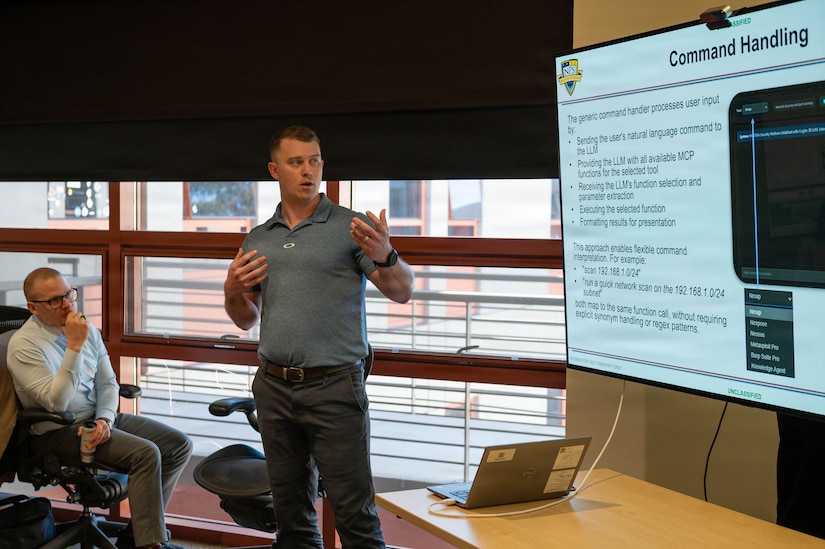
A man wearing casual business attire looks at a screen while speaking in a classroom. Another man, who is seated, watches and listens.

 
"When the fellowship opportunity presented itself, I realized that this is where AI could be appropriately inserted. Not to do our jobs for us, but to streamline our existing process and free our operators to work on more complex problems," said Marine Corps Capt. Stephen Steckler, a member of the inaugural cohort of AI fellows and an NPS graduate in computer science. 
 
Developed in alignment with existing AI strategy and the 39th Commandant's Planning Guidance, the fellowship program accelerates applied AI research while simultaneously developing the service's AI workforce. 
 
Launched in August 2025, program participants spent five months dividing their time between applied research and field experimentation on a use case each fellow has identified. The fellows received targeted AI instruction and mentorship from NPS faculty and industry experts to assist with hands-on research. 
 
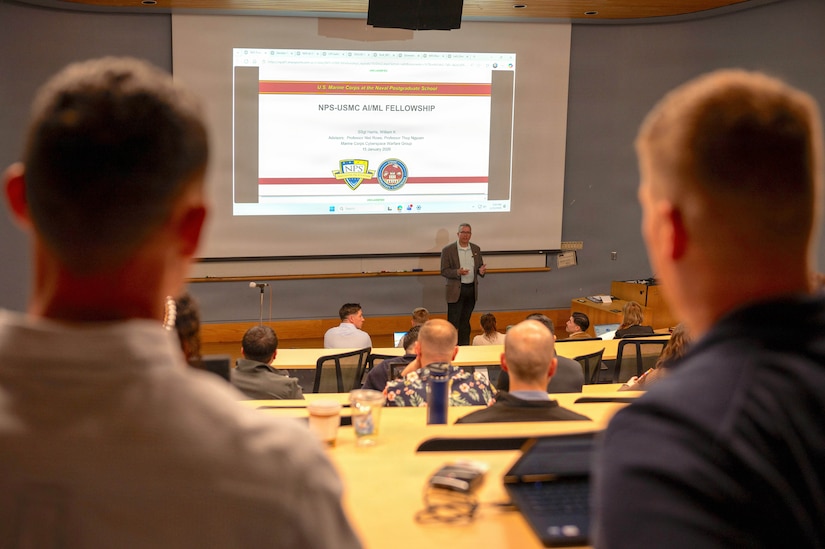
Fast forward to early 2026, and the inaugural cohort of AI fellows returned to campus to present their findings to Marine Corps leaders and a cross-section of NPS professors, faculty, students and advisors.

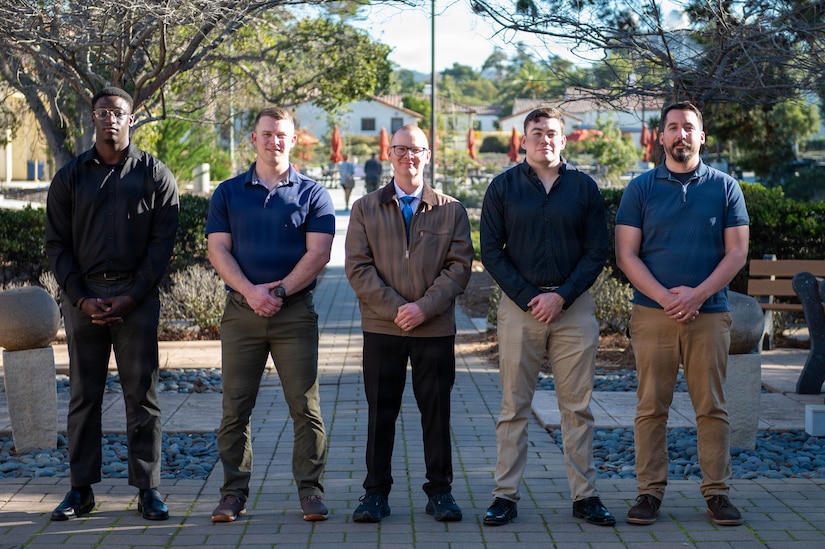
Five men dressed in casual attire stand shoulder to shoulder in a straight line while posing outdoors for a photo.

 
Christopher Paul, Marine Corps chairman for information at NPS, is program lead for this pilot of the AI fellowship, which he modeled after the Air Force Phantom Program at the Massachusetts Institute of Technology in Cambridge, Massachusetts. The program is structured to integrate operational insight with technical expertise, Paul said, leveraging Marines who are familiar with contemporary fleet challenges and understand the potential of AI. 
 
The use cases represented in this inaugural cohort demonstrate the far-reaching potential of AI, Paul said, and how it can be applied across the force to empower people and drive innovation. 
 
"One of our fellows, [Marine Corps] Cpl. Joe Sadler, down at Camp Pendleton, [California,] is in a battalion maintenance facility. He's looking to build a tool that's large language model-based that has an agentic shell that helps with the paperwork surrounding maintenance activities," Paul explained.  

With considerable time and effort spent outside of the actual maintenance, Sadler's idea has the potential to save significant time and effort, he said. 
 
Steckler's project is another example of using AI to help Marines do their jobs better and faster, Paul said.  

"He's at the Marine Corps Operational Test and Evaluation Activity where they get all kinds of new gear and prototype gear, and they have to perform different red teaming and penetration testing of the circuits and the onboard computer apparatus in that gear," Paul said. 
 
Steckler's project explored the use of edge-deployed large language models to automate and streamline Marine Corps cybersecurity operational testing. Developed for his command, the system is designed to operate in classified, air-gapped environments while integrating existing commercial security tools into a single, natural-language interface, reducing both analyst workload and training demands.  

With an overall accuracy rate of 93.3%, the project shows strong potential to reduce personnel requirements and testing timelines, with clear pathways for further development and operational adoption. 
 
In this testing, too much time is spent on applying known vulnerabilities and exploits, Paul said.  

"The vision is to build an AI tool that can automate a bunch of that process," he noted, leaving more time to "think of creative ways to attack or possibly penetrate that gear, so that those vulnerabilities can be patched, closed or avoided before the gear is ever fielded." 
 
While the issues the fellows set out to address were complex, the fellowship's goal is just as much about developing the Marine Corps' AI workforce as it is about the final product. And in just five short months, Steckler said, there were a handful of critical lessons learned that he is eager to share with the next cohort of fellows, who were also on hand for the program review on campus. 
 
"Scope your problem appropriately and pursue your rate-limiting factor aggressively," he said. "Whatever it is that you do not have up front and will take time to get, pursue immediately. With the professors and connections that NPS has, they can move mountains to get you what you need." 
 
While fellows conducted the initial research sprint, programs like the Marine Corps Software Factory provide a parallel pathway to operationalize this work beyond the academic environment. With fellows focused on research-driven prototyping rooted in operational challenges, the software factory works to translate these concepts into production-ready digital tools, reinforcing a broader ecosystem that enables Marines to move AI solutions from the classroom to command.

Two men with their backs to the camera stand in the back of a lecture hall watching a man with a projection screen behind him speak. There are also people seated at desks in the hall.

 
Together, these efforts create a continuum that links education, experimentation and deployment, ensuring innovation does not stall at the prototype stage. Guiding these efforts is Marine Corps Col. Pedro Ortiz, software factory liaison officer for AI and emerging technology, who was on hand to hear the fellows' presentations.  

Ortiz is a graduate of the Marine Corps doctorate technical program at NPS that is designed to build a cadre of highly technical Marine Corps officers to identify technological breakthroughs for warfighting applications and support senior leaders in strategy and long-range concept and capability development. 
 
"The projects presented today are a small and important sample of how Marines can implement AI solutions at their level," Ortiz said. "I can envision in the future that this program could produce prototypes that the Marine Corps Software Factory could then transform into production-level software for use across the Marine Corps." 
 
Central to the plan is the principle that AI must augment, not replace, Marines. As AI adoption escalates, balancing speed and risk emerges as a recurring theme. Marine Corps leaders acknowledge the rapid pace of AI development and the corresponding need for agility, while emphasizing that governance structures must remain robust. 
 
"I am very proud of the breadth this program has become. We have such a dynamic range of participants — from government service employees to officers and even a corporal," Paul said. "This program has the workings of great minds at every level of leadership." 
 
As the second cohort of fellows gets underway, the Marine Corps is looking ahead, exploring the establishment of a center for digital transformation to serve as a hub for AI knowledge products, prototyping and collaboration with academia and industry. Partnerships with institutions like NPS, and federally funded research and development centers are expected to play a central role in this effort.

Thursday, January 8, 2026

The War Department Strengthens Measures to Protect DOW‑Funded Research

Today, Under Secretary of War for Research and Engineering, Emil Michael announced new actions to protect Department of War (DoW)-funded research from malign foreign influence, intellectual property theft, and other forms of exploitation that threaten the security and economic interests of the United States. The Fundamental Research Security Initiatives and Implementation memorandum reflects the Department's commitment to strong research security and close alignment with congressional oversight efforts, including the House and Senate Armed Services Committees, House and Senate Appropriations Committees, and the House Select Committee on the Chinese Communist Party.

"The War Department is intensifying its efforts to safeguard taxpayer-funded research and is upholding the integrity of America's scientific community," said Emil Michael, Under Secretary of War for Research and Engineering. The memorandum directs several immediate steps to strengthen protections across the Department's research enterprise.

Key actions include:

  • Prohibiting fundamental research assistance award funding to companies listed under Section 1260H of the National Defense Authorization Act, which identifies Chinese military companies operating in the United States
  • Establishing a department-wide Fundamental Research Risk Review Repository to improve information collection and sharing across all DoW components
  • Identifying and developing automated vetting and continuous monitoring capabilities where practicable to help detect and mitigate foreign influence risks

Additional measures include further annual spot checks of research awards, standardized reporting of current and pending foreign support, expanded training for research security personnel and coordinated assessments of cases highlighted by congressional oversight committees. These steps allow the Department to identify vulnerabilities faster, more aggressively enforce compliance and more rigorously strengthen protections across all DoW-funded research.

Through these actions, the Department will better anticipate emerging threats, adapt to evolving adversarial tactics, and maintain America's position as a global leader in innovation and research. The War Department will continue to secure the bleeding edge of discovery, so our warfighters remain the most lethal force on earth.