Wednesday, October 1, 2025

Department of War Awards $19M to Stimulate Academic Research in Underutilized States

The Department of War today announced $19.2 million in awards to 29 collaborative academic teams under the Defense Established Program to Stimulate Competitive Research (DEPSCoR). DEPSCoR is a capacity-building program designed to strengthen the basic research infrastructure at institutions of higher education in underutilized states/territories.

"The Department's technology progress relies on a network of creative and insightful academics in every state of the nation. DEPSCoR aims to enhance the science and engineering foundations for these researchers and their institutions, while encouraging more researchers to pursue investigations in DoW-relevant areas. It is crucial that we build defense research infrastructure that strategically develops and uses the vast capabilities found across the country," said Dr. David Montgomery, acting director of DoW's Basic Research Office.

Today's awards follow two fiscal year 2024 competitions – the DEPSCoR Research Collaboration competition and the DEPSCoR Capacity Building competition.

The DEPSCoR Research Collaboration competition is open to tenured and tenure-track faculty members with appointments in the 37 states/territories eligible to compete for program funds. The competition helps these prospects understand DoW's unique research challenges and introduces them to the Department's supportive research ecosystem.

DoW received over 120 white papers for the FY 2024 Research Collaboration competition. Subject matter experts in the military services selected the final 27 collaborative teams, led by universities in Alabama, Arkansas, Arizona, Connecticut, Hawai'i, Indiana, Iowa, Minnesota, Missouri, Montana, Nebraska, Oklahoma, Rhode Island, and Wisconsin. Each team will receive up to $600,000 over a three-year period of performance to pursue science and engineering projects in areas relevant to DoW initiatives.

Click here for the list of winning Research Collaboration teams. 

The DEPSCoR Capacity Building competition supports the strategic objectives of institutes of higher education (either individually or in partnership with others) in DEPSCoR-eligible states/territories, enhancing their competitiveness as research and development centers.

DoW received over 30 white papers for the FY 2024 Capacity Building competition, from which DoW subject matter experts selected two finalists. The executive offices at Boise State University and the University of Iowa will lead the selected teams. Each team will receive up to $1.5 million over a two-year period of performance to pursue capacity-building activities that will help them achieve basic research excellence in areas relevant to DoW.

Sunday, September 28, 2025

When the Grid Goes Down: The Hidden Risks of Reliance on Smart Homes & IoT

Picture the lights flicker and fail—not just the lamps and the TV, but the door locks, garage opener, thermostat, baby monitor, security cameras, and the CPAP that keeps a loved one breathing safely through the night. What used to be a routine outage now instantaneously becomes a whole-home systems failure. That’s the paradox of our connected lives: the more “smart” our homes become, the more brittle they can be when the larger power and communications systems we depend on are stressed or fail.

Smart homes—bundles of internet-connected devices that automate comfort, convenience, surveillance, and safety—have moved from novelty to normal. Consumers increasingly use cloud-tethered services for lighting and HVAC, keyless entry, food storage and cooking, irrigation, entertainment, and even medical monitoring. Yet this expanding convenience layer rests on two preconditions that are often fragile in crisis: electricity and connectivity. When the grid goes down or networks are degraded, homes designed to be “frictionless” may quickly become difficult to manage, less secure, and—if medical devices are involved—potentially dangerous.

This essay examines how rising blackout risk intersects with growing household reliance on smart devices. It identifies the vulnerabilities that can emerge when electricity or internet service falter, explores psychological and social dynamics that increase risk, and outlines practical steps households can take to build resilience without abandoning technology’s benefits. It also situates the problem in a broader policy context: a modernizing grid facing weather extremes, aging infrastructure, and cyberthreats at the same time consumers are connecting more devices than ever.

The Modern Smart Home, in Brief

“Smart home” is a catch-all for internet-enabled sensors, appliances, and systems managed via apps, voice assistants, or automation routines. Common examples include smart thermostats, door locks, doorbells and cameras, lighting, smoke and CO alarms, refrigerators and ranges, irrigation controllers, leak sensors, robot vacuums, and an array of health and wellness devices. Adoption has accelerated alongside near-universal smartphone ownership and widespread home broadband access, which serve as the control surface for these devices (Pew Research Center, 2024). The connective tissue—the cloud, Wi-Fi routers, and consumer IoT platforms—unlocks remote control and data-driven automation. But connectivity is also the Achilles’ heel.

While there is debate over the exact percentage of U.S. households with one or more smart devices (estimates vary with definitions and methods), the directional trend is clear: households continue to add connected devices and spend real money doing so, integrating them into everyday routines (Deloitte, 2023; Pew Research Center, 2024). As smart devices proliferate, the number of single points of failure multiplies.

A Grid Under Stress

Electric reliability is no longer a background guarantee in many regions. Multiple factors have combined to elevate outage risk: more frequent and intense heat waves and winter storms, drought-driven wildfires, aging infrastructure, changing generation mixes with different flexibility characteristics, soaring peak demand from electrification and data centers, and transmission build-out that has lagged behind need. The North American Electric Reliability Corporation (NERC) has repeatedly warned that large swaths of the U.S. face elevated risks of supply shortfalls during extreme conditions (NERC, 2024a; NERC, 2024b).

The 2021 Texas winter storm (Winter Storm Uri) remains a stark case study: cascading failures across natural gas supply, generation, and demand response contributed to days-long outages affecting millions; hundreds died from associated causes (FERC, NERC & Regional Entity Staff Report, 2021/2021a). In the West, utilities increasingly employ Public Safety Power Shutoffs (PSPS)—deliberate, precautionary outages to avoid ignitions during wind events—placing reliability and safety into direct tension for high-fire-threat areas (California Public Utilities Commission, 2025). Meanwhile, federal auditors have underscored persistent cyber risks to grid operations and the need to improve coordination across agencies responsible for protecting critical infrastructure (U.S. Government Accountability Office, 2024).

The upshot is not panic but prudence: the probability of localized, multi-hour (and sometimes multi-day) outages has risen for many consumers. That risk profile matters more in a home where locks, life safety, and daily functions depend on power and network availability.

Hidden Vulnerabilities of Smart Homes During Outages

1) Power Dependence Beyond the Obvious

In a conventional home, the lights go out and most other systems either fail “open” (you can still use a mechanical key) or fail safely. In a smart home, more everyday actions may become power-dependent: keyless entry, powered deadbolts, automated garage doors, induction cooktops, networked smoke alarms, and refrigerator health notifications are all electricity-reliant. When backup batteries exist, their runtime may be measured in hours, not days. If a refrigerator warms, stored insulin or other temperature-sensitive medications can spoil—an example of a household-level failure with health implications.

2) Cloud and Connectivity Fragility

Many devices degrade significantly without internet access, even when local power is present (e.g., during ISP outages or cell network congestion). Cloud authentication may block local control; camera recordings that rely on cloud storage stop; voice assistants go silent. If the router or modem lacks backup power, the “brain” of the smart home dies even if the utility outage is brief. Because the value of many devices is tied to remote control and alerts, network loss erodes the core benefit at precisely the wrong time.

3) Security Systems That Fail “Dumb”

Door locks and security devices that depend on apps, hubs, or Wi-Fi can become unresponsive during outages. Some locks default to a failsafe state that is less secure; others remain locked but cannot be operated electronically—problematic if residents have come to rely on phone-as-key and don’t carry physical keys. Garages with disabled openers can trap vehicles; exterior cameras go dark, potentially at times of heightened criminal opportunity in darkened neighborhoods.

4) Medical and Assistive Devices

Smart medical devices—from CPAPs and oxygen concentrators to home dialysis and cardiac monitors—are increasingly integrated with apps and cloud dashboards. The FDA has issued preparedness guidance emphasizing power and supply continuity for such equipment (U.S. Food and Drug Administration, 2024a; 2024b). For households depending on powered devices for therapy or monitoring, a grid failure is not merely inconvenient: it can be life-threatening unless backup power and contingency plans are in place.

5) Cyber-Physical Complications

A sophisticated cyberattack that degrades parts of the grid or targets internet infrastructure can compound physical outages with network disruptions. Government watchdogs have stressed the need to harden operational technology (OT) and improve information sharing to reduce systemic risk across sectors, including energy (U.S. Government Accountability Office, 2024). Consumer IoT itself has known weaknesses—weak default credentials, inconsistent patching, cloud supply-chain dependencies—that can introduce new attack surfaces in the home. CISA has published acquisition guidance to help buyers evaluate and mitigate these risks before devices enter critical workflows (Cybersecurity and Infrastructure Security Agency, 2022).

Psychological and Social Risk Factors

Technology can create an illusion of control. Routines and automations lull us into believing systems will always work as expected. That confidence can displace analog backups and skills: people stop carrying physical keys, forget manual garage releases exist, and never practice “dark mode” living. Outages then become paralyzing rather than inconvenient. There is also a social dimension: outage-wide darkness increases opportunity for opportunistic crimes, while disabled alarms and cameras degrade deterrence and evidence capture. In this way, highly connected homes can become more attractive targets during blackouts unless households plan for degraded states.

Building Household Resilience Without Abandoning Technology

The goal is not to reject smart homes but to design for graceful degradation—ensuring core functions continue when power or internet fail.

1) Redundancy and “Analog First” Mindset

  • Carry physical keys and confirm every exterior door has a mechanical override. If using smart locks, verify battery life and practice manual operation.

  • Keep a manual garage release tool accessible.

  • Maintain non-networked smoke/CO detectors alongside smart versions or ensure the smart model works fully without cloud and has long-life battery backup.

  • For refrigeration, thermometers with audible alarms provide a power-agnostic check; critically, plan for insulated containers and ice to protect medications during extended outages.

2) Power Resilience Layers

  • Router/ONT backup: a dedicated uninterruptible power supply (UPS) for modem, router, and a central hub can keep local control and LAN-only devices running for hours.

  • Device-level batteries: where available, choose devices with swappable batteries or rechargeable packs and keep spares charged.

  • Portable power stations and inverter generators: size solutions for critical loads (medical devices, refrigeration, communications). Operate generators safely, with proper ventilation and transfer switches.

  • Solar + storage: home battery systems paired with rooftop solar can island during outages if configured with critical-load panels; even modest storage can sustain essentials.

  • Car-to-home options: some EVs and hybrid vehicles support export power for essential circuits; understand limits before an emergency.

3) Connectivity Contingencies

  • Multi-path internet: where feasible, maintain failover from cable/fiber to a cellular hotspot (with its own power bank).

  • Prefer devices that retain local control (e.g., via Bluetooth, Zigbee/Z-Wave, Matter over Thread) even when the cloud is down; verify this in documentation.

  • Local storage for cameras (microSD or local NVR) avoids total loss of security visibility when cloud access fails.

4) Smart Device Procurement with Security in Mind

  • Use CISA’s IoT acquisition considerations to evaluate devices: patchability, SBOM/transparency, secure defaults, and offline functionality (CISA, 2022).

  • Change default passwords, enable MFA where supported, and segment IoT devices on a guest or VLAN network to limit lateral risk.

  • Favor vendors with clear update policies and long support windows; avoid orphaned ecosystems.

5) Medical Device Preparedness

  • Ask your clinician and the manufacturer about battery options, runtime, and generator compatibility.

  • Register with your utility and local fire department if someone in the home depends on powered medical devices; many utilities maintain medical baseline or priority restoration lists (FDA, 2024a).

  • Stock spare consumables and practice switching to backup power to reduce transition risk.

6) Practice “Dark Drills”

  • Twice a year, run a two-hour blackout drill: kill the main breaker (if safe to do so) or simulate by unplugging nonessential circuits. Test door access, lighting, communication, refrigeration plans, and medical device continuity.

  • Document a household outage plan: who does what, in what order, and where backups are stored.

Community and Policy Dimensions

Household resilience sits within broader infrastructure choices. Three themes are especially relevant:

  1. Grid hardening and weatherization. Post-event investigations like the Winter Storm Uri report emphasize weatherization across fuel supply and generation, better winter planning, and improved load shed protocols to prevent catastrophic cascades (FERC/NERC, 2021/2021a). Policymakers and regulators must convert lessons learned into enforceable standards and continuous exercises.

  2. Decentralization and microgrids. Community microgrids, critical-facility islands, and neighborhood-level solar-plus-storage can reduce widespread outages and keep essential services operating. Thoughtful interconnection rules and cost-sharing mechanisms can accelerate deployment, but planning must account for cyber and operational risks so that decentralization doesn’t introduce new fragility.

  3. Cybersecurity across sectors. GAO’s 2024 reviews call for improved coordination between CISA and sector risk management agencies and better measurement of cybersecurity practice adoption—particularly for operational technology (U.S. Government Accountability Office, 2024). As consumer IoT expands, clear labeling, minimum security baselines, and long-term support commitments can reduce household exposure and systemic risk.

Finally, public safety shutoffs present a special case: they can save lives by preventing wildfires, but they also shift risk to households—especially those dependent on powered medical devices. Transparent criteria, granular targeting, robust notification systems, and utility-provided support (e.g., community resource centers, device charging, refrigeration) are essential to make PSPS as safe and tolerable as possible (California Public Utilities Commission, 2025).

Conclusion: Designing for Graceful Degradation

Smart homes are here to stay. They can save energy, enhance safety, and simplify life. But when the grid goes down or networks fail, their very intelligence can turn into brittleness if we haven’t designed for failure. The answer is not to abandon technology—it’s to pair it with redundancy, local control, and practiced contingency plans. Treat internet and power like the critical dependencies they are. Choose devices that still function offline. Keep analog fallbacks for entry, cooking, lighting, and signaling. Plan for medical device continuity. Drill the plan.

The smartest home is the one that stays functional when the world outside isn’t. Build for that day, and every other day gets better too.


References

California Public Utilities Commission. (2025). Public Safety Power Shutoffs (PSPS). Retrieved September 2025.

Cybersecurity and Infrastructure Security Agency. (2022). Internet of Things (IoT) acquisition guidance document. U.S. Department of Homeland Security.

Deloitte. (2023). 2023 connectivity and mobile trends survey. Deloitte Insights.

Federal Energy Regulatory Commission, North American Electric Reliability Corporation, & Regional Entity Staff. (2021/2021a). The February 2021 cold weather outages in Texas and the South Central United States: FERC, NERC and Regional Entity staff report. Federal Energy Regulatory Commission.

North American Electric Reliability Corporation. (2024a). 2024 Summer Reliability Assessment. NERC.

North American Electric Reliability Corporation. (2024b). 2024 Long-Term Reliability Assessment. NERC.

Pew Research Center. (2024). Internet and broadband fact sheet. Pew Research Center.

U.S. Food and Drug Administration. (2024a). FDA offers tips about medical devices and natural disasters. U.S. Department of Health and Human Services.

U.S. Food and Drug Administration. (2024b). Emergency preparedness and medical devices: Supply chain recommendations. U.S. Department of Health and Human Services.

U.S. Government Accountability Office. (2024). Electricity markets, grid security and resilience: High-risk series highlights (GAO-24-107231). GAO.

Friday, September 26, 2025

Department of War Awards $33.5 Million to Increase Solid Rocket Motor Capacity and Capability

Sept. 26, 2025

Today, the Department of War announced two Defense Production Act (DPA) Title III awards totaling $33.5 million to expand the solid rocket motor (SRM) industrial base. The awardees are Americarb. Inc. (Americarb) in Niagara Falls, New York and General Dynamics Ordnance and Tactical Systems (GD-OTS) in Lincoln, Nebraska. These awards support the Department of War's objectives to expand the munitions industrial base, bolster supply chain resiliency, and increase domestic production in strategic priority areas.

"To meet the evolving threats of tomorrow, we must expand our capacity to produce the critical subcomponents that underpin our munitions systems," said Under Secretary of War for Acquisition and Sustainment Michael Duffey. "By advancing resiliency in the solid rocket motor supply chain, we're not only strengthening our defense industrial base but also helping to ensure a reliable and scalable supply of the materials and components crucial to our national security."

Using DPA Title III funds, the two new awardees will strengthen SRM production capability by modernizing existing facilities and improving manufacturing processes:

  • DOW awarded Americarb $12.6 million to develop a solution for converting woven rayon fabric into carbonized rayon phenolic (CRP). CRP is a crucial polymeric ablative material utilized for insulating rocket nozzles in SRMs that are key for tactical missile, hypersonic, and strategic programs. Americarb will provide a prototype process and demonstrate the production of CRP to enhance DoD's supply chain resilience for this critical material.
  • DOW awarded GD-OTS $20.9 million to increase SRM nozzle production capacity and capability, becoming a new supplier for composite rocket nozzles and insulators. The main technologies supported by the investment are tape wrapping and high-rate material handling technologies. These technologies, supplemented with GD-OTS' wide knowledge base of composite processing, will focus on throughput and quality for nozzle fabrication. GD-OTS' ability to manufacture components in-house can bring overall system-level lead times down, increase industry annual production capacity, and assist in the replenishment of the nozzle supply chain.

This announcement brings the total number of DPA Title III awards made to the SRM industrial base under a recent Defense Industrial Base Consortium Other Transaction Agreement (DIBC OTA) solicitation to six, for a total of $87.3 million.

These are two of 16 investments made by the DPA Purchases Office totaling $811.5 million since the beginning of fiscal year 2025. These investments are complemented by $88 million in total recipient cost shares since the beginning of FY 2025. The DPA Purchases Office is overseen by the Manufacturing Capability Expansion and Investment Prioritization (MCEIP) directorate in the Office of the Assistant Secretary of War for Industrial Base Policy (OASW(IBP)).

About the Office of the Assistant Secretary of War for Industrial Base Policy (OASW(IBP)

The OASW(IBP) works with domestic and international partners to forge and sustain a robust, secure, and resilient industrial base enabling the warfighter, now and in the future. OASW(IBP) also utilizes a new Defense Industrial Base Consortium Other Transaction Agreement (DIBC OTA) to solicit new ideas for research or prototype project solutions for critical Supply Chain Resiliency Focus Areas. It underscores the Department's ongoing dedication to safeguarding the integrity of our crucial supply chain and furnishing our warfighters with materials and technologies promptly. To learn more about the DIBC OTA, please visit: https://www.dibconsortium.org.

Phone Forensics: Diving Into Digital Evidence

This is the seventh installment in a series of profiles featuring DEA special agents, diversion investigators, chemists, and more. Learn about the tough but fulfilling, fascinating, and vital work these DEA personnel do, as well as the many different ways to get involved in fighting drug misuse. For our seventh profile, we will be interviewing Senior Examiner Laura from the Digital Evidence Lab.

What motivated you to join the DEA?

When I was in college, I knew I wanted to end up in law enforcement forensics. I was not interested in the other options at the time such as incident response, network forensics, or private/contract work. There are a lot of different opportunities for digital forensics in law enforcement, but the types of cases vary between organizations. I had previously worked other case types that were emotionally draining and I was looking forward to a change of ‘scenery’ while still working on criminal cases. The diversity of case types and the ability to travel globally were major selling points for me. I also really enjoy working with case agents in the field, either when I’m on-site with them or analyzing evidence that they couldn’t get into.

What does an average day on the job look like for you?

There’s a lot of variety in an average day. Generally, at our lab we support law enforcement investigations by acquiring (copying and preserving), processing, and analyzing digital evidence such as computers, phones, and servers. Any given day could be a combination of these. We occasionally get called to testify in court as expert witnesses.

I have specialized training in mobile device processing and analysis, so those are the types of exhibits I typically handle now. In addition to case work, my group and I have been working to develop and present training to the field (non-digital forensics folks) regarding digital evidence and mobile devices. The schedule at the lab is flexible but we have core hours during the day when we can be reached. Most recently I’ve been focusing more on training than exhibit handling, but when I have mobile devices, I check them to see if any are finished processing so I can review the data. I make sure to communicate with the submitting case agent to find out what kind of information they’re specifically interested in. Report writing and detailed notes are part of our everyday life at the lab.

What has been your proudest moment at the DEA thus far?

My proud moments come anytime I help someone. I reach out to colleagues to get their input if I’m stuck on something, so it’s nice to be able to return the favor. It’s difficult to describe, but I am also proud when I am able to get into a particularly difficult device- whether it’s locked, encrypted, broken and needs repair, or generally troublesome. I try not to give up easily on difficult devices and it is always nice when perseverance pays off.

How can young people who are interested in becoming a forensic examiner at DEA best prepare themselves for the positions?

DEA has three different forensic disciplines: digital, chemistry, friction ridge/fingerprints; first you’ll have to decide what kind of forensics you’re interested in. If you choose digital forensics, you should be familiar with the fundamental principles for digital forensics. A passion and willingness to learn are really important in our field because technology changes so fast, you have to be willing to keep up. We have a lot of processes and procedures that require a keen attention to detail. Being a team player is helpful because we rarely work alone, and constantly talk to colleagues about what we’re working on. Other than those skills, a degree or certifications would help set you apart from other applicants but aren’t a requirement to start working at the lab. We have a robust training program here; we’re willing to teach you as long as you’re willing to learn.

The synthetic opioid fentanyl – often mixed into other drugs – is now responsible for tens of thousands of American deaths per year. How has the fentanyl epidemic changed your job?

There have been drastic changes in the amount of evidence we’re seeing related to fentanyl. When someone overdoses, we often get their phone for any number of reasons: to get information about the source of the drug (the potential dealer, recent contacts, unknown numbers, locations, etc.) or to figure out who it belonged to if there were multiple victims. Fentanyl has made drug use so much more dangerous than it was to begin with and we see the unfortunate consequences all too often here at the lab.

Wednesday, September 24, 2025

Department of War Announces New Cybersecurity Risk Management Construct


Sept. 24, 2025

The Department of War (DoW) today announced the implementation of a groundbreaking Cybersecurity Risk Management Construct (CSRMC), a transformative framework to deliver real-time cyber defense at operational speed. This five-phase construct ensures a hardened, verifiable, continuously monitored, and actively defended environment to ensure that U.S. warfighters maintain technological superiority against rapidly evolving and emerging cyber threats.

Addressing Legacy Shortcomings

The previous Risk Management Framework was overly reliant on static checklists and manual processes that failed to account for operational needs and cyber survivability requirements. These limitations left defense systems vulnerable to sophisticated adversaries and slowed the delivery of secure capabilities to the field.

The CSRMC addresses these gaps by shifting from "snapshot in time" assessments to dynamic, automated, and continuous risk management, enabling cyber defense at the speed of relevance required for modern warfare.

The construct is composed of a five-phase lifecycle and ten foundational tenets.

The Five-Phase Lifecycle

The new construct organizes cybersecurity into five phases aligned to system development and operations:

  1. Design Phase – Security is embedded at the outset, ensuring resilience is built into system architecture.
  2. Build Phase – Secure designs are implemented as systems achieve Initial Operating Capability (IOC).
  3. Test Phase – Comprehensive validation and stress testing are performed prior to Full Operating Capability (FOC).
  4. Onboard Phase – Automated continuous monitoring is activated at deployment to sustain system visibility.
  5. Operations Phase – Real-time dashboards and alerting mechanisms provide immediate threat detection and rapid response.

Ten Foundational Tenets

The CSRMC is grounded in ten core principles:

  • Automation – driving efficiency and scale
  • Critical Controls – identifying and tracking the controls that matter most to cybersecurity
  • Continuous Monitoring and ATO – enabling real-time situational awareness to achieve constant ATO posture
  • DevSecOps – supporting secure, agile development and deployment
  • Cyber Survivability – enabling operations in contested environments
  • Training – upskilling personnel to meet evolving challenges
  • Enterprise Services & Inheritance – reducing duplication and compliance burdens
  • Operationalization – ensuring stakeholders near real-time visibility of cybersecurity risk posture
  • Reciprocity – reuse assessments across systems
  • Cybersecurity Assessments – integrating threat-informed testing to validate security

Delivering Cybersecurity at the Speed of War

By institutionalizing this construct across the Department, the DoW is ensuring cyber survivability and mission assurance in every domain: air, land, sea, space, and cyberspace.

"This construct represents a cultural fundamental shift in how the Department approaches cybersecurity," said Kattie Arrington, performing the duties of the DoW CIO. "With automation, continuous monitoring, and resilience at its core, the CSRMC empowers the DoW to defend against today's adversaries while preparing for tomorrow's challenges."

Tuesday, September 23, 2025

Drone Busting: Smart Devices Work Together to Knock Out UAS Threats

What's harder to shoot down than a small drone in the sky? Students at the War Department's only joint training center for countering aerial threats will likely say it's what they practice on — balloons attached to those small drones. 

A man wearing a camouflage military uniform holds a small weapon aimed at a drone with a balloon attached. A man wearing casual attire stands beside him in a small outcrop.

Drones can fly at racecar speeds, making them difficult targets to hit by an individual on the ground. At the Joint Counter-Small Unmanned Aircraft System University, located at Fort Sill, Oklahoma, students use handheld smart devices to help them increase their probability of scoring a hit. 

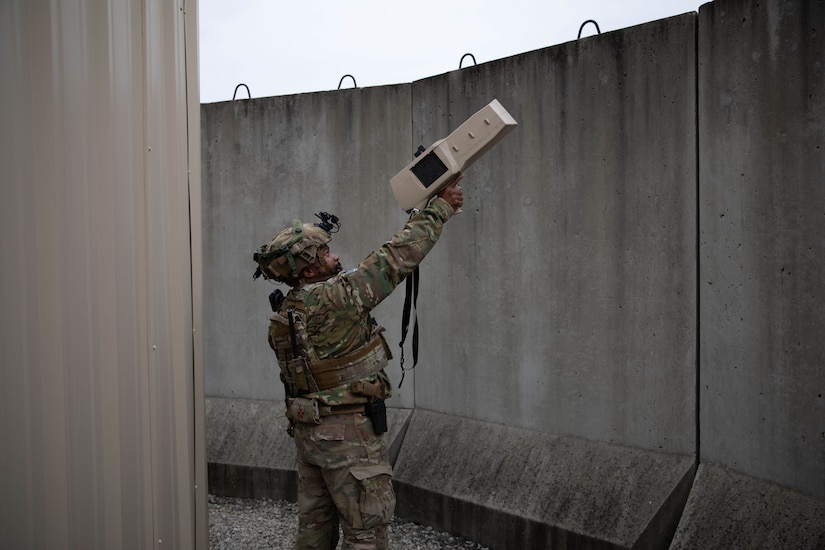
Known as the Dronebuster and Smart Shooter, these two handheld systems work in tandem as a layered defense that uses electronic and kinetic warfare to do the hard work for the shooter. 

A man in a camouflage military uniform points a handheld rectangular weapon device above a concrete wall.
 Students who attend JCU learn about various drones and the intricate service-specific systems used to engage with them. The Dronebuster and Smart Shooter, however, are two of the few used by service members on the ground, such as patrol members or personnel guarding installation towers.  

So, how do these tandem devices work?  

When service members are warned of a drone presence, the Dronebuster can be held up like a weapon to scan the area. Once it identifies a hostile target, the service member simply presses a button on the device to disrupt the target using electronic warfare. 


"It'll start jamming the command and controls, severing that connection between the drone and the operator," explained JCU operator's course instructor Paul Bliefernich.  

The drone remains frozen in the air. That's when a second operator picks up the Smart Shooter, an optic system that attaches to a weapon to control how it fires.

"Typically, when you pull the trigger, you're used to a gun going 'bang.' [The Smart Shooter] doesn't do that," explained JCU operator's course supervisor Fred Hill. "It calculates, and then it shoots when it's ready to shoot." 


A small drone with a balloon attached flies in a blue sky with clouds.
"When [shooters] get to the target they want, they'll hit the 'lock' button … and start squeezing the trigger," Bliefernich explained. However, the weapon doesn't immediately fire. Instead, its computer takes over and displays a set of crosshairs in the scope that the operator aligns with the target. When the computer decides there's a good probability of a hit, it sends a command to the pistol grip, allowing the operator to complete the trigger pull and fire the weapon.  

Bliefernich said it can take from a few seconds up to two minutes. "It's doing calculations and taking a lot into consideration," he added.  

Since shooting down several drones per class isn't cost-effective, JCU students mostly shoot balloons attached to drones. It's a more challenging target, but with practice, it can make them a better shot.  

"The balloons are harder to shoot than the drone," Hill said. "Once the shooter gets toward the end of the training, we'll put up the aircraft and let them shoot at the aircraft." 

"It takes a lot of time and practice," Bliefernich said. 

The students are also able to train on the Smart Shooter in the virtual reality lab beforehand, which instructors said is both cost-effective and safer.  

"It's getting the soldiers, airmen and sailors familiar with the equipment before they ever come and start shooting on the ground," said Army Sgt. 1st Class Alan Buhl, JCU instructor.

The school teaches soldiers, sailors, airmen and Marines much more than just how to operate handheld drone equipment. Students also learn how to use various fixed-site counter-small UAS systems, as well as how to plan strategies, train others and better prepare their installations for future threats.   

Joint Counter-Small Unmanned Aircraft System University became operational in 2023. Fort Sill is home to the Army Field Artillery School, the Army Air Defense Artillery School, the 75th Fires Brigade and the 31st Air Defense Artillery Brigade, all of which have nurtured counter-small UAS strategies since the threat first emerged.  


Sunday, September 21, 2025

A Strategic Reform: Why the New H-1B Policy Benefits Immigrant Tech Workers and the U.S. Economy

On September 19, 2025, the U.S. administration enacted significant changes to the H-1B visa program, including a new $100,000 petition fee for applicants entering from abroad. The H-1B program has long been the cornerstone of skilled immigration in the technology sector, serving as a gateway for highly educated foreign workers to join American companies in software, engineering, and other STEM fields. Critics argue that these new measures create barriers for immigrant workers and companies alike. Yet, when viewed from a broader perspective, these reforms may represent a strategic recalibration. By increasing selectivity, prioritizing higher-skilled applicants, and reinforcing fair labor standards, the changes could ultimately benefit immigrant tech workers who enter the U.S. labor market and strengthen the competitiveness of the American economy.

Clarifying the Policy Changes

The most visible change is the imposition of a $100,000 fee on new petitions filed for H-1B workers entering from abroad, effective September 21, 2025. Importantly, this fee does not apply to existing H-1B holders or to petitions already submitted before the deadline. Renewals, extensions, or changes of employer inside the United States remain exempt. In addition, the administration has advanced new rulemaking processes that will raise prevailing wage levels for H-1B holders and restructure the lottery system to prioritize higher-wage, higher-skilled positions. These steps represent a shift away from the earlier system, which critics claimed was overused for outsourcing and cost-cutting rather than addressing genuine skill shortages (U.S. Citizenship and Immigration Services, 2025).

Who Is Most Affected

The immediate impact of the policy falls on workers currently abroad who intended to enter under H-1B sponsorship. Outsourcing firms, particularly those in India, have expressed concern that the new fee will disrupt operations. Industry groups like Nasscom have suggested that smaller companies might be unable to absorb the costs (Reuters, 2025). However, large multinational technology firms are better positioned to continue sponsorship, albeit at a slower pace. For workers already in the United States, the reforms create a more favorable environment: fewer low-wage entrants from abroad will mean stronger bargaining power, higher salaries, and better working conditions for those already in the H-1B pool.

Impacts and Consequences

At first glance, the new policy seems punitive. Yet its effects must be considered holistically. By imposing a high fee, the administration is discouraging excessive reliance on importing lower-paid labor. The change incentivizes companies to reserve H-1B sponsorship for positions where the value added by immigrant expertise clearly outweighs the cost. For immigrant tech workers who do secure these opportunities, the result is greater recognition of their skills, higher compensation, and increased job security.

Furthermore, the prioritization of higher wages in the lottery system ensures that foreign workers are placed in roles that require advanced expertise. This aligns with the original legislative intent of the H-1B program: to fill specialized gaps in the U.S. workforce, not to undercut domestic labor markets. By reinforcing this focus, immigrant tech workers benefit from being positioned as essential, high-value contributors rather than as cost-saving alternatives.

Policy Goals and Effectiveness

The reforms aim to protect U.S. workers, promote high-skilled immigration, and safeguard against abuse of the visa system. For decades, critics have argued that H-1B visas were disproportionately used for large-scale outsourcing operations, which brought in workers at lower wages and limited their mobility (American Immigration Council, 2023). The new framework addresses these criticisms directly. By setting a high threshold, the policy distinguishes between companies genuinely in need of specialized talent and those using the program to suppress wages.

While short-term disruptions are inevitable, especially for firms dependent on overseas labor pipelines, the long-term benefits are significant. Immigrant workers who do make it through this more selective process will be recognized as elite contributors within their fields. The policy thus fosters both fairness and prestige in the program.

International and Corporate Reactions

Reactions have been mixed. Some Indian IT firms have warned of “humanitarian consequences” if families are separated or workers are stranded abroad (Business Insider, 2025). At the same time, leading U.S. technology firms such as Amazon and Google have already begun adjusting strategies by focusing sponsorship on higher-tier roles and advising employees on travel precautions (Fortune, 2025). Such adaptation demonstrates resilience in the tech industry and underscores that the program is not being dismantled but rather refined.

Conclusion

The new H-1B policy represents a deliberate effort to elevate the standards of skilled immigration. While the imposition of a $100,000 fee and wage prioritization may appear restrictive, they ensure that immigrant tech workers who secure H-1B visas are entering an environment where their skills are valued, their wages are protected, and their contributions are seen as indispensable to the U.S. economy. Rather than weakening opportunities, the reforms ultimately strengthen the integrity of the H-1B program and safeguard its future. For immigrant tech workers, this means fewer exploitative conditions, higher recognition, and an enhanced role as partners in American innovation.


References

American Immigration Council. (2023). The H-1B visa program: A fact sheet. American Immigration Council.

Business Insider. (2025, September 20). India responds to new U.S. H-1B visa fees, citing humanitarian and economic concerns.

Fortune. (2025, September 20). Tech companies warn H-1B visa holders to avoid foreign travel amid immigration crackdown.

Reuters. (2025, September 20). New U.S. H-1B visa fee could disrupt Indian IT operations, says industry body Nasscom.

U.S. Citizenship and Immigration Services. (2025, September 19). H-1B visa program: Frequently asked questions on presidential proclamation.