Showing posts with label Chile. Show all posts

Thursday, May 17, 2012

NSF and CONICYT Strengthen Scientific Cooperation in Chile


Agency leaders sign agreement to further scientific and educational opportunities

The U.S. National Science Foundation (NSF) and the Chilean Comisión Nacional de Investigación Científica y Tecnológica (CONICYT) signed a memorandum of understanding (MoU) on Tuesday, May 15, to further scientific and educational cooperation between the two agencies. The partnership will improve coordination of U.S. and Chilean investments in science and engineering, strengthen support for NSF science activities in Chile and better leverage the scientific investments in Chile.

"This agreement further supports the close ties that the United States and Chile share in science and technology that Presidents Obama and Piñera highlighted during their meeting last year in Santiago," said Alejandro Wolff, U.S. Ambassador to Chile. "We hope it will deepen cooperation across a wide range of endeavors to enhance our shared knowledge and contributions to mankind."

NSF Director Subra Suresh and José Miguel Aguilera, president of CONICYT, met at the National Science Foundation to celebrate this ongoing collaboration and to sign the MoU in an effort to formalize and strengthen the partnership.

"Since 1956, NSF has engaged in collaborations with Chile," said NSF Director Subra Suresh. "Over the course of this long-standing relationship, the U.S. scientific community and Chile have benefitted from millions of dollars in research investments in astronomy, oceanography, seismology and more. The Chileans' enthusiasm for building on these existing activities and developing future partnerships has been inspiring."

Future investments will focus on development of human capital, joint research activities and scientific pursuits that catalyze innovation. Mechanisms of support for educational activities could include NSF's Research Experience for Undergraduates and International Research Experiences for Students programs, while the Science Across Virtual Institutes activity could connect researchers with common interests and goals across international borders.

"CONICYT and NSF share the same views on the importance of science in our lives and of the pivotal role of international cooperation in pushing the boundaries of our knowledge," said José Miguel Aguilera, president of CONICYT. "We also believe that our strengths are complementary and that the bridges we can create through these instruments will not only benefit the collaboration between our scientists but will also inevitably lead to new discoveries and great advancement in the quality of life of our citizens in both countries."

The collaboration with Chile has been crucial to ground-based astronomical sciences as it is one of the best locations in the world for large telescopes that can make discoveries about our universe. The 2011 Nobel Prize for Physics depended on critical observations made from the Blanco 4m telescope at the NSF-supported Cerro Tololo Inter-American Observatory. Further, the largest capital investment the NSF has made in a single facility is for the Atacama Large Millimeter/submillimeter Array (ALMA), to be located in the Altiplano of northern Chile.

The collaborations have expanded into other areas of science including geosciences, polar sciences and cyber-enabled research. This new agreement will pave the way for cooperative activities in additional areas of research and education.

 -NSF-

Monday, May 14, 2012

Got a Pirate Problem? There's Even an App for That


By Grace Jean, Office of Naval Research Public Affairs

ARLINGTON, Va. (NNS) -- The Department of Defense will begin funding an Office of Naval Research (ONR)-sponsored project aimed at developing Web applications to help multinational navies police the world's oceans, officials announced May 14.

The International Collaborative Development for Enhanced Maritime Domain Awareness (ICODE MDA) was one of 14 projects selected by the Office of the Under Secretary of Defense for Acquisition, Technology and Logistics to receive $1 million awards beginning this fall through the Coalition Warfare Program, which funds international collaborative research efforts.

The ICODE MDA project is a research alliance between ONR and Space and Naval Warfare (SPAWAR) Systems Center Pacific (SSC Pacific). ONR is partnering with scientists in Chile to build widgets, or Web-based applications, for use by sailors and maritime operators to analyze data and other information to combat pirates, drug smugglers, arms traffickers, illegal fishermen and other nefarious groups.

"A lot of maritime threats occur in developing parts of the world," said Dr. Augustus Vogel, associate director for Latin America and sub-Saharan Africa in ONR-Global's Chile office. "Our goal is to develop partnerships with countries that have maritime threats to help solve those problems."

ONR will tap researchers at the Technical University of Federico Santa Maria, one of Chile's top engineering schools, to create Web-based tools in an open source environment. The work will focus on producing software to improve automation, small-target detection and intent detection.

Ultimately, the software will be compatible with multiple maritime network systems so that navies around the world can use the tools and share information for global operations.

"We'll take those tools and integrate them into a widget framework that can be part of a coalition-accessible Web portal," said John Stastny, an engineer in the advanced analysis systems branch at SSC Pacific, who is helping to lead the ICODE MDA project.

The effort in Chile is part of a larger collaborative project that encompasses nations in Africa, where ICODE MDA has been underway with researchers at the University of Ghana, University of Pretoria, University of Mauritius and the Council for Scientific and Industrial Research in South Africa.

ONR provides the science and technology necessary to maintain the Navy and Marine Corps' technological advantage. Through its affiliates, ONR is a leader in science and technology with engagement in 50 states, 70 countries, 1,035 institutions of higher learning and 914 industry partners. ONR employs approximately 1,400 people, comprising uniformed, civilian and contract personnel, with additional employees at the Naval Research Lab in Washington, D.C.

Thursday, May 3, 2012

First-of-its-Kind Study Reveals Surprising Ecological Effects of 2010 Chile Earthquake


Long-forgotten coastal habitats reappeared, species unseen for years returned

The reappearance of long-forgotten habitats and the resurgence of species unseen for years may not be among the expected effects of a natural disaster.

Yet that's exactly what researchers found in a study of the sandy beaches of south central Chile, after an 8.8-magnitude earthquake and devastating tsunami in 2010.

Their study also revealed a preview of the problems wrought by sea level rise--a major symptom of climate change.

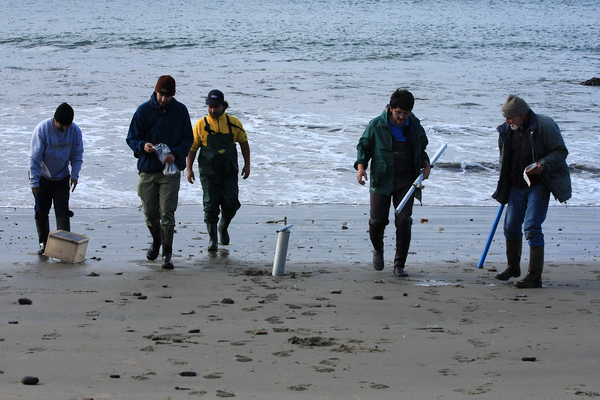
In a scientific first, researchers from Southern University of Chile and the University of California, Santa Barbara (UCSB) were able to document the before-and-after ecological impacts of such cataclysmic occurrences.

A paper appearing today in the journal PLoS ONE details the surprising results of their study, pointing to the potential effects of natural disasters on sandy beaches worldwide.

The study is said to be the first-ever quantification of earthquake and tsunami effects on sandy beach ecosystems along a tectonically active coastal zone.

"So often you think of earthquakes as causing total devastation, and adding a tsunami on top of that is a major catastrophe for coastal ecosystems," said Jenny Dugan, a biologist at UCSB.

"As expected, we saw high mortality of intertidal life on beaches and rocky shores, but the ecological recovery at some of our sandy beach sites was remarkable.

"Plants are coming back in places where there haven't been plants, as far as we know, for a very long time. The earthquake created sandy beach habitat where it had been lost. This is not the initial ecological response you might expect from a major earthquake and tsunami."

Their findings owe a debt to serendipity.

The researchers were knee-deep in a study supported by FONDECYT in Chile and the U.S. National Science Foundation's (NSF) Santa Barbara Coastal Long-Term Ecological Research (LTER) site of how sandy beaches in Santa Barbara and south central Chile respond, ecologically, to man-made armoring such as seawalls and rocky revetments.

By late January, 2010, they had surveyed nine beaches in Chile.

The earthquake hit in February.

Recognizing a unique opportunity, the scientists changed gears and within days were back on the beaches to reassess their study sites in the catastrophe's aftermath.

They've returned many times since, documenting the ecological recovery and long-term effects of the earthquake and tsunami on these coastlines, in both natural and human-altered settings.

"It was fortunate that these scientists had a research program in the right place--and at the right time--to allow them to determine the responses of coastal species to natural catastrophic events," said David Garrison, program director for NSF's coastal and ocean LTER sites.

The magnitude and direction of land-level change resulting from the earthquake and exacerbated by the tsunami brought great effects, namely the drowning, widening and flattening of beaches.

The drowned beach areas suffered mortality of intertidal life; the widened beaches quickly saw the return of biota that had vanished due to the effects of coastal armoring.

"With the study in California and Chile, we knew that building coastal defense structures, such as seawalls, decreases beach area, and that a seawall results in the decline of intertidal diversity," said lead paper author Eduardo Jaramillo of the Universidad Austral de Chile.

"But after the earthquake, where significant continental uplift occurred, the beach area that had been lost due to coastal armoring has now been restored," said Jaramillo. "And the re-colonization of the mobile beach fauna was underway just weeks afterward."

The findings show that the interactions of extreme events with armored beaches can produce surprising ecological outcomes. They also suggest that landscape alteration, including armoring, can leave lasting footprints in coastal ecosystems.

"When someone builds a seawall, beach habitat is covered up with the wall itself, and over time sand is lost in front of the wall until the beach eventually drowns," said Dugan.

"The semi-dry and damp sand zones of the upper and mid-intertidal are lost first, leaving only the wet lower beach zones. This causes the beach to lose diversity, including birds, and to lose ecological function."

Sandy beaches represent about 80 percent of the open coastlines globally, said Jaramillo.

"Beaches are very good barriers against sea level rise. They're important for recreation--and for conservation."

 -NSF-