 The catastrophic consequences of natural
and human disasters have been demonstrated repeatedly in recent years, most
notably in the Great East Japan earthquake, tsunami and nuclear disaster but
also in the Deepwater Horizon oil spill, Hurricane Katrina, and regional
droughts, floods and fires. These events clearly demonstrate the urgent need
for basic research to advance fundamental knowledge and innovation for disaster
prevention, mitigation and management. The big data revolution holds the
potential to mitigate the effects of these events by enabling access to
critical real time information.
The catastrophic consequences of natural
and human disasters have been demonstrated repeatedly in recent years, most
notably in the Great East Japan earthquake, tsunami and nuclear disaster but
also in the Deepwater Horizon oil spill, Hurricane Katrina, and regional
droughts, floods and fires. These events clearly demonstrate the urgent need
for basic research to advance fundamental knowledge and innovation for disaster
prevention, mitigation and management. The big data revolution holds the
potential to mitigate the effects of these events by enabling access to
critical real time information.
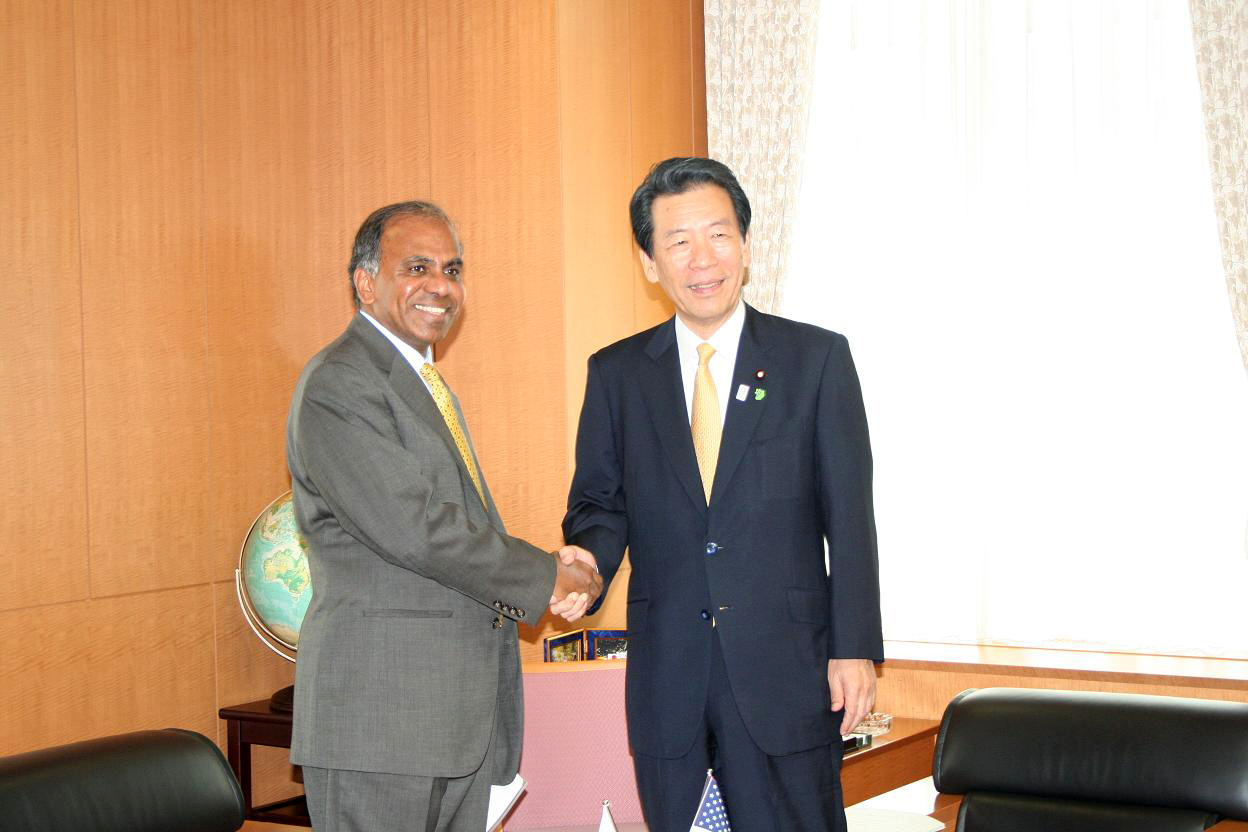
We met in Tokyo on June 5, and agreed
that U.S.-Japan collaboration in disaster research would yield important mutual
advantages, leveraging our respective experiences and expertise to reduce
vulnerability and enhance resilience in our societies. We agreed in principle
to support broad-based research collaborations among computer scientists,
engineers, social scientists, biologists, geoscientists, physical scientists
and mathematicians that strengthen our understanding of disaster robustness and
resilience through big data.
 Among the topics we agreed had potential
for research collaboration are:
Among the topics we agreed had potential
for research collaboration are:
•Harnessing the big data generated by
disasters to advance analytic, modeling, and computational capabilities, with
applications such as probabilistic hazard models.
•Improving the resilience and
responsiveness of information technology to enable real time data sensing,
visualization, analysis, experimentation and prediction, critical for
time-sensitive decision making.
•Advancing fundamental knowledge and
innovation for resilient and sustainable civil infrastructure and distributed
infrastructure networks.
•Acquiring big data and improving broad
knowledge of preparedness and response at human, societal and global scales,
including the human, social, economic and environmental dimensions.
•Integrating expertise from multiple
disciplines, input from end users and big data from all sources in the
emergency preparedness and response community.
We agreed to develop a plan of action at
the working level, with the aim of announcing a more detailed agreement before
the end of 2012.
-NSF-
 The Soyuz TMA-05M spacecraft is rolled
out by train on its way to the launch pad at the Baikonur Cosmodrome in
Kazakhstan, Thursday, July 12, 2012. The launch of the Soyuz spacecraft with
Expedition 32 Soyuz Commander Yuri Malenchenko, NASA Flight Engineer Sunita
Williams and JAXA (Japan Aerospace Exploration Agency) Flight Engineer Akihiko
Hoshide is scheduled for the morning of Sunday, July 15, local time.
The Soyuz TMA-05M spacecraft is rolled
out by train on its way to the launch pad at the Baikonur Cosmodrome in
Kazakhstan, Thursday, July 12, 2012. The launch of the Soyuz spacecraft with
Expedition 32 Soyuz Commander Yuri Malenchenko, NASA Flight Engineer Sunita
Williams and JAXA (Japan Aerospace Exploration Agency) Flight Engineer Akihiko
Hoshide is scheduled for the morning of Sunday, July 15, local time. 


 Posts
Posts

