Showing posts with label War Department. Show all posts

Thursday, May 28, 2026

War Department Signs $9.7B Technology Deal With Dell for Microsoft Services

The War Department announced today a five-year agreement to purchase Microsoft Services — a move expected to save the department $422 million annually. 

"The Department of War is taking a definitive step forward to advance our digital infrastructure to deter near-peer adversaries by awarding a five-year, $9.7 billion Core Enterprise Technology Agreement to Dell Federal Systems," said Kirsten A. Davies, DOW chief information officer. "This second-generation blanket purchase agreement will streamline and consolidate critical Microsoft software and services across the Department of War, the intelligence community and the U.S. Coast Guard." 

The agreement provides the department with access to Microsoft 365, advanced cloud subscriptions and critical on-premises licensing; it's the department's largest to date. 

"This CETA acts as part of the digital connective tissue essential for Combined Joint All-Domain Command and Control ... this ensures our warfighters have the tools for just-in-time data sharing, supports our pivot to [artificial intelligence] and data analytics, and undergirds uninterrupted operational continuity for our most sensitive and disconnected environments," Davies said. 

A woman wearing a camouflage military uniform uses a computer in a dark room.

Previously, across the department, dozens of separate contracts provided services to the same groups who will now receive the services under a single enterprisewide contract. The consolidation of contracts ensures service members and department civilians continue to have access to the same services, but now those services will cost less and save taxpayer dollars. 

"This enterprise approach is not just about capability, it's also about delivering on [Secretary of War Pete Hegseth's] promise to be responsible stewards of the American people's resources — taxpayer money," Davies said, noting that the new agreement is not new funding. 

Because the new contract and old contracts are with the same vendor, the funding does not change; the transition will be seamless for those involved. 

"We are achieving unprecedented scale and cost efficiency," Davies said. "This blanket purchase agreement is expected to save the department an initial $422 million annually, a figure we actually expect to rise as we fully consolidate our IT services." 

The new contract also allows warfighters to focus on what matters, she said. 

"This puts the tools in a warfighter's hands, where they need them," Davies said. "They don't need to worry about an enterprise software capability — they can worry about warfighting. They can focus on the mission, and we focus on the tools to support them in the mission." 

The agreement is scheduled to begin June 1 and includes Microsoft products such as Windows Enterprise Operating System and Office Professional Plus, along with cloud and hybrid capabilities. It also provides the digital foundation for Combined Joint All-Domain Combined Command and Control, the overarching concept to link sensors, weapons and decision-makers, as well as seamlessly share data across the armed forces and with coalition partners.

Tuesday, December 9, 2025

The War Department Unleashes AI on New GenAI.mil Platform

The War Department today announced the launch of Google Cloud's Gemini for Government as the first of several frontier AI capabilities to be housed on GenAI.mil, the Department's new bespoke AI platform. This initiative cultivates an "AI-first" workforce, leveraging generative AI capabilities to create a more efficient and battle-ready enterprise. Additional world-class AI models will be available to all civilians, contractors, and military personnel, delivering on the White House's AI Action Plan announced earlier this year.

This past July, President Donald Trump instituted a mandate to achieve an unprecedented level of AI technological superiority. The War Department is delivering on this mandate, ensuring it is not just ink on paper. In response to this directive, AI capabilities have now reached all desktops in the Pentagon and in American military installations around the world.

The first instance on GenAI.mil, Gemini for Government, empowers intelligent agentic workflows, unleashes experimentation, and ushers in an AI-driven culture change that will dominate the digital battlefield for years to come. Gemini for Government is the embodiment of American AI excellence, placing unmatched analytical and creative power directly into the hands of the world's most dominant fighting force.

"There is no prize for second place in the global race for AI dominance," said Emil Michael, Under Secretary of War for Research and Engineering. "We are moving rapidly to deploy powerful AI capabilities like Gemini for Government directly to our workforce. AI is America's next Manifest Destiny, and we're ensuring that we dominate this new frontier."

The launch of GenAI.mil stands as a testament to American ingenuity, driven by the AI Rapid Capabilities Cell within the War Department's Office of Research & Engineering. Their achievement directly embodies the Department's core tenets of reviving the warrior ethos, rebuilding American military capabilities, and re-establishing deterrence through technological dominance and uncompromising grit.

"We are pushing all of our chips in on artificial intelligence as a fighting force. The Department is tapping into America's commercial genius, and we're embedding generative AI into our daily battle rhythm." Secretary of War Pete Hegseth remarked, "AI tools present boundless opportunities to increase efficiency, and we are thrilled to witness AI's future positive impact across the War Department."

The Department is providing no-cost training for GenAI.mil to all DoW employees. Training sessions are designed to build confidence in using AI and give personnel the education needed to realize its full potential. Security is paramount, and all tools on GenAI.mil are certified for Controlled Unclassified Information (CUI) and Impact Level 5 (IL5), making them secure for operational use. Gemini for Government provides an edge through natural language conversation, retrieval-augmented generation (RAG), and is web-grounded against Google Search to ensure outputs are reliable and dramatically reduces the risk of AI hallucinations.

GenAI.mil is another building block in America's AI revolution. The War Department is unleashing a new era of operational dominance, where every warfighter wields frontier AI as a force multiplier. The release of GenAI.mil is an indispensable strategic imperative for our fighting force, further establishing the United States as the global leader in AI.

Tuesday, December 2, 2025

War Department Asks Industry to Make More Than 300K Drones, Quickly, Cheaply

The War Department requested information earlier this week to gauge industry's willingness and ability to make some 300,000 drones quickly and inexpensively — a concrete effort by Secretary of War Pete Hegseth to directly meet the "drone dominance" goals laid out by the president. 

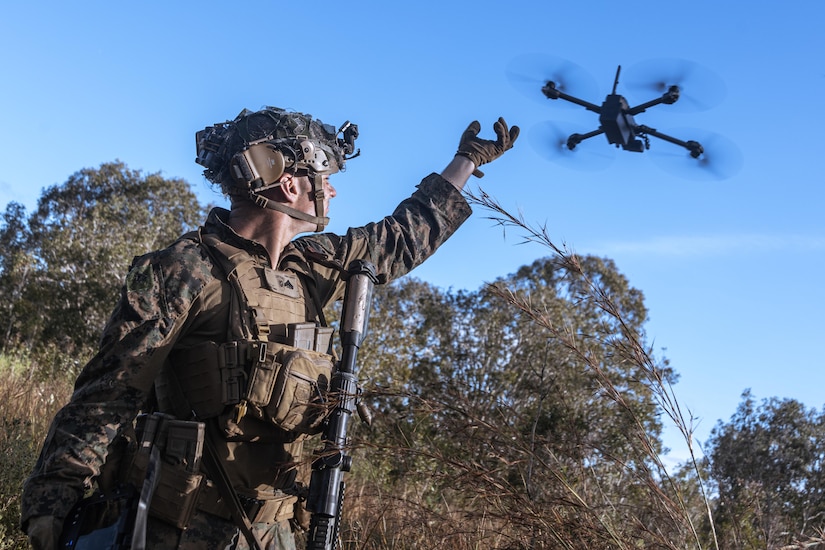
A Marine in tactical gear reaches up towards a drone flying above a forest setting during the day.

On June 6, President Donald J. Trump signed the "Unleashing American Drone Dominance" executive order outlining how the United States would up its drone game in both the commercial and military sectors, including how it would deliver massive amounts of inexpensive, American-made, lethal drones to U.S. military units to amplify their combat capabilities. 

Hegseth followed up in July with the "Unleashing U.S. Military Drone Dominance" memorandum, in which he laid out his plan for how the department would meet the president's intent. 

Part of the secretary's plan included participating with other parts of government in building up the nascent U.S. drone manufacturing base by approving hundreds of American products for purchase by the department, powering a "technological leapfrog" by arming combat units with the very best of low-cost American-made drones, and finally, training as the department expects to fight. 

"Next year I expect to see [drone] capability integrated into all relevant combat training, including force-on-force drone wars," the secretary said. 

At that time, Hegseth said, he had already advanced American drone dominance by stripping away regulations that hindered the military's adoption of small drones and shifting the necessary authorities away from the department's bureaucracy and into the hands of unit commanders. 

"This was the first step in the urgent effort to boost lethality across the force," Hegseth said in a video posted today to social media. 

Now the War Department is moving out in a new way on the drone dominance initiative, Hegseth said. 

"The second step is to kickstart U.S. industrial capacity and reduce prices, so our military can adequately budget for unmanned weapons," the secretary said. 

He noted that, with help from Congress, the department will initially focus on small attack drones. 

"Drone dominance is a billion-dollar program funded by President Trump's Big Beautiful Bill," Hegseth said. "It is purpose-built on the pillars of the War Department's new acquisition philosophy: a stable demand signal to expand the U.S. drone industrial base by leveraging private capital, paired with flexible contracting built for commercial companies, founded by our best engineers and entrepreneurs." 

A stable demand signal means the War Department will make concrete plans to buy lots of drones, on a regular schedule, over a long period of time. When that happens, American industry will step up to the plate to satisfy the department's needs, including by investing in and building out its own capacity to produce in the long term. 

The request for information released to industry this week spells out a plan that'll begin early next year, when the department will, over the course of two years, and within four phases, offer $1 billion to industry to build a large number of small unmanned aerial systems capable of conducting one-way attack missions. 

The first of those four phases, called "gauntlets," runs from February to July 2026. During that time, 12 vendors will be asked to collectively produce 30,000 drones at a cost of $5,000 per unit, for a total of $150 million in department outlays. 

Over the course of the next three gauntlets, the number of vendors will go down from 12 to five, the number of drones ordered will increase from 30,000 to 150,000, and the price per drone will drop from $5,000 to $2,300. 

"Drone dominance will do two things: drive costs down and capabilities up," Hegseth said. "We will deliver tens of thousands of small drones to our force in 2026, and hundreds of thousands of them by 2027." 

Through the drone dominance program, $1 billion from the Big Beautiful Bill will fund the manufacture of approximately 340,000 small UASs for combat units over the course of two years. 

After that, it's expected that American industry's interest in building drones as a result of the program will have strengthened supply chains and manufacturing capacity to the point that the military will be able to afford to buy the drones it wants, in the quantity it wants, at a price it wants, through regular budgeting. 

Equipment is only part of the game, the secretary said. Doctrine — how the warfighter fights — is also critical. 

"I will soon be meeting with the military services to discuss transformational changes in warfighting doctrine," Hegseth said. "We need to outfit our combat units with unmanned systems at scale. We cannot wait. The funding provided by the Big Beautiful Bill is ready to be used to mount an effective sprint to build combat power. At the Department of War, we are adopting new technologies with a 'fight tonight' philosophy — so that our warfighters have the cutting-edge tools they need to prevail." 

Following the end of the Cold War, Hegseth said, U.S. defense spending dropped precipitously, and as a result, there was also a consolidation of defense contractors from hundreds to just dozens. The department, he said, budgeted for quality rather than quantity — and for 30 years got what it needed. 

"However, we now find ourselves in a new era," he said. "An era of cheap, disposable battlefield drones. We cannot be left behind — we must invest in inexpensive, unmanned platforms that have proved so effective." 

Drone dominance, he said, is how the U.S. will meet the drone challenge posed by other nations. 

"One of my priorities is rebuilding our military," Hegseth said. "We can't do that by doing business the same way we have in the past. We cannot afford to shoot down cheap drones with $2 million missiles. And we ourselves must be able to field large quantities of capable attack drones."