Showing posts with label unmanned aerial systems. Show all posts

Tuesday, February 10, 2026

From Backpacks to Bird's-Eye: Drones Are Transforming EOD

Across a stretch of open terrain at Hurlburt Field, Florida, two airmen assigned to the 1st Special Operations Wing began a race between machines. One guided a ground robot toward a simulated casualty, its treads working across dirt and grass. The other launched a small unmanned aerial system, or drone, which reached the site within seconds.
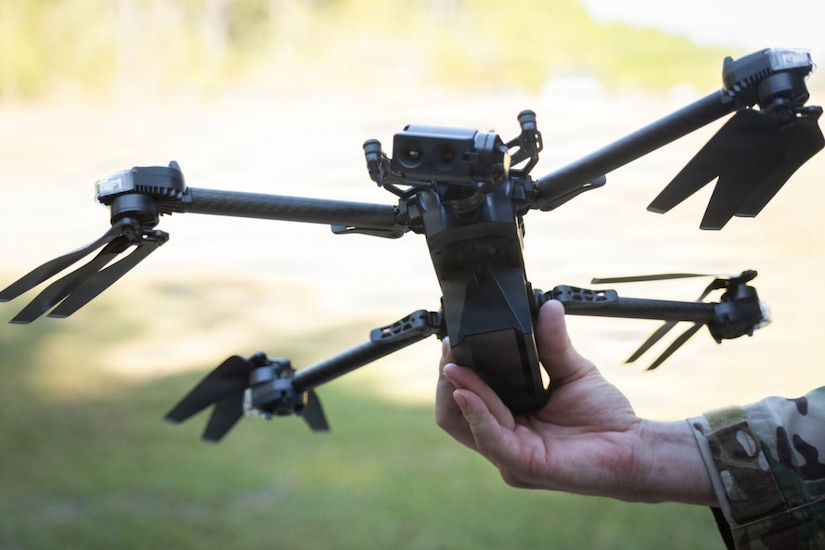
A close-up view of a drone as it’s held by a person in a camouflage military uniform.

From above, the drone's camera streamed a clear view of the scene before the robot made it halfway there. It's a new kind of flight reshaping how explosive ordnance disposal airmen execute their mission — and how the Air Force strengthens readiness through innovation.  

Before the adoption of modernized drones, EOD teams relied primarily on heavy robotic platforms to inspect potential explosive threats. The systems still provide valuable standoff capability but require vehicle transport and setup time, limiting their use during operations on foot. In those scenarios, airmen may have to approach hazards themselves. 

Compact and portable drones can be carried in a backpack and launched within minutes. Operated from a safe distance, they stream real-time imagery that helps airmen assess hazards without approaching them. The drones give teams an unmatched view of any environment. They combine optical and thermal cameras for day or night operations with advanced 3D scanning that produces precise digital models in minutes, whether documenting blast sites or mapping entire airfields. 

Drones can be used to establish a visual reference of a runway and to collect updated imagery after an incident. The data helps civil engineers quickly identify changes or damage, supporting timely clearance actions and repair planning to resume air operations.

Built-in artificial intelligence also allows drones to operate with a high degree of autonomy. The system can identify and track targets, hold position, and navigate around obstacles with minimal operator input. These capabilities boost mission tempo and efficiency while augmenting the work of airmen, keeping them out of harm's way and allowing them to focus on critical decision-making.

Drones have not yet replaced every function of traditional robots, but the two technologies currently complement one another on the battlefield.
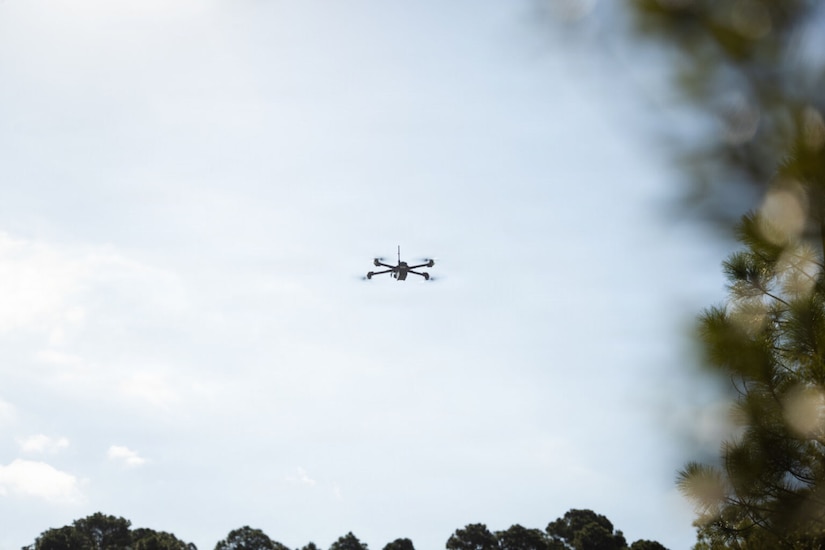
A drone flies in the air with blurry trees in the foreground.

"The big thing doesn't currently have is manipulation," an EOD airman explained. "I can't pull a battery off something or flip something over [with a drone], but a robot can."  

Still, drones are increasingly assuming tasks once limited to ground platforms, expanding options for commanders and reinforcing the Air Force's ability to adapt faster than its adversaries. 

Introducing any new technology brings challenges, but EOD airmen at Hurlburt Field have moved quickly to overcome them. Through local innovation projects, the team acquired and tested drones early, giving them a head start in integrating the capability into daily operations.  

"We've had the ability to work through a lot of the growing pains much faster," said an airman assigned to the 1st Special Operations Wing. "Now we're able to disseminate those lessons throughout the career field." 

That progress continues as airmen refine training and certification standards while identifying where drones provide the most operational value.  

"A lot of this is going to fluctuate based on use cases, because we all have a general idea of how we'd want to use this ... but there's still a lot to learn," said another EOD airman.
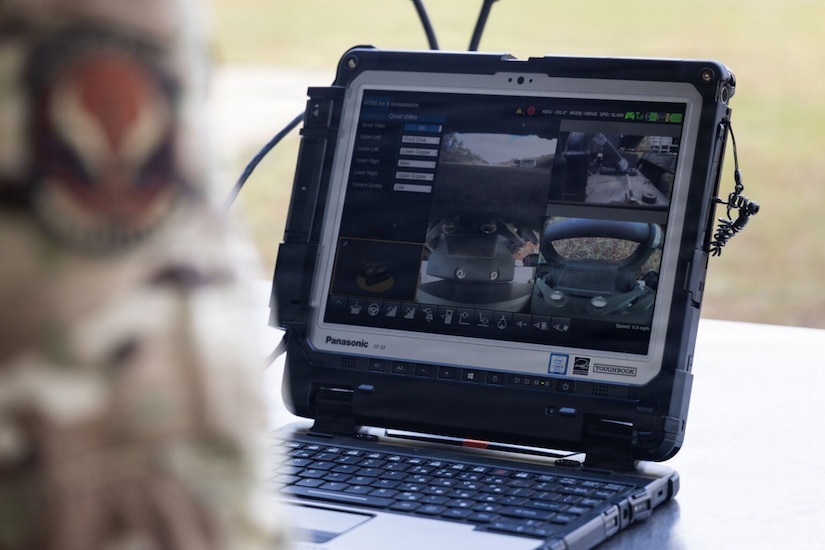
A person in a camouflage military uniform looks at a computer screen that displays the live view from multiple drones.

Wing airmen emphasized that the success of drone integration depends as much on institutional understanding as on technology itself. They said progress requires high-level advocacy to navigate the policies and risk assessments that come with operating in shared airspace, along with trust between ground units employing the systems and aviation communities managing them.  

As one airman explained, the future fight will rely on an enterprise that adapts quickly and learns from those already proving what's possible. 

At Hurlburt Field, EOD airmen are showing how small systems can yield big results. The shift from large ground robots to backpack-sized drones is transforming how they detect, respond and recover — bringing speed, precision and safety to every mission.  

"These are coming. This is the way of the future," said another airman. "If it's not in your shop currently, it probably will be in the very near future. Get ready." 

Tuesday, December 2, 2025

War Department Asks Industry to Make More Than 300K Drones, Quickly, Cheaply

The War Department requested information earlier this week to gauge industry's willingness and ability to make some 300,000 drones quickly and inexpensively — a concrete effort by Secretary of War Pete Hegseth to directly meet the "drone dominance" goals laid out by the president. 

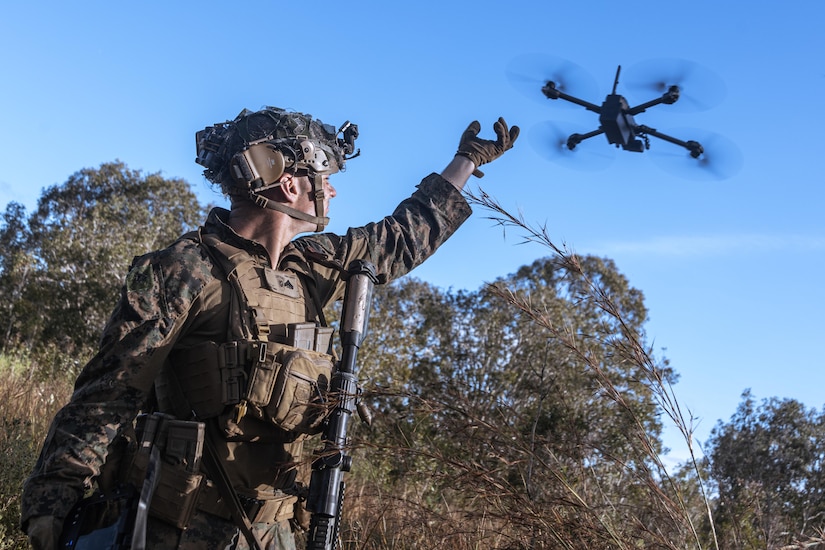
A Marine in tactical gear reaches up towards a drone flying above a forest setting during the day.

On June 6, President Donald J. Trump signed the "Unleashing American Drone Dominance" executive order outlining how the United States would up its drone game in both the commercial and military sectors, including how it would deliver massive amounts of inexpensive, American-made, lethal drones to U.S. military units to amplify their combat capabilities. 

Hegseth followed up in July with the "Unleashing U.S. Military Drone Dominance" memorandum, in which he laid out his plan for how the department would meet the president's intent. 

Part of the secretary's plan included participating with other parts of government in building up the nascent U.S. drone manufacturing base by approving hundreds of American products for purchase by the department, powering a "technological leapfrog" by arming combat units with the very best of low-cost American-made drones, and finally, training as the department expects to fight. 

"Next year I expect to see [drone] capability integrated into all relevant combat training, including force-on-force drone wars," the secretary said. 

At that time, Hegseth said, he had already advanced American drone dominance by stripping away regulations that hindered the military's adoption of small drones and shifting the necessary authorities away from the department's bureaucracy and into the hands of unit commanders. 

"This was the first step in the urgent effort to boost lethality across the force," Hegseth said in a video posted today to social media. 

Now the War Department is moving out in a new way on the drone dominance initiative, Hegseth said. 

"The second step is to kickstart U.S. industrial capacity and reduce prices, so our military can adequately budget for unmanned weapons," the secretary said. 

He noted that, with help from Congress, the department will initially focus on small attack drones. 

"Drone dominance is a billion-dollar program funded by President Trump's Big Beautiful Bill," Hegseth said. "It is purpose-built on the pillars of the War Department's new acquisition philosophy: a stable demand signal to expand the U.S. drone industrial base by leveraging private capital, paired with flexible contracting built for commercial companies, founded by our best engineers and entrepreneurs." 

A stable demand signal means the War Department will make concrete plans to buy lots of drones, on a regular schedule, over a long period of time. When that happens, American industry will step up to the plate to satisfy the department's needs, including by investing in and building out its own capacity to produce in the long term. 

The request for information released to industry this week spells out a plan that'll begin early next year, when the department will, over the course of two years, and within four phases, offer $1 billion to industry to build a large number of small unmanned aerial systems capable of conducting one-way attack missions. 

The first of those four phases, called "gauntlets," runs from February to July 2026. During that time, 12 vendors will be asked to collectively produce 30,000 drones at a cost of $5,000 per unit, for a total of $150 million in department outlays. 

Over the course of the next three gauntlets, the number of vendors will go down from 12 to five, the number of drones ordered will increase from 30,000 to 150,000, and the price per drone will drop from $5,000 to $2,300. 

"Drone dominance will do two things: drive costs down and capabilities up," Hegseth said. "We will deliver tens of thousands of small drones to our force in 2026, and hundreds of thousands of them by 2027." 

Through the drone dominance program, $1 billion from the Big Beautiful Bill will fund the manufacture of approximately 340,000 small UASs for combat units over the course of two years. 

After that, it's expected that American industry's interest in building drones as a result of the program will have strengthened supply chains and manufacturing capacity to the point that the military will be able to afford to buy the drones it wants, in the quantity it wants, at a price it wants, through regular budgeting. 

Equipment is only part of the game, the secretary said. Doctrine — how the warfighter fights — is also critical. 

"I will soon be meeting with the military services to discuss transformational changes in warfighting doctrine," Hegseth said. "We need to outfit our combat units with unmanned systems at scale. We cannot wait. The funding provided by the Big Beautiful Bill is ready to be used to mount an effective sprint to build combat power. At the Department of War, we are adopting new technologies with a 'fight tonight' philosophy — so that our warfighters have the cutting-edge tools they need to prevail." 

Following the end of the Cold War, Hegseth said, U.S. defense spending dropped precipitously, and as a result, there was also a consolidation of defense contractors from hundreds to just dozens. The department, he said, budgeted for quality rather than quantity — and for 30 years got what it needed. 

"However, we now find ourselves in a new era," he said. "An era of cheap, disposable battlefield drones. We cannot be left behind — we must invest in inexpensive, unmanned platforms that have proved so effective." 

Drone dominance, he said, is how the U.S. will meet the drone challenge posed by other nations. 

"One of my priorities is rebuilding our military," Hegseth said. "We can't do that by doing business the same way we have in the past. We cannot afford to shoot down cheap drones with $2 million missiles. And we ourselves must be able to field large quantities of capable attack drones."

Wednesday, November 19, 2025

3rd Combat Aviation Brigade Builds the Future of Drone-Enabled Army Aviation

The low hum of small rotors over Hunter Army Airfield, Savannah, Georgia, may sound routine, but within that hum lies a transformation.

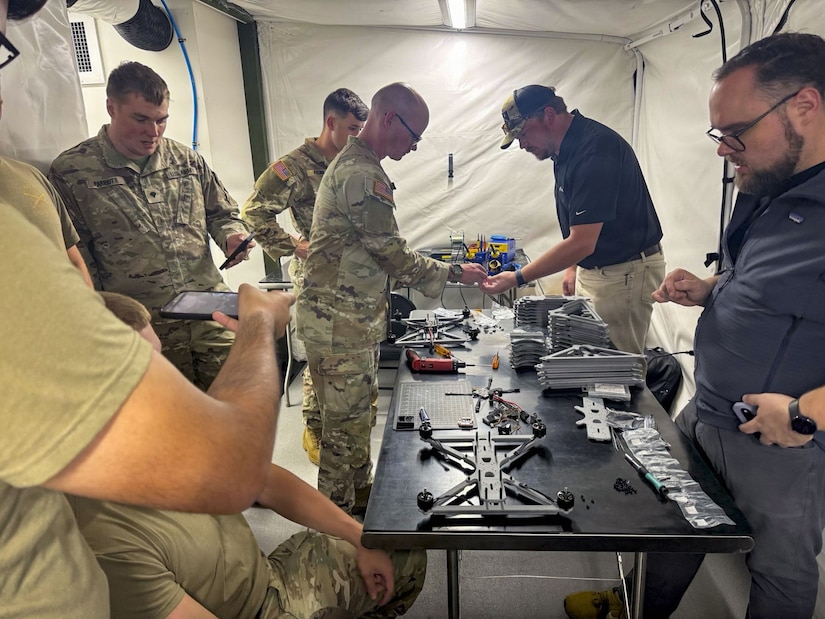
Men some dressed in camouflage military uniforms and others in civilian clothing stand around a table with drone parts.

 
The 3rd Combat Aviation Brigade, 3rd Infantry Division, is not discarding helicopters it is augmenting them. Apache, Black Hawk and Chinook platforms remain indispensable to the force. What is evolving is how those aircraft integrate with unmanned aerial systems and in-house manufacturing, allowing the brigade to redefine what readiness means on a complex future battlefield. 
 
The war in Ukraine offers more than cautionary tales; it offers operational proof. Ukrainian forces have used low-cost drones to strike deep inside Russian territory, harass logistics lines and force Russia's air defense systems into constant repositioning. For example, data shows Ukraine launched at least 58 long-range UAS strikes on Russian energy infrastructure since August 2025, sending drones up to 2,000 km into Russian territory and interrupting about 17% of Russian refining capacity by mid-August.  
 
Russian forces, in turn, have launched hundreds of drones in large-scale saturation attacks. In early February 2025, one overnight strike involved 267 attack drones against Ukraine, marking the largest single drone assault of the war to date. These developments show how unmanned systems are reshaping the way forces detect, target, sustain and make decisions on the front line. 
 
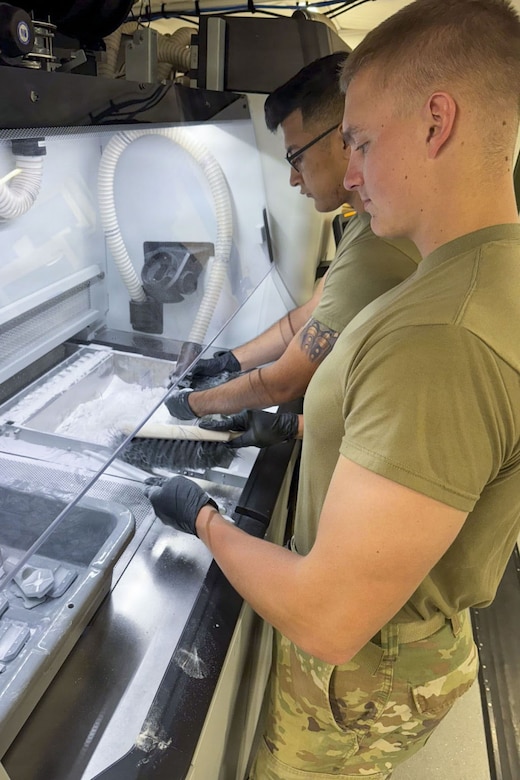
For soldiers of 3rd CAB, the lessons are not theoretical. They recently trained on the Expeditionary Manufacturing Cell, a mobile 3D-printing system that allows rapid production of drone components in the field. Working side by side, UAS operators, UAS repairers and Allied Trade Specialists printed more than 90 unique components in hours rather than waiting weeks for ordered parts. 
 
They progressed from printing and assembly to the first flights with Group1 first-person-view drones, which weigh under 20 pounds and can carry small munitions. Additionally, the team completed calibration, sensor integration and flight testing at the tactical level.

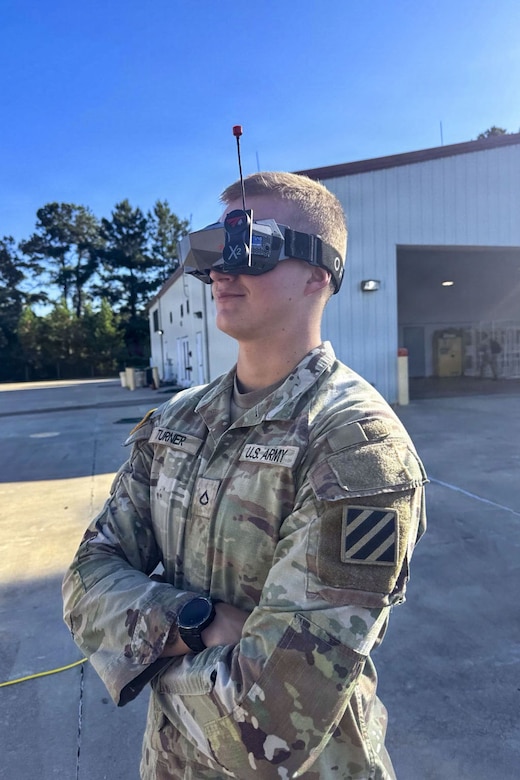
A soldier wearing a camouflage military uniform stands with his arms crossed while wearing first-person-view drone goggles.
Despite the transformation, the brigade also remains committed to its rotary-wing force. The difference now lies in employment: the Apache still offers deep strike and aerial firepower; the Black Hawk still performs medevac and air assault; the Chinook still delivers heavy lift and rapid repositioning. 
 
Soldiers assigned to 3rd CAB are layering unmanned systems into those missions. A Black Hawk air assault might still carry troops, but preceding it, a UAS team could scout the route, drop loitering munitions against anti-air threats, or provide a live video feed that shortens the sensor-to-shooter timeline. A Chinook heavy-lift mission might be preceded by unmanned reconnaissance of the landing zone and suppression of nearby sensors. 
 
The brigade has also taken lessons from signature management in Ukraine to heart. Drones and helicopters both leave signatures acoustic, and thermal and units that emit too much or move too slowly become visible targets. 
 
To counter this, 3rd CAB is practicing smaller command nodes, tighter emission control, decoys and adjunct UAS operations that mask or move pathways ahead of the rotary wing force. The objective: maintain the power of manned aviation while reducing its vulnerability in a contested, unmanned-dense environment. 
 
More than hardware, the change is cultural. Soldiers who once requested parts now design and print them. Aviation maintenance sections that focused on rotors and blades now also queue up small drone print runs and payload modifications. Squad level leaders who ran air-assault briefs now also schedule drone launch timelines. Innovation isn't separate or exotic, it's embedded in routine.

Two soldiers dressed in camouflage pants and t-shirt handle small drone parts.
The brigade is experimenting within its formations, embodying what senior leaders call "transformation in contact." The war in Ukraine underlined the danger of being structurally rigid; 3rd CAB soldiers are proving readiness arises from speed, adaptation and integration. 
 
"Today's battlefield is adapting rapidly. By teaching our soldiers to understand how drones work and are built, we are giving them the skills to think creatively and apply emerging technologies to enhance mission effectiveness and readiness," said Staff Sgt. Christian Dodson, the HAAF Innovation noncommissioned officer in charge. 
 
The future battlefield will reward units that can build, integrate, move fast, sense fast, decide fast, and strike fast with precision. Soldiers assigned to 3rd CAB are building that future today by combining the proven might of helicopters with the distributed reach of unmanned systems and the growing capability to manufacture and sustain that capability on-site. When the next fight demands more than traditional aviation, this brigade will be ready.