Showing posts with label combat readiness. Show all posts

Thursday, June 25, 2026

The Office of the Under Secretary of War for Research and Engineering Finalizes Lab Review, Aims to Modernize R&D Enterprise

The Office of the Under Secretary of War for Research and Engineering has finalized a set of recommendations to modernize and reform the War Department's vast research enterprise, priming it to ease bureaucratic friction points and to rapidly deliver combat-ready technologies. The recommendations flow from a 90-day comprehensive assessment of the Department's laboratories, Federally Funded Research and Development Centers (FFRDCs) and University-Affiliated Research Centers (UARCs).

Secretary of War Pete Hegseth mandated a sweeping modernization of the U.S. defense innovation ecosystem to keep pace with a rapidly evolving, commercially driven global technology landscape. The Office of the Assistant Secretary of War for Science and Technology is executing on this mandate, completing 30 site visits, which represent nearly a third of the Department's research and development (R&D) enterprise. This assessment provided crucial ground-truth insights into systemic challenges and opportunities for reform across the enterprise.

"On one hand, our findings are reassuring, confirming that the research enterprise is fundamentally sound, with an unmatched concentration of world-class scientists, engineers and researchers who continue to drive capabilities to the tactical edge," said Assistant Secretary of War for Science and Technology Joseph Jewell, whose office led the assessment. "But the findings also show the increasing drag that aging, costly infrastructure imposes on labs and test centers striving to tackle changing missions and pursue emerging technologies. We have researchers pushing the boundaries of 21st century technologies in facilities built when the cathode-ray tube and jet propulsion were the state of the art."

According to Dr. Jewell, a key recommendation of the assessment is asking Congress to establish a dedicated laboratory military construction (MILCON) appropriation specifically for research, development, test and evaluation infrastructure. This would protect these funds from being reallocated to general MILCON needs. A related request to Congress would significantly increase the limit on minor MILCON funds, which labs require to respond quickly to new demands for integrated research and enhanced security.

"This assessment highlights how siloed the R&D enterprise has become as it expanded over the past half century," said Under Secretary of War for Research and Engineering Emil Michael. "The labs are more service-centric, and the networks of university and FFRDC partners are not as integrated as they should be. This comprehensive review mandates our path forward to address the overriding challenge of delivering technology from lab to our warfighters rapidly, without sacrificing our rigorous standards for safety and combat effectiveness."

The review does not recommend consolidating or eliminating institutions, concluding that where overlap exists, it tends to be driven by mission need. The findings suggest that the way to reform the research enterprise is to fix the systemic issues surrounding its institutions, focusing on how authority, money and decisions flow, and how the institutions are funded, measured and governed.

Ultimately, the recommendations presented seek to eliminate the largest bureaucratic friction points, optimize resource allocation and empower the Department's unmatched scientific workforce. The report serves as the foundational blueprint to modernize the Department's R&D ecosystem and ensure the Department maintains a dominant and enduring technological advantage.

The assessment team is currently formalizing an implementation plan to address all identified findings and recommendations, with execution scheduled to begin shortly thereafter.

Thursday, June 18, 2026

Camp Lejeune Modernizes Tactical Driving With High-Tech Realism

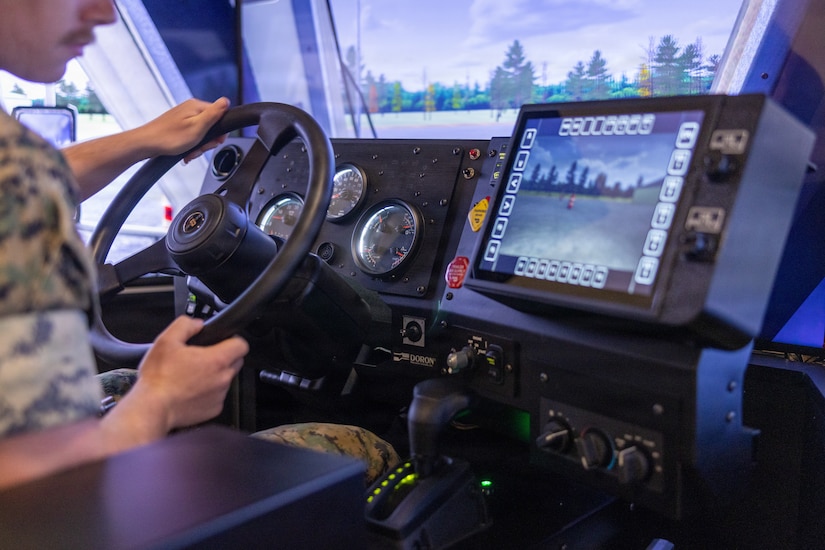
A man wearing a military camouflage uniform operates a driving simulator.

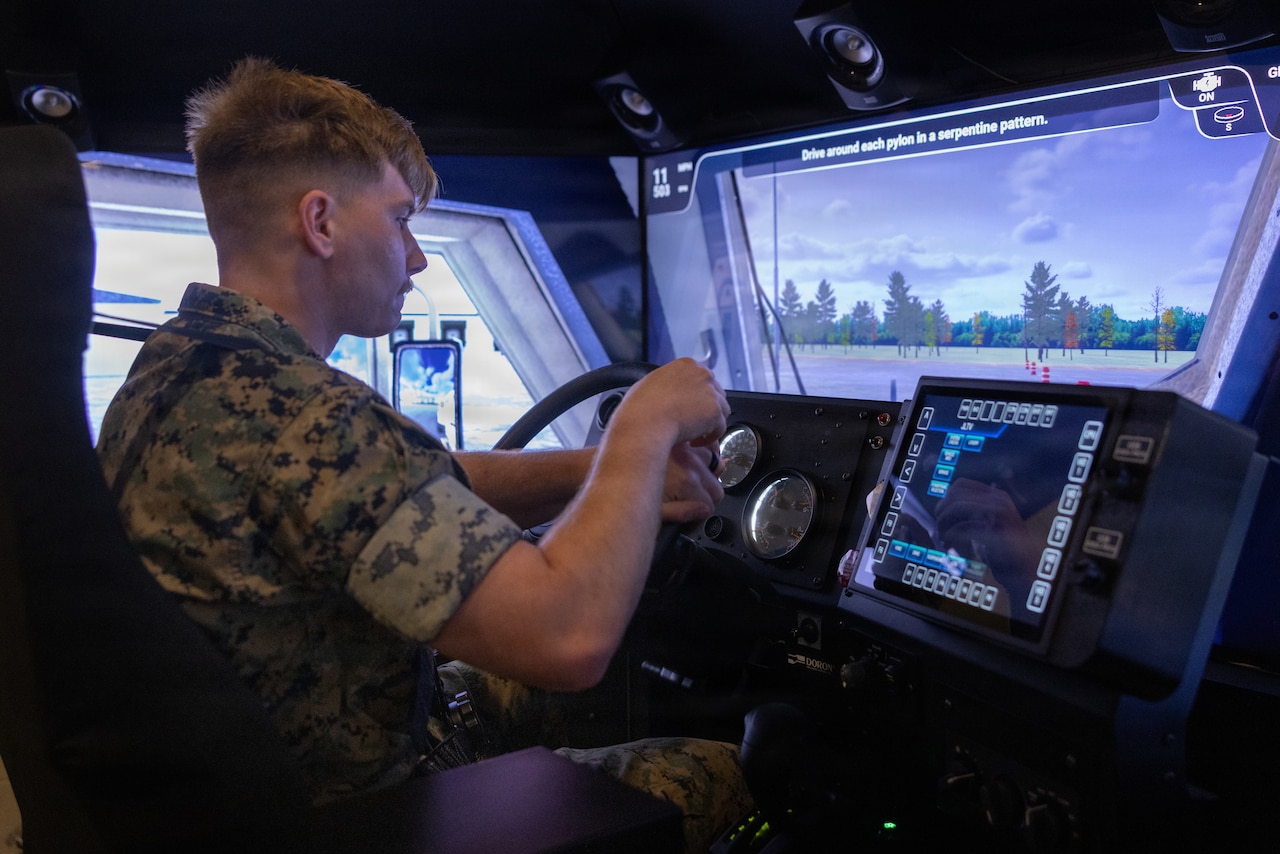
The Marine Corps is taking a leap forward in tactical vehicle training, trading unnecessary wear and tear for high-tech, immersive realism at Marine Corps Base Camp Lejeune, North Carolina. With the introduction of the multiplatform driver simulator, Marines are now able to push the limits of the joint light tactical vehicle without assuming any physical risk.

According to Shannon Ohlinger, the multiplatform driver simulator, or MPDS, training lead and a Marine Corps veteran, the shift in technology is monumental. The new system is designed to build confidence and critical thinking skills more quickly while addressing the challenges of fuel costs and vehicle maintenance.

"The operator driving simulator used prior to the MPDS was all over the place with training," Ohlinger said. "This entire system is much more advanced than the ODS, and it still has the mobility to mimic the movement of the actual vehicle over different types of terrain."

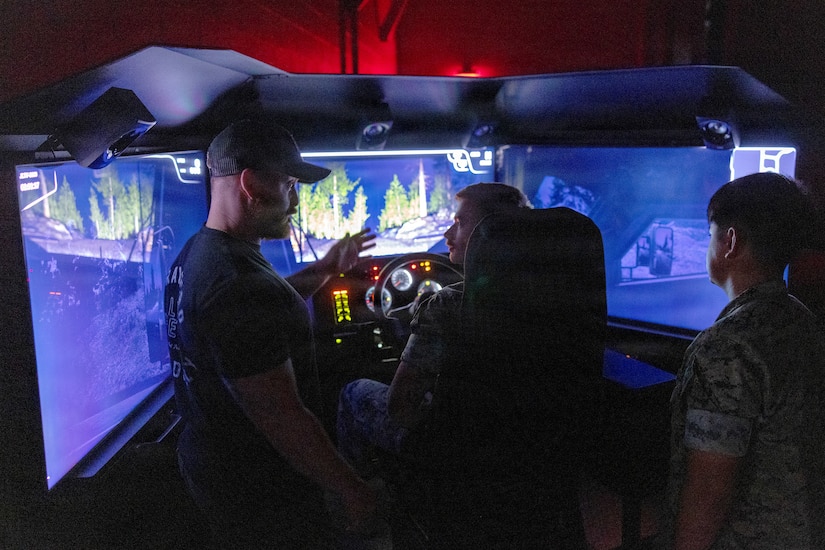
A man wearing casual attire gestures as he speaks to two other men dressed in military camouflage uniforms inside of a driving simulator.

The MPDS is broken into three distinct parts: the cab itself, made with authentic industry parts; the situation screen for viewing analytics and a third-person perspective; and the instructor workstation. While not replacing the actual physical training Marines get in a live joint light tactical vehicle or medium tactical vehicle replacement, it provides a seamless transition from the classroom to the dirt.

"Everything inside the simulator is an exact copy of what you would see in a real live [joint light tactical vehicle]," Ohlinger explained. "From the switches and functionality to the smart user interface, startup procedures and pre-op checks, everything is a one-for-one match."

Where the MPDS truly outperforms previous training methods is at the instructor workstation. From this console, instructors can manipulate the environment in real time, testing a driver's ability to adapt to sudden, catastrophic changes.

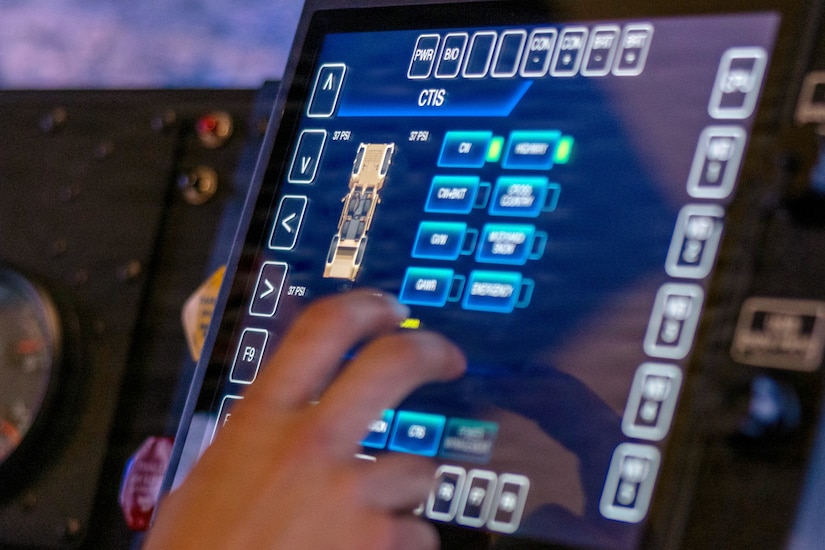
"Through the instructor workstation, I have the ability to throw obstacles at them. I can add rain and thunderstorms, and you will see puddles form and the mud get slick," Ohlinger said. "You're going to start having slippage to where operators need to use their [central tire inflation system] and anything else you would need to incorporate in order to adapt."

A man wearing a military camouflage uniform looks at a screen while operating a driving simulator.
A close-up of a hand tapping the screen in a driving simulator.
Instructors can tailor scenarios to specific unit needs, whether that means deploying a sudden blizzard, initiating low-visibility night driving or triggering dash warnings like low tire pressure or low battery voltage. The goal is to safely overwhelm the driver in a controlled environment, without risking a vehicle roll or a Marine getting hurt.

For Ohlinger, this capability hits close to home. Having driven more than 3,100 miles in Afghanistan, he understands the stakes of tactical driving.

"As a prior enlisted Marine, I can confidently say that if I had training like this, there are situations I experienced that I wouldn't have ever found myself in," he said. "Marines adapt and overcome when they face the unknown, but the MPDS gives them the critical thinking and experience they need ahead of time."

Ultimately, the Marine Corps modernization efforts are about keeping warfighters lethal and safe. The MPDS ensures that by the time a Marine gets behind the wheel of a real joint light tactical vehicle, they have already survived the worst conditions their instructors could throw at them.

"Being in this position gives me the opportunity to help mitigate the accidents that lead to losing service members," Ohlinger said. "I know if I save one life, I have done my job."