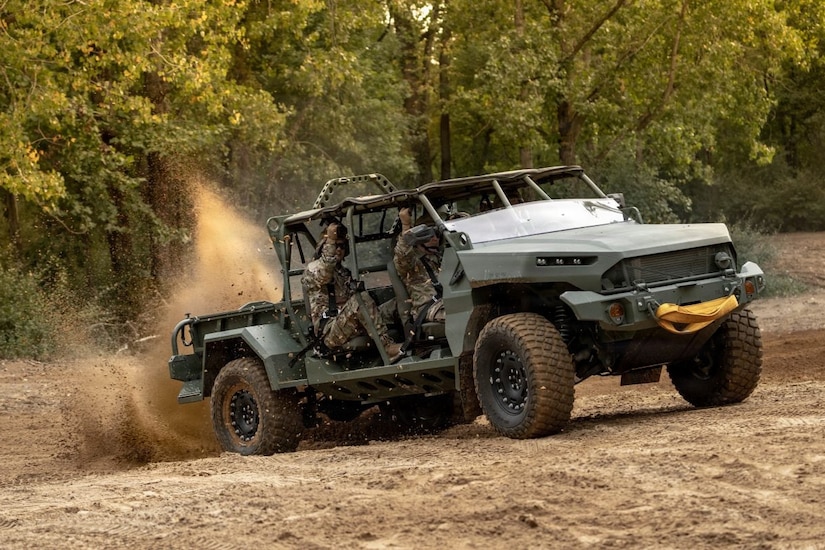
Getting troops and equipment across the battlefield is a vital part of every theater operation — soldiers and their kits, as well as spare ammunition and other supplies, all need to arrive quickly, with nothing left behind — or risk jeopardizing the mission.
The Joint Light Tactical Vehicle and Humvee have done a great job at performing those tasks so far, but the battlefield is always changing. In some cases, those vehicles are too heavy and impractical for the task at hand. So, the Army chose to develop a new, ultra-light troop transport vehicle.
The Infantry Squad Vehicle is an ultra-light tactical vehicle that carries nine passengers and their equipment. Its evolution was informed by soldier touchpoint events.
"We are extremely proud of this program and what we've been able to achieve in a short period of time," said Susan Fung, Portfolio Acquisition Executive Maneuver Ground's mobile brigade combat team deputy project manager. "In this high-stakes environment of modern warfare, playing it completely safe is often the most dangerous thing a leader can do for decades."
Fung explained that the team is intentionally trading the illusion of a risk-free acquisition process for the ability to use commercial products and iterating with continuous soldier feedback through the Army's Transformation in Contact program.
"Traditional defense acquisition has prioritized its bureaucratic processes and zero-defect mentality over speed, and while well-intentioned, that approach often meant our soldiers had to wait quite a bit for critical capabilities to reach the field," she said.
Exponential Growth
The Infantry Squad Vehicle program began in 2019, with a procurement objective of 649 vehicles. However, based on soldier feedback and TIC experimentation, Fung said soldiers told them what they truly needed.
"This led to an explosive growth driven entirely by operational demand," she added.
The number of vehicles required increased to 900 in February 2021. It increased two more times and was set at 2,593. In April 2025, the service approved the ISV utility variant and increased the Army procurement objective, bringing the total to 5,733 vehicles across both variants, Fung explained.
"In February of 2026, the Army established the current position objective and procurement objective at 11,582 vehicles," she said. "That shows you the increased objective based on soldier demand, and that's really equivalent to about an 18-fold increase from the original requirement. Not because of requirements creep, but really because soldiers validated the capability in the combat training environments and demanded more."
John Hufstedler, the product director for ground mobility vehicles at PAE Maneuver Ground, said that connecting with the system's mission was critical during the development of the vehicle.
"Early on, the ISV succeeded by staying locked-in. A few key requirements were transportability, [but] mobility and payload and resisting requirements creep," he said, adding Army senior leaders kept the vehicle's mission in focus.
"Anytime somebody wanted to add a radio with encrypted keys or hang another piece of encrypted equipment off the platform, leadership just didn't buy into it. And that allowed the vehicle to stay focused and true to its mission, so we didn't have to leave a soldier back with the vehicle. All nine could go execute the mission and objective," Hufstedler said.
The traditional acquisition approach allows custom military specifications, extensive government testing and sequential milestone gates. Hufstedler explained that this process can take four to 10 years, often resulting in cost overruns and technological obsolescence.
Instead, he explained that the ISV took the rapid acquisition approach, using commercial off-the-shelf solutions and minimal military modifications. That approach resulted in the first unit being equipped within 24 months.
Transparency Aids Progress
Taking a more risk-positive approach to developing the ISV required somewhat of a culture change within PAE Maneuver Ground. Specifically, it required more direct, transparent communication.
Hufstedler believes that leading by example, empathy, listening, incorporating team feedback into decisions and a willingness to stand by those decisions as leaders were key. He added that providing team autonomy, while clearly defining boundaries and success criteria and transparency at all levels of communication, also contributed to their success.
Next-Generation Variants
"With the ISV program, we prove[d] that calculated risk works," Hufstedler said. "We keep going back to commerciality — I think that has helped us a lot — trusting our soldiers' judgment and moving at the speed of relevance; I think we've delivered that capability."
The Army's willingness to accept commercial standards as a starting point and make the soldiers the primary evaluators of the equipment will be critical to the success of developing ISV variants, he noted.
Fung said the team is currently developing the ISV heavy variant. It will include enhanced onboard power generation and storage capability to support next-generation command and control equipment.
"Overall, the ISV program is a great example of our acquisition reform, which allows getting capabilities to the field faster, leveraging commercial technologies while staying agile and giving soldiers what they really want," she said.


 Posts
Posts

