Showing posts with label military technology. Show all posts

Tuesday, August 4, 2026

Department of War Enhances C-UAS Marketplace to Expand Access to Validated Technologies

The Department of War, through Joint Interagency Task Force 401 (JIATF-401), is enhancing its counter-unmanned aerial system (C-UAS) marketplace to improve how military organizations, domestic law enforcement agencies, and international allies and partners identify, evaluate and acquire validated counter-drone technologies.

Developed in partnership with Kaizen Laboratories, the application helps users rapidly identify proven solutions, enabling clearer procurement pathways and faster fielding timelines.

These ongoing enhancements will make it easier for authorized users to search technologies by operational requirements, review validated performance data, and purchase C-UAS products through a streamlined process.

"JIATF-401 remains focused on delivering the right counter-UAS capabilities to the right users at the right time," said U.S. Army Maj. Mike Hapner, C-UAS marketplace lead for JIATF-401. "Our revolutionary marketplace, powered through our partnership with industry, creates a streamlined, trusted pathway for the Joint force, domestic law enforcement, and our international partners to rapidly discover and acquire validated technologies."

The C-UAS marketplace also supports the Secretary of the Army's Foreign Military Sales (FMS) Fast Lane initiative by integrating with existing acquisition pathways to accelerate requirements development and reduce foreign military sales timelines. Through this process, industry partners submit their products for inclusion in the FMS Fast Lane. JIATF-401, in partnership with Deputy Assistant Secretary of the Army for Defense Exports & Cooperation (DASA DE&C), then evaluates and pre-clears these products for Foreign Military Sales, ensuring the capabilities are seamlessly integrated across the joint force, partners, and Allies.

The marketplace is part of JIATF-401's broader effort to strengthen collaboration across government, industry, and Allied nations while expanding access to trusted C-UAS capabilities. By providing a common platform for validated capabilities, JIATF-401 is helping ensure users can make informed acquisition decisions and respond more quickly to an evolving drone threat.

"Drones are a defining threat of our time," said Brig. Gen. Matt Ross, director of JIATF-401. "The proliferation of small systems and small drones and the threat that they pose both to critical infrastructure and to defense critical assets requires us to move faster in this space. In order to address this threat, we are expanding the counter-UAS marketplace to allow us to share best practices and equipment globally."

The JIATF-401 C-UAS Marketplace can be accessed here: https://cuas.mil/

Wednesday, July 22, 2026

Pentagon's Special Ops Office to Host Rapid Tech Innovation Event

The fourth and final line of effort in the 2026 National Defense Strategy calls for the supercharging of the defense industrial base; and within that effort is a call to grow nontraditional vendors. 

To that end, the War Department's Office of the Assistant Secretary of War for Special Operations and Low-Intensity Conflict will host a one-day "accelerator" event, July 24, in the national capital region, in which representatives from more than a dozen companies will have the opportunity to pitch innovative solutions across nine areas related to the military's special operations community. 

The event comes as the office is seeking ways to rapidly innovate technologies and get them into the hands of warfighters quicker than the traditional acquisition avenues. 

"Traditionally, in acquisition, there's a lot of work and energy around the government figuring out what it needs and then telling industry to just build what it thinks it needs; and this is flipping the script on that," explained Bonnie Evangelista, the office's acquisition director for the Secretariat for Special Operations.   

Rather, she said, the office is working to identify what the mission needs and then identify what industry-driven solutions already exist on the market that can meet that. 

"That is a complete 180 from [a traditional] acquisition perspective," Evangelista said, noting that the state of battlefield technology is rapidly changing in a matter of hours and days rather than years and decades as in the past. 

The method the office incorporates into fielding these new technologies is likened to a "critical triangle," wherein warfighters are put in direct contact with private-sector innovators, as well as acquisition industry experts who understand the fiscal and contractual aspect of getting the new technology into the field.   

"We are doing this accelerator event specifically to highlight the might of that triangle coming together to leverage, and kind of put pen to paper on what [Secretary of War Pete Hegseth] is talking about [regarding] empowering the warfighter [and] creating faster spirals to get technology into the field — and doing that in a very, very short time frame," said Carmella Teeter, deputy assistant secretary of war for special operations analysis, resources and capabilities.   

Whereas many traditional acquisition processes can take three or more years to get from awarding of a contract to putting the new technology into the field, the goal for getting any innovative approach or capability that the office selects for acquisition into the field is six months or less, with contracts being awarded the day of the event.  

To get participants for the accelerator event, the team called for short proposal submissions, asking each applicant for a two-page white paper proposal on how they would address certain challenges. 

Soon, the office received nearly 700 applications, which were eventually narrowed down to 15 organizations being invited to the July 24 event. 

During the day of the event, participants will give an initial presentation consisting of an oral presentation, technical brief and government question-and-answer session. 

Any project selected during the first phase — or gate — will be awarded an initial $10,000, with the eligibility to be invited to the second gate of the event and potentially be awarded an additional $50,000 if the technology meets government mission requirements. 

Those companies that pass the second gate will then proceed to the third gate, which is prototype delivery, followed by the final gate of production.  

"[The accelerator] is very focused on trying to break down those barriers to entry that we see in particular with small businesses and the startups," Teeter said, adding that the goal is to cut bureaucracy and create synergy by way of the aforementioned critical triangle.  

Teeter said that what ultimately drives projects like the upcoming accelerator event is the necessity to remember that the warfighters deserve to have the best technology at their disposal, and as quickly as possible. 

"We owe that to these people that are going to be asked to solve the impossible problems," she said. "We owe them unfair advantage on the battlefield, and that's what this is all designed to do: to give our warfighters unfair advantage by making sure that we remember from all the way up to the senior levels here in the [War Department] that their voice and their comfort level with that technology is the thing that we care about most; and we want to empower them to have a say in their future with that."   

If the upcoming event ultimately proves successful, Teeter said she could envision similar events also permeating throughout the department. 

Tuesday, July 14, 2026

Department of War Issues Final FY26 APFIT Awards, Surpassing $2 Billion Milestone and Debuting Software Capabilities

The Department of War today announced a new round of awards under the Accelerate the Procurement and Fielding of Innovative Technologies (APFIT) program, marking a major milestone as the program surpasses $2 billion in total awards since its inception.

This latest cohort builds on APFIT's proven track record of rapidly transitioning cutting-edge technologies into operational use, delivering over 100 unique capabilities to date to the warfighter at speed and scale.

"APFIT has fundamentally reshaped how the Department of War accelerates the transition of innovative technologies to the warfighter," said Emil Michael, Under Secretary of War for Research and Engineering. "Our adversaries are not waiting, and neither will we. By scaling the APFIT program past $2 billion, we are equipping the Joint Force with the lethal capabilities to guarantee dominance on the battlefield."

By aligning funding with near-term operational needs, APFIT has enabled the rapid deployment of mission-critical systems across mission areas including autonomous systems, electronic warfare, expeditionary manufacturing, counter-Unmanned Aerial Systems (c-UAS), resilient communications, contested logistics and resilient energy.

A defining feature of APFIT's success has been its ability to bring emerging innovators into the national security ecosystem, expanding the defense industrial base by partnering with small, non-traditional, and venture-backed companies. APFIT has provided a pathway for innovative companies to deliver impactful solutions without the traditional barriers of defense acquisition.

The final round of FY 2026 procurement selections include*:

  • Advanced Navigation for UAS and Launched Effects, $11.24 million, U.S. Army
  • Assured Position, Navigation, and Timing (PNT) Device at Scale, $43.00 million, U.S. Army
  • Autonomous Low-Profile Vehicle (ALPV) Liberty, $32.58 million, U.S. Marine Corps
  • Beyond Line-of-Sight Link (BLink), $15.55 million, U.S. Pacific Command
  • Counter for All-Domain Operations, $28.00 million, U.S. Army
  • Dragonfly – Electronic Warfare Sensor, $24.17 million, U.S. Special Operations Command
  • Drake Counter-Unmanned Aircraft System (C-UAS), $11.35 million, U.S. Navy
  • DYNAMO Expeditionary Power, $20.50 million, U.S. Air Force and U.S. Marine Corps
  • Expeditionary Multi-Band Protected Communications, $15.86 million, U.S. Navy
  • Forward Operations Resilient Grid & Energy Environment (FORGE), $14.72 million, U.S. Army
  • Harbinger Open-Architecture Mass Munitions, $30.20 million, U.S. Strategic Command
  • High-Energy Density Fuel, $23.00 million, U.S. Marine Corps
  • Kinetic Electronic Safe and Arming Devices and Payloads, $12.98 million, U.S. Marine Corps
  • Low Collateral Effects Interceptor & Multi-Mission UAS, $17.50 million, U.S. Air Force
  • Mira Highly Maneuverable Spacecraft, $19.75 million, U.S. Space Command
  • Optical Navigation Kits, $13.00 million, U.S. Space Force
  • Persistent Subsea Autonomous Profiler (PSAP), $30.80 million, U.S. Navy
  • Self-Detoxifying Metal Organic Framework Suits for Chemical and Biological Protection, $23.67 million, Defense Threat Reduction Agency
  • Tactical Airborne Communications Kit (TACKit), $12.04 million, U.S. Air Force
  • Unruly Portable, One-Way Attack Unmanned Aerial System, $31.00 million, U.S. Special Operations Command
  • Vehicle Protection Active Terahertz Sensor (VPATS), $12.00 million, U.S. Army
  • Wallabee – Low size, weight, and power (SWaP) Sensing System, $11.30 million, U.S. Northern Command
  • WaterCube, $10.30 million, U.S. Transportation Command
  • XSTAT Injectable Hemorrhage Control Devices for Life-Threatening Bleeding, $11.42 million, Defense Health Agency

*Does not include classified selections.

The inaugural APFIT software award selections include:

  • ARCHER AI Platform for Decision Advantage, $10.00 million, U.S. Pacific Command
  • Cybergenome AI Binary Analysis Software, $10.00 million, U.S. Cyber Command
  • Intelligence and Operations Threat Planning Tool, $15.20 million, U.S. Air Force
  • Machine Assisted Information Sharing (MAIS) System for Rapid Intelligence Disclosure, $10.00 million, U.S. Space Command
  • Operator Tactical Intranet Systems (OTIS) Tactical Assault Kit, $17.00 million, U.S. Special Operations Command
  • SCEPTER AI-Based Course of Action Generation, $10.00 million, U.S. Southern Command

This award cycle further expands APFIT's reach into software-only capabilities, reflecting the Department's focus on delivering adaptable, continuously improving systems. By enabling the rapid deployment of updates and enhancements, these efforts equip commanders with tools that evolve at the speed of relevance to ensure dominance across all domains of warfare.

The latest round of awards reflects continued momentum under APFIT, building on previous cohorts that have already delivered measurable operational outcomes. These include systems now actively supporting combatant commands, enhancing situational awareness and enabling decision superiority at the tactical edge.

With more than $2 billion invested to date, APFIT stands as a core component of the Department's innovation strategy, demonstrating what is possible when speed, scale and strategic focus converge. The Department will continue to expand the program's reach, identify high-impact technologies and partner with industry to deliver the next generation of mission-ready capabilities.

Thursday, June 25, 2026

Army Armaments Center Develops New Counter-UAS Capability

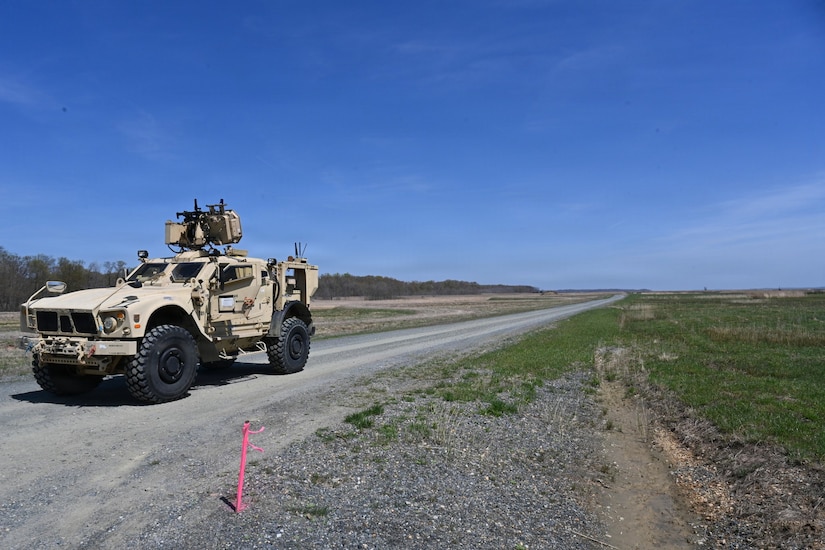
A new effort led by the U.S. Army Combat Capabilities Development Command Armaments Center demonstrated advancements developed for fire control, enabling the ability to engage and defeat drones with a common remotely operated weapon station while shooting on the move.

A military vehicle is parked on a gravel road in a grassy field.

The fire control project is a Science and Technology Integration Office software effort that is designing, developing and demonstrating advanced counter-drone fire control capabilities. The project underwent testing in April at the Aberdeen Proving Ground in Aberdeen, Maryland. 
 
According to Nick Cascia, project officer, the initiative began as a mission-driven response to the emerging small unmanned aerial system threat after leadership directed the team to pursue an advanced fire control capability to defeat small drones.

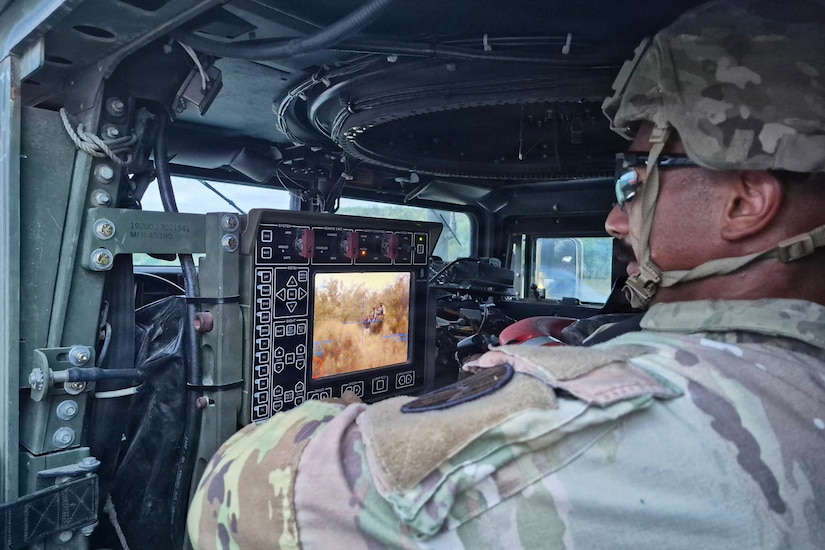
A man in a camouflage military uniform looks at a screen inside a military vehicle.

The effort integrated the Armaments Center's Gunslinger fire control, originally developed under the Future Attack Reconnaissance Aircraft program, and adapted it for ground-to-air targeting. The remote weapon station is able to defeat small moving targets while the vehicle is in motion by using the Gunslinger's fire control, as well as various vehicle sensor feeds, to provide real-time data, ensuring the weapon is accurately aimed at the target drone. 
 
This fire control solution uses a modular open system approach, so the developed software as well as any future enhancements can be shared across the Army. Once matured, the software will improve system accuracy against drones, reducing the number of rounds needed to defeat the threat.

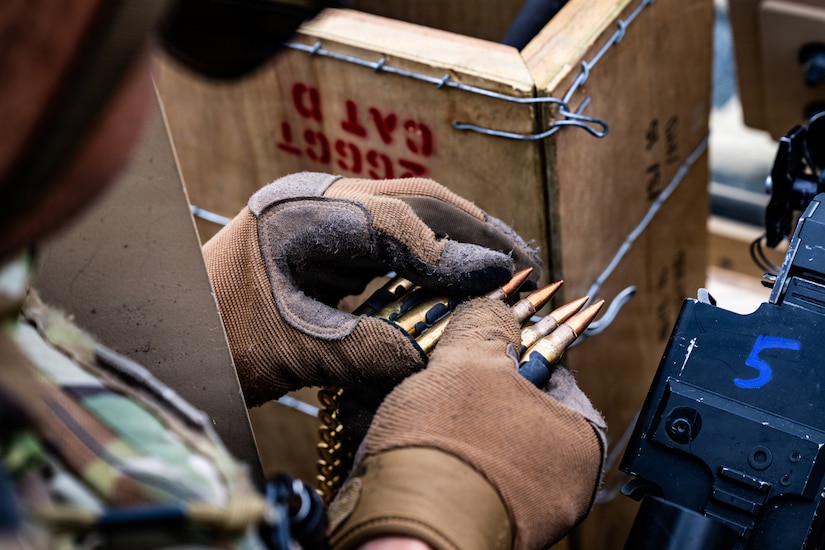
A person in a camouflage military uniform and brown gloves holds a string of large bullets.

 
According to James Little, deputy project lead, the development team received promising results from their April tests and will iterate and build upon these results in subsequent tests to improve system performance. With these tests, developers will continue to increase the speed of both the vehicle and drone. 
 
"It's a great start to the effort," Cascia explained. "The [project] team has put considerable time and effort into developing our advanced fire control algorithms and preparing for this test. Once we started destroying drones, it showed the hard work was paying off."

Tuesday, October 2, 2012

Mobile Devices Offer Fast Decisions, Productivity, Official Says


By Claudette Roulo
American Forces Press Service

WASHINGTON, Oct. 2, 2012 – Mobile devices are becoming the way we communicate, and the Defense Department views that change as an opportunity, the department’s deputy chief information officer for command, control, communications and computers and information infrastructure said Sept. 28.

Air Force Maj. Gen. Robert E. Wheeler told American Forces Press Service and the Pentagon Channel that National Cyber Security Awareness Month is a good time to consider what is involved in adopting mobile communications.

"There's always risks involved in having a mobile strategy where you're not connected directly to the network," he said.

The Pentagon’s mobile device strategy released in June outlines DOD’s plan to maximize the potential uses of mobile devices. The plan covers three key areas: wireless infrastructure, mobile devices and mobile applications. According to the CIO website, the goal is to keep these areas flexible and secure enough to benefit the warfighter and keep pace with changing technology.

Wheeler said the CIO’s mobile implementation plan will be released by mid-October. The plan will consolidate the results of about 21 pilot programs to create a mobile device plan to apply across the enterprise. This will provide the ability to "think and acquire data [from] different directions -- voice, video and data," he said, and is another step toward unified requirements for use of all parts of the DOD network.

"So, instead of having multiple different kinds of ways … of connecting to the network,” the general said, “we're going to have an enterprise-type model that actually buys down the risk" and that ultimately will give DOD a better understanding of problems and the ability to make decisions at a faster pace.

The mobility implementation plan is a way for DOD to take advantage of where the rest of the world is going with mobile communications, Wheeler said.

“So, for example, if we do this in an enterprise-type model,” he added, “we can go cheaper, we can buy down the risks, … [and] we can jump the productivity curve."

The ability to make decisions while on the move versus deciding and then moving is a big change from a DOD perspective, Wheeler said. That process is being adopted more frequently in small pockets around the DOD, he added, “but now this would be an enterprisewide approach to doing business in a particular way, and it allows everyone to do this while on the move."

DOD has several objectives as the CIO shapes mobility strategy, Wheeler said. Saving money and increasing security are important, he said, but the key objective is less quantifiable.

Young people understand the power of apps and how to use them, he said, but for "digital immigrants" like him, it's a bit more difficult to adapt. But doing so could change the way DOD operates, allowing the department to move faster, make decisions faster, stay ahead of adversaries, and make better business decisions.

"I think this is the key piece to it,” Wheeler said. “So we save money [and] we increase the security, but the big power down there is jumping the productivity curve so we can do many more things faster and actually provide more time for our people to think -- to do those things that they need to get done and to make those right decisions."

But, he noted, if the cybersecurity thread is lost at any point, DOD also will lose productivity and the cost becomes an irrelevant issue, because security breaches have the potential to be devastating on a national level. So, Wheeler said, DOD has established three categories of devices that will move through the approval process.

The first category includes devices that never need to connect to a DOD network, he said. An example of those types of device might include tablets to replace the knee boards used by pilots to hold their paper checklists and charts. Pilots could download updated information through a commercial Internet connection set up specifically for that purpose.

The second category would cover mobile devices that connect to the unclassified network, including commercially available devices such as the iPhone or Android devices. “That's a group of devices that will be approved, and in fact, that's going through the process right now,” Wheeler said.

The third category is for devices that connect to the classified network. Some of those devices will meet the security requirements to allow them to connect directly to a classified network, he said, while others will encode classified information in such a way that it can travel on commercial networks.

For average users, this means that the capabilities of today’s mobile devices will be available to them while at work on either classified or unclassified networks, Wheeler said. That capability includes the ability for all approved devices to download required apps from a DOD app store.

Regardless of the type of device, a faster approval process is a key part of the implementation plan, Wheeler said.

"Historically, DOD has been slow to approve electronic devices. … If you see how the market works, in 12 to 18 months that device is no longer even available, so we have to be able to approve it."

To make sure devices can be approved quickly, he said, the CIO took a two-pronged approach: They provided mobile device makers with DOD's security requirements, and they incorporated a mandatory timeline into the approval process. Wheeler cited the specific example of the planned DOD app store.

"We're requiring that if somebody needs an app for their specific mission, they provide it and [we respond] within 90 days," he said. The applicant receives an approval or a denial, or is told that certain changes are required to the app before it can be approved.

One of the main reasons for adopting the timeline was security, the general said. "As new technology comes out we need to take advantage of that new technology and move with that new technology to keep our stuff more secure,” he explained. “So, waiting two, three, four years to approve something is something that would actually hurt our ability to do the mobility implementation plan."

Eventually, the CIO would like to reach the point at which mobile devices are approved for use on the network before they're even released, he said. That way, he added, devices that meet the security requirements could be put into use as soon as they're available.

"At the end of the day,” Wheeler said, it becomes an issue of the individual user understanding the rules [and] following those rules -- not trying to push the envelope and saying, 'Well, I want this specific app' is a prime example of that -- one that doesn't come off the approved list of apps and trying to put that on their phone."

It's incumbent upon everyone to make sure that they're watching how they operate, Wheeler said, both from a cybersecurity perspective and from an operational security perspective. And that's something that isn't just about mobile strategy, he added, but about how DOD does business as a whole.

Sensors on Scan


One of the things I like most about science fiction are the gadgets.

Those cool little devices that make life for us mere mortals so much easier.  From lightsabers to sonic screwdrivers and tractor beams to transporters, the SciFi verse is filled with the convenience of beautiful, impressive, but unfortunately fictitious technology.

I’m sorry, did I say fictitious?  I meant FOR REAL.

Yes that’s right.  One really amazing type of science fiction technology is being actualized right now at the Naval Research Laboratory.  One that could change the way we deal with many different types of situations, and could even go so far as to save lives.  So which one of the amazing futuristic inventions is coming to the real world?

No really, The Naval Research Laboratory has essentially created a technology that will allow us to scan an area and determine what’s in it…And it’s small enough that it could potentially fit on your smart phone.  If you’re not impressed yet just wait until you find out the science behind how this thing actually works.

The technology is called SiN-VAPOR, which stands for silicon nanowire vertical array with a porous electrode.  So what does that mean, exactly?

“That means that we have a sensor about the size of a quarter that can detect very low concentrations of analytes in the vapor phase,” explains Dr. Chris Field, a research chemist at NRL, and also a part of what I’m calling the tricorder team.  “So an example would be that we can detect down to the tenth PPB, or parts per billion range.  So to define what that is, we’re able to detect from the background, ten molecules of one analyte versus a billion of other molecules that may be in the same environment.”

The end product is something quite similar to a Star Trek tricorder, Dr. Field goes on to say, in that someone could walk into a room and be able to determine everything that’s in the vapor phase.  So if there’s a carbon monoxide leak, as an example.  If there is an elevated level of oxygen.  If there is something that’s burning.  If a perfume released in a room.  The SiN-VAPOR would be able to detect that.

And that’s only a few of the things this sensor has the potential to do.

“Another example would be similar to like a breathalyzer, only we would be able to detect pretty much anything from what you had for breakfast this morning all the way down to lung cancer,” says Dr. Field.

Which makes this device both incredible and versatile.  Being able to scan what the human eye cannot see is something that could not only prevent bad breath but also help save lives.  It’s also rather compact.  And by that I mean really, really small.

“The current sensor is about the size of a quarter, and within that quarter or about that size we have over a billion nanowires in that surface,” Dr. Field explains as he holds the tiny tricorder chip in the palm of his hand.  “Each wire is a sensor, so we essentially have a billion sensors on the size of a quarter.  The final form factor for the sensor, or the final product from this research will hopefully be something that can fit onto a cell phone.  Cell phones are ubiquitous in the world these days and we would love to have our sensors on every cell phone in the world.”

Talk about convenient.  I could have my music, my apps, my contacts and my scanner on my phone?  Well I’m sold.  But Dr. Field doesn’t want to stop with the cell phone.  Indeed, NRL has some bigger (and might I add convenient) plans for their vapor scanner.  Something that could change the way we travel.

In a good way.

“Another application [of this technology] would be to take that sensor and apply it to checkpoints or security so that you would never have to wait in line anymore at the airport.  So imagine the airport itself is an entire checkpoint.  So there are these small tiny vapor sensors distributed throughout the entire airport and they work together with wireless communication to map out what different vapors are in the environment.”

This basically means that there could be a future where we no longer have to wait in long security lines and take our shoes off at the airport.

These sensors could basically work around the clock, silently and painlessly scanning the crowds, on the prowl for dangerous materials.  It seems like a more attractive option than the hop-on-one-foot-to-put -shoes-back-on dance that happens now.  Not to mention more effective.

The SiN-VAPOR technology is also something that could help first responders, firefighters, and medical professionals by serving as a preventative measure.  Especially in places where prevention is the first line of defense.  Like in a crisis.

“We portray this as something that improves situational awareness,” Dr. Field explains.  “Okay, let’s say there is a fire on a Navy ship. So if our sensors are on a micro-fliers or on a robot designed to automate firefighting capabilities, you would send in the micro-fliers first as a first responder to show you know what’s going on in the room, where is the fire at, what vapors are being released, is it in a room that has other things we need to be concerned about, and then relay that information back to the central supervisory control system or on top the robot itself.  So before they open that hatch, before they enter that room, they know what’s going on inside.”

Imagine the benefits something like this could have for the military.  Searching for roadside bombs, determining threats in hidden areas, looking for hazardous materials; these are all pretty dangerous things that many service members do on a daily basis.  A device like this could keep troops safer while still allowing them to complete their mission…Only from a safer scanning distance.

This sensor can also be made for less than a dollar a piece, and uses less than a microwatt of power, so it won’t break the bank or drain the battery.  Now that’s what I call efficient technology.  Spock would be so proud.

So what science fiction shows does Dr. Field enjoy/is inspired by when he’s not busy turning science fiction into science fact?

“[It’s] a toss-up between Firefly and Battlestar Galactica – the rebooted series.  Those two – I could watch any of those episodes (with an exception of a couple of Battlestar Galactica episodes) multiple times.”

Me too, Dr. Field.  Me too.

Want to know more about this incredible technology?  Click here!

Jessica L. Tozer is a blogger for DoDLive and Armed With Science.  She is an Army veteran and an avid science fiction fan, both of which contribute to her enthusiasm for technology in the military.

Monday, September 24, 2012

The New Plug-and-Play Mircosatellites


As Arnold Engineering Development Complex‘s (AEDC) project team recently celebrated Arnold’s Space Threat Assessment Testbed’s (STAT) successful initial site acceptance test, they also have another good reason to rejoice.

The STAT Facility also comes complete with a fully-instrumented, plug-and-play microsatellite available to use as a test article in the facility during the initial and final checkout for full mission readiness.

Nikki Tracey, AEDC’s Air Force STAT program manager, said to put the microsatellite into perspective, it is important to understand what the STAT facility is capable of accomplishing.


“STAT can simulate a realistic space environment to test space hardware, using multiple sources to create what a satellite is often subjected to in the orbits they frequently occupy,” she said.

Tracey has been particularly impressed with the team and the effort behind how they obtained and prepared the microsatellite for testing during STAT’s continuing workup to complete mission readiness.

“ATA members of the STAT project management team have built and developed a ‘CubeSat’ from Pumpkin, Inc.,” Tracey said. “It’s something many universities use for research and NASA and other space agencies use for both research and space missions due to the microsatellites’ size and relatively lower cost.”

Marc Smotherman, ATA’s task manager for the STAT’s chamber data acquisition and control system, said, “One of the requirements for the STAT facility was to install a government-furnished microsatellite in the STAT chamber during final system tests.

“The satellite earmarked for this effort became unavailable. The Air Force approached ATA for a solution. An ATA team composed of John Prebola, Carrie McInturff (ATA’s STAT project engineer and lead for the facility’s distributed mission operation system) and I developed requirements for the microsatellite.”

The main requirements were that all the microsatellite components had flown in space and that the instrumentation be included with the microsatellite so that it could measure certain environmental parameters it would encounter in the STAT chamber.

“Carrie and I developed a software and hardware design for the microsatellite that includes not only the microsatellite design,” Smotherman said, “but design of ground support systems to monitor the status of the microsatellite in the STAT chamber.”

The design drawings for the microsatellite and ground support hardware were given to Roger Johnson, an ATA instrumentation technician expert.

“His job, probably the most difficult of the entire effort, was to mount the various computer and instrument systems in the CubeSat frame and wire all the systems,” Smotherman said. “Since this is a ‘micro’ satellite, Roger had to use his special skills to fit all the components in the frame and route all cabling to the various components. And, all the while he was developing solutions to protect the various microsatellite components from the harsh environment of space. Roger delivered a flawless system that Carrie and I checked out.”

The microsatellite was installed in the STAT chamber in August during the STAT Initial Operating Capability test.


“While being subjected to the harsh environment of the STAT chamber, the microsatellite will also be transmitting telemetry data to a satellite operations center, as it would during a real space flight,” Smotherman said.

Johnson, who has been with AEDC since 1973, said building and wiring the satellite was a new experience – it was literally the first time he had ever tackled anything like it during his career.

“It was a challenge and I’m glad that I could offer my talents and that it worked out, but I’m not the only one here at AEDC who has these skills,” he said. “It felt good to have been a part of this.”