Showing posts with label edwards air force base. Show all posts

Tuesday, September 16, 2025

Air Force Announces Arrival of Second B-21 Test Aircraft

The Department of the Air Force announced the arrival of the second B-21 Raider flight test aircraft, Sept. 11, at Edwards Air Force Base, California, enhancing the Air Force's capacity to conduct comprehensive testing and sustainment training. 
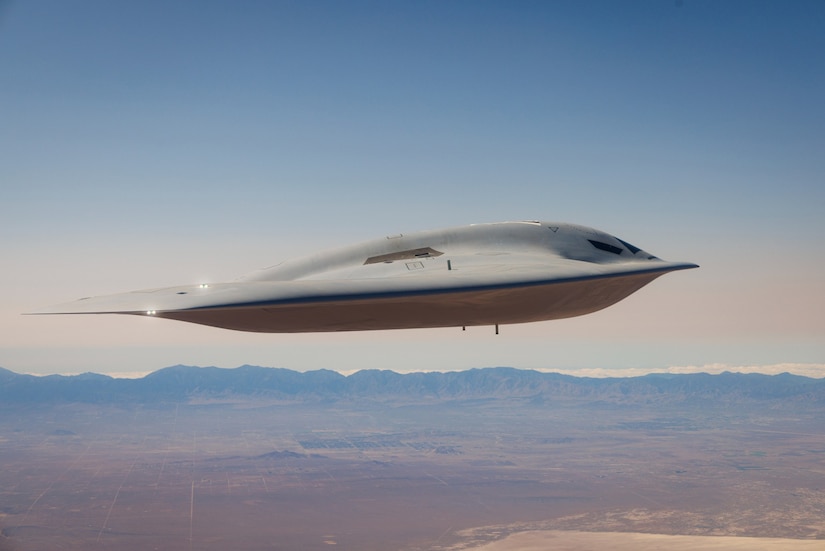
A military bomber aircraft flies over California. There is flat ground below the aircraft and mountains in the background.

 
The addition of the second aircraft expands the service's testing capabilities beyond initial flight performance checks, enabling progression into critical mission systems and weapons integration testing phases. This advancement marks a step toward operational readiness of the nation's sixth-generation stealth bomber. 
 
"With the arrival of the second B-21 Raider, our flight test campaign gains substantial momentum," said Air Force Secretary Troy Meink. "We can now expedite critical evaluations of mission systems and weapons capabilities, directly supporting the strategic deterrence and combat effectiveness envisioned for this aircraft." 
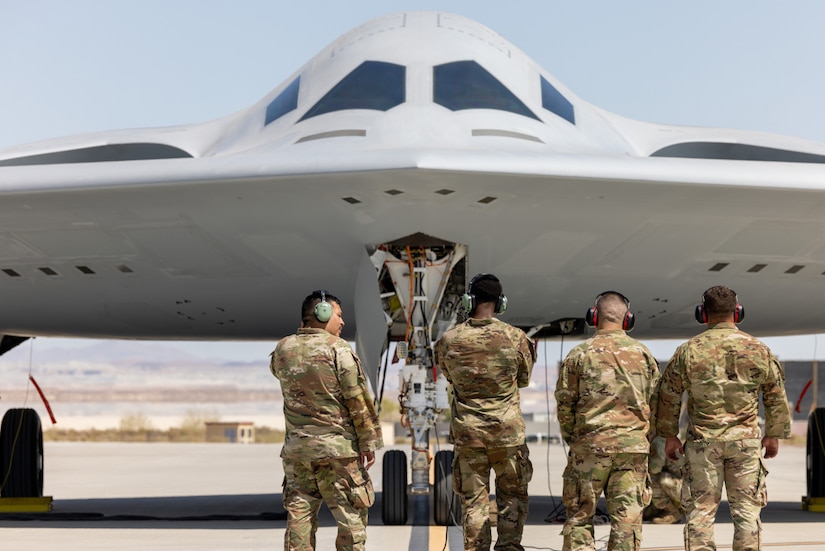
Four men wearing military camouflage uniforms and hearing protection stand in front of a large military bomber aircraft on a tarmac.

 
The presence of multiple test aircraft provides Air Force maintainers hands-on experience in managing simultaneous aircraft sustainment operations, testing the effectiveness of maintenance tools, technical data and the logistical processes that will support future operational squadrons. 
 
"The addition of a second B-21 to the flight test program accelerates the path to fielding," said Air Force Chief of Staff Gen. David Allvin. "By having more assets in the test environment, we [can] bring this capability to our warfighters faster, demonstrating the urgency with which we're tackling modernization." 
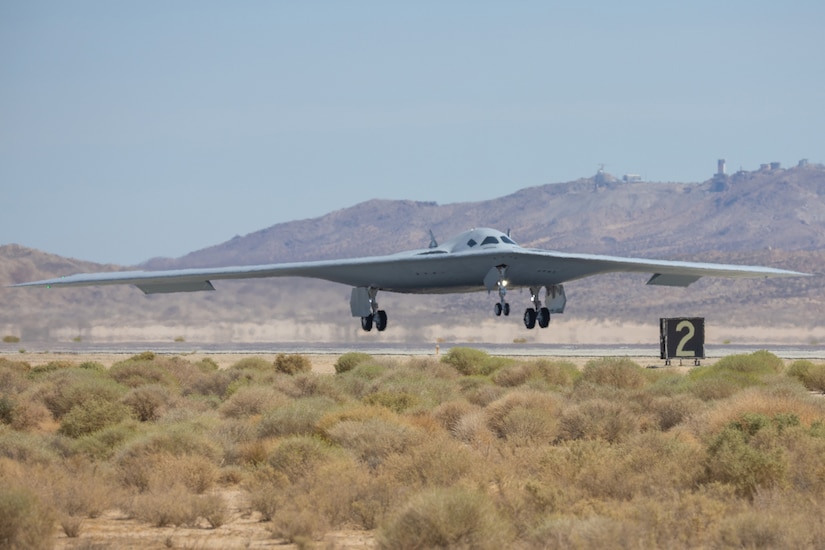
A military bomber aircraft with its wheels down prepares to land on a runway. There are mountains in the background and desert plants in the foreground.

 
Concurrent with the expanded flight-testing effort, fiscal year 2026 will see the launch of extensive military construction projects at all three designated B-21 main operating bases. Ellsworth Air Force Base, South Dakota, the first base set to receive operational B-21 aircraft, is already progressing on numerous infrastructure projects to ensure readiness when the aircraft arrive. 
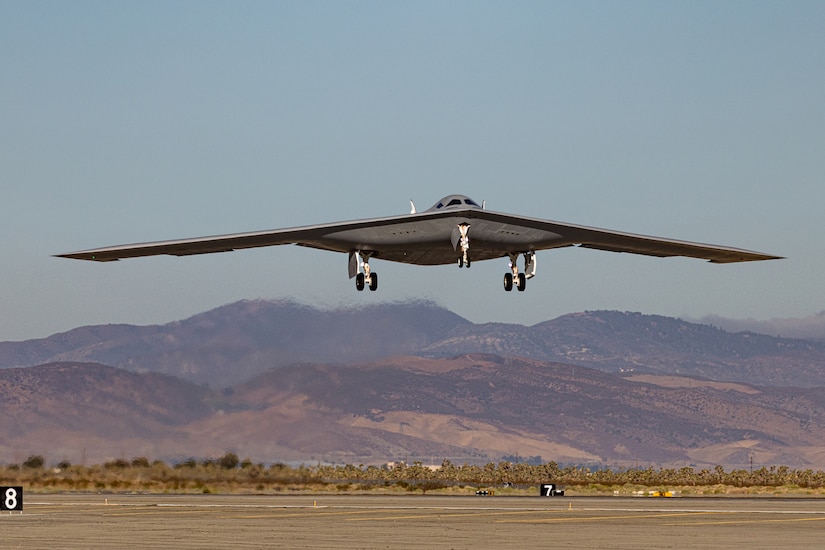
A military bomber aircraft with its wheels down prepares to land on a runway. There are mountains in the background.

 
"The B-21 Raider program represents a cornerstone of our strategic nuclear modernization," Allvin said. "The concurrent efforts in testing, sustainment, preparation and infrastructure investments clearly illustrate our commitment to providing unmatched capabilities to deter and defeat threats well into the future."

Wednesday, August 8, 2012

Blended Wing Body Aircraft Lifts Off


The remotely operated X-48C Blended Wing Body aircraft lifts off Rogers Dry Lake at Edwards Air Force Base, Calif., on its first test flight Aug. 7, 2012. The sub-scale technology demonstrator, modified from the prior X-48B configuration, is entering a new flight test phase in a partnership between NASA and The Boeing Company's Phantom Works research and technology division.

The aircraft, designed by the Boeing Co. and built by Cranfield Aerospace Ltd. of the United Kingdom, is flying again in partnership with NASA. The new X-48C model, which was formerly the X-48B Blended Wing Body aircraft, was modified to evaluate the low-speed stability and control of a low-noise version of a notional, future Hybrid Wing Body (HWB) aircraft design. The HWB design stems from concept studies being conducted by NASA's Environmentally Responsible Aviation project of future potential aircraft designs 20 years from now.

Image Credit: NASA/Carla Thomas

Tuesday, August 7, 2012

Transformed X-48c Flies Successfully


Michael Braukus
Headquarters, Washington     
202-358-1979
michael.j.braukus@nasa.gov
 
Gray Creech
Dryden Flight Research Center
661-276-2662
gray.creech-1@nasa.gov
 
Tom Koehler
Boeing Research & Technology Communications
425-373-2921
thomas.j.koehler@boeing.com
 
Edwards AFB, Calif. -- The remotely piloted X-48C aircraft successfully flew for the first time Tuesday at Edwards Air Force Base in California's Mojave Desert.

The aircraft, designed by The Boeing Co. and built by Cranfield Aerospace Limited of the United Kingdom, is flying again in partnership with NASA. The new X-48C model, which was formerly the X-48B Blended Wing Body aircraft, was modified to evaluate the low-speed stability and control of a low-noise version of a notional, future Hybrid Wing Body (HWB) aircraft design. The HWB design stems from concept studies being conducted by NASA's Environmentally Responsible Aviation project of future potential aircraft designs 20 years from now.

"We are thrilled to get back in the air to start collecting data in this low-noise configuration," said Heather Maliska, X-48C project manager at NASA's Dryden Flight Research Center. "Our dedicated team has worked hard to get the X-48C off the ground for its first flight and we are excited learning about the stability and control characteristics of this low-noise configuration of the blended wing body."

Primary changes to the C model from the B model, which flew 92 flights at Dryden between 2007 and 2010, were geared to transforming it to an airframe noise-shielding configuration. External modifications included relocating the wingtip winglets inboard next to the engines, effectively turning them into twin tails. The aft deck of the aircraft was extended about 2 feet to the rear. Finally, the project team replaced the X-48B's three 50-pound thrust jet engines with two 89-pound thrust engines.

Because handling qualities of the X-48C will be different from those of the X-48B, the project team developed flight control system software modifications, including flight control limiters to keep the airplane flying within a safe flight envelope. This will enable a stronger and safer prototype flight control system suitable for future full-scale commercial hybrid or blended wing aircraft.

"We are very pleased to begin flight tests of the X-48C," said Mike Kisska, Boeing X-48C project manager. "Working with NASA, we've successfully passed another milestone in our work to explore and validate the aerodynamic characteristics and efficiencies of the blended wing body concept."

Additionally, the upcoming flight experiments with the X-48C will help researchers further develop methods to validate the design's aerodynamics and control laws, including a goal of reducing aerodynamic drag through engine yaw control tests.

During the planned second block of flight testing this fall, NASA will test engine yaw control software incorporated in the X-48C's flight computer. This research will use asymmetric engine thrust to create yaw, or nose left or right movements, for trim and for relatively slow maneuvers.
NASA's Aeronautics Research Mission Directorate and Boeing are funding the X-48 technology demonstration research effort, which supports NASA's goals of reduced fuel burn, emissions and noise.

The X-48C retains most dimensions of the B model, with a wingspan just longer than 20 feet, and a weight of about 500 pounds. The aircraft has an estimated top speed of about 140 mph, and a maximum altitude of 10,000 feet.

The Air Force Research Laboratory, Dayton, Ohio, also is a member of the project team.

For more information about the Aeronautics Research Mission Directorate, visit http://www.aeronautics.nasa.gov.

- end -

Monday, May 28, 2012

Upgrades for the B-52


During a recent visit to Edwards AFB, Calif., the commander of Air Force Global Strike Command spent time with B-52 Combined Test Force officials to preview the combat capability enhancements made to the B-52H Stratofortress.

Modernizing and sustaining the nation’s long range strike aviation capability is a top priority for the command, Lt. Gen. Jim Kowalski said, who recently noted the B-52 has served and delivered decisive effects in many recent U.S. conflicts to include Operation Iraqi Freedom.

We’re celebrating this year as the Year of the B-52, marking both the 50th anniversary of the last delivery of a B-52H to Minot AFB, N.D., and the 60th anniversary of the first test flight of the YB-52, he said.

He attributed the reliability and combat capability of the dual-role bomber to the talented maintenance personnel, outstanding depot support and the Air Force’s continued investment in the airframe.

The B-52H is a dual-capable aircraft designed to carry a variety of weapons in support of a range of military operations. It has been projected for a number of upgrades that have already been made to the two B-52H test aircraft at Edwards AFB.

These upgrades are integral to ensuring the B-52H is both effective and able to fully integrate with other services, as envisioned in the Air Sea Battle concept, according to command officials.

Among the upgrades is a guided “smart weapon” capability in the B-52H’s internal weapons bay, which provides a 66 percent increase in guided weapons payload. Another current program is an upgrade to the latest Advanced Targeting Pod, which will increase the B-52H effectiveness when performing close air support and other missions.

One of the test aircraft at Edwards AFB also featured an improved on-board communications upgrade called Combat Network Communications Technology (CONECT).

The CONECT program brings the B-52H from the analog into the digital age, according to command officials, providing an invaluable data link over which to pass mission and threat data.

With the new defense strategy placing a greater emphasis on the Pacific, it’s really important that our bombers are fully networked and integrated with the joint force, Kowalski said.

The command provides a fleet of B-52Hs and a cadre of Airmen from Minot AFB and Barksdale AFB year-round in support of the continuous bomber presence mission in the Pacific, which ensures stability and peace in the region.

“Long-range, payload, persistence … these three attributes underlie key capabilities provided by Global Strike Command’s B-2 and B-52H fleet,” said Col. Rick Mitchell, the Bomber Requirements Division chief. “These attributes become increasingly important to combat the ‘tyranny of distance‘ posed by the vast expanse of the Pacific Ocean.

“Integrating a beyond line-of-sight data link and installing new controls and color displays on the aircraft decreases the crew workload significantly,” Mitchell said “A controlling agency can now send mission updates to the B-52 via the data link without having to rely on voice communications.

“Because the data link is integrated with the aircraft offensive avionics system, the aircrew simply has to accept the mission change which is then automatically loaded into the avionics and weapons,” he continued. “Our current and temporary datalink solution does not provide us with this capability. The ability of CONECT to accomplish this retargeting allows for standoff weapons survivability and shorten the close air support kill chain.”

These digital enhancements will ensure the viability of the B-52H well into the 21st century, Mitchell said.

Courtesy of the Air Force Global Strike Command Public Affairs.

Saturday, November 5, 2011

Air Force modernization takes B-2 to North Pole

By Kate Blais
95th Air Base Wing Public Affairs, Edwards Air Force Base, Calif.

A B-2 Spirit flew from Edwards Air Force Base, Calif., to the North Pole and back Oct. 27 on a mission to test the aircraft’s hardware and software upgrades, endurance and its performance at extremely high latitudes.

The 18-plus hour mission consisted of developmental and operational test points to prove that the B-2′s software upgrade works well and is able to operate anywhere in the world.

“A goal of the test force is to prevent a situation where an aircraft experiences an anomaly with a new system for the first time in an operational mission,” said Lt. Col. Hans Miller, the 419th Flight Test Squadron commander. “This flight to the North Pole could reveal data and lessons that were not seen in a lab or simulated environment.”

Although the B-2 has been to the North Pole in simulated tests, this is the first time the aircraft has physically travelled there, marking a milestone in B-2 testing, officials said.

“This is the first time the B-2 has operated at this extreme of latitude before, and (I believe) the longest flight so far for this hardware and this software,” said Maj. Michael Deaver, the 31st Test and Evaluation Squadron’s B-2 Extremely High Frequency Test director. “Being a global bomber, it may be required to operate at extreme latitudes, if not where the target is, but possibly for the flight path it’ll take to get there.”

The mission worked to verify that the software upgrades, which include new communication and new navigation equipment, still allows the B-2 to operate effectively anywhere in the world, test officials said.

“The main objective of this mission is to look at how the software and hardware works over a long duration (of time),” said 1st Lt. Derek Moore, a test conductor assigned to the 419th Flight Test Squadron. “We try to push the limits of the aircraft and come back and make sure that operationally, it can still meet objectives.”

The operational portion of this mission consisted of releasing four unguided BDU-38 bombs over the precision impact range area here after the flight, officials said. According to Deaver, one of the biggest objectives was to make sure that the aircraft knew where it was and that it could get to a weapons release point.

To get to that point, extensive coordination throughout the 419th FLTS, Bomber Combined Task Force and other Edwards AFB assets, as well as outside support including the Department of State, was necessary for a successful mission, test officials said.

“Support from the Air Force Flight Test Center allowed us to use the (412th FLTS) as a resource, which served as an airborne control room and communication hub,” said Jeremiah Farinella, a 419th FLTS test conductor and operations engineer. “That allowed us to troubleshoot some issues that we saw when we were airborne and provided us communication back to Edwards (Air Force Base), which was essential to our success and allowed the pilots to stay focused on the mission.”

Officials at Fairchild Air Force Base, Wash., provided a KC-135 Stratotanker for aerial refueling support, Farinella said. The tanker refueled the B-2 over Alberta, Canada, to ensure that the B-2 could complete the endurance portion (of the mission). The B-2 was further supported with fuel from a second KC-135 from here that helped ensure that the B-2 could complete the operational portion of the polar mission.

“We had an incredible team that went with us, lessened our workload greatly and contributed to the fact that we were able to get up there and back safely and really lowered the risk of the mission for us,” said Maj. Andrew Murphy, a B-2 experimental test pilot assigned to the 419th FLTS.

Flight test helps find problems early on so that they can be fixed before aircraft end up in the field, Murphy said.

“The warfighter needs to know where they can and can’t go,” he said. “Essentially, we’ve proven the fact that they can get up into those (high) latitudes safely and effectively. That previously was a question mark.”

Ensuring that the B-2 maintains its legacy capabilities contributes to the greater Air Force mission, Farinella said.

“It’s a very good cross-check to ensure that we maintain global vigilance and can strike any target in the world at any time, providing overall global combat power.” Farinella said.

Monday, August 8, 2011

Birds of a Feather

NASA's modified Boeing 747 Shuttle Carrier Aircraft briefly flew in formation over the Edwards Air Force Base Test Range on Aug. 2, 2011. The aircraft were scheduled to be in the air on the same day, NASA 911 (plane in the foreground) on a flight crew proficiency flight, and NASA 905 (rear) on a functional check flight following maintenance operations. Since both aircraft were scheduled to be in the air at the same time, SCA pilot Jeff Moultrie of Johnson Space Center's Aircraft Operations Directorate took the opportunity to have both SCA's fly in formation for about 20 minutes while NASA photographer Carla Thomas captured still and video imagery from a NASA Dryden F/A-18. In addition to Moultrie, NASA 905's check flight crew included pilot Arthur "Ace" Beall and flight engineer Henry Taylor while NASA 911 was flown by Larry LaRose, Steve Malarchick and Bob Zimmerman from NASA Johnson and Frank Batteas and Bill Brockett from NASA Dryden.

Image Credit: NASA/Carla Thomas

Thursday, July 21, 2011

End of an Era: STS-135 Atlantis Landing

By Carla Voorhees

Kathy Winters is an Air Force Civilian Meteorologist at the 45th Weather Squadron at Cape Canaveral Air Force Station. She is the Space Shuttle Launch Weather Officer providing weather support to the Space Shuttle Program at Kennedy Space Center (KSC) as the Launch Team prepares for the 21 July 2011 landing of Atlantis. You can find out more about the 45th Space Wing at their Facebook page.

Atlantis landed at Kennedy Space Center this morning. The weather was perfect!

Sometimes weather can cause the Shuttle to land at Edwards Air Force Base, California. In this case, the Shuttle team immediately starts preparing the vehicle for a Ferry Flight. This mission was not the last chance for a Ferry Flight—Ferry Flights will also take Endeavour and Discovery to their designated static display locations once they are prepared.

The 45th Weather Squadron normally deploys a team of 3 people to provide weather support for Ferry Flights. Not only does the team travel to Edwards for the flight planning when orbiters land there, but they also ride on the “Pathfinder” aircraft, an aircraft which carries the bulk of the Ferry Flight Team and flies ahead of the Shuttle Carrier Aircraft. There are two Shuttle Carrier Aircraft, and they are modified 747s. It’s hard to imagine with how much fuel a 747 can carry, the Ferry Flight still has to make approximately 3 stops from California to Florida!

The Ferry Flight is a weather-sensitive mission, so the weather team’s forecast and the Pathfinder aircraft ensure the Ferry Flight does not experience any unexpected weather. In fact, although the route is pre-planned, the weather usually drives the actual route the Ferry Flight takes. Check out these weather constraints for Ferry Flight—not a typical aviation mission! These are the typical constraints for a post-mission Ferry Flight. The 45th Weather Squadron team will find out soon whether all of these constraints apply for the flights to the static display locations.

The Shuttle Ferry Flight is a weather sensitive operation! (Source: 45th Weather Squadron)
I guess this is my last blog! Check out the KSC Multimedia web site to see the images from today’s event. It’s hard to believe this is the last Space Shuttle mission; 30 years, 135 missions—the end of an era.

Thursday, March 17, 2011

DoDLive Bloggers Roundtable: The X-51A Waverider

The Air Force is making final preparations for the second hypersonic flight test by the X-51A Waverider slated to launch this spring from Edwards Air Force Base, Calif. The X-51A team made some slight vehicle modifications following the May 26, 2010 longest-ever hypersonic flight powered by a supersonic combustion ramjet engine. Charlie Brink, Air Force Research Laboratorys X-51A technology demonstrator program manager; Joseph Vogel, Boeing Phantom Works/Defense, Space & Security Director of Hypersonics X-51A program manager; and George Thum, X-51A Program Manager, Pratt & Whitney Rocketdyne, will participate in a Roundtable to discuss the upcoming X-51A test flight.