Showing posts with label air force. Show all posts

Tuesday, February 10, 2026

From Backpacks to Bird's-Eye: Drones Are Transforming EOD

Across a stretch of open terrain at Hurlburt Field, Florida, two airmen assigned to the 1st Special Operations Wing began a race between machines. One guided a ground robot toward a simulated casualty, its treads working across dirt and grass. The other launched a small unmanned aerial system, or drone, which reached the site within seconds.
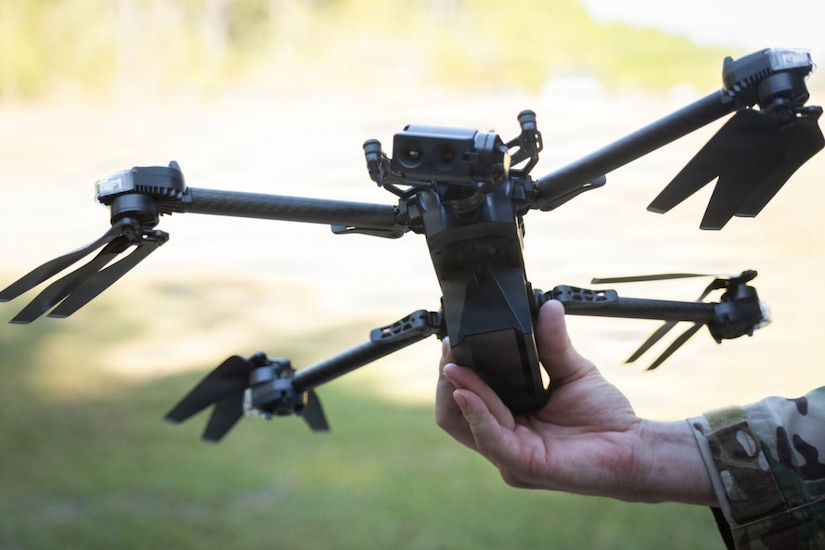
A close-up view of a drone as it’s held by a person in a camouflage military uniform.

From above, the drone's camera streamed a clear view of the scene before the robot made it halfway there. It's a new kind of flight reshaping how explosive ordnance disposal airmen execute their mission — and how the Air Force strengthens readiness through innovation.  

Before the adoption of modernized drones, EOD teams relied primarily on heavy robotic platforms to inspect potential explosive threats. The systems still provide valuable standoff capability but require vehicle transport and setup time, limiting their use during operations on foot. In those scenarios, airmen may have to approach hazards themselves. 

Compact and portable drones can be carried in a backpack and launched within minutes. Operated from a safe distance, they stream real-time imagery that helps airmen assess hazards without approaching them. The drones give teams an unmatched view of any environment. They combine optical and thermal cameras for day or night operations with advanced 3D scanning that produces precise digital models in minutes, whether documenting blast sites or mapping entire airfields. 

Drones can be used to establish a visual reference of a runway and to collect updated imagery after an incident. The data helps civil engineers quickly identify changes or damage, supporting timely clearance actions and repair planning to resume air operations.

Built-in artificial intelligence also allows drones to operate with a high degree of autonomy. The system can identify and track targets, hold position, and navigate around obstacles with minimal operator input. These capabilities boost mission tempo and efficiency while augmenting the work of airmen, keeping them out of harm's way and allowing them to focus on critical decision-making.

Drones have not yet replaced every function of traditional robots, but the two technologies currently complement one another on the battlefield.
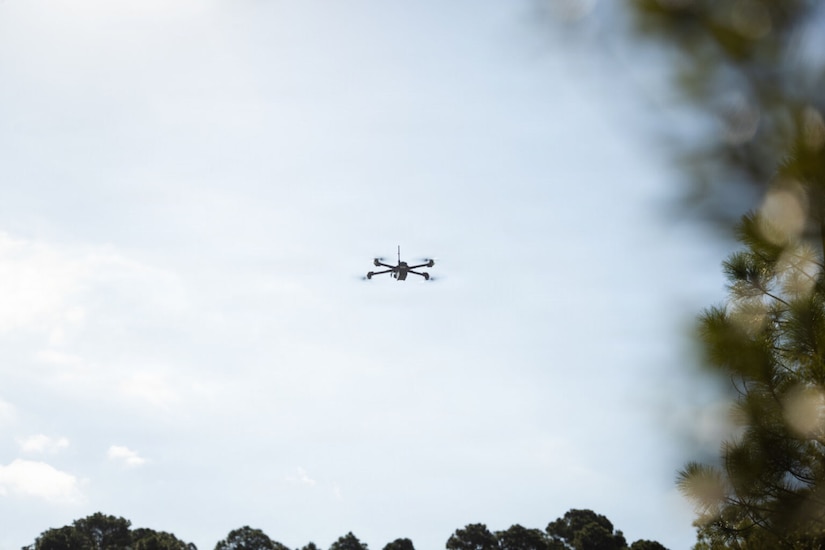
A drone flies in the air with blurry trees in the foreground.

"The big thing doesn't currently have is manipulation," an EOD airman explained. "I can't pull a battery off something or flip something over [with a drone], but a robot can."  

Still, drones are increasingly assuming tasks once limited to ground platforms, expanding options for commanders and reinforcing the Air Force's ability to adapt faster than its adversaries. 

Introducing any new technology brings challenges, but EOD airmen at Hurlburt Field have moved quickly to overcome them. Through local innovation projects, the team acquired and tested drones early, giving them a head start in integrating the capability into daily operations.  

"We've had the ability to work through a lot of the growing pains much faster," said an airman assigned to the 1st Special Operations Wing. "Now we're able to disseminate those lessons throughout the career field." 

That progress continues as airmen refine training and certification standards while identifying where drones provide the most operational value.  

"A lot of this is going to fluctuate based on use cases, because we all have a general idea of how we'd want to use this ... but there's still a lot to learn," said another EOD airman.
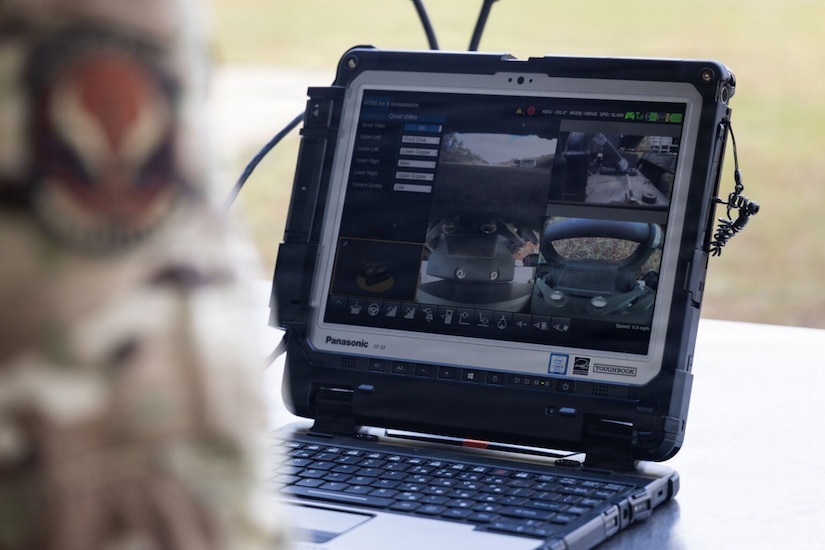
A person in a camouflage military uniform looks at a computer screen that displays the live view from multiple drones.

Wing airmen emphasized that the success of drone integration depends as much on institutional understanding as on technology itself. They said progress requires high-level advocacy to navigate the policies and risk assessments that come with operating in shared airspace, along with trust between ground units employing the systems and aviation communities managing them.  

As one airman explained, the future fight will rely on an enterprise that adapts quickly and learns from those already proving what's possible. 

At Hurlburt Field, EOD airmen are showing how small systems can yield big results. The shift from large ground robots to backpack-sized drones is transforming how they detect, respond and recover — bringing speed, precision and safety to every mission.  

"These are coming. This is the way of the future," said another airman. "If it's not in your shop currently, it probably will be in the very near future. Get ready." 

Monday, July 27, 2015

AF’s Task Force Cyber Secure develops partnerships with industry, academia


By Krista McManus , Task Force Cyber Secure / Published July 27, 2015

WASHINGTON (AFNS) -- Task Force Cyber Secure is midway through phase one of the four-phased chief of staff of the Air Force initiative to address challenges of the cyberspace domain within the Air Force.

As part of phase one, or the discovery phase, a collection of previously completed assessment, vulnerabilities, recommendations and identified mission critical systems are being reviewed, analyzed and prioritized based on support for the Air Force core missions.

In the past three months, the task force has sparked renewed conversation with industry and academia. The Air Force realizes establishing mutually beneficial relationships allows for sharing of best practices to strengthen the enterprise.

Lt. Gen. William Bender, the Air Force chief of information and sponsor of TFCS, traveled to Silicon Valley, California, to meet with leaders from the technology mega-hub’s most innovative companies in an effort to increase collaboration. Bender met with 53 technology companies, including Microsoft Corps. and Oracle Corp., as well as nontraditional potential partners like Twitter, Facebook and Uber. Through small-group discussions, key findings came to light that could improve collaboration between the Air Force and industry.

Silicon Valley leaders agreed partnering with the Air Force would offer opportunities to solve unique problems not present in the commercial sector, and provide industry a chance to help protect the U.S. in cyberspace.

In order to field technology at a more rapid pace, the Air Force is looking to develop a method of technology acquisition and implementation that closely aligns with industry best practices.

"We should mimic the companies in Silicon Valley by increasing agility in our acquisition and procurement processes, accepting risk, failing fast and quickly learning from our failures,” Bender said. “The Air Force information technology community needs to adapt to this agile mindset, and quickly. The alternative costs precious time and money -- two resources which we are really short on."

In regards to academia, the Air Force has been working to establish the Air Force Cyber Innovation Center in an effort produce more cyber-oriented Airmen. The U.S. Air Force Academy-based center will comprise of a highly virtualized environment where cadets will work closely with other service academies, industry and government partners to research and develop state-of-the-art technology.

The AFCIC plans to use innovative approaches to aid in the advancement of new cyberspace capabilities to deploy across the Air Force enterprise. By offering cadets more opportunities for professional development within the cyber realm, the center will provide new generations of cyber warriors for the Air Force who are better prepared to stay ahead of the constantly evolving technology curve.

By the end of the 12-month task force lifecycle in April 2016, TFCS will provide a prioritized Air Force roadmap of cybersecurity efforts, identify potential investments and Doctrine, Organization, Training, Materiel, Leadership, Personnel, Facilities and Policy changes; and develop an enduring Air Force enterprise-wide cybersecurity governance framework.

Tuesday, July 14, 2015

Transcom Nominee Pledges to Address Cyber Concerns


By Jim Garamone
DoD News, Defense Media Activity

WASHINGTON, July 14, 2015 – President Barack Obama’s nominee to be the next commander of U.S. Transportation Command told the Senate Armed Services Committee today that problems in the cyber domain worry him, and that he will emphasize operations to make that domain safer if he’s confirmed.

Air Force Gen. Darren W. McDew, currently the commander of Air Mobility Command -- Transcom’s air component -- has been nominated to succeed Air Force Gen. Paul Selva, who has been nominated to be the next vice chairman of the Joint Chiefs of Staff.

Transcom is an almost seamless mix of active-duty and reserve-component service members responsible for global logistics. The command also is a mix of government and private-enterprise entities. Tying it together is a communications network that must be hardened against cyberattacks, McDew told the senators.

“One of the greatest threats that faces our nation is our ability to deal with the cyber threat,” he said.

Particularly Vulnerable

Transportation Command is particularly vulnerable when dealing with commercial partners, the general said, noting that about 90 percent of the work the command does with private firms is done on the commercial networks. “That is a threat that I have got to face going forward, if confirmed,” he said.

The general said it is possible that an adversary could shut down the command’s network. “That threat is there,” he said. “I believe that U.S. Transportation Command has put some things in place to make that less likely, but as we go forward, the threat only gets worse. Our ability to deal with it must evolve and we have to find ways to do better with it going forward.”

Transcom officials have put clauses in their contracts with commercial vendors to stress the “assuredness of their network and to provide for requirements to report intrusions in their network,” McDew said. “Those are, I think, very beneficial.”

The general told the senators he is thrilled to be nominated to be commander of Transportation Command.

“These unheralded professionals are the business end that projects military power around the globe,” he said. “I cannot overstate the importance of the often thankless work accomplished at Transcom and I am humbled to be considered to be their commander.

Tuesday, October 2, 2012

Mobile Devices Offer Fast Decisions, Productivity, Official Says


By Claudette Roulo
American Forces Press Service

WASHINGTON, Oct. 2, 2012 – Mobile devices are becoming the way we communicate, and the Defense Department views that change as an opportunity, the department’s deputy chief information officer for command, control, communications and computers and information infrastructure said Sept. 28.

Air Force Maj. Gen. Robert E. Wheeler told American Forces Press Service and the Pentagon Channel that National Cyber Security Awareness Month is a good time to consider what is involved in adopting mobile communications.

"There's always risks involved in having a mobile strategy where you're not connected directly to the network," he said.

The Pentagon’s mobile device strategy released in June outlines DOD’s plan to maximize the potential uses of mobile devices. The plan covers three key areas: wireless infrastructure, mobile devices and mobile applications. According to the CIO website, the goal is to keep these areas flexible and secure enough to benefit the warfighter and keep pace with changing technology.

Wheeler said the CIO’s mobile implementation plan will be released by mid-October. The plan will consolidate the results of about 21 pilot programs to create a mobile device plan to apply across the enterprise. This will provide the ability to "think and acquire data [from] different directions -- voice, video and data," he said, and is another step toward unified requirements for use of all parts of the DOD network.

"So, instead of having multiple different kinds of ways … of connecting to the network,” the general said, “we're going to have an enterprise-type model that actually buys down the risk" and that ultimately will give DOD a better understanding of problems and the ability to make decisions at a faster pace.

The mobility implementation plan is a way for DOD to take advantage of where the rest of the world is going with mobile communications, Wheeler said.

“So, for example, if we do this in an enterprise-type model,” he added, “we can go cheaper, we can buy down the risks, … [and] we can jump the productivity curve."

The ability to make decisions while on the move versus deciding and then moving is a big change from a DOD perspective, Wheeler said. That process is being adopted more frequently in small pockets around the DOD, he added, “but now this would be an enterprisewide approach to doing business in a particular way, and it allows everyone to do this while on the move."

DOD has several objectives as the CIO shapes mobility strategy, Wheeler said. Saving money and increasing security are important, he said, but the key objective is less quantifiable.

Young people understand the power of apps and how to use them, he said, but for "digital immigrants" like him, it's a bit more difficult to adapt. But doing so could change the way DOD operates, allowing the department to move faster, make decisions faster, stay ahead of adversaries, and make better business decisions.

"I think this is the key piece to it,” Wheeler said. “So we save money [and] we increase the security, but the big power down there is jumping the productivity curve so we can do many more things faster and actually provide more time for our people to think -- to do those things that they need to get done and to make those right decisions."

But, he noted, if the cybersecurity thread is lost at any point, DOD also will lose productivity and the cost becomes an irrelevant issue, because security breaches have the potential to be devastating on a national level. So, Wheeler said, DOD has established three categories of devices that will move through the approval process.

The first category includes devices that never need to connect to a DOD network, he said. An example of those types of device might include tablets to replace the knee boards used by pilots to hold their paper checklists and charts. Pilots could download updated information through a commercial Internet connection set up specifically for that purpose.

The second category would cover mobile devices that connect to the unclassified network, including commercially available devices such as the iPhone or Android devices. “That's a group of devices that will be approved, and in fact, that's going through the process right now,” Wheeler said.

The third category is for devices that connect to the classified network. Some of those devices will meet the security requirements to allow them to connect directly to a classified network, he said, while others will encode classified information in such a way that it can travel on commercial networks.

For average users, this means that the capabilities of today’s mobile devices will be available to them while at work on either classified or unclassified networks, Wheeler said. That capability includes the ability for all approved devices to download required apps from a DOD app store.

Regardless of the type of device, a faster approval process is a key part of the implementation plan, Wheeler said.

"Historically, DOD has been slow to approve electronic devices. … If you see how the market works, in 12 to 18 months that device is no longer even available, so we have to be able to approve it."

To make sure devices can be approved quickly, he said, the CIO took a two-pronged approach: They provided mobile device makers with DOD's security requirements, and they incorporated a mandatory timeline into the approval process. Wheeler cited the specific example of the planned DOD app store.

"We're requiring that if somebody needs an app for their specific mission, they provide it and [we respond] within 90 days," he said. The applicant receives an approval or a denial, or is told that certain changes are required to the app before it can be approved.

One of the main reasons for adopting the timeline was security, the general said. "As new technology comes out we need to take advantage of that new technology and move with that new technology to keep our stuff more secure,” he explained. “So, waiting two, three, four years to approve something is something that would actually hurt our ability to do the mobility implementation plan."

Eventually, the CIO would like to reach the point at which mobile devices are approved for use on the network before they're even released, he said. That way, he added, devices that meet the security requirements could be put into use as soon as they're available.

"At the end of the day,” Wheeler said, it becomes an issue of the individual user understanding the rules [and] following those rules -- not trying to push the envelope and saying, 'Well, I want this specific app' is a prime example of that -- one that doesn't come off the approved list of apps and trying to put that on their phone."

It's incumbent upon everyone to make sure that they're watching how they operate, Wheeler said, both from a cybersecurity perspective and from an operational security perspective. And that's something that isn't just about mobile strategy, he added, but about how DOD does business as a whole.