Showing posts with label science journal. Show all posts

Thursday, June 7, 2012

All the Colors of a High-Energy Rainbow, in a Tightly Focused Beam


Tabletop laser-like device can create multicolor beam of ultraviolet light, X-rays, and the wavelengths in between
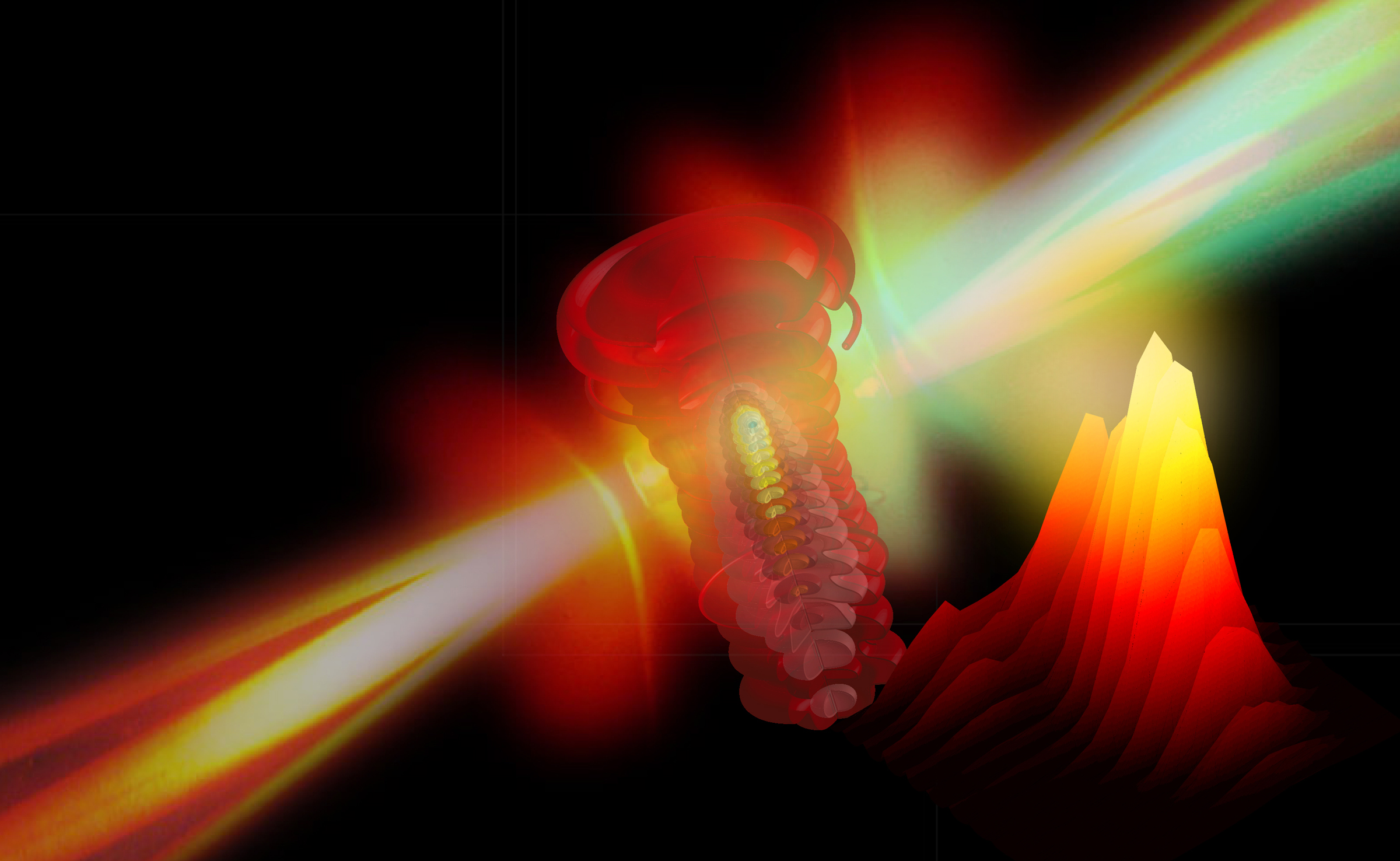
For the first time, researchers have produced a coherent, laser-like, directed beam of light that simultaneously streams ultraviolet light, X-rays and all wavelengths in between.

One of the few light sources to successfully produce a coherent beam that includes X-rays, this new technology is the first to do so using a setup that fits on a laboratory table.

An international team of researchers, led by engineers from the National Science Foundation's Engineering Research Center (ERC) for EUV Science and Technology, reports its findings in the June 8, 2012, issue of Science.

By focusing intense pulses of infrared light--each just a few optical cycles in duration--into a high-pressure gas cell, the researchers converted part of the original laser energy into a coherent super-continuum of light that extends well into the X-ray region of the spectrum.

The X-ray burst that emerges has much shorter wavelengths than the original laser pulse, which will make it possible to follow the tiniest, fastest physical processes in nature, including the coupled dance of electrons and ions in molecules as they undergo chemical reactions, or the flow of charges and spins in materials.

"This is the broadest spectral, coherent-light source ever generated," says engineering and physics professor Henry Kapteyn of JILA at the University of Colorado at Boulder, who led the study with fellow JILA professor Margaret Murnane and research scientist Tenio Popmintchev, in collaboration with researchers from the Vienna University of Technology, Cornell University and the University of Salamanca.

"It definitely opens up the possibility to probe the shortest space and time scales relevant to any process in our natural world other than nuclear or fundamental particle interactions," Kapteyn adds. The breakthrough builds upon earlier discoveries from Murnane, Kapteyn and their colleagues to generate laser-like beams of light across a broad spectrum of wavelengths.

The researchers use a technique called high-harmonic generation (HHG). HHG was first discovered in the late 1980s, when researchers focused a powerful, ultra-short laser beam into a spray of gas. The researchers were surprised to find that the output beam contained a small amount of many different wavelengths in the ultraviolet region of the spectrum, as well as the original laser wavelength. The new ultraviolet wavelengths were created as the gas atoms were ionized by the laser.

"Just as a violin or guitar string will emit harmonics of its fundamental sound tone when plucked strongly, an atom can also emit harmonics of light when plucked violently by a laser pulse," adds Murnane. "The laser pulse first plucks electrons from the atoms, before driving them back again where they can collide with the atoms from which they came. Any excess energy is emitted as high-energy ultraviolet photons."

Like many phenomena, when HHG was first discovered, there was little science to explain it, and it was considered more a curious phenomenon than a potentially useful light source. After years of work, scientists eventually understood how very high harmonics were emitted. However, there was one major challenge that most researchers gave up on--for most wavelengths in the X-ray region, the output HHG beams were extremely weak.

Murnane, Kapteyn and their students realized that there might be a chance to overcome that challenge and turn HHG into a useful X-ray light source--the tabletop-scale X-ray laser that has been a goal for laser science since shortly after the laser was first demonstrated in 1960.

"This was not an easy task," says Murnane. "Unlike a laser--which gets more intense as more energy is pumped into the system--in HHG, if the laser hits the atoms too hard, too many electrons are liberated from the gas atoms, and those electrons cause the laser light to speed up. If the speed of the laser and X-rays do not match, there is no way to combine the many X-ray waves together to create a bright output beam, since the X-ray waves from different gas atoms will interfere destructively."

Popmintchev and JILA graduate student Ming-Chang Chen worked out conditions that enable X-ray waves from many atoms in the gas to interfere constructively. The key was to use a relatively long-wavelength, mid-infrared laser and a high pressure gas cell that also guides the laser light. The resulting bright, X-ray beams maintain the coherent, directed beam qualities of the laser that drives the process.

The HHG process is effective only when the atoms are hit "hard and fast" by the laser pulses, with durations nearing 10-14 seconds--a fundamental limit representing just a few oscillations of the electromagnetic fields. Murnane and Kapteyn pioneered the technology for generating such light pulses in the 1990s, and used those lasers to develop and utilize HHG-based light sources in the extreme-ultraviolet (EUV) region of the spectrum in the 2000s. However, while researchers were using those lasers and the HHG technique to measure ever-shorter duration light pulses, they were stymied in how to make coherent light at shorter wavelengths in the more penetrating X-ray region of the spectrum.

The new paper in Science, under lead author and senior research associate Popmintchev, demonstrates that breakthrough, showing that the understanding of the HHG process the researchers developed is broadly valid.

"We would have never found this if we hadn't sat down and thought about what happens overall during HHG, when we change the wavelength of the laser driving it, what parameters have to be changed to make it work," added Kapteyn. "The amazing thing is that the physics seem to be panning out even over a very broad range of parameters. Usually in science you find a scaling rule that prevents you from making a dramatic jump, but in this case, we were able to generate 1.6 keV - each X-ray photon was generated from more than 5,000 infrared photons."

When the researchers first started to work with ultrafast, mid-infrared lasers just a few years ago, they actually made a step backwards and generated bright extreme-ultraviolet light of longer wavelengths than they used to achieve in the lab.

"However, we discovered a new regime that helped us to realize, just on paper, that we could make this giant step forward towards much shorter electromagnetic wavelengths and generate bright, laser-like, soft and hard X-rays," adds Popmintchev. "What the experiments were suggesting back then looked too good to be true! It seemed that Mother Nature has combined together, in the most simple and beautiful way, all the microscopic and macroscopic physics. Now, we are already at X-ray wavelengths as short as roughly 7.7 angstroms, and we do not know the limit."

To truly control the beam of photons, the researchers needed to understand the HHG process at the atomic level and how X-rays emitted from individual atoms combine to form a coherent beam of light.

That understanding combines microscopic and macroscopic models of the HHG process with the fact that those interactions occur at very high intensity in a dynamically changing medium. The development of such a conceptual understanding took the last decade to develop.

The result was the realization that there is no fundamental limit to the energy of the photons that can be generated using the HHG process. To obtain higher-energy photons, the system paradoxically begins with laser light using lower energy photons--specifically, mid-infrared lasers.

The JILA researchers demonstrated the validity of that principle in their labs in Colorado, but to achieve their breakthrough, the researchers traveled to Vienna with their beam-generating setup. There, they used a laser developed by co-author Andrius Baltuška and colleagues at the Vienna University of Technology--the world's most-intense ultrashort-pulse laser operating in the mid-infrared, with a wavelength of four microns.

"Thirty years ago, people were saying we could make a coherent X-ray source, but it would have to be an X-ray laser, and we'd need an atomic bomb as the energy source to pump it," said Deborah Jackson, the program officer who oversees the ERC's grant. "Now, we have these guys who understand the science fundamentals well enough to introduce new tricks for efficiently extracting energetic photons, pulling them out at X-ray wavelengths ... and it's all done on a table-top!"

In addition to achieving the high energy, the increasingly broad spectrum opens a range of new applications.

"In an experiment using such a source, one energy region from the beam will correspond with one element, another with another element, and so on to simultaneously look at atoms across entire molecules, and that will allow us to see how charge moves from one part of a molecule to another as a chemical reaction is happening," adds Kapteyn. "It'll take us awhile to learn how to use this, but it's very exciting."

 -NSF-

Monday, May 7, 2012

NASA to Hold News Conference on Asteroid Mission Results


Dwayne Brown
Headquarters, Washington     
202-358-1726
dwayne.c.brown@nasa.gov
 
Jia-Rui Cook
Jet Propulsion Laboratory, Pasadena, Calif.
818-354-0850
jccook@jpl.nasa.gov

WASHINGTON -- NASA will host a news conference on Thursday, May 10, at 2 p.m. EDT to present a new analysis of the giant asteroid Vesta using data from the agency’s Dawn spacecraft.

The event will be held in the James E. Webb Auditorium at NASA Headquarters located at 300 E St. SW in Washington. The event will be broadcast live on NASA Television and streamed on the agency’s website. The journal Science has embargoed the findings prior to the news conference.

The panelists for the briefing are:
-- Carol Raymond, Dawn deputy principal investigator, NASA’s Jet Propulsion Laboratory, Pasadena, Calif.
-- Harry McSween, chair, Dawn surface composition working group, University of Tennessee, Knoxville
-- Vishnu Reddy, Dawn framing camera team member, Max Planck Institute for Solar System Research, Katlenburg-Lindau, Germany, and the University of North Dakota, Grand Forks
-- David O’Brien, Dawn participating scientist, Planetary Science Institute, Tucson, Ariz.
-- Maria Cristina De Sanctis, Dawn co-investigator and visible and infrared mapping spectrometer team lead, Italian National Institute for Astrophysics, Rome
     
Reporters unable to attend the briefing in-person can ask questions from other NASA centers, by telephone or via Twitter using the hashtag #asknasa. To obtain dial-in information, journalists must send their name, affiliation and telephone number to dwayne.c.brown@nasa.gov by noon on May 10.

For NASA TV streaming video, downlink and scheduling information, visit http://www.nasa.gov/ntv.

The event will be streamed live on Ustream with a moderated chat available at http://www.ustream.com/nasajpl2.

For more information about Dawn, visit http://www.nasa.gov/dawn.

- end -

Analysis of Speed of Greenland Glaciers Gives New Insight for Rising Sea Level


Researchers determine that although glaciers continue to increase in velocity, the rate at which they can dump ice into the ocean is limited

Changes in the speed that ice travels in more than 200 outlet glaciers indicates that Greenland's contribution to rising sea level in the 21st century could be significantly less than the upper limits some scientists thought possible.

The finding comes from a paper funded by the National Science Foundation (NSF) and NASA and published in today's journal Science.

While the study indicates that a melting Greenland's contributions to rising sea levels could be less than expected, researchers concede that more work needs to be done before any definitive trend can be identified.

Studies like this one are designed to examine more closely and in greater detail what is actually happening with the ice sheets, often using newer and more precise tools and thereby better defining the parameters that scientists use to make predictions, such as the upper limits of sea-level rise.

"This study provides more evidence that the rate at which these glaciers can dump ice into the ocean is indeed limited," said Ian Howat, assistant professor of Earth sciences and member of the Byrd Polar Research Center at Ohio State University, a co-author on the paper. "What remains to be seen is how long the acceleration will continue--but it appears that our worst-case scenarios aren't likely."

The fate of the Earth's ice sheets and their potential contributions to sea-level rise as the globe warms are among the major scientific uncertainties cited in the Fourth Assessment of the Intergovernmental Panel on Climate Change (IPCC). This is in part because the Greenland and Antarctic ice sheets have historically been, and in large measure continue to be, relatively sparsely monitored, as compared to other parts of the globe.

The faster the glaciers move, the more ice and melt water they release into the ocean.

In previous studies, scientists trying to understand the contribution of melting ice to rising sea level in a warming world considered a scenario in which the Greenland glaciers would either double or increase by as much as ten-fold their velocity between 2000 and 2010 and then stabilize at the higher speed.

This new study shows Greenland ice would likely move at the lower rate--a doubling of its speed--and contribute about four inches to rising sea level by 2100. The previous studies used the higher speed and estimated the glaciers would contribute nearly 19 inches by the end of this century.

In the new study, the scientists extracted a decade-long record of changes in Greenland outlet glaciers by producing velocity maps using data from the Canadian Space Agency's Radarsat-1 satellite, Germany's TerraSar-X satellite and Japan's Advanced Land Observation Satellite. They started with the winter of 2000-01 and then repeated the process for each winter from 2005-06 through 2010-11 and found that the outlet glaciers had not increased in velocity as much as had been speculated.

"So far, on average we're seeing about a 30 percent speedup in 10 years [of Greenland glaciers, which gives new insight for rising sea level]," said Twila Moon, a University of Washington doctoral student in Earth and space sciences and lead author of the paper documenting the observations.

"This study is a great example of the power of high-resolution data sets in both space and time, and the importance of looking carefully at as much data as possible in helping make the best predictions we can of future changes", said Henrietta Edmonds, program director for Arctic Natural Sciences in NSF's Office of Polar Programs.

The scientists saw no clear indication in the new research that the glaciers will stop gaining speed during the rest of the century, and so by 2100 they could reach or exceed the scenario in which they contribute four inches to sea level rise.

The record showed a complex pattern of behavior. Nearly all of Greenland's largest glaciers that end on land move at top speeds of 30 to 325 feet a year, and their changes in speed are small because they are already moving slowly. Glaciers that terminate in fjord ice shelves move at 1,000 feet to a mile a year, but didn't gain speed appreciably during the decade.

In the East, Southeast and Northwest areas of Greenland, glaciers that end in the ocean can travel seven miles or more in a year. Their changes in speed varied (some even slowed), but on average the speeds increased by 28 percent in the Northwest and 32 percent in the Southeast during the decade.

Moon said she was drawn to the research from a desire to take the large store of data available from the satellites and put it into a usable form to understand what is happening to Greenland's ice. "We don't have a really good handle on it and we need to have that if we're going to understand the effects of climate change," she said.  "We are going to need to continue to look at all of the ice sheet to see how it's changing, and we are going to need to continue to work on some tough details to understand how individual glaciers change."

 -NSF-

Tuesday, February 28, 2012

The Evolving Climate for Science and Engineering

On Monday, March 12, the Office of Naval Research is pleased to host the American Association for the Advancement of Science CEO, Dr. Alan Leshner as the next speaker in the Director of Innovation’s ONR Distinguished Lecture Series.
 
Dr. Leshner’s talk is entitled “The Evolving Climate for Science and Engineering.” In his positions as CEO of the American Association for the Advancement of Science, publisher of SCIENCE magazine, and member of the U.S. National Science Board, Dr. Leshner has a uniquely broad perspective on the U.S. Science, Technology and Innovation enterprise. Dr. Leshner will draw from his current roles as well as his long experience as a university researcher and then scientific administrator in various Federal agencies, to explore the challenges and opportunities government agencies and their academic and public sector partners currently face in Science and Engineering.  What are the impacts of strengthening international competition, budget pressures, a domestic crisis in STEM education, and other issues? What is the role of national policy and how might we better coordinate our efforts at the Federal level while preserving a core strength derived from individually guided, discovery based research? Please join us for an important conversation about the future of Federal ST&I with this significant public policy thought leader.
 
We’ll be streaming the talk live here on the Armed with Science blog via UStream. If you’re in the Arlington, VA, area, you can attend the talk in person by registering at the ONR website .

Wednesday, February 8, 2012

Live Chat About the Science of Love on February 9

Do you want to understand what makes "good chemistry" in relationships--literally? If so, on February 9 at 3 p.m. EST, please participate in a live, online chat about the huge influence of certain attachment-promoting brain hormones on:

•Relationships between people--including relationships between romantic partners, between parents and their children and even between people and their pets.
•The different bonding/pairing styles of various wildlife species.

Who
This chat will be hosted by ScienceNOW, the daily news site of the journal Science, and it will feature:

•Diane M. Witt, the leader of the Neural Systems Cluster and a program director at the National Science Foundation.
•Marc Bekoff, a professor emeritus of ecology and evolutionary biology at the University of Colorado, Boulder and the author of The Emotional Lives of Animals.

Potential topic coverage:
You may ask our experts what the latest research says about these and other topics:

•Why love may literally make your heart go pitter patter and your knees go weak.
•Biological factors that may compound grief that is triggered by temporary separations or break-ups.
•Why human mothers usually instantly bond with their babies at first sight.
•Why even a quick hug can mean so much.
•Why women tend to form wider social networks than men.
•What we know, so far, about the influence of brain hormones on the ability of individual people to bond with others?
•The reasons for the varying bonding/pairing patterns across the animal kingdom, including monogamy (some rodent and canine species), polygamy (lions) and even long-term social pairing between male and female partners that involves partners mating with individuals outside of their own pairs. (Hint:  do birds really deserve to be called "love birds?")
•Why mothers and/or fathers in some animal species are devoted to rearing their offspring while those in other species abandon their offspring at birth or shortly thereafter.
•The possible relationships between abnormal hormone levels of certain brain hormones in humans and anti-social behaviors.

How to participate
To participate in this chat, visit the chat page on February 9 from 3 to 4 p.m. EST and submit your questions. A transcript of the chat will be archived on the ScienceLIVE Web site.

This chat is part of Science's weekly series of chats on the hottest topics in science; these chats are held every Thursday at 3 p.m. EST.

-NSF-

Friday, February 3, 2012

2011 International Science & Engineering Visualization Challenge Winners Announced

The National Science Foundation (NSF) along with the journal Science, published by the American Association for the Advancement of Science (AAAS), today announced the winners of the ninth annual International Science & Engineering Visualization Challenge.

Illustrators, photographers, computer programmers and designers from around the world submitted visualizations to a once-a-year challenge designed to celebrate and encourage the visual communication of science for education and journalistic purposes. Two-hundred-twelve entries were received from 33 countries, representing every continent except Antarctica.

For the first time, this year's challenge allowed participants to submit entries online. The public also participated for the first time in the voting process, selecting their favorite images as People's Choice winners. One entry, "Velu the Welder" in the Interactive Games category, received 286 public votes. All together, the entries received 3,204 public votes.

Another entry, "Rapid Visual Inventory & Comparison of Complex 3D Structures" won 1st place from the judges and was the People's Choice in the Video category.

Also for the first time this year, participants and the public were able to use social media, such as Facebook and Twitter, to share their favorites with others.

Winning entries can be viewed on the NSF website, the Science website and in the February 3rd print issue of Science.

First place, Honorable Mention, and People's Choice winners are listed below.

VIDEO
1st Place & People's Choice: Rapid Visual Inventory & Comparison of Complex 3D Structures
Graham Johnson
The Scripps Research Institute: Molecular Graphics Lab

Andrew Noske
National Center for Microscopy & Imaging Research

Bradley Marsh
Institute for Molecular Bioscience, University of Queensland

Honorable Mention: There's No Such Thing as a Jellyfish
Steven Haddock and Susan Von Thun
Monterey Bay Aquarium Research Institute & jellywatch.org

Honorable Mention: High Density Energy Storage Using Self-Assembled Materials
Christopher Wilmer, Omar K. Farha and Patrick E. Fuller
Northwestern University

INTERACTIVE GAMES
1st Place: Foldit
Seth Cooper, David Baker, Zoran Popoviæ, Firas Khatib, Jeff Flatten, Kefan Xu, Dun-Yu Hsiao and Riley Adams
University of Washington

Honorable Mention: Meta!Blast 3D Interactive Application for Cell and Metabolic Biology. Level 1: The Cell
W. Schneller, P.J. Campbell, M. Stenerson, D. Bassham and E.S. Wurtele
Iowa State University

Honorable Mention: Build-a-Body
Jeremy Friedberg, Nicole Husain, Ian Wood, Genevieve Brydson, Wensi Sheng, Lorraine Trecroce, Kariane St-Denis, David Rowe, Ruby Pajares, Arij Al Chawaf, Shaun Rana and Nancy Reilly
Spongelab Interactive

Honorable Mention: Powers of Minus Ten
Laura Lynn Gonzalez
Green-Eye Visualization

People's Choice: Velu the Welder
Muralitharan Vengadasalam, Ganesh Venkat, Vignesh Palanimuthu, Fabian Herrera and Ashok Maharaja
Tata Consultancy Services

ILLUSTRATION
Honorable Mention: Tumor Death-Cell Receptors on Breast Cancer Cell
Emiko Paul and Quade Paul
Echo Medical Media
Ron Gamble
UAB Insight

Honorable Mention: Variable-Diameter Carbon Nanotubes
Joel Brehm
University of Nebraska-Lincoln, Office of Research & Economic Development

Honorable Mention: Exploring Complex Functions using Domain Coloring
Konstantin Poelke and Konrad Polthier
Free University of Berlin

People's Choice: Separation of a Cell
Andrew Noske and Thomas Deerinck
The National Center for Microscopy and Imaging Research, University of California, San Diego

Horng Ou and Clodagh O'Shea
Salk Institute

PHOTOGRAPHY
1st Place: Metabolomic Eye
Bryan William Jones
The University of Utah, Moran Eye Center

Honorable Mention: Microscopic Image of Trichomes on the Skin of an Immature Cucumber
Robert Rock Belliveau
People's Choice: The Cliff of the Two-dimensional World

Babak Anasori, Michael Naguib, Yury Gogotsi and Michel W. Barsoum
Drexel University

INFORMATIONAL POSTER & GRAPHICS
1st Place: The Cosmic Web
Miguel Angel Aragon-Calvo
Johns Hopkins University

Julieta Aguilera and Mark SubbaRao
Adler Planetarium

Honorable Mention: The Ebola Virus
Ivan Konstantinov, Yury Stefanov, Alexander Kovalevsky, Anastasya Bakulina
Visual Science

People's Choice: Transmission Electron Microscopy: Structure, Function & 3D Reconstruction
Fabian de Kok-Mercado, Victoria Wahl-Jensen and Laura Bollinger
National Institute of Allergy and Infectious Diseases

-NSF-