Showing posts with label lasers. Show all posts

Wednesday, August 29, 2012

Got A Laser Weapon? The Navy Would Like To Have It


The Office of Naval Research (ONR) continues to seek industry proposals to develop an affordable solid-state laser weapon prototype for Navy ships, part of a broad agency announcement published Aug. 14.

“We are in the process of developing a laser weapon prototype for the naval surface fleet to counter small unmanned aerial vehicles and small boat threats,” said Chief of Naval Research Rear Adm. Matthew Klunder.

ONR hosted an industry day in May to provide the research and development community with information about its Solid-State Laser Technology Maturation (SSL-TM) program. Managers incorporated feedback into the announcement, which solicits industry’s investment in the program on a number of levels, from subcomponents to systems design.

“We’re looking for an open systems solution to this warfighting capability because we believe it’s cost effective and can provide the best value to the government,” said Peter Morrison, ONR program officer.

The SSL-TM program builds upon ONR’s directed-energy developments in kilowatt-scale lasers. Among the programs, the Maritime Laser Demonstration developed a proof-of-concept technology that was tested at sea in 2011 aboard a decommissioned Navy ship.

The demonstrator was able to disable a small boat target. (Click here to watch a video.)

During the first week of August off the California coast the Naval Sea Systems Command (NAVSEA), ONR and Navy Air and Missile Defense Command (NAMDC) sponsored a series of successful laser weapon concept development tests aboard a U.S. Navy destroyer. The Navy intends to use the technical data collected from this test to inform potential development of a Navy laser weapon system.

All of these efforts could help the Department of the Navy become the first of the armed forces to deploy cost-effective, high-energy laser weapons.

Inventors?  I say “Challenge accepted”.  Let’s do this!

By Grace Jean, Office of Naval Research

Information for this story provided by the Office Of Naval Research

Sunday, August 26, 2012

Ultrafast Pulsed Lasers


A Navy ship at sea is surrounded by water, with nothing but its carrier group in site, and searches the skies for activity overhead.

Isolated radars on each ship in the group scan independently of each other with limited effectiveness. But consider if all of the ships’ radars could be coherently linked to function as one.

Such a capability would improve the range and resolution of each radar system, making it possible to identify and characterize objects further away and with greater fidelity.

Conventional X-ray machines provide images of bones and organs that help doctors make crucial decisions regarding patient care. They cannot, however, resolve structures at the cellular level.

Imagine having access to a table-top x-ray imager that could not only image a single cell, but also the nucleus, ribosomes and other components that make it up; and not only as a flat image, but in 3-D. Such information would be invaluable for testing responses to candidate drugs and discovering new treatments.

These two very different applications are not science fiction and could be enabled by the same basic technology: ultrafast, pulsed lasers operating at optical wavelengths.

These kinds of pulsed lasers are known as frequency combs because they are composed of thousands of individual laser lines, equally separated in frequency like the teeth of a comb. DARPA seeks to control the entire electromagnetic spectrum by using frequency combs to generate and engineer waves in the optical domain and then down or up-convert those waveforms to the desired wavelength.

Such technology has many potential applications relevant to the Department of Defense (DoD), such as low phase noise microwave oscillators for secure communications, explosive and chemical agent detection, and the production of attosecond (10-18s) pulses for imaging the motion of electrons in complex materials.

Many of the techniques that underlie these applications have been demonstrated, but are currently unsuitable for practical use because they are restricted to a laboratory setting. DARPA’s Program in Ultrafast Laser Science and Engineering (PULSE) aims to enable synchronization, metrology and communications applications for DoD by advancing compact, high power and environmentally insensitive frequency comb technology, as well as the science underlying these applications.

Achieving these goals will require input from researchers across a broad spectrum of disciplines. Potential proposers are encouraged to review and respond to the PULSE Broad Agency Announcement (BAA).

“PULSE is a basic research program initially focused on component technology. Our primary concern isn’t demonstrating a specific application, rather making these tools a reality at a practical scale by overcoming current obstacles like size and thermal management,” said Jamil Abo-Shaeer, DARPA program manager for PULSE. “The range of potential applications is enormous. Literally any technology that uses electromagnetic radiation could be impacted.”

Low phase noise microwave oscillators represent one potential application of the high frequency stability provided by optical frequency combs. Under PULSE, DARPA will pursue enabling technologies to reduce comb size. One possible approach involves recently demonstrated, chip-based optical frequency combs that were generated from micron-scale optical resonators.

However, while such combs potentially offer a vast reduction in form-factor compared with conventional technology, they have yet to demonstrate the stability and bandwidth required for low phase noise microwave oscillator production.

At the other end of the spectrum, PULSE will explore how to capitalize on the high intensity obtainable from pulsed lasers for applications like x-ray imaging. PULSE aims to enhance the capabilities of tabletop, high-peak power, pulsed-laser driven x-ray generation techniques; these sources should produce high flux, coherent x-rays with wavelengths in the water-window (2.3 to 4.4 nm) for biological imaging applications.  At present, these types of x-rays can only be generated by a few building-sized machines, thus limiting the range of applications.

Proposers are sought for the development of ultrafast laser science applications, including microwave generation, optical time-transfer, laser-driven secondary radiation generation and attosecond science.

As a fundamental research program, PULSE welcomes proposals from U.S. and international researchers and is expected to span over a five year time-scale. For detailed information, please review the BAA.  Proposal abstracts are due by 4:00 PM ET, September 6, 2012. Full proposals are due by 4:00 PM ET, November 6, 2012.

Information for this story provided by DARPA

Sunday, August 19, 2012

ONR Solicits Bids for Solid-State Laser Weapons for Ships


By Grace Jean, Office of Naval Research Public Affairs

ARLINGTON, Va. (NNS) -- The Office of Naval Research (ONR) continues to seek industry proposals to develop an affordable solid-state laser weapon prototype for Navy ships, part of a broad agency announcement published Aug. 14.

"We are in the process of developing a laser weapon prototype for the naval surface fleet to counter small unmanned aerial vehicles and small boat threats," said Chief of Naval Research Rear Adm. Matthew Klunder.

ONR hosted an industry day in May to provide the research and development community with information about its Solid-State Laser Technology Maturation (SSL-TM) program. Managers incorporated feedback into the announcement, which solicits industry's investment in the program on a number of levels, from subcomponents to systems design.

"We're looking for an open systems solution to this warfighting capability because we believe it's cost effective and can provide the best value to the government," said Peter Morrison, ONR program officer.

The SSL-TM program builds upon ONR's directed-energy developments in kilowatt-scale lasers. Among the programs, the Maritime Laser Demonstration developed a proof-of-concept technology that was tested at sea in 2011 aboard a decommissioned Navy ship. The demonstrator was able to disable a small boat target.

During the first week of August off the California coast the Naval Sea Systems Command (NAVSEA), ONR and Navy Air and Missile Defense Command (NAMDC) sponsored a series of successful laser weapon concept development tests aboard a U.S. Navy destroyer. The Navy intends to use the technical data collected from this test to inform potential development of a Navy laser weapon system.

All of these efforts could help the Department of the Navy become the first of the armed forces to deploy cost-effective, high-energy laser weapons.

For more information:
 Watch the Maritime Laser Demonstration video on YouTube at:
 http://www.youtube.com/watch?v=awsQs4ct0c4&feature=plcp
Read broad agency announcement 12-019 at:
 http://www.onr.navy.mil/Contracts-Grants/Funding-Opportunities/Broad-Agency-Announcements.aspx

The Department of the Navy's Office of Naval Research (ONR) provides the science and technology necessary to maintain the Navy and Marine Corps' technological advantage. Through its affiliates, ONR is a leader in science and technology with engagement in 50 states, 70 countries, 1,035 institutions of higher learning and 914 industry partners. ONR employs approximately 1,400 people, comprising of uniformed, civilian and contract personnel, with additional employees at the Naval Research Lab in Washington, D.C.

Tuesday, July 10, 2012

Set Phasers To Fry


Scientists and engineers at Picatinny Arsenal are busy developing a device that will shoot lightning bolts down laser beams to destroy its target.

Seriously.

Soldiers and science fiction fans, you’re welcome.

“We never got tired of the lightning bolts zapping our simulated (targets),” said George Fischer, lead scientist on the project.

The Laser-Induced Plasma Channel, or LIPC, is designed to take out targets that conduct electricity better than the air or ground that surrounds them. How did the scientists harness the seemingly random path made by lightning bolts and how does a laser help?

To understand how the technology, it helps to get a brief background on physics.

“Light travels more slowly in gases and solids than it does in a vacuum,” explained Fischer. “We typically think of the speed of light in each material as constant. There is, however, a very small additional intensity-dependent factor to its speed. In air, this factor is positive, so light slows down by a tiny fraction when the light is more intense.”

“If a laser puts out a pulse with modest energy, but the time is incredibly tiny, the power can be huge,” Fischer continued. “During the duration of the laser pulse, it can be putting out more power than a large city needs, but the pulse only lasts for two-trillionths of a second.”

Why is this important?
 “For very powerful and high intensity laser pulses, the air can act like a lens, keeping the light in a small-diameter filament,” said Fischer. “We use an ultra-short-pulse laser of modest energy to make a laser beam so intense that it focuses on itself in air and stays focused in a filament.”

To put the energy output in perspective, a big filament light bulb uses 100 watts. The optical amplifier output is 50 billion watts of optical power, Fischer said.

“If a laser beam is intense enough, its electro-magnetic field is strong enough to rip electrons off of air molecules, creating plasma,” said Fischer. “This plasma is located along the path of the laser beam, so we can direct it wherever we want by moving a mirror.”

“Air is composed of neutral molecules and is an insulator,” Fischer said. When lightning from a thunderstorm leaps from cloud to ground, it behaves just as any other sources of electrical energy and follows the path of least resistance.

“The plasma channel conducts electricity way better than un-ionized air, so if we set up the laser so that the filament comes near a high voltage source, the electrical energy will travel down the filament,” Fischer elaborated.

A target, an enemy vehicle or even some types of unexploded ordnance, would be a better conductor than the ground it sits on. Since the voltage drop across the target would be the same as the voltage drop across the same distance of ground, current flows through the target. In the case of unexploded ordnance, it would detonate, explained Fischer.

Even though the physics behind the project is sound, the technical challenges were many, Fischer recalled.

“If the light focuses in air, there is certainly the danger that it will focus in a glass lens, or in other parts of the laser amplifier system, destroying it,” Fischer said. “We needed to lower the intensity in the optical amplifier and keep it low until we wanted the light to self-focus in air.

Other challenges included synchronizing the laser with the high voltage, ruggedizing the device to survive under the extreme environmental conditions of an operational environment, and powering the system for extended periods of time.

“There are a number of high-tech components that need to run continuously,” said Fischer.

But despite the challenges, the project has made notable progress in recent months.

“Definitely our last week of testing in January 2012 was a highlight,” said Tom Shadis, project officer on the program. “We had a well thought-out test plan and our ARDEC and contractor team worked together tirelessly and efficiently over long hours to work through the entire plan.

“The excellent results certainly added to the excitement and camaraderie,” added Fischer.

As development continues, Shadis said that those involved with the project never lose sight of the importance of their work.

“We were all proud to be serving our warfighters and can picture the LIPC system saving U.S. lives,” Fischer said.

By Jason Kaneshiro, AMC
 From www.army.mil

Thursday, June 7, 2012

All the Colors of a High-Energy Rainbow, in a Tightly Focused Beam


Tabletop laser-like device can create multicolor beam of ultraviolet light, X-rays, and the wavelengths in between

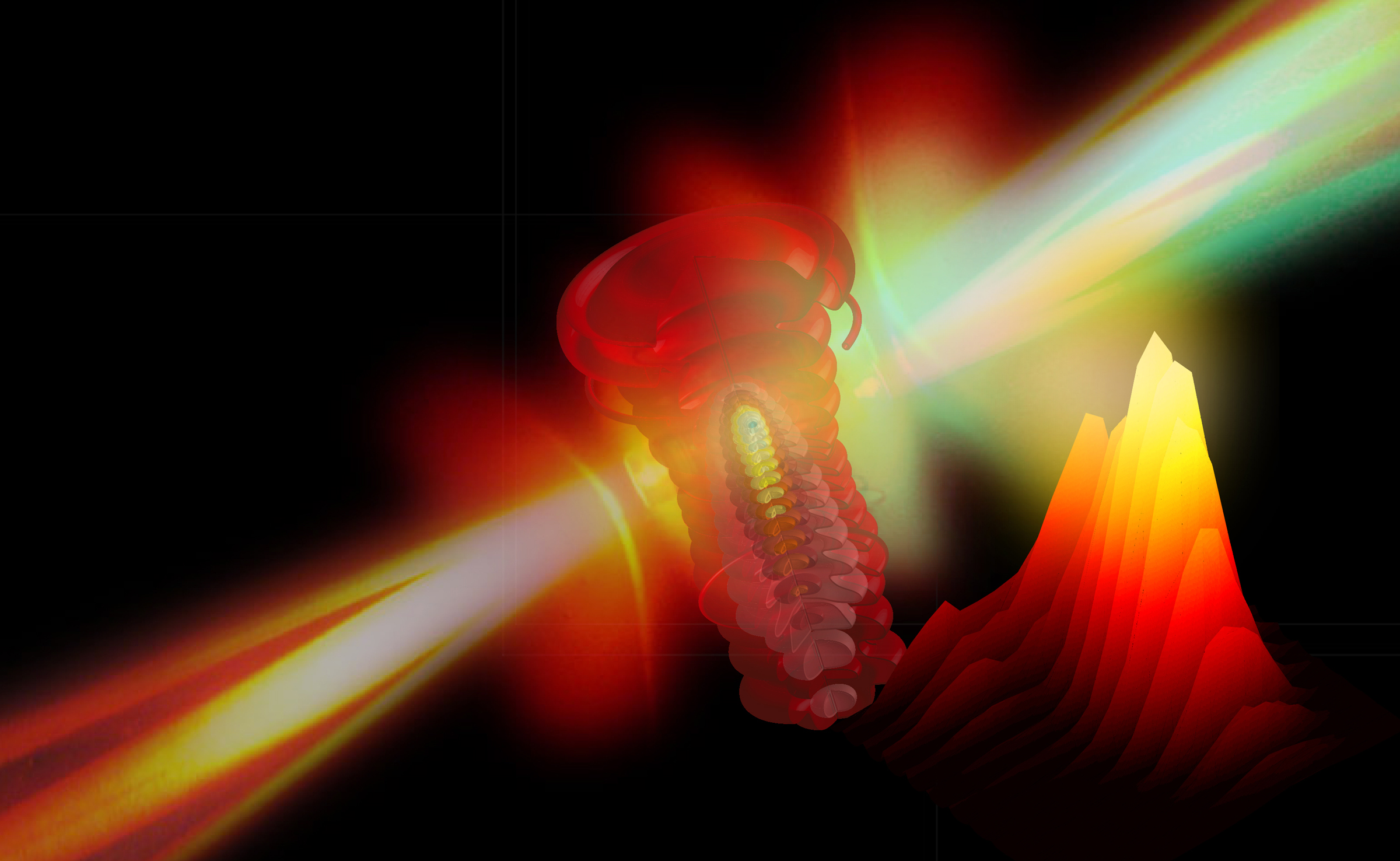
For the first time, researchers have produced a coherent, laser-like, directed beam of light that simultaneously streams ultraviolet light, X-rays and all wavelengths in between.

One of the few light sources to successfully produce a coherent beam that includes X-rays, this new technology is the first to do so using a setup that fits on a laboratory table.

An international team of researchers, led by engineers from the National Science Foundation's Engineering Research Center (ERC) for EUV Science and Technology, reports its findings in the June 8, 2012, issue of Science.

By focusing intense pulses of infrared light--each just a few optical cycles in duration--into a high-pressure gas cell, the researchers converted part of the original laser energy into a coherent super-continuum of light that extends well into the X-ray region of the spectrum.

The X-ray burst that emerges has much shorter wavelengths than the original laser pulse, which will make it possible to follow the tiniest, fastest physical processes in nature, including the coupled dance of electrons and ions in molecules as they undergo chemical reactions, or the flow of charges and spins in materials.

"This is the broadest spectral, coherent-light source ever generated," says engineering and physics professor Henry Kapteyn of JILA at the University of Colorado at Boulder, who led the study with fellow JILA professor Margaret Murnane and research scientist Tenio Popmintchev, in collaboration with researchers from the Vienna University of Technology, Cornell University and the University of Salamanca.

"It definitely opens up the possibility to probe the shortest space and time scales relevant to any process in our natural world other than nuclear or fundamental particle interactions," Kapteyn adds. The breakthrough builds upon earlier discoveries from Murnane, Kapteyn and their colleagues to generate laser-like beams of light across a broad spectrum of wavelengths.

The researchers use a technique called high-harmonic generation (HHG). HHG was first discovered in the late 1980s, when researchers focused a powerful, ultra-short laser beam into a spray of gas. The researchers were surprised to find that the output beam contained a small amount of many different wavelengths in the ultraviolet region of the spectrum, as well as the original laser wavelength. The new ultraviolet wavelengths were created as the gas atoms were ionized by the laser.

"Just as a violin or guitar string will emit harmonics of its fundamental sound tone when plucked strongly, an atom can also emit harmonics of light when plucked violently by a laser pulse," adds Murnane. "The laser pulse first plucks electrons from the atoms, before driving them back again where they can collide with the atoms from which they came. Any excess energy is emitted as high-energy ultraviolet photons."

Like many phenomena, when HHG was first discovered, there was little science to explain it, and it was considered more a curious phenomenon than a potentially useful light source. After years of work, scientists eventually understood how very high harmonics were emitted. However, there was one major challenge that most researchers gave up on--for most wavelengths in the X-ray region, the output HHG beams were extremely weak.

Murnane, Kapteyn and their students realized that there might be a chance to overcome that challenge and turn HHG into a useful X-ray light source--the tabletop-scale X-ray laser that has been a goal for laser science since shortly after the laser was first demonstrated in 1960.

"This was not an easy task," says Murnane. "Unlike a laser--which gets more intense as more energy is pumped into the system--in HHG, if the laser hits the atoms too hard, too many electrons are liberated from the gas atoms, and those electrons cause the laser light to speed up. If the speed of the laser and X-rays do not match, there is no way to combine the many X-ray waves together to create a bright output beam, since the X-ray waves from different gas atoms will interfere destructively."

Popmintchev and JILA graduate student Ming-Chang Chen worked out conditions that enable X-ray waves from many atoms in the gas to interfere constructively. The key was to use a relatively long-wavelength, mid-infrared laser and a high pressure gas cell that also guides the laser light. The resulting bright, X-ray beams maintain the coherent, directed beam qualities of the laser that drives the process.

The HHG process is effective only when the atoms are hit "hard and fast" by the laser pulses, with durations nearing 10-14 seconds--a fundamental limit representing just a few oscillations of the electromagnetic fields. Murnane and Kapteyn pioneered the technology for generating such light pulses in the 1990s, and used those lasers to develop and utilize HHG-based light sources in the extreme-ultraviolet (EUV) region of the spectrum in the 2000s. However, while researchers were using those lasers and the HHG technique to measure ever-shorter duration light pulses, they were stymied in how to make coherent light at shorter wavelengths in the more penetrating X-ray region of the spectrum.

The new paper in Science, under lead author and senior research associate Popmintchev, demonstrates that breakthrough, showing that the understanding of the HHG process the researchers developed is broadly valid.

"We would have never found this if we hadn't sat down and thought about what happens overall during HHG, when we change the wavelength of the laser driving it, what parameters have to be changed to make it work," added Kapteyn. "The amazing thing is that the physics seem to be panning out even over a very broad range of parameters. Usually in science you find a scaling rule that prevents you from making a dramatic jump, but in this case, we were able to generate 1.6 keV - each X-ray photon was generated from more than 5,000 infrared photons."

When the researchers first started to work with ultrafast, mid-infrared lasers just a few years ago, they actually made a step backwards and generated bright extreme-ultraviolet light of longer wavelengths than they used to achieve in the lab.

"However, we discovered a new regime that helped us to realize, just on paper, that we could make this giant step forward towards much shorter electromagnetic wavelengths and generate bright, laser-like, soft and hard X-rays," adds Popmintchev. "What the experiments were suggesting back then looked too good to be true! It seemed that Mother Nature has combined together, in the most simple and beautiful way, all the microscopic and macroscopic physics. Now, we are already at X-ray wavelengths as short as roughly 7.7 angstroms, and we do not know the limit."

To truly control the beam of photons, the researchers needed to understand the HHG process at the atomic level and how X-rays emitted from individual atoms combine to form a coherent beam of light.

That understanding combines microscopic and macroscopic models of the HHG process with the fact that those interactions occur at very high intensity in a dynamically changing medium. The development of such a conceptual understanding took the last decade to develop.

The result was the realization that there is no fundamental limit to the energy of the photons that can be generated using the HHG process. To obtain higher-energy photons, the system paradoxically begins with laser light using lower energy photons--specifically, mid-infrared lasers.

The JILA researchers demonstrated the validity of that principle in their labs in Colorado, but to achieve their breakthrough, the researchers traveled to Vienna with their beam-generating setup. There, they used a laser developed by co-author Andrius Baltuška and colleagues at the Vienna University of Technology--the world's most-intense ultrashort-pulse laser operating in the mid-infrared, with a wavelength of four microns.

"Thirty years ago, people were saying we could make a coherent X-ray source, but it would have to be an X-ray laser, and we'd need an atomic bomb as the energy source to pump it," said Deborah Jackson, the program officer who oversees the ERC's grant. "Now, we have these guys who understand the science fundamentals well enough to introduce new tricks for efficiently extracting energetic photons, pulling them out at X-ray wavelengths ... and it's all done on a table-top!"

In addition to achieving the high energy, the increasingly broad spectrum opens a range of new applications.

"In an experiment using such a source, one energy region from the beam will correspond with one element, another with another element, and so on to simultaneously look at atoms across entire molecules, and that will allow us to see how charge moves from one part of a molecule to another as a chemical reaction is happening," adds Kapteyn. "It'll take us awhile to learn how to use this, but it's very exciting."

 -NSF-