Showing posts with label smithsonian institute. Show all posts

Tuesday, July 10, 2012

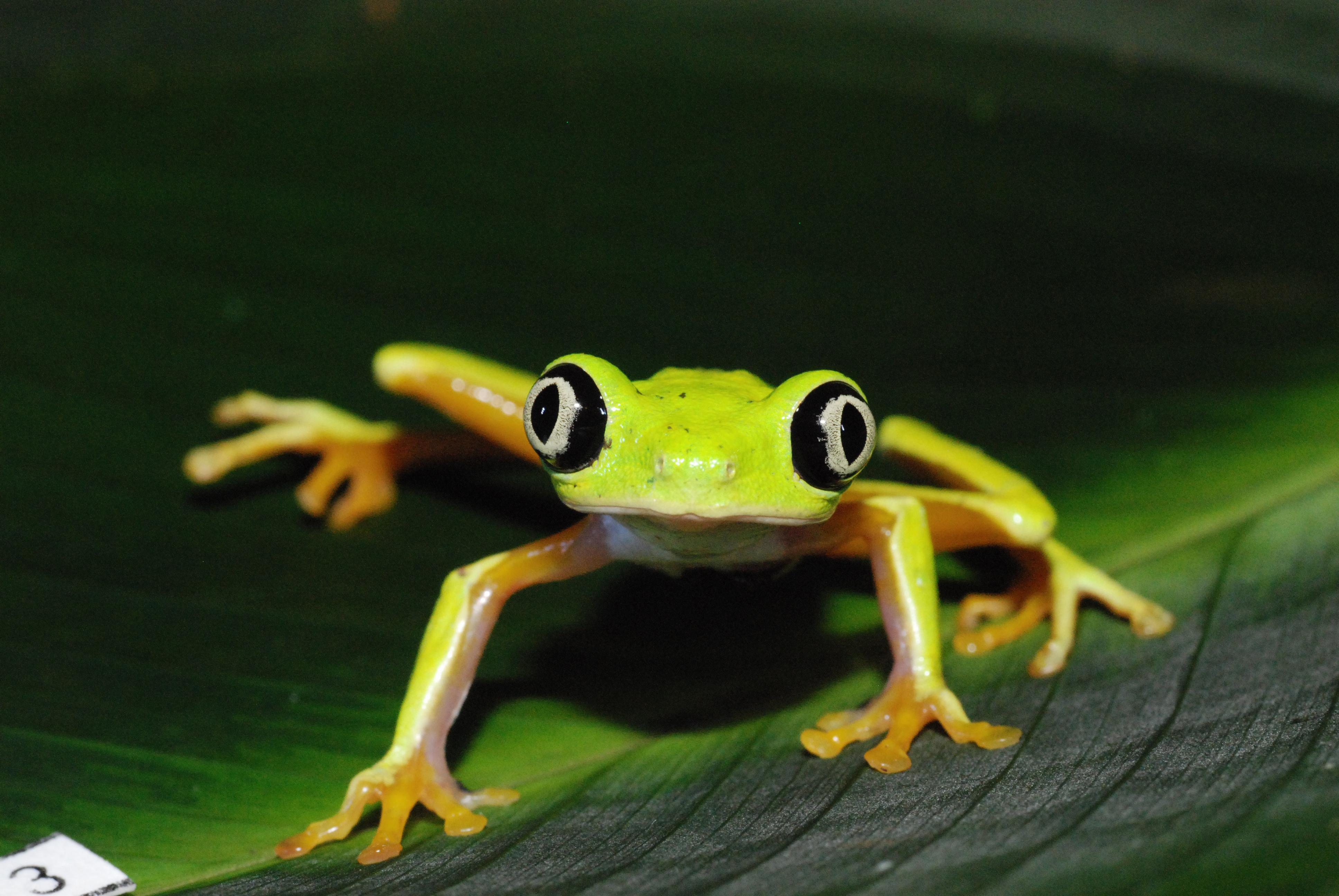
Tree Frog Hylomantis lemur


This tree frog Hylomantis lemur (recently named Agalychnis lemur), was photographed in Cerro Azul, Panama, in 2007, before the chytrid fungus arrived. The fungus appeared at the site in 2009 and this tree frog species has likely been extirpated from the area.

First noted when the golden toad and about half of the frog species disappeared in Monteverde reserve in Costa Rica in 1987, the killer fungus has been spreading eastward through the Central American highlands and also through a large portion of the Andes Mountains (likely from a separate introduction) ever since. You can read more about the deadly fungus in the National Science Foundation press release "Frog Killer Caught in the Act."

(Date of Image: October 2007)

Credit: Justin C. Touchon, Smithsonian Tropical Research Institute

Friday, June 15, 2012

Scientists Reconstruct Pre-Columbian Human Effects on the Amazon Basin


Findings overturn idea that the Amazon had large populations of humans that transformed the landscape

Small, shifting human populations existed in the Amazon before the arrival of Europeans, with little long-term effect on the forest.

That's the result of research led by Crystal McMichael and Mark Bush of the Florida Institute of Technology (FIT). The finding overturns the idea the Amazon was a cultural parkland in pre-Columbian times with large human populations that transformed vast tracts of the landscape.

The Amazon Basin is one of the highest biodiversity areas on Earth. Understanding how it was modified by humans in the past is important for conservation and for understanding the ecological processes in tropical rainforests.

McMichael, Bush and a team of researchers looked at how widespread human effects were in Amazonia before Europeans arrived. They published their results in this week's issue of the journal Science.

"The findings have major implications for how we understand the effect of the land-use change now occurring in Amazonia," said Alan Tessier, program director in the National Science Foundation's Division of Environmental Biology, which funded the research.

"Making the assumption that this system is resilient to deforestation, it turns out, isn't a position supported by historical evidence," Tessier said.

If the pre-Columbian Amazon was a highly altered landscape, then most of the Amazon's current biodiversity could have come from human effects.

The team retrieved 247 soil cores from 55 locations throughout the central and western Amazon, sampling sites that were likely disturbed by humans, such as river banks and other areas known from archaeological evidence to have been occupied by people.

They used markers in the cores to track the histories of fire, vegetation and human alterations of the soil.

The scientists conclude that people lived in small groups, with larger populations in the eastern Amazon--and most people lived near rivers.

They did not live in large settlements throughout the basin as was previously thought. Even sites of supposedly large settlements did not show evidence of high population densities and large-scale agriculture.

All the signs point to smaller, mobile populations before Europeans arrived. These small populations did not alter the forests substantially.

"The amazing biodiversity of the Amazon is not a by-product of past human disturbance," said McMichael. "We can't assume that these forests will be resilient to disturbance, because most of them have, at most, been lightly disturbed in the past.

"There is no parallel in western Amazonia for the scale of modern disturbance that accompanies industrial agriculture, road construction and the synergies of those disturbances with climate change."

Other co-authors of the paper are D.R. Piperno of the Smithsonian National Museum of Natural History; M.R. Silman of Wake Forest University; A.R. Zimmerman of the University of Florida; M.F. Raczka of FIT; and L.C. Lobato of the Federal University of Rondônia in Brazil.

 -NSF-
Friday, April 20, 2012

NASA Transfers Shuttle Discovery to National Air and Space Museum


Michael Braukus/Michael Curie
Headquarters, Washington                               
202-358-1100
michael.j.braukus@nasa.gov / michael.curie@nasa.gov

Focuses on Bold New Era of Space Exploration

WASHINGTON -- NASA transferred space shuttle Discovery to the Smithsonian's National Air and Space Museum during a ceremony Thursday, April 19, at the Stephen F. Udvar-Hazy Center in Chantilly, Va.

"Today, while we look back at Discovery's amazing legacy, I also want to look forward to what she and the shuttle fleet helped to make possible," said NASA Administrator Charles Bolden. "As NASA transfers the shuttle orbiters to museums across the country, we are embarked on an exciting new space exploration journey. Relying on American ingenuity and know-how, NASA is partnering with private industry to provide crew and cargo transportation to the International Space Station, while developing the most powerful rocket ever built to take the nation farther than ever before into the solar system."

National Air and Space Museum Director, General John "Jack" Dailey said, "Discovery has distinguished itself as the champion of America's shuttle fleet. In its new home, it will shine as an American icon, educating and inspiring people of all ages for generations to come. The Museum is committed to teaching and inspiring youngsters, so that they will climb the ladder of academic success and choose professions that will help America be competitive and successful in the world of tomorrow."

In this new era of exploration, NASA will build the capabilities to send humans deeper into space than ever before. NASA is using the space station as a test bed and stepping stone for the journey ahead. The agency is changing the way it does business and fostering a commercial industry that will safely service low Earth orbit, so NASA can focus its energy and resources on sending astronauts to an asteroid by 2025 and eventually to Mars in the 2030s.

The space station is the centerpiece of NASA's human spaceflight activities in low Earth orbit. It is fully staffed with an international crew of six, and American astronauts will continue to live and work there 24 hours a day, 365 days a year, as they have for more than 11 years. Part of the U.S. portion of the station has been designated as a national laboratory, and NASA is committed to using this unique resource for scientific research.

The station is testing exploration technologies such as autonomous refueling of spacecraft, advanced life support systems and human/robotic interfaces. Commercial companies are well on their way to providing cargo and crew flights to the station, allowing NASA to focus its attention on the next steps into our solar system.

For more information about NASA, visit http://www.nasa.gov.

- end -

Space Shuttle Discovery Arrives at Udvar-Hazy


Space shuttles Enterprise, left, and Discovery meet nose-to-nose at the beginning of a transfer ceremony at the Smithsonian's Steven F. Udvar-Hazy Center, Thursday, April 19, 2012, in Chantilly, Va. Space shuttle Discovery--the first orbiter retired from NASA’s shuttle fleet, completed 39 missions, spent 365 days in space, orbited the Earth 5,830 times, and traveled 148,221,675 miles--will take the place of Enterprise at the center to commemorate past achievements in space and to educate and inspire future generations of explorers at the center.

Image Credit: NASA/Smithsonian Institution/Carolyn Russo

Wednesday, April 18, 2012

NASA Deputy Administrator Garver Speaks About NASA's Future at Discovery Arrival


David Weaver
Headquarters, Washington                               
202-358-1600
david.s.weaver@nasa.gov

WASHINGTON -- "Following are excerpts from remarks given by NASA Deputy Administrator Lori Garver at the arrival of the space shuttle Discovery at Dulles International Airport on Tuesday, April 17:

"Discovery was the longest-serving veteran of NASA's space shuttle fleet. Her maiden voyage was in 1984. She flew 39 missions, spent 365 days in space, orbited Earth 5,830 times and traveled 148,221,675 miles."

"The space shuttles’ 30-year history literally changed the world. Their greatest accomplishment and purpose, now complete, was the launch and construction of the ISS -- our science laboratory in space and our foothold to the rest of the solar system. Like all great accomplishments, these achievements came at a cost. When we lost the Challenger and Columbia flights and their brave crews, we re-dedicated ourselves to an even more meaningful and exciting future."

"Today, NASA is following through on this commitment by building on the successes of the past and learning from our failures. President Obama has set us on a course that will tap into the innovative spirit that has made this nation great. It will allow us to more fully utilize the ISS and explore farther than ever before -- to an asteroid and on to Mars. This shift will permit us to advance our technology, open new markets and create more American jobs, making our aerospace industry even more competitive and increasing our economic and national security."

"To those who say our best exploration days are behind us, I must disagree. While it is wonderful to reminisce about the past, NASA continues to focus on the future. You need only admire the amazing space shuttles and their accomplishments to realize the people, organizations and nation that created them have only just begun. Vehicles with names like Orion, Dragon and Dreamchaser are being built all across the country today. They will continue and expand on the space shuttle’s many accomplishments."

"It is an honor to deliver Discovery to the Smithsonian today to share this national treasure with the nation -- telling not only the stories of the past, but ushering in the promise of the future."

- end -