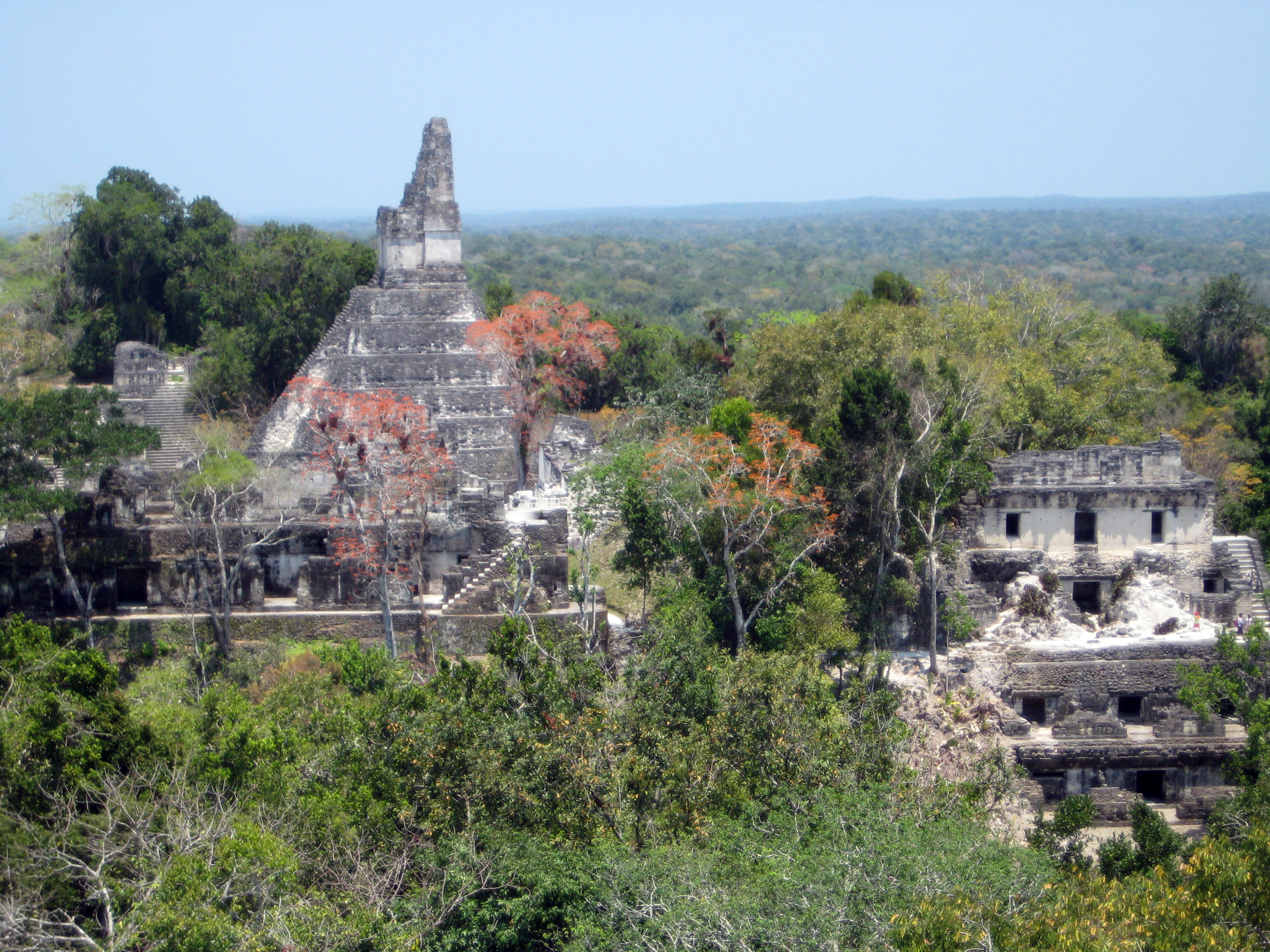
 Image 1: This temple in Tikal, labeled
"Temple 1" by researchers, was built by the ancient Maya somewhere
between 682 and 734 A.D., and was possibly completed after Jasaw Chan K'awiil's
death. It was the second temple built in the area.
Image 1: This temple in Tikal, labeled
"Temple 1" by researchers, was built by the ancient Maya somewhere
between 682 and 734 A.D., and was possibly completed after Jasaw Chan K'awiil's
death. It was the second temple built in the area.
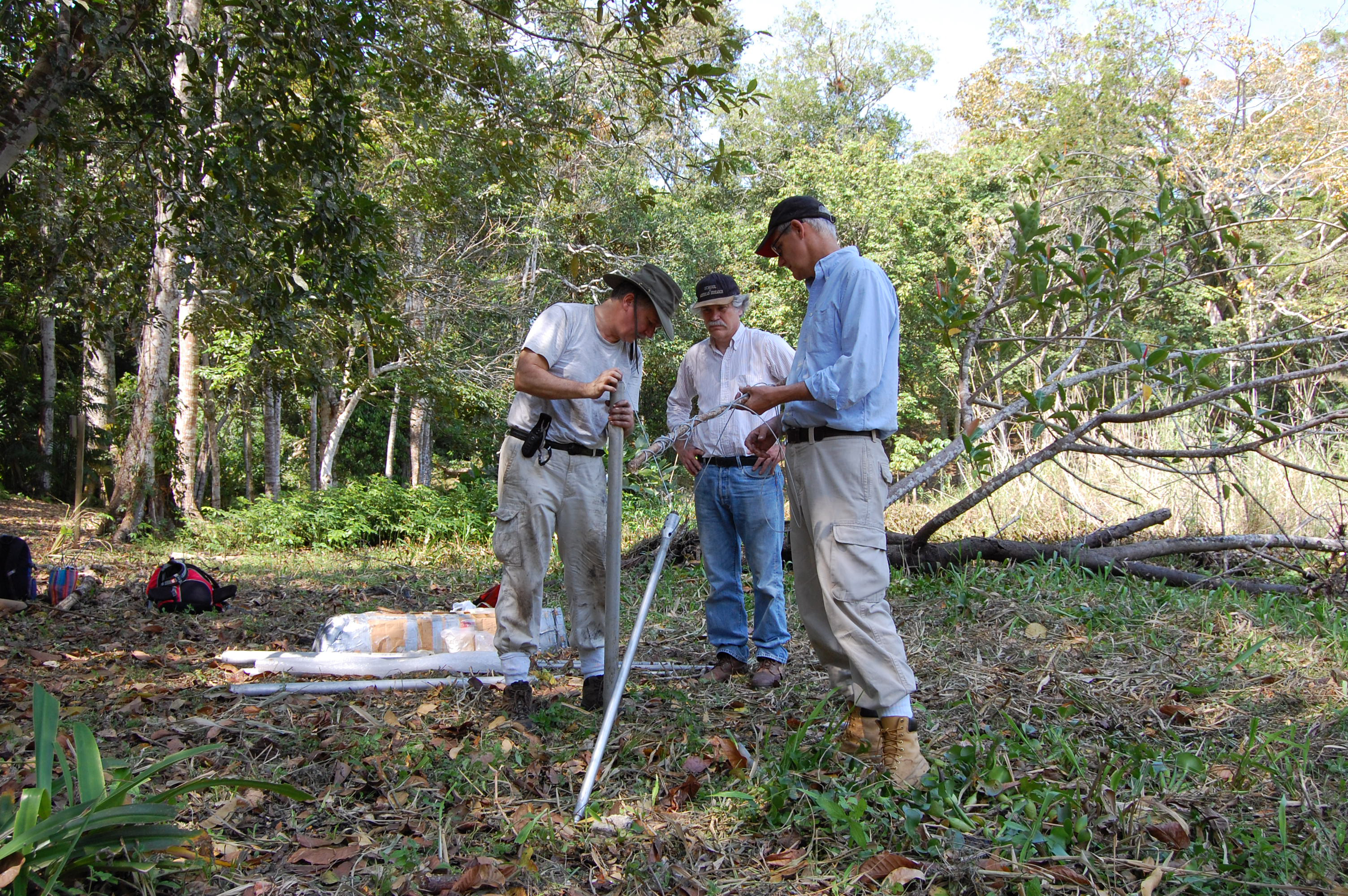
Image 2: Nick Dunning, Vern Scarborough
and David Lentz (l-r) take a soil core to measure the depth of one of several
large reservoirs that surround the site of Tikal, the ancient Maya city. Lentz
was principal investigator for a National Science Foundation-supported study at
the site.
Image 3: This temple in Tikal, labeled
"Temple 5" by researchers, was built by the ancient Maya somewhere
between 768 and 780 A.D.
More
About These Images
David Lentz, a biology professor at the
University of Cincinnati (UC), received a grant from the National Science
Foundation (NSF) to study the interaction between the ancient Maya of Tikal and
their local environment.
 Lentz's research found that the Maya
practiced forest conservation early on. They were not allowed to cut down
certain forests of virgin timber--some of which were over 200 years old--which
the researchers dubbed the "sacred groves." "From our research
we have learned that the Maya were deliberately conserving forest
resources," says Lentz. "Their deliberate conservation practices can
be observed in the wood they used for construction and this observation is
reinforced by the pollen record." But later, the Maya abandoned this
practice.
Lentz's research found that the Maya
practiced forest conservation early on. They were not allowed to cut down
certain forests of virgin timber--some of which were over 200 years old--which
the researchers dubbed the "sacred groves." "From our research
we have learned that the Maya were deliberately conserving forest
resources," says Lentz. "Their deliberate conservation practices can
be observed in the wood they used for construction and this observation is
reinforced by the pollen record." But later, the Maya abandoned this
practice.
When Jasaw Chan K'awiil took over as
ruler during the Late Classic period, the Maya rebuilt the city of Tikal. This
rebuilding included construction of enormous temples that required large,
straight trees whose wood could withstand the weight of tons of heavy stone.
Lentz found that the Maya used the sacred groves for this purpose but soon ran
out of timber, which came from the Manilkara zapota (or sapodilla) tree.
Sapodilla wood is soft when first cut but once it dries it's as hard as iron,
making it an ideal building material for the temples. Once the sapodilla were
gone, the Maya began using inferior wood from the Haematoxylon campechianum
(logwood or ink wood) trees. Logwood trees, which grow in swamps, are hard like
iron from start to finish. The archways to the temples built using logwood were
less ornate because the tree grows crooked and is not as lofty as the
sapodilla.
 The earlier temples (labeled 1 through 4
by the researchers) are quite large. The beams over the doorways (called
Lintels) of Temple 4 are the largest of them all, whereas Temples 5 and 6 are
much smaller. But Lentz found that for Temple 3, the last temple built, the
Maya went back to using sapodilla. Lentz believes they may have replanted the sacred
groves after cutting them down (after 40 years, you would have a tree large
enough to use for building). Also, Lentz says, things began going downhill for
the Maya at this point. "Perhaps they reasoned that the gods didn't like
the new style of temple and they needed to return to the construction style of
earlier, and more prosperous, times."
The earlier temples (labeled 1 through 4
by the researchers) are quite large. The beams over the doorways (called
Lintels) of Temple 4 are the largest of them all, whereas Temples 5 and 6 are
much smaller. But Lentz found that for Temple 3, the last temple built, the
Maya went back to using sapodilla. Lentz believes they may have replanted the sacred
groves after cutting them down (after 40 years, you would have a tree large
enough to use for building). Also, Lentz says, things began going downhill for
the Maya at this point. "Perhaps they reasoned that the gods didn't like
the new style of temple and they needed to return to the construction style of
earlier, and more prosperous, times."
To learn more about this research, see
the UC news story UC Scientists Determine That Ancient Maya Practiced Forest
Conservation 3,000 Years Ago. [Research supported by NSF grant BCS 08-10118.]
(Date of Image: February/March 2009)
Credit: Department of Biological
Sciences, University of Cincinnati


 Posts
Posts

