Showing posts with label volcanoes. Show all posts

Monday, August 6, 2012

Scientists Define New Limits of Microbial Life in Undersea Volcanoes


A third of Earth's organisms live in rocks and sediments, but their lives have been a mystery

By some estimates, a third of Earth's organisms live in our planet's rocks and sediments, yet their lives are almost a complete mystery.

This week, the work of microbiologist James Holden of the University of Massachusetts-Amherst and colleagues shines a light into this dark world.

In the journal Proceedings of the National Academy of Sciences (PNAS), they report the first detailed data on methane-exhaling microbes that live deep in the cracks of hot undersea volcanoes.

"Evidence has built that there's an incredible amount of biomass in the Earth's subsurface, in the crust and marine sediments, perhaps as much as all the plants and animals on the surface," says Holden.

"We're interested in the microbes in the deep rock, and the best place to study them is at hydrothermal vents at undersea volcanoes. Warm water there brings the nutrient and energy sources these microbes need."

Just as biologists studied the habitats and life requirements of giraffes and penguins when they were new to science, Holden says, "for the first time we're studying these subsurface microorganisms, defining their habitat requirements and determining how they differ among species."

The result will advance scientists' comprehension of biogeochemical cycles in the deep ocean, he and co-authors believe.

"Studies such as this add greatly to our understanding of microbial processes in the still poorly-known deep biosphere," says David Garrison, program director in the National Science Foundation's Division of Ocean Sciences, which funded the research.

The project also addresses such questions as what metabolic processes may have looked like on Earth three billion years ago, and what alien microbial life might look like on other planets.

Because the study involves methanogens--microbes that inhale hydrogen and carbon dioxide to produce methane as waste--it may also shed light on natural gas formation on Earth.

One major goal was to test results of predictive computer models and to establish the first environmental hydrogen threshold for hyperthermophilic (super-heat-loving), methanogenic (methane-producing) microbes in hydrothermal vent fluids.

"Models have predicted the 'habitability' of the rocky environments we're most interested in, but we wanted to ground-truth these models and refine them," Holden says.

In a two-liter bioreactor at UMass Amherst where the scientists could control hydrogen levels, they grew pure cultures of hyperthermophilic methanogens from their study site alongside a commercially available hyperthermophilic methanogen species.

The researchers found that growth measurements for the organisms were about the same. All grew at the same rate when given equal amounts of hydrogen and had the same minimum growth requirements.

Holden and Helene Ver Eecke at UMass Amherst used culturing techniques to look for organisms in nature and then study their growth in the lab.

Co-investigators Julie Huber at the Marine Biological Laboratory on Cape Cod provided molecular analyses of the microbes, while David Butterfield and Marvin Lilley at the University of Washington contributed geochemical fluid analyses.

Using the research submarine Alvin, they collected samples of hydrothermal fluids flowing from black smokers up to 350 degrees C (662 degrees F), and from ocean floor cracks with lower temperatures.

Samples were taken from Axial Volcano and the Endeavour Segment, both long-term observatory sites along an undersea mountain range about 200 miles off the coast of Washington and Oregon and more than a mile below the ocean's surface.

"We used specialized sampling instruments to measure both the chemical and microbial composition of hydrothermal fluids," says Butterfield.

"This was an effort to understand the biological and chemical factors that determine microbial community structure and growth rates."

A happy twist awaited the researchers as they pieced together a picture of how the methanogens live and work.

At the low-hydrogen Endeavour site, they found that a few hyperthermophilic methanogens eke out a living by feeding on the hydrogen waste produced by other hyperthermophiles.

"This was extremely exciting," says Holden. "We've described a methanogen ecosystem that includes a symbiotic relationship between microbes."

The research was also supported by the NASA Astrobiology Institute and the National Oceanic and Atmospheric Administration.

 -NSF-

Tuesday, July 10, 2012

Ancient Volcanic Ash Beds in Nebraska


Multiple ancient volcanic ash beds (the lighter color on the cliff) are exposed at Scotts Bluff National Monument in Nebraska.

Research by Huiming Bao, a geologist at Louisiana State University, at Scotts Bluff and surrounding areas found the remains of eruptions deposited in layers of rock from volcanoes located on North America's northern high plains. These volcanos spewed massive amounts of sulfate aerosols into the atmosphere 40 million years ago.

"Combining measurements of the sulfate in ancient volcanic ash beds with a detailed atmospheric chemistry model, we found that the long-ago chemistry of volcanic sulfate gases is distinct from that of more modern times," said Bao. "This is the first example showing that the history of massive volcanic sulfate emissions, and their associated atmospheric conditions in the geologic past, may be retrieved from rock records."

This research was funded by the National Science Foundation's Division of Earth Sciences. To read more about this study, see the Epoch Times news story Ancient North American Volcanic Eruptions Were More Explosive. (Date of Image: 2005)

Credit: Huiming Bao, Louisiana State University

Saturday, May 26, 2012

Santiaguito Field Experiment (Image 7)


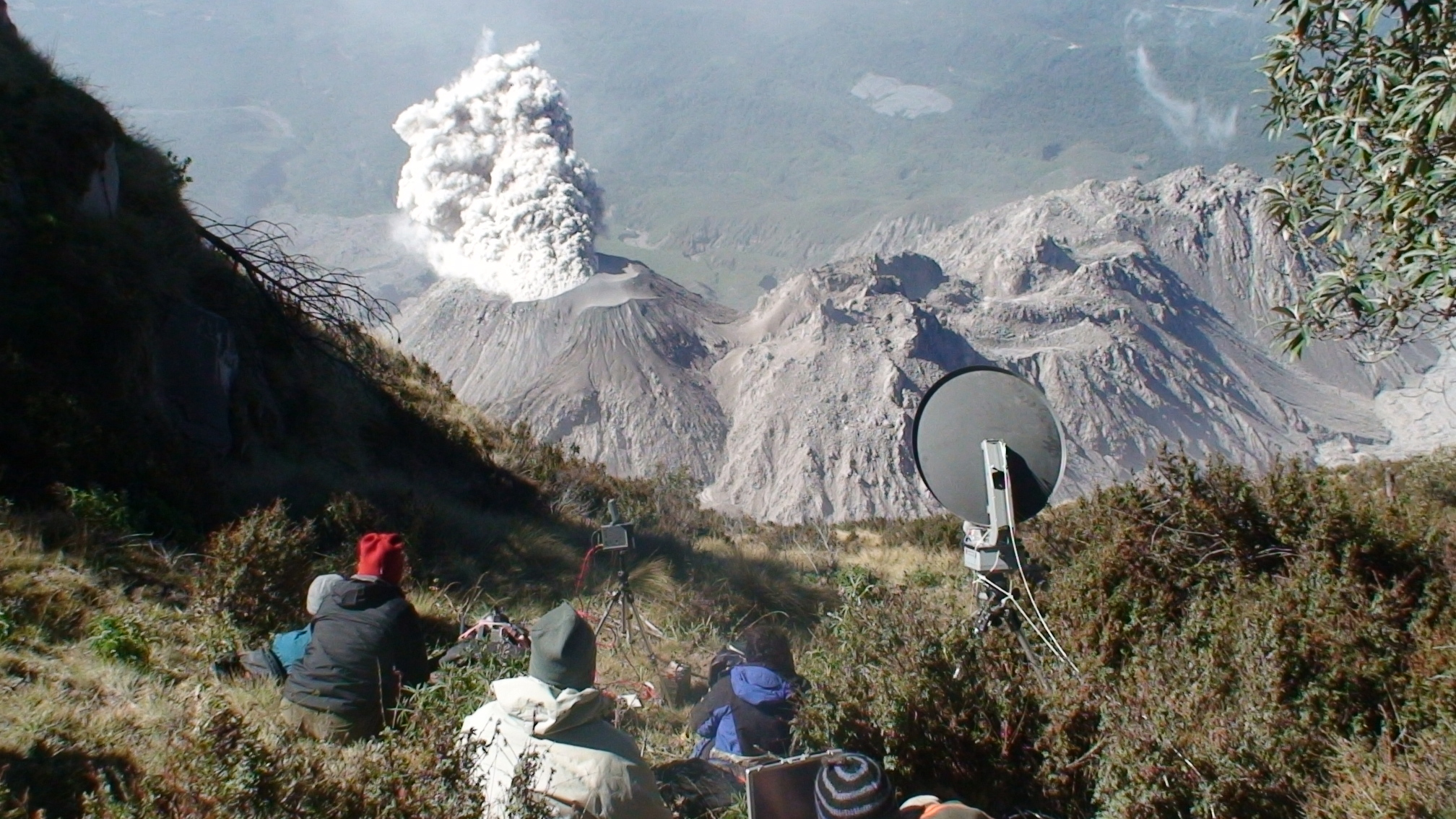
Doppler radar observations of the regular (hourly) explosions from Santiaguito's Caliente dome as seen by principal investigator Jeffrey Johnson and his research team from their vantage point on the summit of Santa Maria in 2007.

Santiaguito is an active dome that has been growing since 1922 within the crater left by the catastrophic 1902 eruption of Santa Maria plinian eruption (a 6 on the Volcanic Explosivity Index). Plinian eruptions have columns of gas and volcanic ash that extend high into the stratosphere and include such characteristics as ejections of large amounts of pumice and very powerful continuous gas blast eruptions.

In January 2007, Johnson (with New Mexico Tech at the time) and a multi-institution team of researchers conducted a week-long field experiment that included establishing a manned observation post near the summit of Santa Maria from which eruptions of Santiaguito's Caliente dome can be viewed.

Caliente (summit elevation ~2600 meters) is located approximately 1.2 kilometers below and 2 kilometers to the southwest of the Santa Maria summit. In recent years, Santiaguito has been simultaneously extruding dacitic magma and erupts explosively several tens of times each day. Typically these pyroclastic-laden eruptions originate from diffuse, often concentric fractures distributed about the 200 meter-diameter crater. Plumes are buoyantly driven up to heights of 1 to 2 kilometers. Larger explosions and/or associated lava flow that collapse on the steep slopes of Caliente dome generate pyroclastic flows that are generally confined to the upper reaches of the volcano.

The project by Johnson and the team included coordinated experiments on the volcano with seismic and acoustic sensors (for analysis of earthquakes), infrared video (for study of thermal signals), Doppler radar (for analysis of eruption material velocities), UV absorption imagery (for analysis of gas flux), and high-resolution digital video (from the summit looking straight down into the vent). Simultaneous thermal and UV imagery was obtained from the Santiaguito Observatory. Further information about the data collected during the experiment is available Here.

This research was supported in part by a grant from the National Science Foundation's Division of Earth Sciences (EAR 04-40225). Johnson was with New Mexico Tech earth and environmental sciences department at the time of this research but is now in the department of geosciences, Boise State University. (Date of Image: 2007)

Credit: Assistant Professor Jeffrey Johnson, Department of Geosciences, Boise State University

Thursday, May 24, 2012

Santiaguito Field Experiment (Images 5 and 6)


A view of the Santiaguito dome complex as seen from the summit of Santa Maria. Coalescing domes have been growing for 90 years within the crater left by the catastrophic 1902 Santa Maria plinian eruption (a 6 on the Volcanic Explosivity Index). Plinian eruptions have columns of gas and volcanic ash that extend high into the stratosphere and include such characteristics as ejections of large amounts of pumice and very powerful continuous gas blast eruptions.

In January 2007, principal investigator Jeffrey Johnson (with New Mexico Tech at the time) and a multi-institution team of researchers conducted a week-long field experiment that included establishing a manned observation post near the summit of Santa Maria from which eruptions of Santiaguito's Caliente dome can be viewed.

Caliente (summit elevation ~2600 meters) is located approximately 1.2 kilometers below and 2 kilometers to the southwest of the Santa Maria summit. In recent years, Santiaguito has been simultaneously extruding dacitic magma and erupts explosively several tens of times each day. Typically these pyroclastic-laden eruptions originate from diffuse, often concentric fractures distributed about the 200 meter-diameter crater. Plumes are buoyantly driven up to heights of 1 to 2 kilometers. Larger explosions and/or associated lava flow that collapse on the steep slopes of Caliente dome generate pyroclastic flows that are generally confined to the upper reaches of the volcano.

The project by Johnson and the team included coordinated experiments on the volcano with seismic and acoustic sensors (for analysis of earthquakes), infrared video (for study of thermal signals), Doppler radar (for analysis of eruption material velocities), UV absorption imagery (for analysis of gas flux), and high-resolution digital video (from the summit looking straight down into the vent). Simultaneous thermal and UV imagery was obtained from the Santiaguito Observatory.

Graduate student Richard Sanderson enjoys the sunrise from the summit of Santa Maria. The shadow of Santa Maria is overprinted on the Guatemala cordillera.

This research was supported in part by a grant from the National Science Foundation's Division of Earth Sciences (EAR 04-40225). Johnson was with New Mexico Tech earth and environmental sciences department at the time of this research but is now in the department of geosciences, Boise State University. (Date of Images: 2007)

Credit: Professor Nick Varley, Facultade de Ciencias, University of Colima, Mexico

Santiaguito Field Experiment (Images 3 and 4)


Detail of pyroclastic-laden explosive eruptions from Santiaguito's Caliente dome. The explosions were observed hourly by principal investigator Jeffrey Johnson from his vantage point on the summit of Santa Maria in 2007.

Santiaguito is an active dome that has been growing since 1922 within the crater left by the catastrophic 1902 eruption of Santa Maria plinian eruption (a 6 on the Volcanic Explosivity Index). Plinian eruptions have columns of gas and volcanic ash that extend high into the stratosphere and include such characteristics as ejections of large amounts of pumice and very powerful continuous gas blast eruptions.

In January 2007, Johnson (with New Mexico Tech at the time) and a multi-institution team of researchers conducted a week-long field experiment that included establishing a manned observation post near the summit of Santa Maria from which eruptions of Santiaguito's Caliente dome can be viewed.

Caliente (summit elevation ~2600 meters) is located approximately 1.2 kilometers below and 2 kilometers to the southwest of the Santa Maria summit. In recent years, Santiaguito has been simultaneously extruding dacitic magma and erupts explosively several tens of times each day. Typically these pyroclastic-laden eruptions originate from diffuse, often concentric fractures distributed about the 200 meter-diameter crater. Plumes are buoyantly driven up to heights of 1 to 2 kilometers. Larger explosions and/or associated lava flow that collapse on the steep slopes of Caliente dome generate pyroclastic flows that are generally confined to the upper reaches of the volcano.

The project by Johnson and the team included coordinated experiments on the volcano with seismic and acoustic sensors (for analysis of earthquakes), infrared video (for study of thermal signals), Doppler radar (for analysis of eruption material velocities), UV absorption imagery (for analysis of gas flux), and high-resolution digital video (from the summit looking straight down into the vent). Simultaneous thermal and UV imagery was obtained from the Santiaguito Observatory. Further information about the data collected during the experiment is available Here.

This research was supported in part by a grant from the National Science Foundation's Division of Earth Sciences (EAR 04-40225). Johnson was with New Mexico Tech earth and environmental sciences department at the time of this research but is now in the department of geosciences, Boise State University. (Date of Image: 2007)

Credit: Assistant Professor Jeffrey Johnson, Department of Geosciences, Boise State University

Wednesday, May 23, 2012

Santiaguito Field Experiment (Images 1 and 2)


Principal investigator Jeffrey Johnson films explosions coming from Santiaguito, as viewed from the summit of Santa Maria in 2007. Santiaguito is an active dome that has been growing since 1922 within the crater left by the catastrophic 1902 eruption of Santa Maria plinian eruption (a 6 on the Volcanic Explosivity Index). Plinian eruptions have columns of gas and volcanic ash that extend high into the stratosphere and include such characteristics as ejections of large amounts of pumice and very powerful continuous gas blast eruptions.

Detail of pyroclastic-laden explosive eruptions from Santiaguito's Caliente dome. The explosions were observed hourly by principal investigator Jeffrey Johnson from his vantage point on the summit of Santa Maria in 2007.

Santiaguito is an active dome that has been growing since 1922 within the crater left by the catastrophic 1902 eruption of Santa Maria plinian eruption (a 6 on the Volcanic Explosivity Index). Plinian eruptions have columns of gas and volcanic ash that extend high into the stratosphere and include such characteristics as ejections of large amounts of pumice and very powerful continuous gas blast eruptions.

In January 2007, Johnson (with New Mexico Tech at the time) and a multi-institution team of researchers conducted a week-long field experiment that included establishing a manned observation post near the summit of Santa Maria from which eruptions of Santiaguito's Caliente dome can be viewed.

Caliente (summit elevation ~2600 meters) is located approximately 1.2 kilometers below and 2 kilometers to the southwest of the Santa Maria summit. In recent years, Santiaguito has been simultaneously extruding dacitic magma and erupts explosively several tens of times each day. Typically these pyroclastic-laden eruptions originate from diffuse, often concentric fractures distributed about the 200 meter-diameter crater. Plumes are buoyantly driven up to heights of 1 to 2 kilometers. Larger explosions and/or associated lava flow that collapse on the steep slopes of Caliente dome generate pyroclastic flows that are generally confined to the upper reaches of the volcano.

The project by Johnson and the team included coordinated experiments on the volcano with seismic and acoustic sensors (for analysis of earthquakes), infrared video (for study of thermal signals), Doppler radar (for analysis of eruption material velocities), UV absorption imagery (for analysis of gas flux), and high-resolution digital video (from the summit looking straight down into the vent). Simultaneous thermal and UV imagery was obtained from the Santiaguito Observatory. Further information about the data collected during the experiment is available Here.

This research was supported in part by a grant from the National Science Foundation's Division of Earth Sciences (EAR 04-40225). Johnson was with New Mexico Tech earth and environmental sciences department at the time of this research but is now in the department of geosciences, Boise State University. (Date of Images: 2007)

Credit: Professor Nick Varley, Facultade de Ciencias, University of Colima, Mexico