Showing posts with label oceanography. Show all posts

Friday, September 21, 2012

Unusual Symbiosis Discovered in Marine Microorganisms


Single-celled algae and nitrogen-fixing bacteria help fertilize the oceans
Scientists have discovered an unusual symbiosis between tiny single-celled algae and highly specialized bacteria in the ocean.

The partnership plays an important role in fertilizing the oceans by taking nitrogen from the atmosphere and "fixing" it into a form that other organisms can use.

Details of the finding, published in this week's issue of the journal Science, emerged from the investigation of a mysterious nitrogen-fixing microbe that has a very small genome.

First detected in 1998 by Jonathan Zehr, a marine scientist at the University of California, Santa Cruz (UCSC), the microbe now appears to be the most widespread nitrogen-fixing organism in the oceans.

It belongs to a group of photosynthetic bacteria known as cyanobacteria, but it lacks the genes needed to carry out photosynthesis.

Apparently its association with the algae makes those genes unnecessary.

"The cyanobacterium is a nitrogen-fixer, so it provides nitrogen to the host cell [the algae], and the host cell provides needed carbon to the cyanobacterium, which is lacking the machinery to get its own," says Anne Thompson, a lead author of the paper and researcher at UCSC. Rachel Foster of the Max Planck Institute for Marine Microbiology is the other lead author.

The finding has uncovered a symbiosis between two types of microorganisms that had remained hidden until now, says Matt Kane, program director in the National Science Foundation's (NSF) Division of Environmental Biology, which funded the research along with NSF's Division of Ocean Sciences.

"Genomic analysis indicates that the partnership between these organisms in some ways models the one that led to the evolution of plant organelles," says Kane.

This is an interesting symbiosis from an evolutionary perspective, says Zehr, "because it can be seen as analogous to an early stage in the endosymbiosis that led to chloroplasts in plants."

Chloroplasts, which carry out photosynthesis in all plants, evolved from symbiotic cyanobacteria that eventually were incorporated into host cells in a process known as endosymbiosis.

In previous work, Zehr's team had studied the cyanobacteria in samples processed at sea and brought back to the lab.

The researchers were able to sequence the microbe's complete genome. They discovered that it's missing the genes for several key metabolic pathways, suggesting that it might live in association with another organism.

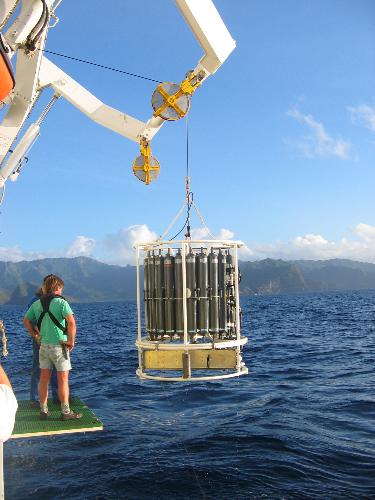
The scientists were only able to see the symbiotic partners together when they sorted freshly collected seawater samples onboard a research vessel.

"Our collaborators at the University of Hawaii, Dave Karl and Ken Doggett, put a cell sorter into a portable laboratory--a lab in a box--so now we can take the machine to sea and sort cells that minutes before were in their natural environment," says Thompson. "That's how we found the association."

Zehr noted that it's difficult to estimate the contribution of this symbiosis to global carbon and nitrogen cycles.

Other algae are more abundant and may be more important in terms of the ocean's carbon cycle than the algae hosts in this symbiosis, he says. But the cyanobacteria partners likely make this a significant contribution to global nitrogen fixation in the oceans.

"Planktonic symbioses are very difficult to study," says Foster. "The associations are often fragile.  Here we used multiple tools to identify one of the first examples of this kind of partnership in plankton."

In addition to Thompson, Zehr and Foster, the co-authors of the paper include Andreas Krupke, Niculina Musat and Marcel Kuypers of the Max Planck Institute for Marine Microbiology; Brandon Carter of UCSC; and Daniel Vaulot of the Station Biologique de Roscoff and the Pierre and Marie Curie University in Paris.

The research was also funded by the Gordon and Betty Moore Foundation and the Max Planck Society.

-NSF-

Thursday, September 6, 2012

NASA Voyage Set To Explore Link Between Sea Saltiness And Climate


Steve Cole
Headquarters, Washington          
202-358-0918
stephen.e.cole@nasa.gov
 
WASHINGTON -- A NASA-sponsored expedition is set to sail to the North Atlantic's saltiest spot to get a detailed, 3-D picture of how salt content fluctuates in the ocean's upper layers and how these variations are related to shifts in rainfall patterns around the planet.

The research voyage is part of a multi-year mission, dubbed the Salinity Processes in the Upper Ocean Regional Study (SPURS), which will deploy multiple instruments in different regions of the ocean. The new data also will help calibrate the salinity measurements NASA's Aquarius instrument has been collecting from space since August 2011.

SPURS scientists aboard the research vessel Knorr leave Sept. 6 from the Woods Hole Oceanographic Institution in Woods Hole, Mass., and head toward a spot known as the Atlantic surface salinity maximum, located halfway between the Bahamas and the western coast of North Africa. The expedition also is supported by the National Oceanic and Atmospheric Administration and the National Science Foundation.

The researchers will spend about three weeks on site deploying instruments and taking salinity, temperature and other measurements, before sailing to the Azores to complete the voyage on Oct. 9.

They will return with new data to aid in understanding one of the most worrisome effects of climate change -- the acceleration of Earth's water cycle. As global temperatures go up, evaporation increases, altering the frequency, strength, and distribution of rainfall around the planet, with far-reaching implications for life on Earth.

"What if the drought in the U.S. Midwest became permanent? To understand whether that could happen we must understand the water cycle and how it will change as the climate continues to warm," said Raymond Schmitt, a physical oceanographer at Woods Hole and principal investigator for SPURS. "Getting that right is going to involve understanding the ocean, because the ocean is the source of most of the water."

Oceanographers believe the ocean retains a better record of changes in precipitation than land, and translates these changes into variations in the salt concentration of its surface waters. Scientists studying the salinity records of the past 50 years say they already see the footprint of an increase in the speed of the water cycle. The places in the ocean where evaporation has increased and rain has become scarcer have turned saltier over time, while the spots that now receive more rain have become fresher. This acceleration ultimately may exacerbate droughts and floods around the planet. Some climate models, however, predict less dramatic changes in the global water cycle.

"With SPURS we hope to find out why these climate models do not track our observations of changing salinities," said Eric Lindstrom, physical oceanography program scientist at NASA Headquarters in Washington. "We will investigate to what extent the observed salinity trends are a signature of a change in evaporation and precipitation over the ocean versus the ocean's own processes, such as the mixing of salty surface waters with deeper and fresher waters or the sideways transport of salt."

To learn more about what drives salinity, the SPURS researchers will deploy an array of instruments and platforms, including autonomous gliders, sensor-laden buoys and unmanned underwater vehicles. Some will be collected before the research vessel heads to the Azores, but others will remain in place for a year or more, providing scientists with data on seasonal variations of salinity.

Some of the devices used during SPURS to explore the Atlantic's saltiest spot will focus on the outer edges of the study area, traveling for hundreds of miles and studying the broadest salinity features. Other instruments will explore smaller areas nested inside the research site, focusing on smaller fluxes of salt in the waters. The suite of ocean instruments will complement data from NASA's salinity-sensing instrument aboard the Aquarius/SAC-D (Satelite de Aplicaciones Cientificas-D) observatory, and be integrated into real-time computer models that will help guide researchers to the most interesting phenomena in the cruise area.

"We'll be able to look at lots of different scales of salinity variability in the ocean, some of which can be seen from space, from a sensor like Aquarius," said David Fratantoni, a physical oceanographer with Woods Hole and a member of the SPURS expedition. "But we're also trying to see variations in the ocean that can't be resolved by current satellite technology."

The 2012 SPURS measurements in the North Atlantic will help scientists understand the behavior of other high-salinity regions around the world. A second SPURS expedition in 2015 will investigate low-salinity regions where there is a high input of fresh water, such as the mouth of a large river or the rainy belts near the equator.

For more information on the SPURS expedition, visit http://spurs.jpl.nasa.gov/SPURS.

For more information on Aquarius, visit http://www.nasa.gov/aquarius.

Regular blog updates from the SPURS expedition will be posted at
http://go.nasa.gov/PuyO5q.

- end -

Wednesday, August 15, 2012

Studying Life in Underwater Caves (Images 4 and 5)


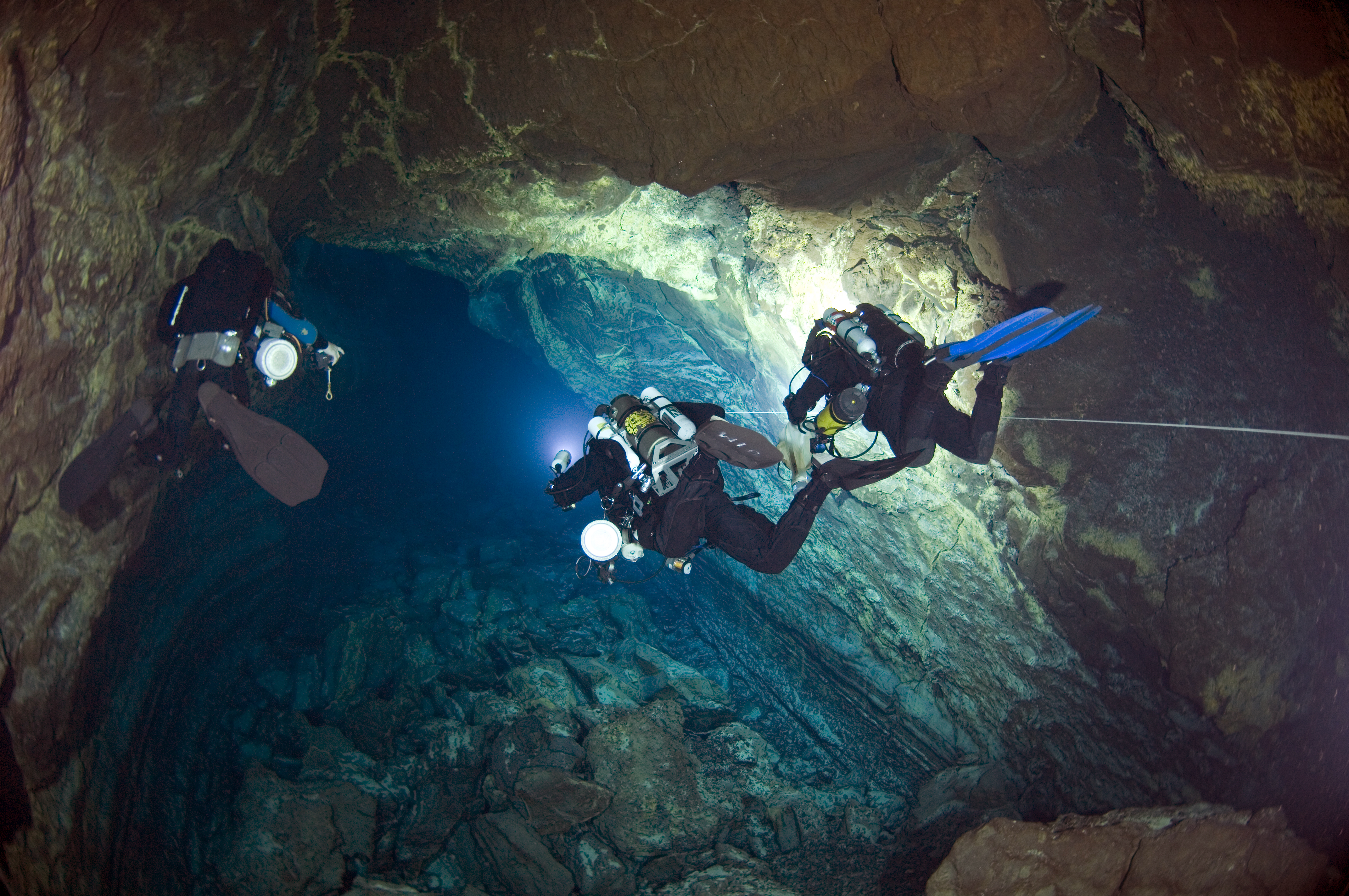
Cave divers Terrence Tysall, Jim Rozzi and Thomas Iliffe (left to right) diving in a submarine lava tube cave in the Canary Islands.

Tom Iliffe , a Texas A&M University at Galveston professor of marnie biology, is seen here diving with a Megalodon closed circuit rebreather in the Atlantida Tunnel, Lanzarote, Canary Islands.

Underwater caves such as this were the focus of a National Science Foundation-supported expedition--"Survey of Anchialine Cave Fauna of the Bahama Islands" (grant DEB 03-15903)--led by Iliffe, a professor of marine biology at Texas A&M University at Galveston.

Anchialine (a Greek word meaning "near the sea") caves are coastal and form in limestone or volcanic rock. They flood with seawater and include the longest submerged caves on Earth. Many previously unknown species of higher taxa live in these caves. Most do not have eyes or pigment since they live in perpetual darkness.

To learn more, see the Texas A&M news story Texas A&M marine experts take discoveries to new underwater heights; or visit Iliffe's website, Here. [Ref. Koenemann, S. M. Ziegler and T.M. Iliffe (2008). Pleomothra fragilis n. sp. (Remipedia) from the Bahamas, with remarks on morphologic reductions and postnaupliar development. Journal of Crustacean Biology, 28(1):128-136.]

(Date of Images: March 2008)

Credit: Jill Heinerth

Tuesday, August 14, 2012

Studying Life in Underwater Caves (Images 1-3)


Image 1
Dean's Blue Hole on Long Island in the Bahamas. At more than 200 meters deep, it's the deepest blue hole cave in the Bahamas.

The underwater cave was the focus of a National Science Foundation-supported expedition--"Survey of Anchialine Cave Fauna of the Bahama Islands" (grant DEB 03-15903)--led by Thomas Iliffe, a professor of marine biology at Texas A&M University at Galveston.

Anchialine (a Greek word meaning "near the sea") caves are coastal and form in limestone or volcanic rock. They flood with seawater and include the longest submerged caves on Earth. Many previously unknown species of higher taxa live in these caves. Most do not have eyes or pigment since they live in perpetual darkness.

Image 2
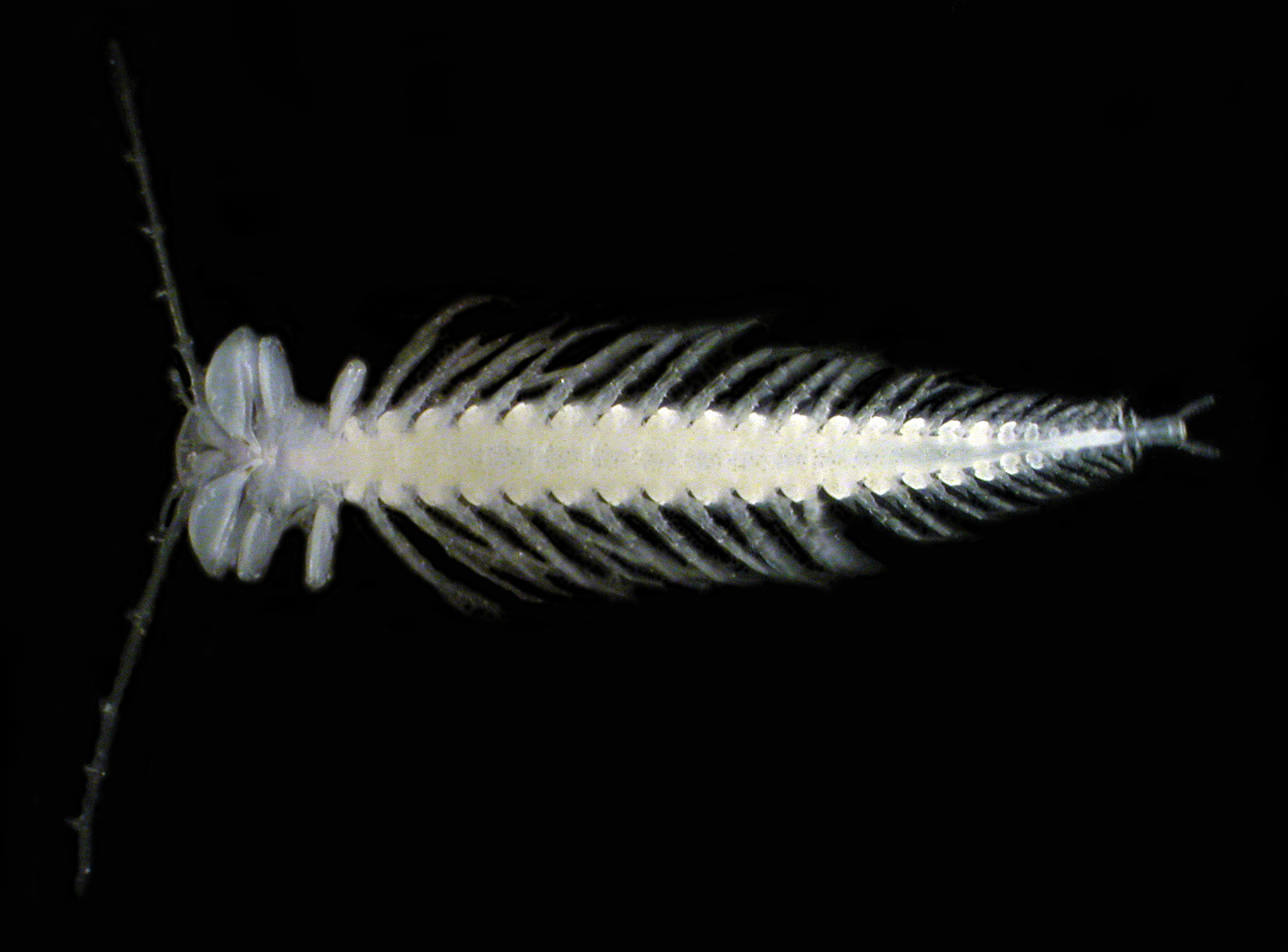
This species of remipede, Pleomothra fragilis, newly described in 1989, was found in Oven Rock Cave in the Exuma Cays, Bahamas.

Remipedes are a primitive class of crustacean believed to be one of the oldest crustacean groups on Earth, possibly dating back 200 million years to the time of the dinosaurs. Remipedes look similar to centipedes and have hollow-tip fangs for injecting venom. They are hermaphrodites.

Image 3
This species of remipede, Pleomothra fragilis, newly described in 1989, was found in Oven Rock Cave in the Exuma Cays, Bahamas.

Remipedes are a primitive class of crustacean believed to be one of the oldest crustacean groups on Earth, possibly dating back 200 million years to the time of the dinosaurs. Remipedes look similar to centipedes and have hollow-tip fangs for injecting venom. They are hermaphrodites.

These pictures were taken by Thomas Iliffe, a professor of marine biology at Texas A&M University at Galveston. Iliffe was awarded a grant by the National Science Foundation in 2003 to study anchialine caves in the Bahamas (grant DEB-0315903). Anchialine (a Greek word meaning "near the sea") caves are coastal and form in limestone or volcanic rock. They flood with seawater and include the longest submerged caves on Earth. Many previously unknown species of higher taxa live in these caves. Most do not have eyes or pigment since they live in perpetual darkness.

To learn more, see the Texas A&M news story Texas A&M marine experts take discoveries to new underwater heights; or visit Iliffe's website, Here. [Ref. Koenemann, S. M. Ziegler and T.M. Iliffe (2008). Pleomothra fragilis n. sp. (Remipedia) from the Bahamas, with remarks on morphologic reductions and postnaupliar development. Journal of Crustacean Biology, 28(1):128-136.]

(Date of Image: 2005)

Credit: Tamara Thomsen

Monday, August 6, 2012

Scientists Define New Limits of Microbial Life in Undersea Volcanoes


A third of Earth's organisms live in rocks and sediments, but their lives have been a mystery

By some estimates, a third of Earth's organisms live in our planet's rocks and sediments, yet their lives are almost a complete mystery.

This week, the work of microbiologist James Holden of the University of Massachusetts-Amherst and colleagues shines a light into this dark world.

In the journal Proceedings of the National Academy of Sciences (PNAS), they report the first detailed data on methane-exhaling microbes that live deep in the cracks of hot undersea volcanoes.

"Evidence has built that there's an incredible amount of biomass in the Earth's subsurface, in the crust and marine sediments, perhaps as much as all the plants and animals on the surface," says Holden.

"We're interested in the microbes in the deep rock, and the best place to study them is at hydrothermal vents at undersea volcanoes. Warm water there brings the nutrient and energy sources these microbes need."

Just as biologists studied the habitats and life requirements of giraffes and penguins when they were new to science, Holden says, "for the first time we're studying these subsurface microorganisms, defining their habitat requirements and determining how they differ among species."

The result will advance scientists' comprehension of biogeochemical cycles in the deep ocean, he and co-authors believe.

"Studies such as this add greatly to our understanding of microbial processes in the still poorly-known deep biosphere," says David Garrison, program director in the National Science Foundation's Division of Ocean Sciences, which funded the research.

The project also addresses such questions as what metabolic processes may have looked like on Earth three billion years ago, and what alien microbial life might look like on other planets.

Because the study involves methanogens--microbes that inhale hydrogen and carbon dioxide to produce methane as waste--it may also shed light on natural gas formation on Earth.

One major goal was to test results of predictive computer models and to establish the first environmental hydrogen threshold for hyperthermophilic (super-heat-loving), methanogenic (methane-producing) microbes in hydrothermal vent fluids.

"Models have predicted the 'habitability' of the rocky environments we're most interested in, but we wanted to ground-truth these models and refine them," Holden says.

In a two-liter bioreactor at UMass Amherst where the scientists could control hydrogen levels, they grew pure cultures of hyperthermophilic methanogens from their study site alongside a commercially available hyperthermophilic methanogen species.

The researchers found that growth measurements for the organisms were about the same. All grew at the same rate when given equal amounts of hydrogen and had the same minimum growth requirements.

Holden and Helene Ver Eecke at UMass Amherst used culturing techniques to look for organisms in nature and then study their growth in the lab.

Co-investigators Julie Huber at the Marine Biological Laboratory on Cape Cod provided molecular analyses of the microbes, while David Butterfield and Marvin Lilley at the University of Washington contributed geochemical fluid analyses.

Using the research submarine Alvin, they collected samples of hydrothermal fluids flowing from black smokers up to 350 degrees C (662 degrees F), and from ocean floor cracks with lower temperatures.

Samples were taken from Axial Volcano and the Endeavour Segment, both long-term observatory sites along an undersea mountain range about 200 miles off the coast of Washington and Oregon and more than a mile below the ocean's surface.

"We used specialized sampling instruments to measure both the chemical and microbial composition of hydrothermal fluids," says Butterfield.

"This was an effort to understand the biological and chemical factors that determine microbial community structure and growth rates."

A happy twist awaited the researchers as they pieced together a picture of how the methanogens live and work.

At the low-hydrogen Endeavour site, they found that a few hyperthermophilic methanogens eke out a living by feeding on the hydrogen waste produced by other hyperthermophiles.

"This was extremely exciting," says Holden. "We've described a methanogen ecosystem that includes a symbiotic relationship between microbes."

The research was also supported by the NASA Astrobiology Institute and the National Oceanic and Atmospheric Administration.

 -NSF-

Sunday, July 22, 2012

All Washed Up and Somewhere to Go


Seaweed on beaches is an ecological treasure trove

Wrack, it's called--the tangled mass of seaweed found on beaches around the world. It washes in with the high tide and lingers long after the waters recede.

Beach-goers in summer barely notice it, other than to call it a nuisance. They step across piles of it to get to the water, finding the seaweed little but a hindrance.

They might want to take a second look, says ecologist David Spiller of the University of California, Davis (UC-Davis), currently on leave at the National Science Foundation (NSF) as a program director in the Division of Environmental Biology.

"Seaweed provides an important connection between two ecosystems," he says, "that of the sea and that of the land."

Ecologists generally studied habitats with the idea that what happens there stays there--or at least stays within certain boundaries. They assumed that most interactions occur within one habitat, rather than across two or more.

But that thinking has gone out to sea.

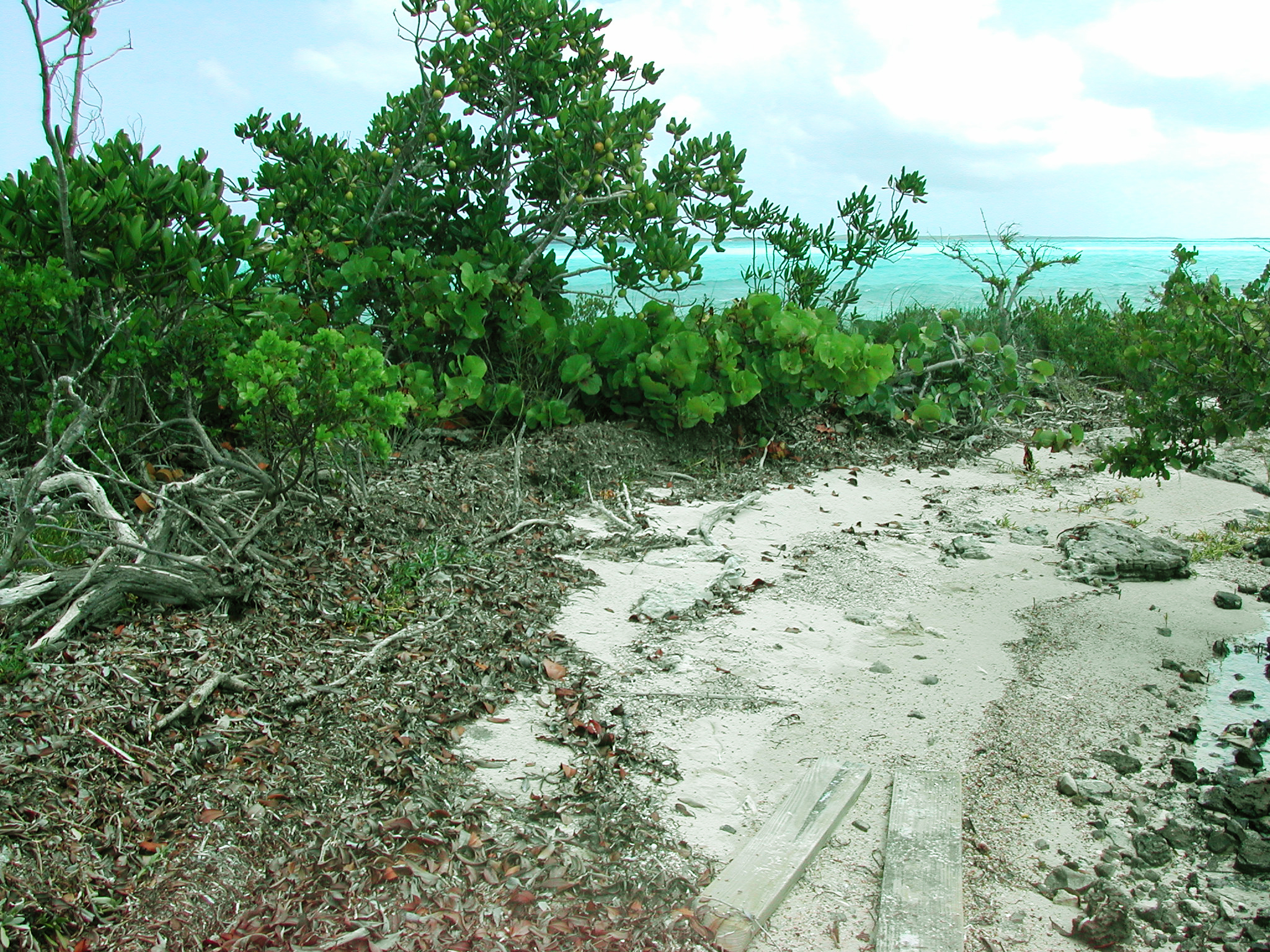
Spiller and colleagues conducted a study of the effects of "deposition events" on seaweed species inhabiting tropical islands in the Bahamas. In this case, the researchers looked at seaweed transported from one location to another by hurricanes and other major storms.

They added seaweed to six shoreline plots and removed seaweed from six other plots over a three-month-period.  All plots were monitored for 12 months after the initial change.

Spiller found that washed-up seaweed is in fact a resource "subsidy" that's consumed by flies and small amphipods such as beach fleas, which in turn are eaten by lizards and predatory arthropods like spiders.

Seaweed also decomposes directly into the soil, providing nutrients to plants. In the study, the growth rate of land-based plants near seaweed-subsidized plots was 70 percent higher than in non-seaweed-subsidized plots.

In subsidized plots, the density of lizards also increased rapidly, averaging 63 percent higher than in non-subsidized plots. In addition, lizards shifted their diets to marine-based prey.

When clumps of seaweed appeared on the scene, they attracted marine amphipods that reproduce rapidly. Lizards then went from land-based vegetation to seaweed to feast on the treasure trove.

The addition of seaweed also led to an increase in insect damage to plants living along the beach. When lizards moved to seaweed from land-based vegetation, their usual prey--plant-eating insects--were free to go on a spree, decimating plant leaves as they munched.

"What we saw may be called a 'fertilization effect' in which seaweed adds nutrients to plants, increasing their growth rate," says Spiller, "and a 'predator-diet-shift effect' in which lizards shift from eating land-based prey to consuming small, marine detritivores that breed in seaweed."

Spiller and colleagues published the results in the journal Ecology. Co-authors of the paper are Jonah Piovia-Scott, Amber Wright, Louie Yang and Thomas Schoener of UC-Davis, Gaku Takimoto of Toho University in Japan, and Tomoya Iwata of the University of Yamanashi in Japan.

Understanding how various factors influence species interactions in food webs is a central goal of current ecological research, say the scientists.

In a follow-up study published in the journal Science, the biologists looked at the effect of another predator, ants, on plant-eating insects on the same islands. The ants chow down on the insects, giving plants a breather.

A combination of ants and lizards has a strong positive effect--on plants. But insects aren't as lucky.

Predatory ants on islands in the Bahamas are nocturnal; lizards go about their business by day. In a world with both ants and lizards, plant-eating insects are hit from both sides.

But when seaweed is added to the mix, the effect disappears. Like the lizards, the ants head for the beach to dine on small creatures breeding in shoreline seaweed. 

Damage to land-based plants then increases as there are more of the plant-eating insects.

"Ecosystems are clearly very complicated networks of interactions," says Spiller.

Seaweed "wrack" is likely to increase with more frequent storms as a result of global warming, as well as from increased nutrient run-off that fuels seaweed growth--and via a reduction in seaweed-eating fish caused by overfishing.

"We all need to take a closer look," says Spiller, "at that line of seaweed on the sand."

-- Cheryl Dybas, NSF (703) 292-7734 cdybas@nsf.gov