Thursday, February 2, 2012

NASA Spacecraft Returns First Video from Far Side of The Moon

Dwayne Brown
Headquarters, Washington

DC Agle
Jet Propulsion Laboratory, Pasadena, Calif.

Caroline McCall
Massachusetts Institute of Technology, Cambridge

Whitney Lawrence Mullen
Sally Ride Science, San Diego

WASHINGTON -- A camera aboard one of NASA's twin Gravity Recovery And Interior Laboratory (GRAIL) lunar spacecraft has returned its first unique view of the far side of the moon. MoonKAM, or Moon Knowledge Acquired by Middle school students, will be used by students nationwide to select lunar images for study.

GRAIL consists of two identical spacecraft, recently named Ebb and Flow, each of which is equipped with a MoonKAM. The images were taken as part of a test of Ebb's MoonKAM on Jan. 19. The GRAIL project plans to test the MoonKAM aboard Flow at a later date.

To view the 30-second video clip, visit http://go.nasa.gov/zZXAPs.

In the video, the north pole of the moon is visible at the top of the screen as the spacecraft flies toward the lunar south pole. One of the first prominent geological features seen on the lower third of the moon is the Mare Orientale, a 560 mile-wide (900 kilometer) impact basin that straddles both the moon's near and far side.

The clip ends with rugged terrain just short of the lunar south pole. To the left of center, near the bottom of the screen, is the 93 mile-wide (149 kilometer) Drygalski crater with a distinctive star-shaped formation in the middle. The formation is a central peak, created many billions of years ago by a comet or asteroid impact.

"The quality of the video is excellent and should energize our MoonKAM students as they prepare to explore the moon," said Maria Zuber, GRAIL principal investigator from the Massachusetts Institute of Technology in Cambridge.

The twin spacecraft successfully achieved lunar orbit last New Year's Eve and New Year's Day. Previously named GRAIL-A and -B, the washing machine-sized spacecraft received their new names from fourth graders at the Emily Dickinson Elementary School in Bozeman, Mont., following a nationwide student-naming contest.

Thousands of fourth- to eighth-grade students will select target areas on the lunar surface and send requests to the GRAIL MoonKAM Mission Operations Center in San Diego. Photos of the target areas will be sent back by the satellites for students to study. The MoonKAM program is led by Sally Ride, America's first woman in space. Her team at Sally Ride Science and undergraduate students at the University of California in San Diego will engage middle schools across the country in the GRAIL mission and lunar exploration. GRAIL is NASA's first planetary mission carrying instruments fully dedicated to education and public outreach.

"We have had great response from schools around the country, more than 2,500 signed up to participate so far," Ride said. "In mid-March, the first pictures of the moon will be taken by students using MoonKAM. I expect this will excite many students about possible careers in science and engineering."

Launched in September 2011, Ebb and Flow periodically perform trajectory correction maneuvers that, over time, will lower their orbits to near-circular ones with an altitude of about 34 miles (55 kilometers). During their science mission, the duo will answer longstanding questions about the moon and give scientists a better understanding of how Earth and other rocky planets in the solar system formed.

NASA's Jet Propulsion Laboratory in Pasadena, Calif., manages the GRAIL mission for NASA's Science Mission Directorate in Washington. The GRAIL mission is part of the Discovery Program managed at NASA's Marshall Space Flight Center in Huntsville, Ala. Lockheed Martin Space Systems in Denver built the spacecraft.

For more information about GRAIL, visit http://www.nasa.gov/grail.

Information about MoonKAM is available at https://moonkam.ucsd.edu/.

- end -

NASA Receives Final NRC Report On Space Technology Roadmaps

David E. Steitz
Headquarters, Washington                                    

WASHINGTON -- NASA has received the National Research Council (NRC) report "NASA Space Technology Roadmaps and Priorities," which provides the agency with findings and recommendations on where best to invest in technologies needed to enable NASA's future missions in space. The NRC report will help define NASA's technology development priorities in the years to come.

One year ago, NASA provided 14 draft space technology area roadmaps to the NRC and asked the council to examine and prioritize technologies for the agency. The technologies were prioritized in each of the 14 areas and then across all categories.

The report finalizes the NRC's review and identifies 16 top-priority technologies necessary for NASA's future missions, which also could benefit American aerospace industries and the nation. The 16 were chosen by the NRC from its own ranking of 83 high-priority technologies out of approximately 300 identified in the roadmaps.

"The report strongly reaffirms the vital importance of technology development to enable the agency's future missions and grow the nation's new technology economy," said Mason Peck, chief technologist at NASA Headquarters in Washington. "The report confirms the value of our technology development strategy to date. NASA currently invests in all of the highest-priority technologies and will study the report and adjust its investment portfolio as needed."

The technology priorities the report identifies are aligned with NASA missions to extend and sustain human activities beyond low Earth orbit, explore the evolution of the solar system and the potential for life elsewhere, and expand our un¬derstanding of Earth and the universe in which we live.

The report observes that "technological breakthroughs have been the foundation of virtually every NASA success. In addition, technological advances have yielded benefits far beyond space itself in down-to-Earth applications." It also states "future U.S. leadership in space requires a foundation of sustained technology advances."

During the coming months, NASA's Office of the Chief Technologist will lead an agency-wide analysis and coordination effort to update the 14 technology area roadmaps with the NRC report's findings and recommendations.

To review a copy of the report, visit http://www.nap.edu/catalog.php?record_id=13354.

For more information about NASA's Space Technology Program, visit http://www.nasa.gov/oct.

- end -

NASA Glenn To Host Tweetup Celebrating 50th Anniversary Of First American To Orbit Earth

Stephanie L. Schierholz
Headquarters, Washington                                    

Lori J. Rachul
Glenn Research Center, Cleveland, Ohio

CLEVELAND -- NASA's Glenn Research Center (GRC) in Cleveland will host a special event on March 2 to celebrate the 50th anniversary of John Glenn's first orbital flight by an American. NASA also will invite 100 people for a behind-the-scenes Tweetup at GRC in advance of the celebration event.

The Tweetup activities begin at 7:30 a.m. EST with a tour of Glenn's world-class flight research and ground test facilities that support aeronautics and space exploration. Participants will speak with scientists and engineers about technologies being investigated and developed.

Following the tours, the Tweetup will move to downtown Cleveland for the Glenn tribute event. "Celebrating John Glenn's Legacy: 50 years of Americans in Orbit," will be held at 1 p.m. at Cleveland State University's Wolstein Center. The program will include a video tribute and remarks by Glenn and agency and political officials. Tweetup participants also will meet astronaut Greg "Box" Johnson and other special guests.

On March 1, 1999, the Lewis Research Center was officially renamed the NASA John H. Glenn Research Center at Lewis Field in recognition of Glenn's contributions to science, space and the State of Ohio. As one of the original seven Mercury astronauts, Glenn trained in 1960 at Lewis in the Multiple Axis Space Test Inertia Facility.

Today, the center's research and technology development work focuses on air-breathing propulsion; communications; in-space propulsion and cryogenic fluids management; power, energy storage and conversion; materials and structures for extreme environments; and physical sciences and biomedical technologies in space.

Tweetup registration opens at noon on Friday, Feb. 3, and closes at noon on Monday, Feb. 6. NASA will select 100 total participants, including Twitter followers and their guests, by lottery from those who register online. Because Glenn is a government facility with restricted access, the event is open only to U.S. citizens and legal permanent residents.

For more NASA Tweetup information and to sign up, visit http://www.nasa.gov/tweetup.

To follow Johnson on Twitter, visit http://www.twitter.com/Astro_Box.

For more information about John Glenn, visit http://www.nasa.gov/centers/glenn/about/bios/john_glenn.html.

For more information about NASA's Glenn Research Center, visit http://www.nasa.gov/glenn.

- end -

A Spider Web's Strength Lies in More Than its Silk

While researchers have long known of the incredible strength of spider silk, the robust nature of the tiny filaments cannot alone explain how webs survive multiple tears and winds that exceed hurricane strength.

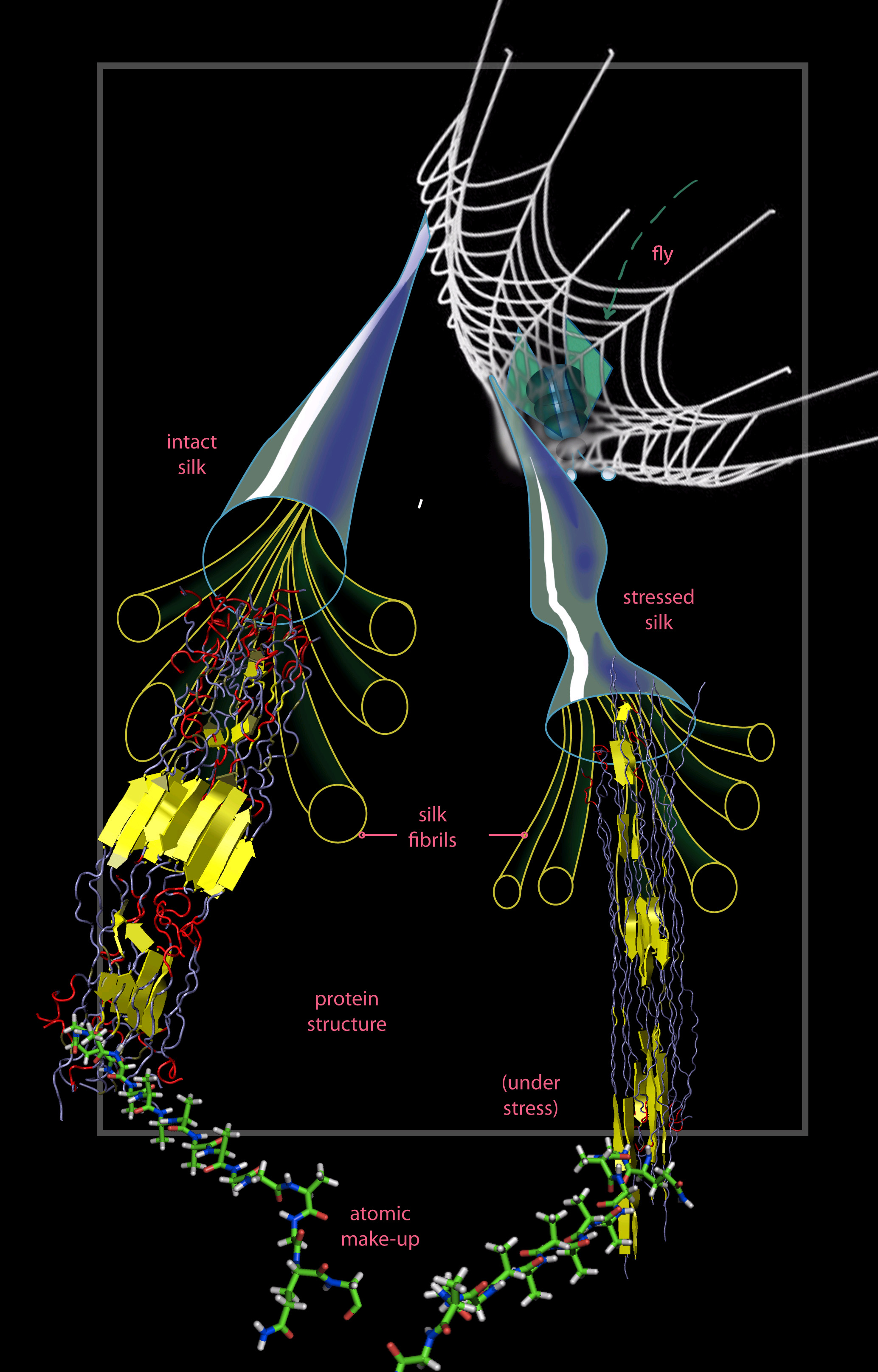
Now, a study that combines experimental observations of spider webs with complex computer simulations shows that web durability depends not only on silk strength, but on how the overall web design compensates for damage and the response of individual strands to continuously varying stresses.

Reporting in the cover story of the Feb. 2, 2012, issue of Nature, researchers from the Massachusetts Institute of Technology (MIT) and the Politecnico di Torino in Italy show how spider web-design localizes strain and damage, preserving the web as a whole.

"Multiple research groups have investigated the complex, hierarchical structure of spider silk and its amazing strength, extensibility and toughness," says Markus Buehler, associate professor of civil and environmental engineering at MIT. "But, while we understand the peculiar behavior of dragline silk from the 'nanoscale up'--initially stiff, then softening, then stiffening again--we have little insight into how the molecular structure of silk uniquely improves the performance of a web."

The spider webs found in gardens and garages are made from multiple silk types, but viscid silk and dragline silk are most critical to the integrity of the web. Viscid silk is stretchy, wet and sticky, and it is the silk that winds out in increasing spirals from the web center. Its primary function is to capture prey. Dragline silk is stiff and dry, and it serves as the threads that radiate out from a web's center, providing structural support. Dragline silk is crucial to the mechanical behavior of the web.

Some of Buehler's earlier work showed that dragline silk is composed of a suite of proteins with a unique molecular structure that lends both strength and flexibility. "While the strength and toughness of silk has been touted before--it is stronger than steel and tougher than Kevlar by weight--the advantages of silk within a web, beyond such measures, has been unknown," Buehler adds.

The common spiders represented in the recent study, including orb weavers (Nephila clavipes), garden spiders (Araneus diadematus) and others, craft familiar, spiraling web patterns atop a scaffolding of radiating filaments. Building each web takes energy the spider cannot afford to expend often, so durability is key to the arachnid's survival.

Through a series of computer models matched to laboratory experiments with spider webs, the researchers were able to tease apart what factors play what role in helping a web endure natural threats that are either localized, such as a twig falling on a filament, or distributed, such as high winds.

"For our models, we used a molecular dynamics framework in which we scaled up the molecular behavior of silk threads to the macroscopic world. This allowed us to investigate different load cases on the web, but more importantly, it also allowed us to trace and visualize how the web fractured under extreme loading conditions," says Anna Tarakanova, who developed the computer models along with Steven Cranford, both graduate students in Buehler's laboratory.

"Through computer modeling of the web," Cranford adds, "we were able to efficiently create 'synthetic' webs, constructed out of virtual silks that resembled more typical engineering materials such as those that are linear elastic, like many ceramics, and elastic-plastic materials, which behave like many metals. With the models, we could make comparisons between the modeled web's performance and the performance seen in the webs made from natural silk. In addition, we could analyze the web in terms of energy, and details of the local stress and strain," which are traits experiments were able to reveal.

The study showed that, as one might expect, when any part of a web is perturbed, the whole web reacts. Such sensitivity is what alerts a spider to the struggling of a trapped insect. However, the radial and spiral filaments each play different roles in attenuating motion, and when stresses are particularly harsh, they are sacrificed so that the entire web may survive.

"The concept of selective, localized failure for spider webs is interesting since it is a distinct departure from the structural principles that seem to be in play for many biological materials and components," adds Dennis Carter, the NSF program director for biomechanics and mechanobiology who helped support the study.

"For example, the distributed material components in bone spread stress broadly, adding strength. There is no 'wasted' material, minimizing the weight of the structure. While all of the bone is being used to resist force, bone everywhere along the structure tends to be damaged prior to failure."

In contrast, a spider's web is organized to sacrifice local areas so that failure will not prevent the remaining web from functioning, even if in a diminished capacity, says Carter. "This is a clever strategy when the alternative is having to make an entire, new web," he adds. "As Buehler suggests, engineers can learn from nature and adapt the design strategies that are most appropriate for specific applications."

Specifically, when a radial filament in a web is snagged, the web deforms more than when a relatively compliant spiral filament is caught. However, when either type fails--under great stress--it is the only filament to fail.

The unique nature of the spider-silk proteins enhances that effect. When a filament is pulled, the silk's unique molecular structure--a combination of amorphous proteins and ordered, nanoscale crystals--unfurls as stress increases, leading to a stretching effect that has four distinct phases: an initial, linear tugging; a drawn out stretching as the proteins unfold; a stiffening phase that absorbs the greatest amount of force; and then a final, stick-slip phase before the silk breaks.

According to the researchers' findings, the failure of silk threads occurs at points where the filament is disturbed by that external force, but after failure, the web returns to stability--even in simulations using broad forces, like hurricane-force winds.

"Engineered structures are typically designed to withstand large loads with limited damage, but extreme loads are more difficult to account for," says Cranford. "The spider has uniquely solved this problem by allowing a sacrificial member to fail under high load. One of the first questions a structural engineer must ask is ‘What is the design load?' For a spider web, however, it doesn't matter if the load is just strong enough to cause failure, or one hundred times higher--the net effect is the same. Allowing a sacrificial member to fail removes the unpredictability of 'extreme' loads from the design equation."

For detailed information on NSF-supported research elsewhere in Massachusetts, see results for Massachusetts on Research.gov.

 -NSF-

Wednesday, February 1, 2012

NASA Spacecraft Reveals New Observations of Interstellar Matter

Dwayne Brown                                   
Headquarters, Washington                                    

Susan Hendrix
Goddard Space Flight Center, Greenbelt, Md.

WASHINGTON -- NASA's Interstellar Boundary Explorer (IBEX) has captured the best and most complete glimpse yet of what lies beyond the solar system. The new measurements give clues about how and where our solar system formed, the forces that physically shape our solar system, and the history of other stars in the Milky Way.

The Earth-orbiting spacecraft observed four separate types of atoms including hydrogen, oxygen, neon and helium. These interstellar atoms are the byproducts of older stars, which spread across the galaxy and fill the vast space between stars. IBEX determined the distribution of these elements outside the solar system, which are flowing charged and neutral particles that blow through the galaxy, or the so-called interstellar wind.

"IBEX is a small Explorer mission and was built with a modest investment," said Barbara Giles, director of the Heliophysics Division at NASA Headquarters in Washington. "The science achievements though have been truly remarkable and are a testament to what can be accomplished when we give our nation's scientists the freedom to innovate."

In a series of science papers appearing in the Astrophysics Journal on Jan. 31, scientists report finding 74 oxygen atoms for every 20 neon atoms in the interstellar wind. In our own solar system, there are 111 oxygen atoms for every 20 neon atoms. This translates to more oxygen in any part of the solar system than in nearby interstellar space.

"Our solar system is different than the space right outside it, suggesting two possibilities," says David McComas, IBEX principal investigator, at the Southwest Research Institute in San Antonio. "Either the solar system evolved in a separate, more oxygen-rich part of the galaxy than where we currently reside, or a great deal of critical, life-giving oxygen lies trapped in interstellar dust grains or ices, unable to move freely throughout space."

The new results hold clues about the history of material in the universe. While the big bang initially created hydrogen and helium, only the supernovae explosions at the end of a star's life can spread the heavier elements of oxygen and neon through the galaxy. Knowing the amounts of elements in space may help scientists map how our galaxy evolved and changed over time.

Scientists want to understand the composition of the boundary region that separates the nearest reaches of our galaxy, called the local interstellar medium, from our heliosphere. The heliosphere acts as a protective bubble that shields our solar system from most of the dangerous galactic cosmic radiation that otherwise would enter the solar system from interstellar space.

IBEX measured the interstellar wind traveling at a slower speed than previously measured by the Ulysses spacecraft, and from a different direction. The improved measurements from IBEX show a 20 percent difference in how much pressure the interstellar wind exerts on our heliosphere.

"Measuring the pressure on our heliosphere from the material in the galaxy and from the magnetic fields out there will help determine the size and shape of our solar system as it travels through the galaxy," says Eric Christian, IBEX mission scientist, at NASA's Goddard Space Flight Center in Greenbelt, Md.

The IBEX spacecraft was launched in October 2008. Its science objective is to discover the nature of the interactions between the solar wind and the interstellar medium at the edge of our solar system.

The Southwest Research Institute developed and leads the IBEX mission with a team of national and international partners. The spacecraft is one of NASA's series of low-cost, rapidly developed missions in the Small Explorers Program. Goddard manages the program for the agency's Science Mission Directorate at NASA Headquarters in Washington.

For more information about IBEX, visit http://www.nasa.gov/ibex.

- end -

NASA, University Of Maryland Invite Public To Astronauts' Discussion Of Recent International Space Station Missions

Joshua Buck
Headquarters, Washington

Lee Tune
Office of Public Affairs
University of Maryland

WASHINGTON -- NASA and the University of Maryland's A. James Clark School of Engineering invite the public to a discussion with three astronauts from recent International Space Station expedition missions at 5:30 p.m. EST on Tuesday, Feb. 14, in the Hoff Theater inside the Adele H. Stamp Student Union. The crew members will give a video presentation about their mission and answer questions from the audience.

Free tickets will be available on a first-come, first-served basis. Tickets can be picked up from the Stamp Union ticket office daily between noon and 10 p.m., starting Monday, Feb. 6. Reporters interested in covering the event should contact Missy Corley at 301-405-6501 or mcorley@umd.edu.

Mike Fossum served as a flight engineer for Expedition 28 and as commander for Expedition 29. During his stay, the station celebrated 11 years of continuous residence and work. Fossum returned to Earth on Nov. 21, 2011. He has logged more than 194 days in space, including more than 48 hours of extravehicular activity (EVA) in seven spacewalks. He is seventh on the all-time list of cumulative EVA time.

Ron Garan served as a flight engineer for Expeditions 27 and 28. While aboard the station, Garan continued work on a variety of microgravity experiments and welcomed two shuttle visits, including the last to the station. Garan landed on Sept. 15, 2011. He has logged more than 178 days in space, including 27 hours and 3 minutes outside the station during four spacewalks.

Cady Coleman served as a flight engineer for Expeditions 26 and 27. She was the lead robotics and science officer. While aboard, the station hosted a record number of visiting spacecraft: five vehicles from four space agencies. She returned to Earth on May 24, 2011. Coleman has logged over 4,330 hours in space aboard the station and space shuttle Columbia.

The trio also will give a presentation earlier in the day to NASA employees at 10:30 a.m. in NASA Headquarters' James E. Webb Auditorium, located at 300 E St. SW in Washington. The presentation will air live on NASA Television and the agency's website. The astronauts will be available for media interviews from 9 to 10 a.m. Journalists must call 202-358-1100 to attend the presentation or to schedule an interview.

For more information about Fossum, visit http://www.jsc.nasa.gov/Bios/htmlbios/fossum.html, http://www.twitter.com/astro_aggie.

For more information about Garan, visit http://www.jsc.nasa.gov/Bios/htmlbios/garan-rj.html, http://www.twitter.com/Astro_Ron.

For more information about Coleman, visit http://www.jsc.nasa.gov/Bios/htmlbios/coleman.html, http://www.twitter.com/astro_cady.

For more information about the A. James Clark School of Engineering, visit http://www.eng.umd.edu/impact/space .

For a map of the University of Maryland campus and location of the Stamp Student Union (Building 163), visit http://bit.ly/zku8ht.

For NASA TV schedule information and links to streaming video, visit http://www.nasa.gov/ntv.

- end -

Understanding Basic Concepts in Spatial Measurement

In a first or second grade classroom, a teacher asks students to take a ruler and measure (in inches) the length of a rectangular block. A student aligns the "0 inch" mark of the ruler with the end of the block, and counts the number of inches from the end of the ruler to where the block ends.

"It's three inches," the student says.

In reality, the block is two inches. The student counted the 0 inch mark as part of the measurement, instead of starting at the 1 inch mark. The child moved from one end of the object to the other, but counted the inch marks on the ruler, instead of the intervals of space between them.

This is just one of common misconceptions that elementary-school-aged children make when learning how to measure various objects.

To help prevent students from having these misconceptions, Jack Smith and his colleagues at Michigan State University (MSU) are analyzing curricula that elementary school teachers and children currently use in schools to learn spatial measurement--length, area and volume.

Smith explained the goal of their research is to inform the revision of curriculum materials, guide the design and implementation of professional development, pre-service education to improve the use of existing curriculum materials and enrich the nation's research capacity to build usable knowledge in this specific area of need in mathematics education.

To achieve this, Smith and his team are examining three elementary mathematics curricula, "Everyday Mathematics," "Scott-Foresman-Addison Wesley Mathematics (Michigan edition)" and "Saxon Math," and applying what they have learned about teacher professional development with state-wide partners in Michigan, teacher education at MSU and research with partners at other universities. They also are working with curriculum authors to revise measurement content to align with the Common Core State Standards in Mathematics and support stronger learning opportunities for students.

"Current curriculum materials generally focus on teaching students how to measure, but attend little to why those procedures work," said Smith. "The result is that what is not understood in the first place is easily forgotten. This procedural focus also means that students have a much harder time adapting to measurement situations that they have not seen and practiced in school. That's because they have learned the steps in standard, practiced situations but they don't know why those are there or how to adapt them."

Teaching children about spatial measurement is crucial in understanding the physical world and for practical application, such as being able to measure objects accurately.

"There are two kinds of quantities in the world that mathematics and numbers represent," said Smith. "There are collections of objects (discrete quantity) and there are measurable objects (continuous quantity). Currently, in U.S. classrooms we focus mostly on the former and avoid the latter. This means that less attention to measurement fails to prepare students to deal practically with the physical--that is, to measure things and think about measurement in their everyday world. That's the immediate impact."

Smith added that learning about these foundations of measurement further prepares students to comprehend more advanced mathematics and science. "A lot of math and science is not easily accessible without understanding the basics of measurement, which in this country and most others is learned in the study of spatial measurement," said Smith.

To better teach measurement, Smith outlines a variety of techniques.

"First, using length as an example, children need to be able to see, think about and talk about length as an attribute of objects and distance," said Smith. "That is, they have to be able to 'see' length. This is not a step that can be taken for granted."

For instance, Smith provides the following example (see image in the right side-bar): A student is asked to find the perimeter--the length of the continuous line forming the boundary of a closed geometric figure--of a 2-D rectangle. The student is told that the perimeter of the rectangle can be found by surrounding the rectangle with square tiles, including tiles at each of the four corners. The student claims that the perimeter of the rectangle is 22 tiles. However, the actual perimeter is 18 tiles. The student is not distinguishing the edges of the tiles as length units from the square tiles that are area units--the ability to visualize the difference is crucial in understanding what one is measuring.

Smith explained additional characteristics of effective instruction and curricula for elementary school that include "attention to core conceptual principles that underlie and justify measurement procedures; specific attention to understanding how measurement tools and formulas work, as many of the nation's fourth graders do not understand how rulers work; consistently asking kids to present what they did to solve problems and why those methods worked or not; tracing common conceptual principles across the measurement of different physical quantities (spatial and non-spatial); and attention to the importance of motion in measurement."

Another key in helping elementary-school-aged children learn, is making sure that they have a strong mathematics foundation in pre-school. Smith explained, "For spatial measurement, a strong pre-school focus on qualitative comparisons of spatial quantities as attributes of everyday objects, e.g., is the coat rack taller than the door? How can we tell?, lays the groundwork for exploring measurement issues in more exact ways, e.g., how much taller is the coat rack than the door?"

Smith suggests that ultimately, measurement plays a large role in how children understand the foundations of mathematics. "It has been an axiom for some time that counting and numbers, and operations on numbers is the heart of elementary mathematics education," said Smith. "But there is evidence that this is a historical choice rather than a clearly justified application of knowledge of human development."

-- Ellen Ferrante, (703) 292-2204 emferran@nsf.gov