Showing posts with label insects. Show all posts

Saturday, August 25, 2012

Tobacco Hawkmoth (Sphingidae: Manduca sexta)


A hovering tobacco hawkmoth (Sphingidae: Manduca sexta). The moth's wings beat about 25 times a second and considerable deformation of the wings occurs during certain phases of the wing stroke. (Note the S-shaped deformation of the left wing in this picture).

Based on previous studies on insect flight, researchers assumed that insect wings are relatively rigid as they flap. But research by Andrew Mountcastle, a doctoral student in biology at the University of Washington (UW), used high-speed digital imaging to show that, at least for some insects, wings that flex and deform--similar to what happens to a heavy beach towel when you snap it to get rid of the sand--are best for staying aloft. "The evidence indicates that flexible wings are producing profoundly different air flows than stiff wings, and those flows appear to be more beneficial for generating lift," said Mountcastle.

Mountcastle used particle image velocimetry, a technique commonly used to determine flow velocities in fluids, to study how air flowed over the wings of the tobacco hawkmoth. The method combined laser light and high-speed digital video to model air flow.

To learn more about this research, which was funded in part by a grant from the National Science Foundation, see the UW news story Straighten Up and Fly Right: Moths Benefit More From Flexible Wings Than Rigid

(Date of Image: January 2006)

Credit: Armin Hinterwirth, University of Washington

Wednesday, July 11, 2012

Studying Jeweled Beetle's Iridescence (Images 3 and 4)


Image 3: Jung Ok Park, the principal research scientist in the lab of Mohan Srinivasarao, a professor at the School of Polymer, Textile and Fiber Engineering at the Georgia Institute of Technology, uses a microspectrophotometer to image the exocuticle of the jeweled beetle Chrysina gloriosa. The research team studied the surface structures on the beetle's shell and discovered that the iridescent colors are produced from liquid crystalline material that self-assembles into a complex arrangement of polygonal shapes.

Image 4:  Enlarged image showing jeweled beetle Chrysina gloriosa. Researchers from the Georgia Institute of Technology studied the surface structures on the beetle's shell and discovered that the iridescent colors are produced from liquid crystalline material that self-assembles into a complex arrangement of polygonal shapes.

More About This Image
Mohan Srinivasarao, a professor at the School of Polymer, Textile and Fiber Engineering at Georgia Tech, received a grant from the National Science Foundation (NSF) to study what gives the jeweled beetle's shell its iridescence. Iridescent beetles, butterflies, certain sea organisms and many birds get their unique colors from the interaction of light with physical structures on their external surfaces.

Srinivasarao worked with colleagues Vivek Sharma, Matija Crne and Jung Ok Park to study the surface structures on the shells. The team published a detailed analysis in Science magazine of how the jeweled beetle Chrysina gloriosa uses a helical structure that reflects light of two specific colors, and of only one polarization--left circular polarization, to create their striking colors. The reflecting structures used by the beetle consist predominately of three different polygonal shapes--primarily hexagons, pentagons and heptagons, each less than 10 microns in size--whose percentages vary with the curvature of the insect's shell.

"This is really a pattern formation issue," said Srinivasarao. "It is difficult to pack only hexagons onto a curved surface. On flat surfaces, there are fewer defects in the form of five- and seven-sided cells."

Srinivasarao believes the patterns are due to the nature of the cholesteric liquid crystal and because the liquid crystal phase structures itself at the interface between air and fluid. "We think these patterns result because the liquid crystal must have defects on the surface when exposed to air, and those defects create the patterns in the beetle's shell or exoskeleton," says Srinivasarao.

Studying these shimmery shells may lead to new insights into liquid crystal technology. "Understanding how these structures give rise to the stunning colors we see in nature could benefit the quest for miniature optical devices and photonics," said Srinivasarao. Liquid crystalline materials have many uses, from displays for laptop computers to portable music players and other devices to children's thermometers.

This information was taken from the Georgia Tech news release "Jeweled Beetles: Scientists Unlock Optical and Liquid Crystal Secrets of Iridescent Metallic Green Insects." The full story is available Here.

Or, to learn more, you can view the NSF presentation "Inside a Beetle's Iridescence." [Research supported by NSF grant DMR 07-06235.]

(Date of Image: July 2009)

Credit: Georgia Tech; photo by Gary Meek

Studying Jeweled Beetle's Iridescence (Images 1 and 2)


Image 1: Professor Mohan Srinivasarao holds a collection of beetles and points to the jeweled beetle Chrysina gloriosa. C. gloriosa was the subject of research by Srinivasarao and his team at the Georgia Institute of Technology in which they studied the surface structures on the beetles' shells and discovered that the iridescent colors are produced from liquid crystalline material that self-assembles into a complex arrangement of polygonal shapes.

Image 2: A jeweled beetle Chrysina gloriosa. The enlarged image in the background shows the insect's light-reflecting structures. Researchers from the Georgia Institute of Technology studied the surface structures on the beetle's shell and discovered that the iridescent colors are produced from liquid crystalline material that self-assembles into a complex arrangement of polygonal shapes.
 
More About These Images
 Mohan Srinivasarao, a professor at the School of Polymer, Textile and Fiber Engineering at Georgia Tech, received a grant from the National Science Foundation (NSF) to study what gives the jeweled beetle's shell its iridescence. It is the interaction of light with physical structures on their external surfaces that gives creatures like iridescent beetles, butterflies, certain sea organisms and many birds their unique colors.

Srinivasarao worked with colleagues Vivek Sharma, Matija Crne and Jung Ok Park to study the surface structures on the shells. The team published a detailed analysis in Science magazine of how the jeweled beetle Chrysina gloriosa uses a helical structure that reflects light of two specific colors, and of only one polarization--left circular polarization, to create their striking colors. The reflecting structures used by the beetle consist predominately of three different polygonal shapes--hexagons, pentagons and heptagons, each less than 10 microns in size--whose percentages vary with the curvature of the insect's shell.

"This is really a pattern formation issue," said Srinivasarao. "It is difficult to pack only hexagons onto a curved surface. On flat surfaces, there are fewer defects in the form of five- and seven-sided cells."

Srinivasarao believes the patterns are due to the nature of the cholesteric liquid crystal and because the liquid crystal phase structures itself at the interface between air and fluid. "We think these patterns result because the liquid crystal must have defects on the surface when exposed to air, and those defects create the patterns in the beetle's shell or exoskeleton," says Srinivasarao.

Studying these shimmery shells may lead to new insights into liquid crystal technology. "Understanding how these structures give rise to the stunning colors we see in nature could benefit the quest for miniature optical devices and photonics," said Srinivasarao. Liquid crystalline materials have many uses, from displays for laptop computers to portable music players and other devices to children's thermometers.

This information was taken from the Georgia Tech news release "Jeweled Beetles: Scientists Unlock Optical and Liquid Crystal Secrets of Iridescent Metallic Green Insects." The full story is available Here.

Or, to learn more, view the NSF presentation "Inside a Beetle's Iridescence." [Research supported by NSF grant DMR 07-06235.] (Date of Image: July 2009)

Credit: Georgia Tech; photo by Gary Meek

Thursday, June 14, 2012

Predators Have Outsized Influence Over Habitats


Study of grasshoppers' diets shows that animals are an important part of organic matter decomposition

A grasshopper's change in diet to high-energy carbohydrates while being hunted by spiders may affect the way soil releases carbon dioxide into the atmosphere, according to research results published this week in the journal Science.

Grasshoppers like to munch on nitrogen-rich grass because it stimulates their growth and reproduction.

But when spiders enter the picture, grasshoppers cope with the stress from fear of predation by shifting to carbohydrate-rich plants, setting in motion dynamic changes to the ecosystem they inhabit, scientists have found.

"Under stressful conditions they go to different parts of the 'grocery store' and choose different foods, changing the makeup of the plant community," said Oswald Schmitz, a co-author of the paper and an ecologist at Yale University.

The high-energy, carbohydrate diet also tilts a grasshopper's body chemistry toward carbon at the expense of nitrogen.

So when a grasshopper dies, its carcass breaks down more slowly, thus depriving the soil of high-quality fertilizer and slowing the decomposition of uneaten plants.

"This study casts a new light on the importance of predation in natural communities," said Saran Twombly, program director in the National Science Foundation's Division of Environmental Biology, which funded the research.

"A clever suite of experiments shows that the dark hand of predation extends all the way from altering what prey eat to the nutrients their decomposing bodies contribute to soil."

Microbes in the soil require a lot of nitrogen to function and to produce the enzymes that break down organic matter.

"It only takes a slight change in the chemical composition of that animal biomass to fundamentally alter how much carbon dioxide the microbial pool is releasing to the atmosphere while it is decomposing plant organic matter," said Schmitz.

"This shows that animals could potentially have huge effects on the global carbon balance because they're changing the way microbes respire organic matter."

The researchers found that the rate at which the organic matter of leaves decomposed increased between 60 percent and 200 percent in stress-free conditions relative to stressed conditions, which they consider "huge."

"Climate and litter quality are considered the main controls on organic-matter decomposition, but we show that aboveground predators change how soil microbes break down organic matter," said Mark Bradford, a co-author of the study and also an ecologist at Yale.

Schmitz added: "What it means is that we're not paying enough attention to the control that animals have over what we view as a classically important process in ecosystem functioning."

The researchers took soil from the field, put it in test tubes and ground up grasshopper carcasses obtained from environments either with or without grasshopper predators.

They then sprinkled the powder atop the soil, where the microbes digested it.

When the grasshopper carcasses were completely decomposed, the researchers added leaf litter and measured the rate of leaf-litter decomposition.

The experiment was then replicated in the field at the Yale Myers Forest in northeastern Connecticut.

"It was a two-stage process where the grasshoppers were used to prime the soil, then we measured the consequences of that priming," said Schmitz.

The effect of animals on ecosystems is disproportionately larger than their biomass would suggest.

"Traditionally people thought that animals had no important role in recycling of organic matter, because their biomass is relatively small compared to the plant material that's entering ecosystems," Schmitz said.

"We need to pay more attention to the role of animals, however. In an era of biodiversity loss we're losing many top predators and larger herbivores from ecosystems."

Other co-authors are Michael Strickland of Yale, and Dror Hawlena of the Hebrew University of Jerusalem.

-NSF-

Wednesday, May 30, 2012

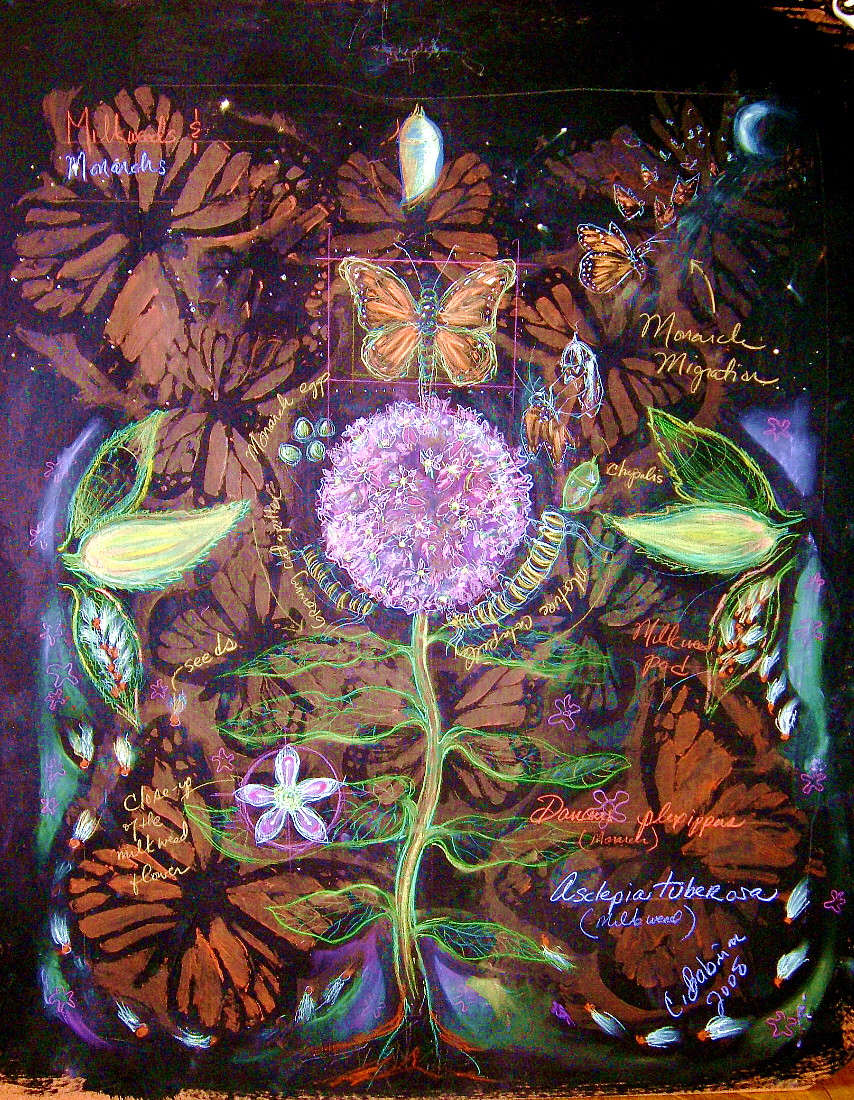
Butterfly/Milkweed Co-evolutionary Relationship


This illustration shows the co-evolutionary relationship between the monarch butterfly and the milkweed plant. It also shows the migration of the butterflies and the seeds replanted by the milkweed pods.

(Date of Image: October 2008)

Credit: C. Babaian