Saturday, March 7, 2026

IATF-401, FAA to Conduct Advanced Counter-Drone Laser Test at White Sands Missile Range

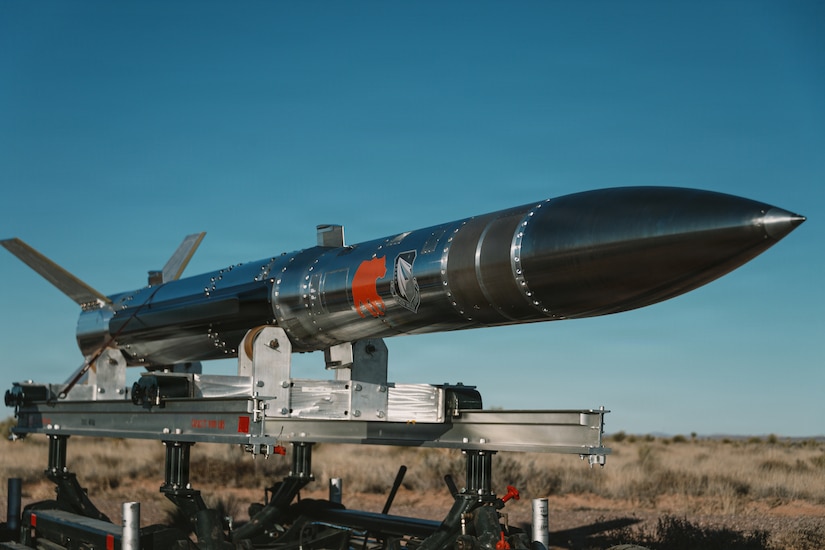
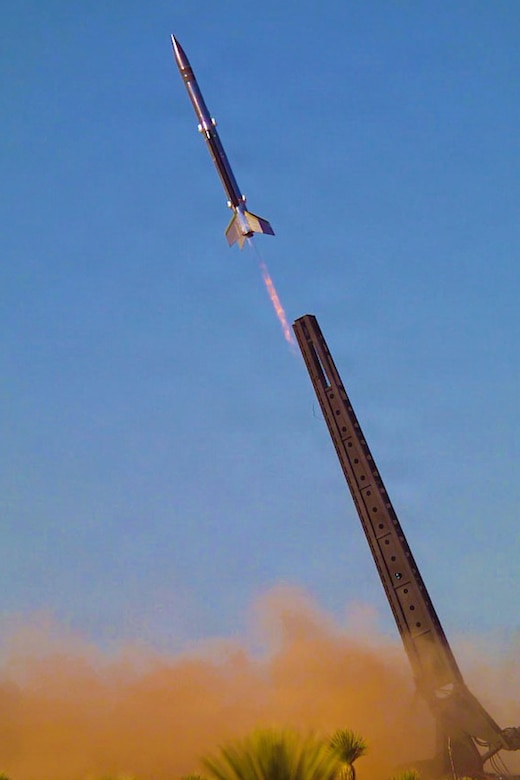
Joint Interagency Task Force 401 and the Federal Aviation Administration will conduct a high-energy laser test on March 7-8, 2026, to continue advancing the safe use of counter-unmanned aerial systems in the United States.

This test is part of a long-term, multi-year partnership between the Department of War and the FAA to ensure counter-drone technologies are safely integrated into the national airspace. The plan has been jointly developed by a wide range of stakeholders, with support from the White House Task Force to Restore American Airspace Sovereignty. Key partners supporting the JIATF-401 laser test include the FAA, White Sands Missile Range, the Army Program Acquisition Executive-Fires, Northern Command, and Joint Task Force Southern Border.

"This is a critical step in making sure our warfighters have the most advanced tools to defend the homeland," said U.S. Army Brigadier General Matt Ross, Director of JIATF-401. "By working hand-in-hand with the FAA and our interagency partners, we are ensuring that these cutting-edge capabilities are safe, effective, and ready to protect Americans from emerging drone threats. Our measure of success is to quickly deliver state-of-the-art C-UAS capability to the warfighter, and this test furthers that mission."

The test is a continuation of extensive testing conducted by the DoW over the last few decades. Earlier tests provided valuable data, further refining the system's capabilities and advancing the collaborative effort between DoW and the FAA. This upcoming event will specifically address FAA safety concerns while gathering data about the laser’s material effects on aircraft surrogates, validating the functionality of automated safety shut-off systems, and informing analyses for aircrew eye safety.

To maximize collaboration, representatives from the Department of Energy, National Nuclear Security Administration, Department of Homeland Security, Customs and Border Protection, and the New Mexico National Guard will be in attendance. The test underscores an ongoing unified federal effort to counter threats posed by unmanned aerial systems while maintaining the sovereignty and safety of U.S. airspace.

Tuesday, March 3, 2026

U.S. Space Force Strengthens Partnerships at 45th Cobra Gold

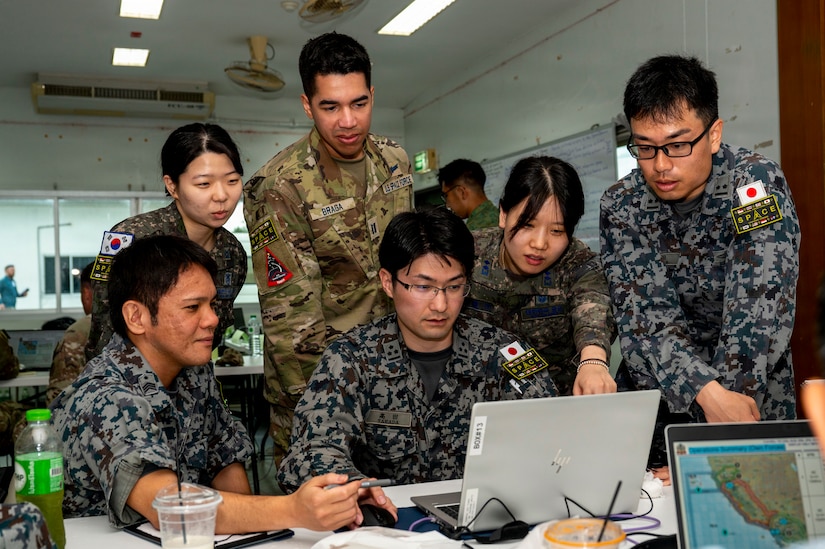
Space Force guardians are participating in the 45th iteration of Cobra Gold for the first time in the exercise's history, marking a milestone for the service and further integrating space as a warfighting domain within one of the Indo-Pacific's largest multinational exercises, Feb. 23 to March 6.

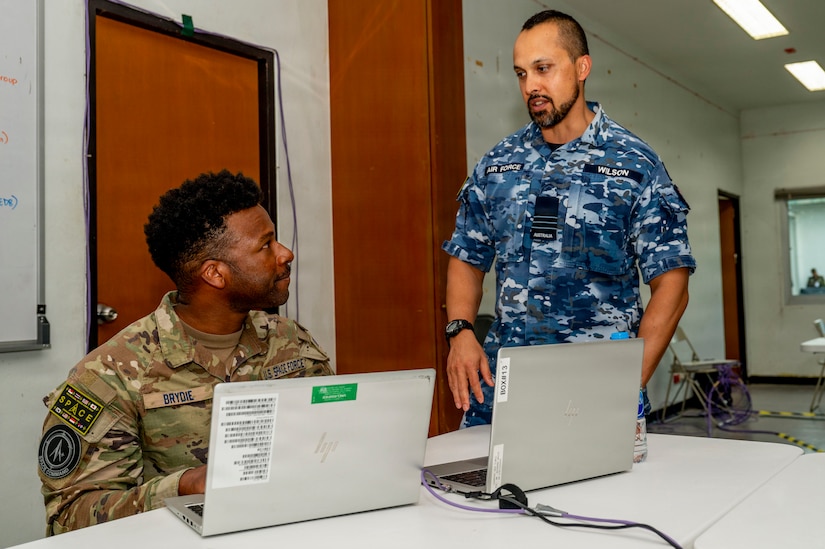
Two men, one seated and wearing a green camouflage military uniform and another standing and wearing a blue camouflage uniform, look at each other. There is a table with laptops in front of them.

The presence of guardians at Cobra Gold signals the continued evolution of the Space Force. It reinforces the U.S.-Thai alliance by enhancing multinational crisis response, mission effectiveness and capability across all domains.

"This marks a significant milestone for the United States Space Force," said Space Force Maj. Jonathan Brydie, a military exchange program embed assigned to the Joint Force Space Component, Headquarters Joint Operations Command. "As our service continues to mature, our participation demonstrates that we can support real-world operations and major multinational exercises simultaneously. It reinforces that space is a warfighting domain. Integrating space from the outset ensures the joint force operates with synchronized effects across air, land, maritime, cyber and space."

As the Air Force's newest military service, the Space Force was established to organize, train and equip forces to protect the United States and allied interests in, from and to space. Its integration into Cobra Gold reflects both operational necessity and the evolving character of warfare.

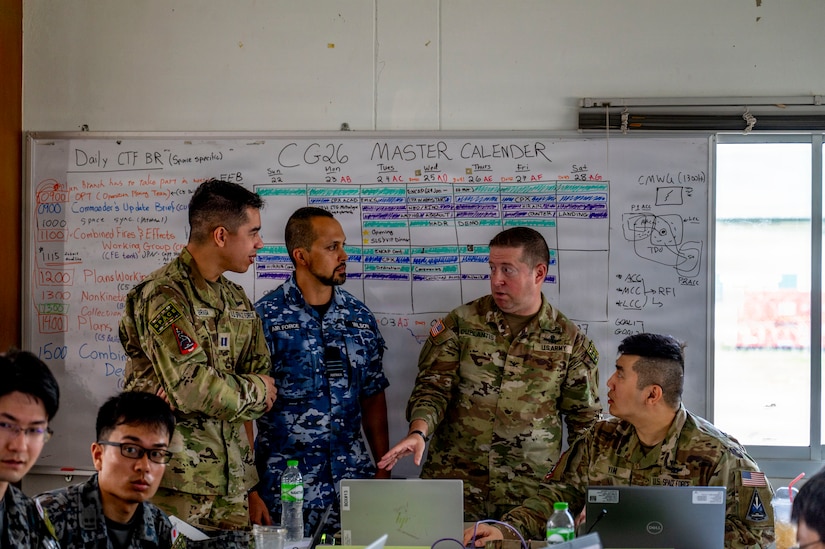
Three men wearing camouflage military uniforms from multiple nations stand in front of a white board. There are other men in similar attire seated at tables with laptops in front of them.

"Integrating space into Cobra Gold enhances the exercise by educating Indo-Pacific partners on the operational role of the space domain during conflict," said Space Force Capt. Nicholas Braga, Space Forces Korea chief of future operations. "It also opens dialogue on how nations can responsibly develop and integrate space capabilities that contribute to regional stability."

In support of Cobra Gold, guardians contributed expertise in space domain awareness, defensive and offensive space operations and operational-level space planning required to maintain space superiority. Rather than operating in isolation, Space Force personnel are embedded alongside air, land, maritime and cyber planners to integrate space effects into decision-making processes.

"We are ensuring space is a deliberate consideration at every decision point," Braga said. "Branch plans and contingency options are developed with space effects integrated from the beginning, giving commanders greater clarity and flexibility in achieving mission objectives."

A group of people, both men and women and wearing various camouflage uniforms from multiple nations, stand and crouch as they look at a laptop on a table.

The operational importance of space domain awareness was a central theme throughout the exercise.

"Most command and control systems rely on satellites and space-enabled networks," Brydie said. "Space superiority is now as vital as air superiority in modern conflict. Maintaining awareness of the space environment allows us to protect those systems and ensure the joint force can operate without disruption."

Beyond operational integration, Cobra Gold provided an opportunity for the Space Force to deepen relationships with regional allies actively developing their own space competencies.

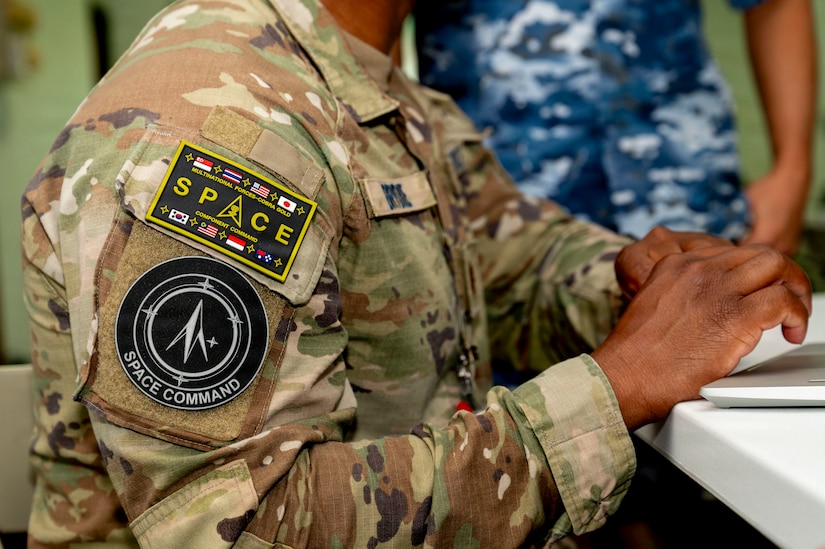
A Space Force patch is shown on the shoulder of a person wearing a camouflage military uniform. Another person in similar attire is standing in the background.

"It has been a tremendous opportunity to collaborate with partner nations," Braga said. "The United States is not the only space-capable entity in this region. Working alongside the Republic of Korea and other allies strengthens trilateral and multilateral integration. The cohesion built here enhances deterrence and reinforces our collective posture across Indo-Pacom."

Coalition partners emphasize shared responsibility in the space domain is essential to regional stability.

"Participating in Cobra Gold demonstrates a shared commitment to the responsible and secure use of space," said Royal Australian Air Force Staff Officer Mark Wilson, wing commander of Joint Force Space Component, Headquarters Joint Operations Command. "It shows we are willing and capable of sharing information and operational experience to achieve common security objectives."

"For the U.S. Space Force, Cobra Gold 2026 serves as both a milestone and platform to demonstrate the service's ability to integrate seamlessly within a complex multinational environment while delivering operational advantage to the joint force," Braga said.

From space domain awareness to operational-level planning, guardians ensured space effects were integrated at every stage of execution reinforcing deterrence, strengthening alliances and advancing the service's role as an essential component of joint and coalition operations in the Indo-Pacific.

Thursday, February 26, 2026

HoloLens Enables Remote Joint Inspection of Cargo

A joint inspection is an important part of preparing cargo for transport on military aircraft. Nearly every day, there are aerial porters in the 521st Air Mobility Operations Wing, spread across multiple areas of responsibility, who inspect pallets of equipment and supplies to confirm proper packaging, weight, balance and preparation, ensuring the cargo can be safely transported via aircraft.

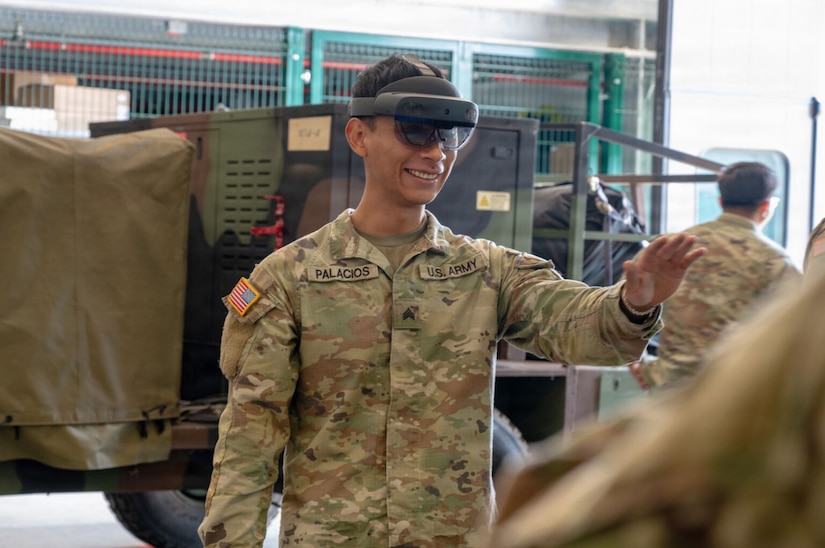
A man in a camouflage military uniform holds his hand out while looking through a headset. There are two other people in similar attire, as well as a vehicle with equipment on it, in the background.
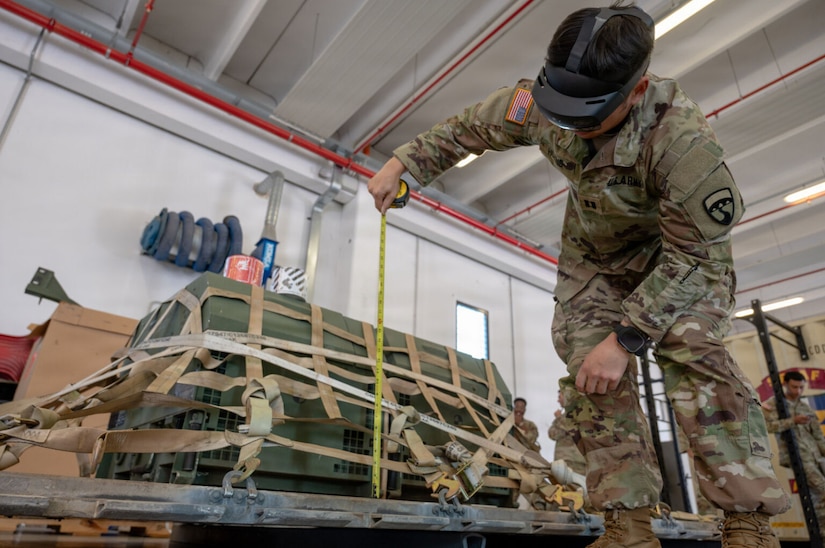
A person in a camouflage military uniform bends over to look at a measurement of a cargo pallet while wearing a headset in a warehouse.
It's an efficient process, but what if these airmen couldn't inspect the cargo in person? 
 
That's the question that the 725th Air Mobility Squadron has been trying to answer since 2021. The HoloLens, an augmented reality headset enabling aerial port experts to aid and guide technicians by looking through their eyes, could be the solution.  

The squadron airmen have demonstrated how the augmented reality capability can be used to increase rapid global mobility in a variety of maintenance, air transportation, and command and control scenarios, increasing the speed of maneuver to sustain joint force lethality across the competition continuum.
 
Stationed at Aviano Air Base, Italy, the 724th Air Mobility Squadron regularly partners with users in the region to prepare their cargo for forward deployment. They received an opportunity to work with the Army's 173rd Airborne Brigade in Vicenza, Italy, to perform a joint inspection remotely using the HoloLens. To best test the utility of the device, the 724th AMS worked alongside the 725th AMS, the operations wings' foremost authority on the technology.

A man in a camouflage military uniform sits at a table looking at a computer screen while in a warehouse. Another man in similar attire stands in the background, holding a phone.

 
"We spent a year working with the manufacturer and experimenting with different add-ons to figure out the right software and process we needed to get to where we are today," said Air Force Chief Master Sgt. Anthony Sewejkis, 725th AMS superintendent. "Now it's plug and play. We can connect [from] anywhere just using the HoloLens, a Wi-Fi hotspot and a laptop." 
 
From a conference room back in Aviano, Air Force Airman 1st Class Delaney Boehm, a 724th AMS aircraft services specialist, guided the personnel in Vicenza through the joint inspection, circling areas on her screen that she wanted them to focus on. 
 
"It was a great experience that showcased our squadrons' innovative approach to conducting routine inspections and allowed a technician in the field to work hands-free while receiving real-time guidance from a remote expert," said Air Force Staff Sgt. Devin Robert, 725th AMS noncommissioned officer in charge of network operations. "The ability to highlight individual objects in the technician's field of view goes beyond the capabilities of a traditional video call." 
 
Although the remote inspection was just a proof of concept, it demonstrated flexibility and ease of use to joint partners and to the headquarters Air Mobility Command staff.

A close-up view of a man in a brown T-shirt looking through a headset.
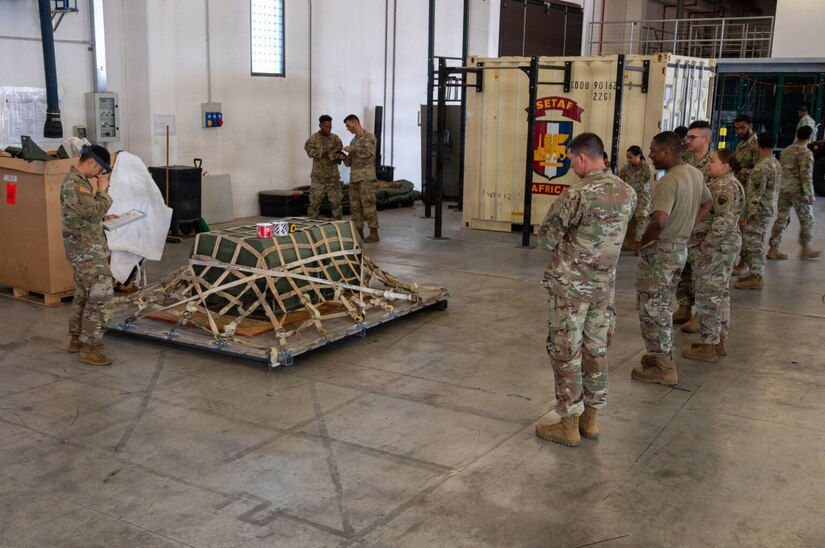
Several people in camouflage military uniforms stand in a warehouse looking at a cargo pallet on the floor. There is a large container and workout equipment in the background.
"There is a push in the air transportation career field to explore new ways of accomplishing our mission, irrespective of geographical constraints," said Air Force Lt. Col. Katherine Wilson, 724th AMS commander. "We tried the HoloLens alongside a traditional video call, and the immersive hands-free component of the HoloLens experience streamlined communication and overall speed of the inspection." 
 
Leveraging this new technology, the 725th AMS is continuing to refine processes and enabling mission execution despite the geographical separation within the operations wing.

Soldiers Experiment With First-Person-View Unmanned Aircraft Systems

The Army's 3rd Infantry Division is revolutionizing how ground forces employ unmanned aircraft systems through specialized UAS operators assigned to the 6th Squadron, 8th Cavalry Regiment, 2nd Armored Brigade Combat Team, 3rd Infantry Division, which officials say is critical to winning on the modern battlefield.

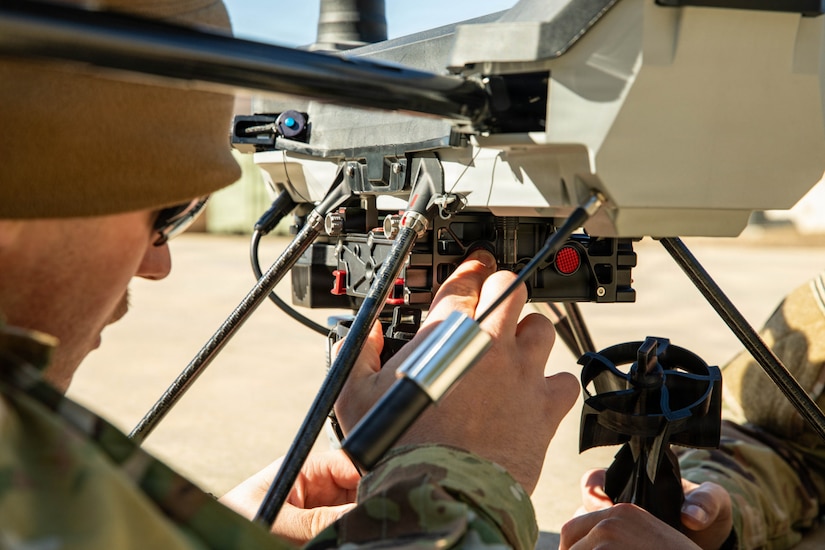
A close-up of two people wearing camouflage military uniforms working on a drone outside.

Combat team soldiers have fundamentally changed how drones are used at the brigade level by spreading the technology across the entire force and establishing a hub for testing innovative capabilities, said Army Capt. William Langley, brigade collection manager. 

"UAS is important on the modern battlefield today because it is a very fast-paced battlefield," Langley said. "The faster you can receive information and sense the enemy, the faster you can react, and whoever reacts first wins."  

The unit combines electronic warfare, UAS and launch effects platoons — a reorganization that provides tactical advantages on the battlefield. Soldiers are experimenting with various payloads on drones, including electronic warfare sensors and advanced capabilities for operational missions.

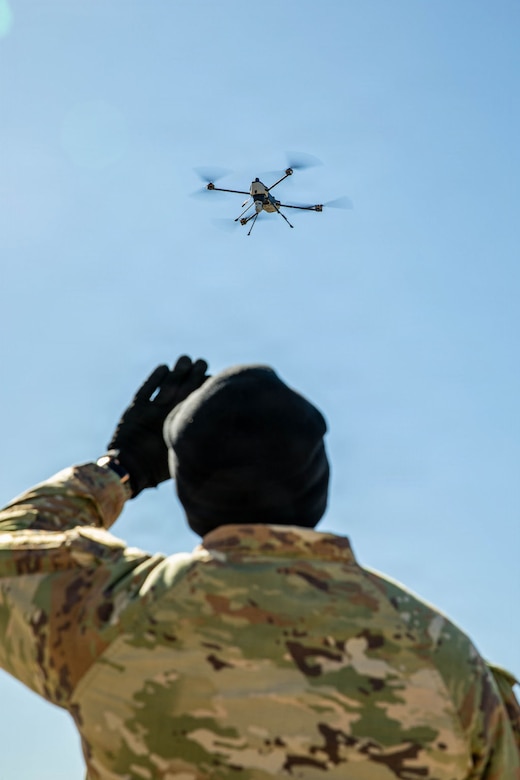
A man wearing a camouflage military uniform looks up at a drone flying in the air.
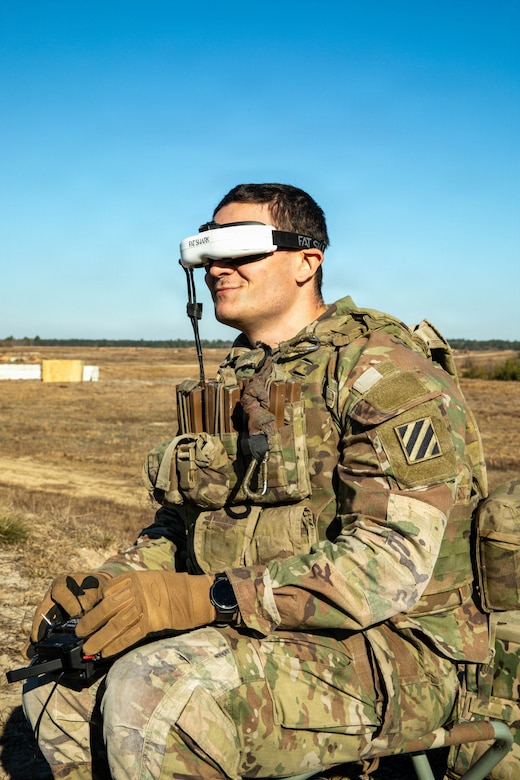
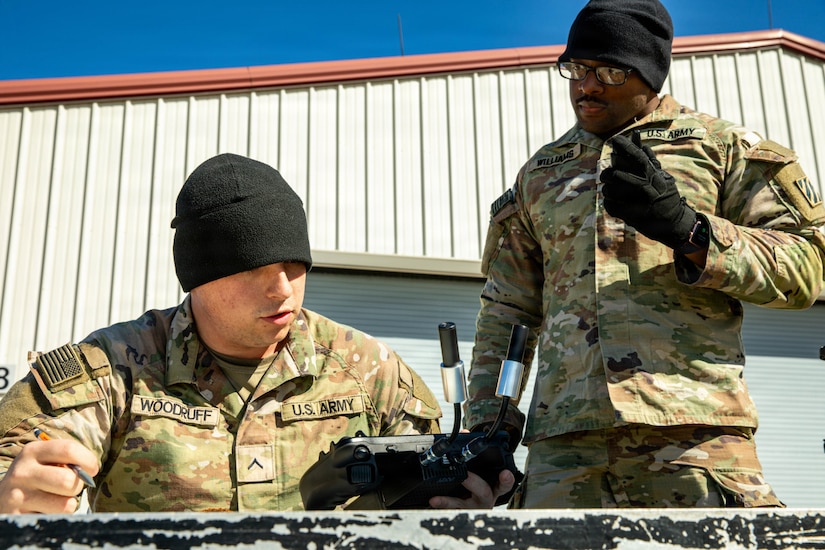
A man wearing a camouflage military uniform pilots a drone by looking through a headset and using a remote control. The man in seated in field.
Army 1st Lt. Declan McKeown, UAS platoon leader, said the combat team aims to improve operational effectiveness by using its platoons to gather intelligence and respond to threats faster than traditional methods allow. 

"The enemy wants to find us first, so it's a competition between the enemy and us to utilize our systems to be able to sense, track and maintain tactical advantage," McKeown said. 

The innovation comes as the 3rd ID participates in the Army's Transforming in Contact 2.0 initiative, which accelerates how combat formations test and adopt new technologies. The division has been designated as an initiative unit, positioning it at the forefront of procurement and experimentation with different platforms.

"Innovation is necessary for the 3rd ID to be successful because, as we have seen in recent conflicts in Ukraine, Israel and other places around the world, the way we fight battles is changing at a rapid pace, and we must continue to modernize to maintain our readiness for future operations," Langley said.

A man wearing a camouflage military uniform stands outside while looking down at another man in similar attire as he is seated holding a remote control. There is a building in the background.

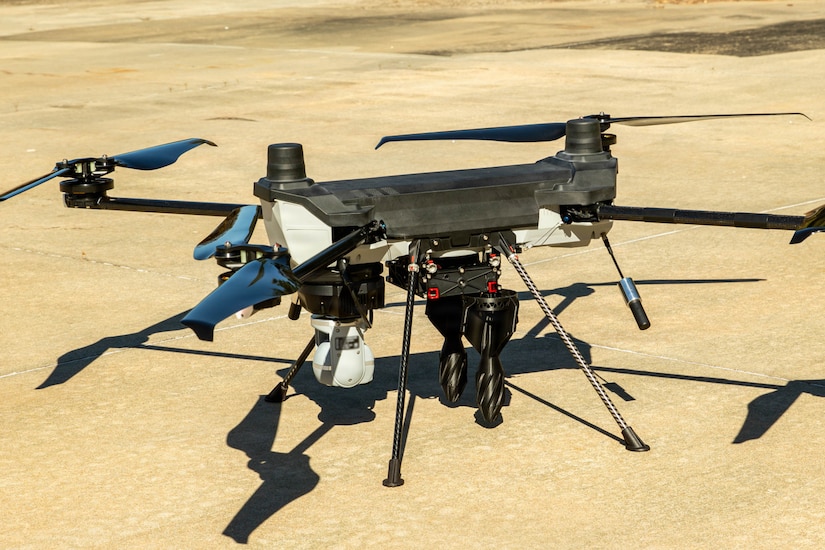
A recent training exercise at Fort Stewart, Georgia, during Spartan Focus 26, featured 6th Squadron soldiers conducting UAS training with C100 medium-range reconnaissance systems configured with 3D-printed training rounds. The exercise incorporated lessons learned from Ukraine, where low-cost quadcopter drones have been widely used in recent conflicts. 

The division's approach has significantly improved the decision-making cycle, allowing forces to gather and process intelligence much faster than previous methods, McKeown said, emphasizing the importance of soldiers maintaining situational awareness. 

"Whoever sees the enemy first can react first, and can respond more effectively, which leads to operational success," he said. 

Soldiers continue to experiment with electronic warfare payloads on medium-range reconnaissance systems and test various configurations on first-person-view drones to determine system limitations and capabilities. The ongoing innovation includes stressing equipment through rigorous training to understand what works best for operational units.

A drone sits on a paved surface outside.

The division's 3rd Combat Aviation Brigade has also integrated unmanned systems manufacturing capabilities, training soldiers on expeditionary manufacturing cells that enable rapid 3D printing of drone components in the field. Soldiers printed more than 90 unique components in hours rather than waiting weeks for ordered parts. 

Langley said being a part of the 3rd ID during this transformative period presents unique opportunities. 

"This is an exciting time to be part of this unit, and it's a great time to test our new capabilities and to really release the creativity of soldiers at every level," he said. 

Tuesday, February 24, 2026

Securing Rare Earth Elements a National Security Imperative, Official Says

Securing a resilient supply chain for critical minerals is fundamental to national security and the economy, said Michael P. Cadenazzi Jr., assistant secretary of war for industrial base policy, who testified today at a Senate Armed Services Committee hearing in Washington.

A man wearing business attire sits at a table and speaks into a microphone.

He noted that there is a growing demand for U.S. capabilities from allies and partners, such as fifth-generation aircraft, precision-guided munitions, satellite constellations and next-generation naval vessels. Cadenazzi said those capabilities all depend on a reliable supply of rare earth elements, including gallium antimony and germanium, as well as dozens of others.

"For decades, we have outsourced and offshored mining and processing, creating a strategic vulnerability of the highest order. Today, our primary strategic competitor, China, controls the global supply chain for numerous critical minerals," he said.

On heavy rare earths alone, China controls 95% of global output, with the United States importing almost 100% of what it uses, 90% of that coming from China.

"This control provides Beijing with the ability to weaponize these supply chains, threatening to disrupt our defense industrial base and compromise military readiness in a crisis; this is not a theoretical risk. It is a clear and present danger to our national security," Cadenazzi said.

A military fighter aircraft flies against a blue sky.

To address this vulnerability, the War Department developed a comprehensive, multiyear strategy designed to create a secure, resilient and sustainable supply chain ecosystem, Cadenazzi said.

Included in that approach is a commitment to reshore and onshore the production of critical minerals. Congress provided funding to do this, he said, utilizing the Defense Production Act.

Cadenazzi said his office partners with colleagues in the Office of Strategic Capital to offer loans, loan guarantees and debt financing options to bring mineral supply chains to friendly shores.

"Through these tools, we are sending a clear and sustained demand signal to the industrial base. We are working across the entire value chain, from mine to front line, to build our resilience," he said.

A silvery metal disc sits atop a sparkly blue surface. Metal shavings stand on edge.

Although DOW prioritizes domestic production, Cadenazzi said no single nation can achieve complete self-sufficiency. Therefore, the supply chain includes allies and America's closest partners.

The department is also aggressively investing in research and development to mitigate demand for the most heavily contested minerals.

"Our scientists at [the Defense Advanced Research Projects Agency] and other service research labs are pioneering the development of next-generation materials and novel manufacturing techniques that can reduce or eliminate the need for certain rare earths and other critical inputs," Cadenazzi said.

He noted that other DOW strategies include funding the development of advanced recycling technologies to recover rare earth from systems and materials being retired, and modernizing the national defense stockpile to ensure it serves as an effective buffer against near-term supply chain shocks.

"We are conducting a rigorous, data-driven analysis of our strategic requirements for 21st-century contested environments and [we] are taking action to acquire materials that face the most acute supply chain risks," Cadenazzi said.

Forecasting the Fight: How Meteorology, Oceanography Marines Support Operational Planning

Weather, while it cannot be controlled, can be predicted, which helps commanders make informed decisions about planning exercises and troop movements. Meteorology and oceanography Marines support battlefield capabilities through forecasting and predicting how weather will impact operations.

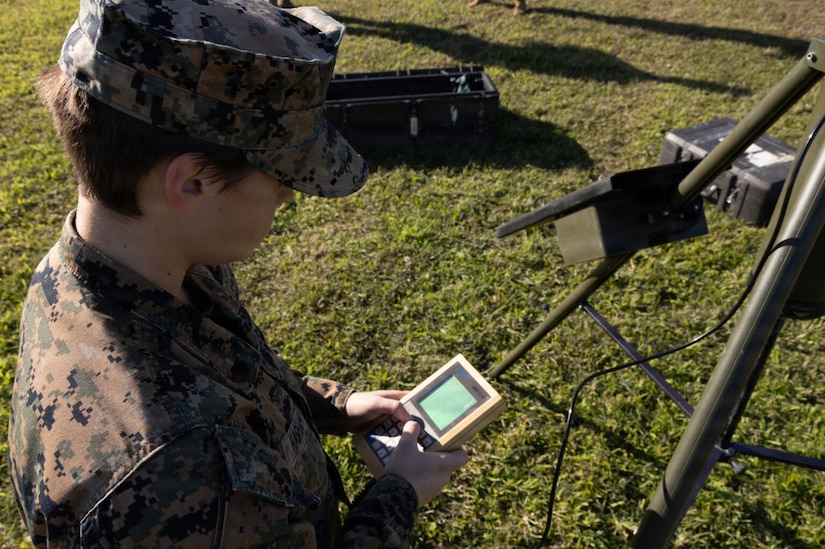
A woman in a camouflage military uniform works on a piece of military weather equipment.

These Marines are trained meteorologists and oceanographers who look at the current state of the environment and create weather forecasts that support operational planning and execution. They create routine forecasts, 96-120 hours out, using satellite data and weather patterns, in addition to future forecasts for exercise planning, using historical weather data over a 20-year period.

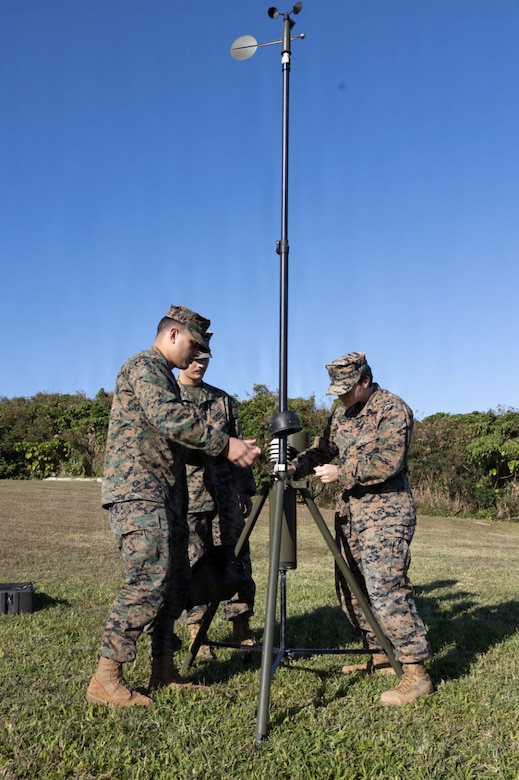
Three people in camouflaged military uniforms work on military equipment in a grassy field.

"Out here in the Pacific, weather can determine both friendly and adversarial pacing of operations," said Marine Corps Sgt. Priya Hasham, a meteorology and oceanography analyst forecaster with the III Marine Expeditionary Force.

To learn this field, Marines attend a yearlong program where they are taught basic physics, develop an understanding of the atmosphere and how it affects the weather and gain the ability to interpret weather radar data to create forecasts. 

In creating a forecast, satellite imagery, radar and data from weather stations around the world can be used. Pattern recognition also plays a significant role in forecasting, making personal experience an important factor. Since weather is influenced by local terrain, the longer a Marine has been in an area, the more familiar they are with local weather patterns, improving their ability to create accurate predictions.

A woman in a camouflage military uniform works on a piece of military weather equipment.
Three people in camouflage military uniforms work on military equipment in a grassy field. A large body of water is in the background.
Most Marine Corps installations have these specialized Marines, whose responsibilities vary between units. At the III Marine Expeditionary Force, their weather predictions support intelligence and battlespace awareness by looking at the big picture of air, land and sea operations to inform commanders as to how assets will operate in various weather conditions.

"Forecasting is an art and science," Hasham said. "There is a lot of technical skill involved."

Monday, February 16, 2026

War, Energy Departments Team up to Advance Future of Nuclear Power, Military Base Energy Security

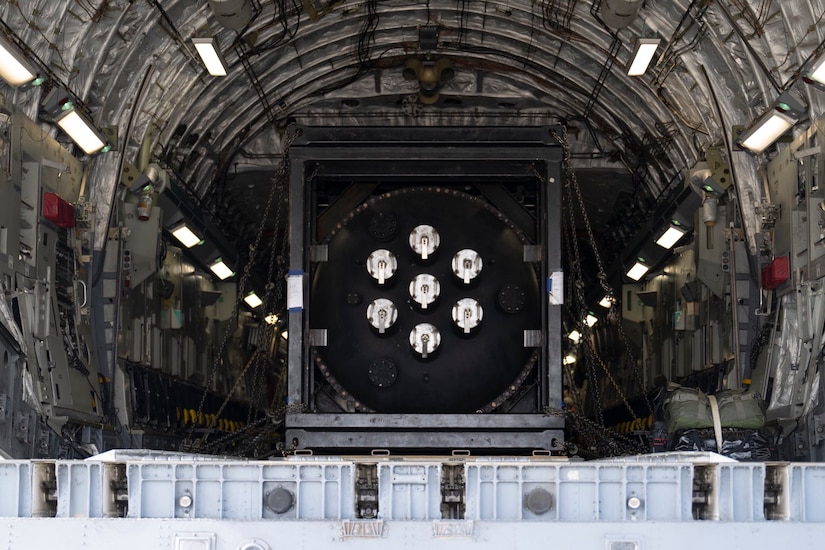
At March Air Reserve Base, California, today, a next-generation nuclear reactor was loaded aboard a C-17 Globemaster III aircraft for transport to Hill Air Force Base, Utah. The reactor will eventually head to the Utah San Rafael Energy Lab for testing and evaluation.

A large piece of equipment is strapped down inside the back of an aircraft.

The Ward 250 is a 5 megawatt nuclear reactor that fits into the back of a C-17 aircraft could theoretically power about 5,000 homes. 

For military use, such a reactor could provide energy security on a military base ensuring the mission there need not depend on the civilian power grid, and in military operations overseas, such reactors would mean U.S. forces could operate without concern that an enemy might cut fuel supplies. 

A reactor such as the Ward 250 also means greater energy security for the entire United States. It is firmly in line with President Donald J. Trump's executive orders to reshape and modernize America's nuclear energy landscape. 

The president signed four executive orders designed to advance America's nuclear energy posture, May 23, 2025. Those include "Reinvigorating the Nuclear Industrial Base," "Reforming Nuclear Reactor Testing at the Department of Energy," "Ordering the Reform of the Nuclear Regulatory Commission," and "Deploying Advanced Nuclear Reactor Technologies for National Security." 

Michael P. Duffey, the undersecretary of war for acquisition and sustainment, said the partnership between the War and Energy Departments is critical to advancing the president's nuclear energy initiatives. 

"It's clear to me that advancing President Trump's priority on nuclear energy depends on close coordination between the Department of Energy and the Department of War," Duffey said. "This partnership ensures advanced nuclear technologies are developed, evaluated and deployed in ways that strengthen energy resilience and national security." 

The future of warfare is energy-intensive, he said, and includes AI data centers, directed-energy weapons, and space and cyber infrastructure. The civilian power grid was not built for that, and so the War Department will need to build its own energy infrastructure.

An aircraft sits on an apron or ramp at an airport.

"Powering next generation warfare will require us to move faster than our adversaries, to build a system that doesn't just equip our warfighters to fight, but equips them to win at extraordinary speed," Duffey said. "Today is a monumental step toward building that system. By supporting the industrial base and its capacity to innovate, we accelerate the delivery of resilient power to where it's needed." 

Secretary of Energy Chris Wright said that with small reactors like those transferred from March Air Reserve Base to Hill Air Force Base, the United States is aiming for a nuclear energy renaissance. 

"The American nuclear renaissance is to get that ball moving again, fast, carefully, but with private capital, American innovation and determination," Wright said. "President Trump signed multiple executive orders that have unleashed tremendous reform of all the things that stopped the American nuclear industry from moving." 

Part of that effort, he said, will mean that by July 4, the administration expects three small reactors will be critical — or running smoothly.

"That's speed, that's innovation, that's the start of a nuclear renaissance," Wright said.

Friday, February 13, 2026

DOW Aims to Accelerate Advanced Materials Processing

The Department of War (DOW) announced today the September 17, 2025 investment on a five-year contract totaling nearly $9.2 million to the national advanced materials Manufacturing Innovation Institute, LIFT, to address manufacturing challenges associated with ceramic matrix composites (CMC). This announcement was delayed due to the government shutdown. This effort, funded through the Office of the Assistant Secretary of War for Industrial Base Policy (OASW(IBP))'s Industrial Base Analysis and Sustainment (IBAS) Program, supports White House and Secretary of War priorities in advanced composites manufacturing research and development and defense industrial base workforce development.

"This project aims to disrupt manufacturing affordability through advanced materials and processing technologies," said Assistant Secretary of War for Industrial Base Policy Michael Cadenazzi. "I believe its location in Detroit, Michigan at LIFT's new Ceramics Manufacturing Center will help revitalize economic growth and industrial capacity in a state with a rich history in building America's industrial might." 

While composites have been used for decades, they're relatively new to the centuries old metallics manufacturing industry. Recent advancements in carbon-fiber technologies have impacted CMCs, which are known for their ability to withstand higher temperatures as compared to their polymer composite counterparts. This capability is currently being employed in technologies used in the production of commercial products and defense-critical systems such as stealth aircraft, jet engines, and hypersonic weapons.

LIFT is 1 of 18 Manufacturing USA Innovation Institutes designed to foster innovation, enhance domestic supply chains, and forge a skilled workforce to reestablish U.S. leadership in advanced manufacturing across the globe.

Since the IBAS Program's inception in 2014, the Innovation Capability and Modernization (ICAM) Office has invested over $2.6 billion across 206 projects to restore domestic manufacturing capacity and capability. ICAM is part of OASW(IBP)'s Manufacturing Capability Expansion and Investment Prioritization (MCEIP) Directorate within the Office of the Deputy Assistant Secretary of War for Industrial Base Resilience. For more information on MCEIP, please visit: https://www.businessdefense.gov/ibr/mceip/index.html

About the Office of the Assistant Secretary of War for Industrial Base Policy (OASW(IBP))

The OASW(IBP) works with domestic and international partners to forge and sustain a robust, secure, and resilient industrial base enabling the warfighter, now and in the future. OASW(IBP)'s Innovation Capability and Modernization Office, which executes the IBAS Program, provides DOW with key capabilities to achieve the strategic aims of the Department and Presidential Executive Orders. These call for a strong, resilient, responsive, and healthy national industrial base that can respond at-will to national security requirements.

Thursday, February 12, 2026

Joint Force Marks First Lightfish Unmanned Vessel Launch

Commander Task Force 66 launched the Lightfish, an unmanned surface vessel, for the first time from a partner nation's vessel during Exercise Cutlass Express 26 off the coast of Seychelles in the Indian Ocean, Feb. 9.

Two men wearing camouflage military uniforms and life jackets and another man in casual attire and a life jacket launch an unmanned surface vessel from a small boat in the water. The boat has ropes attached to it from a large ship on the left.

 
The launch was part of an unmanned systems training event with the Seychelles Coast Guard, designed to test the Lightfish's abilities in the open ocean with limited connection. 
 
"We are making history at Cutlass Express 26 by demonstrating our enhanced warfighting skills through our robotic and unmanned capabilities alongside our maritime partners," said Navy Lt. Bryna Loranger, CTF 66 operations officer. "[U.S.] 6th Fleet is seeking new ways to build partner maritime domain awareness capabilities during this exercise by promoting interoperability. Through sharing and experimenting with Seychelles Coast Guard assets and infrastructure, we are enhancing our expeditionary robotic autonomous systems capabilities in the U.S. Africa Command area of responsibility." 
 
CTF 66 is a fully uncrewed task force that uses advanced technologies, like artificial intelligence, to help the 6th Fleet and its partners move faster to maintain a strong presence across Africa's maritime zones while detecting illegal activity. 
 
The task force is leading the Navy in innovating its approach to warfighting during an age when information systems, technology and vulnerabilities in the global economy are being weaponized by adversaries operating in the gray zone, outside the domain of traditional warfare.

A man wearing a black T-shirt and another man in a camouflage military uniform maneuver an unmanned surface vessel aboard a large ship. The unmanned vessel is being held in the air by several ropes and chains.

 
"Through exercises like Cutlass Express 26, we are adapting alongside our partners by integrating unmanned tactics directly into operations," said Navy Rear Adm. Kelly Ward, director of strategic effects for CTF 66. "We are leaning into this domain hand in hand with our partners, translating innovation into warfighting readiness and enhancing maritime security to protect freedom of navigation." 
 
Cutlass Express 26 has 19 partners and allies working together through a series of shore-based training events. The exercise provides all participating nations with an opportunity to work side by side to synchronize and rehearse real-world scenarios that will include medical training, visit, board, search and seizure and maritime interdiction training, as well as counter illegal, unregulated and unreported fishing procedures. 
 
Established in May 2024, CTF 66 is the 6th Fleet's first all-domain task force designed to integrate robotic and autonomous systems with naval, joint and NATO partners in the European and African theaters of operations. Since its establishment, the task force has driven innovation and developed unmanned technologies to enhance the way militaries integrate naval platforms across all domains, all of which are enabled by this emerging technology.

Two men wearing casual attire work on an unmanned surface vessel aboard a large ship. A woman in a camouflage military uniform on the right is looking at a device in her hands. There are four other people wearing camouflage military uniforms and casual attire working around the unmanned vessel in the background.

 
CTF 66 currently maintains 22 USVs; however, the task force expects to double its lethality as additional assets reach operational readiness. These USVs increase maritime domain awareness and serve as force multipliers. 
 
Exercises like Cutlass Express allow CTF 66 to leverage strong collaboration with partners and allied nations to operate large numbers of unmanned systems at scale. These partnerships enable the task force to preposition and deploy assets in host countries ahead of time. 
 
CTF 66 and its USVs continue to enhance deterrence, lethality and capabilities in the European and African theaters of operations.

DOW Strengthens Domestic Production of Critical Display Technologies

The Department of War (DOW) announced today two September 19, 2025 investments totaling $24.5 million to bolster the U.S. supply chain for advanced optical displays.  This announcement was delayed due to the government shutdown. The projects, funded through the Office of the Assistant Secretary of War for Industrial Base Policy (OASW(IBP))'s Industrial Base Analysis and Sustainment (IBAS) Program, were awarded this summer to Kopin Corporation of Westborough, Massachusetts and Tectus Corporation of Cupertino, California. They will focus on developing and validating a cost-effective manufacturing process for MicroLED displays that are essential for next-generation weapon systems.

"Microdisplays are crucial components in delivering information to the joint warfighter and are integrated into solutions across all domains including heads-up-displays for pilots, advanced night vision goggles, weapon optics, and unmanned systems," said Assistant Secretary of War for Industrial Base Policy Michael Cadenazzi. "Securing a domestic supply of advanced MicroLED displays is vital for the Department's next-generation defense applications, ensuring both performance and security."

Both projects will establish an onshore, multi-vendor supply chain of state-of-the-art MicroLED displays.  MicroLED technology promisea to enable daylight readability with full-color symbology and imagery by delivering ultra-high brightness levels that remain visible in direct sunlight, while also supporting high image quality at low brightness for nighttime operations.  The technology also allows for reduced size, weight and power, improving warfighter capability and effectiveness.

These investments demonstrate the Department's commitment to strengthening domestic manufacturing and securing critical supply chains. They also support the Secretary of War's priority of Rebuilding the Military by ensuring that there are reliable, trusted U.S. manufacturers of state-of-the-art micro-displays to enable successful development, delivery, and operation of next-generation weapon systems.

Since the IBAS Program's inception in 2014, the Innovation Capability and Modernization (ICAM) Office has invested over $2.6 billion across 205 projects to restore domestic manufacturing capacity and capability.  ICAM is part of OASW(IBP)'s Manufacturing Capability Expansion and Investment Prioritization (MCEIP) Directorate within the Office of the Deputy Assistant Secretary of War for Industrial Base Resilience.  For more information on MCEIP, please visit: https://www.businessdefense.gov/ibr/mceip/index.html.

About the Office of the Assistant Secretary of War for Industrial Base Policy (OASW(IBP))

The OASW(IBP) works with domestic and international partners to forge and sustain a robust, secure, and resilient industrial base enabling the warfighter, now and in the future.  The OASW(IBP)'s Innovation Capability and Modernization (ICAM) Office, which manages the IBAS Program, provides DOW with key capabilities to achieve the strategic aims of Department priorities and Presidential Executive Orders.  These call for a strong, resilient, responsive, and healthy national industrial base that can respond at-will to national security requirements.

Tuesday, February 10, 2026

From Backpacks to Bird's-Eye: Drones Are Transforming EOD

Across a stretch of open terrain at Hurlburt Field, Florida, two airmen assigned to the 1st Special Operations Wing began a race between machines. One guided a ground robot toward a simulated casualty, its treads working across dirt and grass. The other launched a small unmanned aerial system, or drone, which reached the site within seconds.

A close-up view of a drone as it’s held by a person in a camouflage military uniform.

From above, the drone's camera streamed a clear view of the scene before the robot made it halfway there. It's a new kind of flight reshaping how explosive ordnance disposal airmen execute their mission — and how the Air Force strengthens readiness through innovation.  

Before the adoption of modernized drones, EOD teams relied primarily on heavy robotic platforms to inspect potential explosive threats. The systems still provide valuable standoff capability but require vehicle transport and setup time, limiting their use during operations on foot. In those scenarios, airmen may have to approach hazards themselves. 

Compact and portable drones can be carried in a backpack and launched within minutes. Operated from a safe distance, they stream real-time imagery that helps airmen assess hazards without approaching them. The drones give teams an unmatched view of any environment. They combine optical and thermal cameras for day or night operations with advanced 3D scanning that produces precise digital models in minutes, whether documenting blast sites or mapping entire airfields. 

Drones can be used to establish a visual reference of a runway and to collect updated imagery after an incident. The data helps civil engineers quickly identify changes or damage, supporting timely clearance actions and repair planning to resume air operations.

Built-in artificial intelligence also allows drones to operate with a high degree of autonomy. The system can identify and track targets, hold position, and navigate around obstacles with minimal operator input. These capabilities boost mission tempo and efficiency while augmenting the work of airmen, keeping them out of harm's way and allowing them to focus on critical decision-making.

Drones have not yet replaced every function of traditional robots, but the two technologies currently complement one another on the battlefield.

A drone flies in the air with blurry trees in the foreground.

"The big thing doesn't currently have is manipulation," an EOD airman explained. "I can't pull a battery off something or flip something over [with a drone], but a robot can."  

Still, drones are increasingly assuming tasks once limited to ground platforms, expanding options for commanders and reinforcing the Air Force's ability to adapt faster than its adversaries. 

Introducing any new technology brings challenges, but EOD airmen at Hurlburt Field have moved quickly to overcome them. Through local innovation projects, the team acquired and tested drones early, giving them a head start in integrating the capability into daily operations.  

"We've had the ability to work through a lot of the growing pains much faster," said an airman assigned to the 1st Special Operations Wing. "Now we're able to disseminate those lessons throughout the career field." 

That progress continues as airmen refine training and certification standards while identifying where drones provide the most operational value.  

"A lot of this is going to fluctuate based on use cases, because we all have a general idea of how we'd want to use this ... but there's still a lot to learn," said another EOD airman.

A person in a camouflage military uniform looks at a computer screen that displays the live view from multiple drones.

Wing airmen emphasized that the success of drone integration depends as much on institutional understanding as on technology itself. They said progress requires high-level advocacy to navigate the policies and risk assessments that come with operating in shared airspace, along with trust between ground units employing the systems and aviation communities managing them.  

As one airman explained, the future fight will rely on an enterprise that adapts quickly and learns from those already proving what's possible. 

At Hurlburt Field, EOD airmen are showing how small systems can yield big results. The shift from large ground robots to backpack-sized drones is transforming how they detect, respond and recover — bringing speed, precision and safety to every mission.  

"These are coming. This is the way of the future," said another airman. "If it's not in your shop currently, it probably will be in the very near future. Get ready." 

Monday, February 9, 2026

GenAI.mil's Rapid Expansion Continues With OpenAI Partnership

In just two months since deployment, the War Department's enterprise AI platform, GenAI.mil, has surpassed one million unique users. With adoption spanning every Military Service, GenAI has cemented itself as the Department's unified environment for secure, mission-ready AI capabilities. Building on this momentum, the Department today announced a partnership with OpenAI to integrate ChatGPT into GenAI.mil. This partnership will make OpenAI's advanced large language models readily available to all 3 million Department personnel. ChatGPT will be made available to enhance mission execution and readiness, delivering reliable capabilities to the joint force.

GenAI.mil's rapid rise reflects a decisive cultural and technological shift, validating the Department's commitment to being an AI-first enterprise. The platform's proven reliability, evidenced by its 100% uptime since launch and its robust infrastructure, has established it as the trusted AI platform across the Department. The platform's adoption is already accelerating operational tempo and sharpening the decision superiority of its users. To ensure this advantage extends to the entire joint force, comprehensive training for all Department personnel will continue, empowering them to effectively learn the platform and integrate AI capabilities into their daily workflows.

This initiative is a direct execution of the War Department's AI Acceleration Strategy released last month, and acts on the mandate of President Trump's White House AI Action Plan. The War Department is building an AI ecosystem for speed, security, and enduring mission impact. Integrating ChatGPT into GenAI.mil marks another critical step in making frontier AI capabilities the standard for daily operations.

DOW Addresses Material Obsolescence Through Reverse Engineering Training

The Department of War (DOW) announced today a two-year investment totaling nearly $1.8 million made in the Great Plains Innovation Network (GPIN) of Manhattan, Kansas for a reverse engineering activity for obsolescent defense-critical parts missing technical data packages.  This announcement was awarded on August 27, 2025, but this announcement was delayed due to the government shutdown. The project, funded through the Office of the Assistant Secretary of War for Industrial Base Policy (OASW(IBP))'s Industrial Base Analysis and Sustainment (IBAS) Program, will culminate with updated engineering documentation for manufacturability and low-rate initial production opportunities for at least three prototypes of critical obsolescent assemblies.

"This is an important effort as some of our most important legacy systems are to some degree unsustainable as the original equipment manufacturers are no longer in our industrial base," said the Assistant Secretary of War for Industrial Base Policy Michael Cadenazzi.  "At the end of the project, the United States will have a more resilient and competitive supply chain as a result of the collaboration we've made possible between GPIN and Kansas State University, and others across the Midwest as they forge new partnerships." 

GPIN will partner with Kansas State University (KSU) to train interns and non-traditional defense contractors on the process of generating technical data packages (e.g., bills of material, computer aided design models, and quality documentation) for defense-critical parts and components for which technical data no longer exists.  This will open more competitive opportunities across the defense industrial base (DIB) to a wider pool of performers by enabling them to bid on parts and assemblies' contracts with known data, while limiting design workaround requirements to support the manufacture of various platforms. 

Some companies working in the DIB have gone out of business and left no technical data packages behind to support future defense manufacturing needs.  This investment supports the Secretary of War's priority of Rebuilding the Military by leveraging the Defense Logistics Agency's parts catalog to target high-demand parts and assemblies that are no longer procurable to design data packages that will support future defense-critical manufacturing needs.   

Since the IBAS Program's inception in 2014, the Innovation Capability and Modernization (ICAM) Office has invested over $2.6 billion across 204 projects to restore domestic manufacturing capacity and capability.  ICAM is part of OASW(IBP)'s Manufacturing Capability Expansion and Investment Prioritization (MCEIP) Directorate within the Office of the Deputy Assistant Secretary of War for Industrial Base Resilience.  For more information on MCEIP, please visit: https://www.businessdefense.gov/ibr/mceip/index.html.

About the Office of the Assistant Secretary of War for Industrial Base Policy (OASW(IBP))

The OASW(IBP) works with domestic and international partners to forge and sustain a robust, secure, and resilient industrial base enabling the warfighter, now and in the future.  The OASW(IBP)'s Innovation Capability and Modernization (ICAM) Office, which manages the IBAS Program, provides DOW with key capabilities to achieve the strategic aims of Department priorities and Presidential Executive Orders.  These call for a strong, resilient, responsive, and healthy national industrial base that can respond at-will to national security requirements.

Friday, February 6, 2026

As Promised, War Department Moving Out Fast on Drone Dominance

The War Department announced Feb. 3 the selection of 25 vendors who will help the department achieve its goal of getting some 300,000 drones into the force, both quickly and inexpensively, by 2027.

A man in a camouflage military uniform stands in thick brush while holding his hand in the air as a drone flies away.

Those companies will compete in the first phase, or "gauntlet," that makes up the department's Drone Dominance Program — an acquisition reform effort designed to rapidly field low-cost, unmanned one-way attack drones at scale. 

This first gauntlet begins Feb. 18 when program participants will bring unmanned aircraft system prototypes to Fort Benning, Georgia. There, participants will teach military personnel how to use those prototypes, and then military operators will use them to complete various mission scenarios, including an evaluation on their ability to find, lock on and destroy a target. 

By the end of the first gauntlet, vendors will be scored on the systems, and up to 12 of the 25 vendors will be invited to produce their drones, at scale, for the department. 

As part of the first phase, the selected 12 vendors will produce a total of 30,000 units, at an average price of $5,000 for each, and deliver by July. 

Over the course of three additional gauntlets — a total of four in all — the number of vendors will go down from 12 to five, the number of drones ordered will increase from 30,000 to 150,000, and the price per drone will drop from $5,000 to just $2,300. 

The Drone Dominance Program will do two things: drive costs down and capabilities up, Secretary of War Pete Hegseth said in a video posted to social media late last year. 

 "We will deliver tens of thousands of small drones to our force in 2026, and hundreds of thousands of them by 2027." 

Through the program, funding will allow for the manufacture of some 340,000 small UAS to combat units over the course of two years. 

After that, it's expected that American industry's interest in building drones, as a result of the program, will have strengthened supply chains and manufacturing capacity to the point that military services will be able to afford to buy the drones they want, in the quantity they want and at a price they want, through regular budgeting. 

Last year, President Donald J. Trump signed an executive order outlining how the United States would up its drone game in both the commercial and military sectors, including how it would deliver massive amounts of inexpensive, American-made, lethal drones to military units, so they can amplify their own combat capabilities. 

Friday, January 30, 2026

Breakthroughs in Testing Solid-Fuel Ramjets Advance Research

Scientists at the U.S. Naval Research Laboratory are developing the next generation of solid-fuel ramjet propulsion, addressing one of the field's most persistent challenges: understanding and predicting what happens inside an operating combustor. 

NRL scientists have figured out how to "see inside" one of the most extreme engines ever built, turning guesswork into knowledge and making future long-range, high-speed flight more achievable than ever before.

Two men wearing civilian attire sit at a conference table. The man to the right points at a laptop on the table as the other man looks on.

A solid-fuel ramjet is an air-breathing engine that uses solid fuel rather than liquid, offering high energy density and mechanically simple propulsion by burning the fuel with oxygen from the air to produce thrust. By drawing oxygen from the atmosphere rather than carrying an oxidizer on board, solid-fuel ramjets can carry more fuel in the same volume and fly farther than traditional rocket systems. 

"If you replace all the oxidizer and instead use oxygen from the air to burn your fuel, you can increase range by up to 200 to 300% in the same form factor," said Brian Bojko, a combustion scientist at NRL. 

Despite that promise, widespread adoption has been slowed by the extreme internal environment of solid-fuel ramjets, where high temperatures, soot and rapidly evolving flow structures prevent traditional probes from accessing critical data. Unlike liquid or gaseous fuels, solid fuels release energy through surface regression and often produce a complex mixture of combustion products, making it far more difficult to control burning rates and predict performance. This is why understanding and predicting what happens inside an operating combustor is so important. 

"In solid-fuel ramjets, you don't have direct control over the mass flow rate like you do with liquid systems," Bojko explained. "The heat from combustion actually drives the gasification of the solid fuel, so pressure, temperature and airflow all feed back into how the engine behaves." 

Without detailed measurements of flame temperature, fuel regression and fuel-vapor transport, designers have historically relied on trial-and-error approaches.  

"A lot of the design has been kind of Edisonian," Bojko said. "You take a guess, test it and iterate. But without seeing the physics inside the combustor, it's hard to know if you're getting the right answer for the right reason." 

At the same time, computational approaches such as Reynolds-Averaged Navier–Stokes and Detached Eddy Simulation have been limited by a lack of high-quality experimental data for validation. 

RANS, DES and`Large Eddy Simulation represent increasing levels of physical realism in turbulence simulation, where more turbulent structures are directly resolved rather than modeled. Moving from RANS to DES to LES brings simulations closer to the true flow physics, especially for unsteady flows, but at a significantly higher computational cost. Reynolds-Averaged Navier–Stokes models capture most of the turbulence and are computationally efficient but less accurate for unsteady flows. Detached Eddy Simulation resolves large turbulent structures while modeling smaller ones, balancing accuracy and cost. LES resolves most turbulent motion directly, offering the highest accuracy at the highest computational expense.

A person holds a black block in a gloved hand. A gray block is on a table nearby.

"With only a few pressure or temperature points, you can match a simulation to an experiment and still be wrong," Bojko said. "Optical access lets us validate the flame structure, recirculation zones and combustion species directly."

Seeing Flame Temperature in Real Time 

To address these gaps, researchers employed optical diagnostics capable of operating in the harsh, particle-laden environment of a solid-fuel ramjet combustor. Measuring flame temperature is especially important, Bojko said, because models often assume combustion efficiency rather than measure it. 

"These diagnostics give us new data we simply didn't have before," said David Kessler, a senior computational scientist at NRL. "They allow us to measure gas-phase species and temperatures in an environment where traditional probes just don't work." 

The chemistry behind how solid fuels decompose and feed the flame is just as important as measuring the flame itself, according to researchers. As heat from the flame feeds back into the fuel surface, the solid polymer undergoes phase change and chemical breakdown, releasing a complex mixture of gaseous hydrocarbons that sustain combustion.

A man wearing a lab coat tightens the bolt on a device that has multiple wires and metal bars attached to it.

"You have this continuous feedback loop," said Brian Fisher, a combustion research engineer at NRL. "The flame heats the fuel, the fuel decomposes into gas-phase species, and those species then mix with the air and keep the flame going. It's a coupled thermal, chemical and fluid-dynamic process, and that's what makes solid-fuel ramjets both powerful and challenging to predict."

Mapping Fuel Regression and Validating Models 

Understanding how quickly the solid fuel surface recedes, known as fuel regression, is critical because it directly governs thrust and performance. The team combined experimental diagnostics with high-fidelity simulations to resolve heat feedback to the fuel surface, a key driver of regression. 

"One of the biggest things you need to capture is the heat transfer back to the solid fuel," Bojko said. "RANS can give you an OK answer, but it doesn't resolve the fundamental processes as well as DES or Large Eddy Simulation. Those higher-fidelity approaches cost more computationally, but they give you a much better picture of what's happening."

Visualizing Fuel Vapor Before It Burns 

For the first time, the researchers also visualized fuel vapor released from the solid surface before ignition, revealing how complex hydrocarbon species mix and evolve prior to combustion. Solid-fuel ramjets commonly use hydroxyl-terminated polybutadiene, a long-chain polymer that breaks down into many different gaseous species. 

"When HTPB decomposes, you don't know what species are coming off the surface, and those species dictate the combustion mechanism," Bojko said. "They change with temperature, pressure and heat flux, so being able to characterize them is critical to understanding the underlying mechanisms across different flight conditions." 

In parallel, NRL researchers are investigating advanced composite fuels designed to increase the energy density of solid fuel in the same volume. 

"We're interested in adding energetic additives, like metal particles, into polymer fuels to increase their energy density," said Clayton Geipel, a combustion research engineer at NRL. "As the fuel burns, those particles are released into the flame and ignite, giving you more energy from the same volume of fuel. That directly translates into greater potential range for future systems." 

"You want to jam as much energy content into that block of fuel as you can while still having a reasonable rate of combustion; that's the challenge," said Albert Epshteyn, materials scientist at NRL. 

Although metals can have slightly lower energy per unit mass than hydrocarbons, their much higher density allows more total energy to be packed into the same volume, a critical advantage for compact, long-range systems.

Reducing Risk and Accelerating 

Together, these diagnostics and simulations transform solid-fuel ramjet combustion from a largely inferred process into a measurable, predictable system. The validated models allow researchers to conduct design iterations computationally before moving to costly experiments. 

"Our main objective is to reduce risk," Bojko said. "If we have validated computational models, we can do design iterations much more efficiently in terms of cost and time and narrow down the physics before we ever go to full-scale testing." 

Kessler emphasized the broader impact. 

"NRL is developing technologies that help accelerate the transition of solid-fuel ramjets, technology that can significantly increase the range of next-generation high-speed systems," he said. 

Building on that foundation, the team is now focused on bridging the gap between small-scale laboratory experiments and real-world propulsion systems.

A man dressed in a lab coat and goggles, holds a metal bar on a device that has other metal bars and wires protruding from it.

"All of our work right now happens at small-scale facilities in idealized, optically accessible geometries," Geipel said. "That's what allows us to make detailed measurements, but there are still important questions about how those results apply to a full-scale, enclosed ramjet." 

While small-scale experiments reveal detailed physics, scaling those results to full-size engines remains a central uncertainty in the field. The next phase of the research will focus on extending these validated tools and models to larger, more representative test configurations. This intermediate step preserves diagnostic access while introducing greater geometric and physical realism. That progression is designed to ensure the physics and chemistry observed in the lab translate reliably to operational propulsion systems. 

By integrating optical diagnostics, detailed chemistry and validated simulations across multiple scales, the research provides the propulsion community with tools to reduce uncertainty, shorten development timelines and enable future high-speed air-breathing propulsion technologies. 

U.S. Space Command Announces General Officer, Alabama Native to Serve as Headquarters Transition Team Director

Gen. Stephen Whiting, U.S. Space Command (USSPACECOM) commander, announced today that Maj. Gen. Terry L. Grisham, a long-time Alabama native with nearly 40 years of military and civilian service, will serve as the command's transition team director. In his role, Grisham will lead the Program Management Office in Huntsville and oversee the relocation support.

"Terry's nearly 40 years of expertise is informed by both his military service in the Alabama National Guard and civil service with the U.S. Army Aviation and Missile Command," Whiting said. "This experience — paired with his deep ties to the surrounding community — will prove invaluable as he leads our efforts on Redstone Arsenal to expeditiously relocate our warfighting organization while ensuring that the perspectives of both our military and civilian workforce are clearly represented."

The first members of USSPACECOM's headquarters staff are already on the ground at Redstone Arsenal, forming a dedicated Project Management Office focused on military construction and infrastructure. Whiting made the announcement shoulder-to-shoulder with Grisham as part of a visit with the PMO team during a day-long tour of facilities on Redstone Arsenal. 

"I'm thrilled to be joining the USSPACECOM team as the on-ground lead to continue establishing our permanent headquarters on Redstone Arsenal," Grisham said. "It's a great honor to both represent the command in our community, and as a longtime resident of Northern Alabama, serve as an ambassador to welcome our workforce home."

Grisham will lead the team — known as the command's "South Detachment," alongside deputy director Col. Raymond Ruscoe, who previously served as the director of USSPACECOM's European Command Joint Integrated Service Team (JIST). In addition to managing the requirements for military construction and infrastructure, being on-ground full time will facilitate greater engagement with local and state leaders.

In September 2025, the President announced USSPACECOM's relocation to Redstone Arsenal, a move that underscores the command's critical role in safeguarding America's interests in space. The command has been working since that time to lay the groundwork for a purpose-built headquarters on Redstone Arsenal. This effort was recognized by Secretary of War Pete Hegseth during a ceremony at Redstone on Dec. 12, 2025, where he remarked that, "We are deadly serious in committing to cutting every piece of red tape and bureaucracy to get this headquarters established as quickly as humanly possible."