Showing posts with label dark matter. Show all posts

Sunday, March 4, 2012

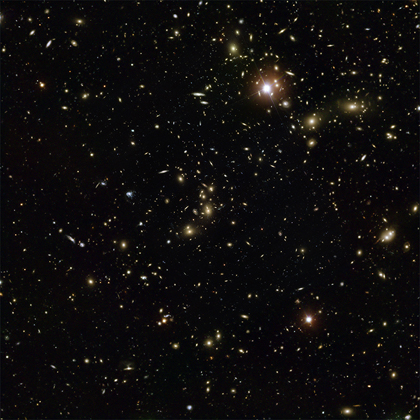
Dark Matter Core Defies Explanation in NASA Hubble Image

Trent J. Perrotto
Headquarters, Washington     

Ray Villard
Space Telescope Science Institute, Baltimore, Md.

WASHINGTON -- Astronomers using data from NASA's Hubble Telescope have observed what appears to be a clump of dark matter left behind from a wreck between massive clusters of galaxies. The result could challenge current theories about dark matter that predict galaxies should be anchored to the invisible substance even during the shock of a collision.

Abell 520 is a gigantic merger of galaxy clusters located 2.4 billion light-years away. Dark matter is not visible, although its presence and distribution is found indirectly through its effects. Dark matter can act like a magnifying glass, bending and distorting light from galaxies and clusters behind it. Astronomers can use this effect, called gravitational lensing, to infer the presence of dark matter in massive galaxy clusters.

This technique revealed the dark matter in Abell 520 had collected into a "dark core," containing far fewer galaxies than would be expected if the dark matter and galaxies were anchored together. Most of the galaxies apparently have sailed far away from the collision.

"This result is a puzzle," said astronomer James Jee of the University of California in Davis, lead author of paper about the results available online in The Astrophysical Journal. "Dark matter is not behaving as predicted, and it's not obviously clear what is going on. It is difficult to explain this Hubble observation with the current theories of galaxy formation and dark matter."

Initial detections of dark matter in the cluster, made in 2007, were so unusual that astronomers shrugged them off as unreal, because of poor data. New results from NASA's Hubble Space Telescope confirm that dark matter and galaxies separated in Abell 520.

One way to study the overall properties of dark matter is by analyzing collisions between galaxy clusters, the largest structures in the universe. When galaxy clusters crash, astronomers expect galaxies to tag along with the dark matter, like a dog on a leash. Clouds of hot, X-ray emitting intergalactic gas, however, plow into one another, slow down, and lag behind the impact.

That theory was supported by visible-light and X-ray observations of a colossal collision between two galaxy clusters called the Bullet Cluster. The galactic grouping has become an example of how dark matter should behave.

Studies of Abell 520 showed that dark matter's behavior may not be so simple. Using the original observations, astronomers found the system's core was rich in dark matter and hot gas, but contained no luminous galaxies, which normally would be seen in the same location as the dark matter. NASA's Chandra X-ray Observatory was used to detect the hot gas. Astronomers used the Canada-France-Hawaii Telescope and Subaru Telescope atop Mauna Kea to infer the location of dark matter by measuring the gravitationally lensed light from more distant background galaxies.

The astronomers then turned to the Hubble's Wide Field Planetary Camera 2, which can detect subtle distortions in the images of background galaxies and use this information to map dark matter. To astronomers' surprise, the Hubble observations helped confirm the 2007 findings.

"We know of maybe six examples of high-speed galaxy cluster collisions where the dark matter has been mapped," Jee said. "But the Bullet Cluster and Abell 520 are the two that show the clearest evidence of recent mergers, and they are inconsistent with each other. No single theory explains the different behavior of dark matter in those two collisions. We need more examples."

The team proposed numerous explanations for the findings, but each is unsettling for astronomers. In one scenario, which would have staggering implications, some dark matter may be what astronomers call "sticky." Like two snowballs smashing together, normal matter slams together during a collision and slows down. However, dark matter blobs are thought to pass through each other during an encounter without slowing down. This scenario proposes that some dark matter interacts with itself and stays behind during an encounter.

Another possible explanation for the discrepancy is that Abell 520 has resulted from a more complicated interaction than the Bullet Cluster encounter. Abell 520 may have formed from a collision between three galaxy clusters, instead of just two colliding systems in the case of the Bullet Cluster.

A third possibility is that the core contained many galaxies, but they were too dim to be seen, even by Hubble. Those galaxies would have to have formed dramatically fewer stars than other normal galaxies. Armed with the Hubble data, the group will try to create a computer simulation to reconstruct the collision and see if it yields some answers to dark matter's weird behavior.

The Hubble Space Telescope is a project of international cooperation between NASA and the European Space Agency. NASA's Goddard Space Flight Center in Greenbelt, Md., manages the telescope. The Space Telescope Science Institute (STScI) in Baltimore, Md., conducts Hubble science operations. STScI is operated by the Association of Universities for Research in Astronomy, Inc., in Washington, D.C.

For more information about Hubble visit http://www.nasa.gov/hubble.

For images and more information about Abell 520's dark core, visit http://hubblesite.org/news/2012/10.

For more information about dark matter, visit http://go.nasa.gov/dJzOp1.

- end -

Thursday, December 1, 2011

Search for Dark Matter Narrowed by New Data From XENON100

Today, scientists from the XENON collaboration announced the result from their search for the elusive component of our universe known as dark matter. After analyzing one hundred days of data taken with the XENON100 experiment, they see no evidence for the existence of Weakly Interacting Massive Particles (WIMPs), the leading candidates for the mysterious dark matter. The XENON100 experiment is operated deep underground at the Gran Sasso National Laboratory of the Italian National Institute for Physics (INFN).

While the group observed three candidate events, two had been expected in conjunction with background radiation. This new result translates into the highest sensitivity reported by any dark matter experiment to date, and serves to further constrain the new physics models for particle dark matter, which will help target future WIMP searches. A paper about the results has been submitted to the journal Physical Review Letters and posted to arXiv, the e-print archive hosted by the Cornell University Library.

A direct observation of WIMPs would link the largest observed structures in the universe with the world of subatomic particle physics. While no detection can be claimed yet, the level of sensitivity achieved by the XENON100 experiment may allow an actual detection in the near future.

XENON100 is an ultra-sensitive device, with specially designed layers of water, lead, copper and other shielding, to filter out radiation and other sources of energy that could cause a false signal. This is also why the experiment is located beneath a mile of rock and Earth--these materials help shield the detector from cosmic radiation that is constantly bombarding Earth.

The XENON100 detector uses 62 kg of liquid xenon as a WIMP target, and measures the tiny charge and light signals that are expected when rare collisions between WIMPs and xenon atoms take place. Xenon--the same element used to make those ultra-bright car headlights that have a bluish tint--is used in this experiment because it has a large nucleus that WIMPS can collide with. When such a collision occurs, it creates a bluish light and a charge that scientists can detect with highly sensitive cameras positioned at each end of the detector.

Cosmological observations consistently point to a picture of our universe where ordinary matter as we know it makes up only about 4 percent, while new, yet unobserved forms of so-called dark matter and dark energy make up the rest. This is consistent with ideas on small scales too, since attractive extensions of the Standard Model of particle physics suggest that exotic new particles, which are perfect dark matter candidates, exist. This makes Weakly Interacting Massive Particles of interest to both cosmology and particle physics. Thus, the search for WIMPs is well motivated, and a direct detection is a central piece of information that could confirm this new picture of our universe. New data from the 2011 run, and the collaboration's plan to build a much larger experiment with 2500 kg of xenon in the coming years, promise an exciting decade towards the solution of one of nature's most fundamental mysteries.

The XENON collaboration consists of 60 scientists from 14 institutions in the U.S. (Columbia University, N.Y., University of California Los Angeles: and Rice University, Houston), China (Shanghai Jiao Tong University), France (Subatech Nantes), Germany (Max-Planck-Institut für Kernphysik Heidelberg, Johannes Gutenberg University Mainz, Westfälische Wilhelms-Universität Münster), Israel (Weizmann Institute of Science), Italy (Laboratori Nazionali del Gran Sasso, INFN e Università di Bologna), Netherlands (Nikhef Amsterdam), Portugal (Universidade de Coimbra) and Switzerland (Universität Zürich).

XENON100 is supported by the collaborating institutions and by the National Science Foundation and the Department of Energy in the U.S., by the Swiss National Foundation in Switzerland, by l'Institut national de physique des particules et de physique nucléaire and La Région des Pays de la Loire in France, by the Max-Planck-Society and by Deutsche Forschungsgemeinschaft in Germany, by the Weizmann Institute of Science, by the German-Israeli Minerva Gesellschaft and GIF in Israel, by FOM in the Netherlands, by the Fundação para a Ciência e Tecnologia in Portugal, by the Instituto Nazionale di FIsica Nucleare in Italy and by STCSM in China.

-NSF-

Thursday, June 23, 2011

Pandora's Cluster Revealed

One of the most complicated and dramatic collisions between galaxy clusters ever seen is captured in this new composite image. This collision site, known officially as Abell 2744, has been dubbed "Pandora's Cluster" because of the wide variety of different structures seen. Data from NASA's Chandra X-ray Observatory are colored red, showing gas with temperatures of millions of degrees. In blue is a map showing the total mass concentration (mostly dark matter) based on data from the Hubble Space Telescope (HST), the European Southern Observatory's Very Large Telescope (VLT), and the Japanese Subaru telescope. Optical data from HST and VLT also show the constituent galaxies of the clusters.

The "core" region shows a bullet-shaped structure in the X-ray emitting hot gas and a separation between the hot gas and the dark matter. (As a guide, local peaks in the distribution of hot gas and overall matter in the different regions are shown with red and blue circles respectively). This separation occurs because electric forces between colliding particles in the clouds of hot gas create a friction that slows them down, while dark matter is unaffected by such forces.

In the Northwest ("NW") region, a much larger separation is seen between the hot gas and the dark matter. Surprisingly, the hot gas leads the "dark" clump (mostly dark matter) by about 500,000 light years. This unusual configuration may require a slingshot scenario, as suggested previously by scientists, to fling the hot gas ahead of the dark matter during an earlier interaction. In the North ("N") and the West ("W") two additional examples of hot gas separated from dark matter may be visible. The latter appears to exhibit the largest separation seen to date between hot gas and dark matter.

The authors of this study retraced the details of the collision, and deduce that at least four different galaxy clusters coming from a variety of directions were involved. To understand this history, it was crucial to map the positions of all three types of matter in Abell 2744. Although the galaxies are bright, they make up less than 5% of the mass in Abell 2744. The rest is hot gas (around 20%) visible only in X-rays, and dark matter (around 75%), which is completely invisible.

Dark matter is particularly elusive as it does not emit, absorb or reflect light, but only makes itself apparent through its gravitational attraction. To pinpoint the location of this mysterious substance the team used a phenomenon known as gravitational lensing. This is the bending of light rays from distant galaxies as they pass through the gravitational field present in the cluster. The result is a series of telltale distortions in the images of galaxies in the background of optical observations. By carefully plotting the way that these images are distorted, a map is constructed of where the mass -- and hence the dark matter -- actually lies (shown in blue).

Galaxy clusters are the largest gravitationally bound objects in the Universe and have become powerful tools in cosmology studies. Further studies of Abell 2744 may provide a deeper understanding of the way that these important objects grow and provide new insight into the properties of dark matter.

Image credit: X-ray: NASA/CXC/ITA/INAF/J. Merten et al. Lensing: NASA/STScI; NAOJ/Subaru; ESO/VLT Optical: NASA/STScI/R. Dupke

Janet Anderson, 256-544-0034
Marshall Space Flight Center, Huntsville, Ala.
janet.l.anderson@nasa.gov

Megan Watzke 617-496-7998
Chandra X-ray Center, Cambridge, Mass.
m.watzke@cfa.harvard.edu