Showing posts with label galaxy clusters. Show all posts

Thursday, September 20, 2012

NASA Telescopes Spy Ultra-Distant Galaxy Amidst Cosmic 'Dark Ages'


J.D. Harrington
Headquarters, Washington
202-358-5241
j.d.harrington@nasa.gov
 
Whitney Clavin
Jet Propulsion Laboratory, Pasadena, Calif.
818-354-4673
whitney.clavin@jpl.nasa.gov

WASHINGTON -- With the combined power of NASA's Spitzer and Hubble space telescopes, as well as a cosmic magnification effect, astronomers have spotted what could be the most distant galaxy ever seen. Light from the young galaxy captured by the orbiting observatories first shone when our 13.7-billion-year-old universe was just 500 million years old.

The far-off galaxy existed within an important era when the universe began to transit from the so-called cosmic dark ages. During this period, the universe went from a dark, starless expanse to a recognizable cosmos full of galaxies. The discovery of the faint, small galaxy opens a window onto the deepest, remotest epochs of cosmic history.

"This galaxy is the most distant object we have ever observed with high confidence," said Wei Zheng, a principal research scientist in the department of physics and astronomy at Johns Hopkins University in Baltimore and lead author of a new paper appearing in Nature. "Future work involving this galaxy, as well as others like it that we hope to find, will allow us to study the universe's earliest objects and how the dark ages ended."

Light from the primordial galaxy traveled approximately 13.2 billion light-years before reaching NASA's telescopes. In other words, the starlight snagged by Hubble and Spitzer left the galaxy when the universe was just 3.6 percent of its present age. Technically speaking, the galaxy has a redshift, or "z," of 9.6. The term redshift refers to how much an object's light has shifted into longer wavelengths as a result of the expansion of the universe. Astronomers use redshift to describe cosmic distances.

Unlike previous detections of galaxy candidates in this age range, which were only glimpsed in a single color, or waveband, this newfound galaxy has been seen in five different wavebands. As part of the Cluster Lensing And Supernova Survey with Hubble Program, the Hubble Space Telescope registered the newly described, far-flung galaxy in four visible and infrared wavelength bands. Spitzer measured it in a fifth, longer-wavelength infrared band, placing the discovery on firmer ground.

Objects at these extreme distances are mostly beyond the detection sensitivity of today's largest telescopes. To catch sight of these early, distant galaxies, astronomers rely on gravitational lensing. In this phenomenon, predicted by Albert Einstein a century ago, the gravity of foreground objects warps and magnifies the light from background objects. A massive galaxy cluster situated between our galaxy and the newfound galaxy magnified the newfound galaxy's light, brightening the remote object some 15 times and bringing it into view.

Based on the Hubble and Spitzer observations, astronomers think the distant galaxy was less than 200 million years old when it was viewed. It also is small and compact, containing only about 1 percent of the Milky Way's mass. According to leading cosmological theories, the first galaxies indeed should have started out tiny. They then progressively merged, eventually accumulating into the sizable galaxies of the more modern universe.

These first galaxies likely played the dominant role in the epoch of reionization, the event that signaled the demise of the universe's dark ages. This epoch began about 400,000 years after the Big Bang when neutral hydrogen gas formed from cooling particles. The first luminous stars and their host galaxies emerged a few hundred million years later. The energy released by these earliest galaxies is thought to have caused the neutral hydrogen strewn throughout the universe to ionize, or lose an electron, a state that the gas has remained in since that time.

"In essence, during the epoch of reionization, the lights came on in the universe," said paper co-author Leonidas Moustakas, a research scientist at NASA's Jet Propulsion Laboratory, a division of the California Institute of Technology in Pasadena, Calif.

Astronomers plan to study the rise of the first stars and galaxies and the epoch of reionization with the successor to both Hubble and Spitzer, NASA's James Webb Telescope, which is scheduled for launch in 2018. The newly described distant galaxy likely will be a prime target.

For more information about Spitzer, visit http://www.nasa.gov/spitzer.

For more information about Hubble, visit\ http://www.nasa.gov/hubble.

- end -

Friday, August 31, 2012

WISE Survey Uncovers Millions Of Black Holes


J.D. Harrington
Headquarters, Washington                                
202-358-5241
j.d.harrington@nasa.gov
 
Whitney Clavin
Jet Propulsion Laboratory, Pasadena, Calif.
818-354-4673
whitney.clavin@jpl.nasa.gov

WASHINGTON -- NASA's Wide-field Infrared Survey Explorer (WISE) mission has led to a bonanza of newfound supermassive black holes and extreme galaxies called hot DOGs, or dust-obscured galaxies.

Images from the telescope have revealed millions of dusty black hole candidates across the universe and about 1,000 even dustier objects thought to be among the brightest galaxies ever found. These powerful galaxies that burn brightly with infrared light are nicknamed hot DOGs.

"WISE has exposed a menagerie of hidden objects," said Hashima Hasan, WISE program scientist at NASA Headquarters in Washington. "We've found an asteroid dancing ahead of Earth in its orbit, the coldest star-like orbs known and now, supermassive black holes and galaxies hiding behind cloaks of dust."

WISE scanned the whole sky twice in infrared light, completing its survey in early 2011. Like night-vision goggles probing the dark, the telescope captured millions of images of the sky. All the data from the mission have been released publicly, allowing astronomers to dig in and make new discoveries.

The latest findings are helping astronomers better understand how galaxies and the behemoth black holes at their centers grow and evolve together. For example, the giant black hole at the center of our Milky Way galaxy, called Sagittarius A*, has 4 million times the mass of our sun and has gone through periodic feeding frenzies where material falls towards the black hole, heats up, and irradiates its surroundings. Bigger central black holes, up to a billion times the mass of our sun, even may shut down star formation in galaxies.

In one study, astronomers used WISE to identify about 2.5 million actively feeding supermassive black holes across the full sky, stretching back to distances more than 10 billion light-years away. About two-thirds of these black holes never had been detected before because dust blocks their visible light. WISE easily sees these monsters because their powerful, accreting black holes warm the dust, causing it to glow in infrared light.

In two other WISE papers, researchers report finding what are among the brightest galaxies known, one of the main goals of the mission. So far, they have identified about 1,000 candidates.

These extreme objects can pour out more than 100 trillion times as much light as our sun. They are so dusty, however, that they appear only in the longest wavelengths of infrared light captured by WISE. NASA's Spitzer Space Telescope followed up on the discoveries in more detail and helped show that, in addition to hosting supermassive black holes feverishly snacking on gas and dust, these DOGs are busy churning out new stars.

"These dusty, cataclysmically forming galaxies are so rare WISE had to scan the entire sky to find them," said Peter Eisenhardt, lead author of the paper on the first of these bright, dusty galaxies, and project scientist for WISE at JPL. "We are also seeing evidence that these record setters may have formed their black holes before the bulk of their stars. The 'eggs' may have come before the 'chickens.'"

More than 100 of these objects, located about 10 billion light-years away, have been confirmed using the W.M. Keck Observatory on Mauna Kea, Hawaii, as well as the Gemini Observatory in Chile, Palomar's 200-inch Hale telescope near San Diego, and the Multiple Mirror Telescope Observatory near Tucson, Ariz.

The WISE observations combined with data at even longer infrared wavelengths from Caltech's Submillimeter Observatory atop Mauna Kea, Hawaii, revealed that these extreme galaxies are more than twice as hot as other infrared-bright galaxies. One theory is their dust is being heated by an extremely powerful burst of activity from the supermassive black hole.

"We may be seeing a new, rare phase in the evolution of galaxies," said Jingwen Wu of JPL, lead author of the study on the submillimeter observations. All three papers are being published in the Astrophysical Journal.

For more information about WISE, visit http://www.nasa.gov/wise.

- end -

Tuesday, August 28, 2012

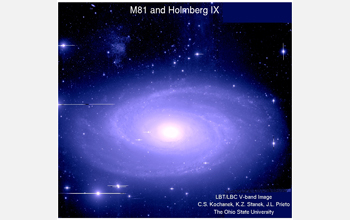
Deep V-band Image of Nearby Spiral Galaxy M81


A deep V-band image of the nearby spiral galaxy M81, taken using the Large Binocular Telescope (LBT) built from a series of shorter images being used to identify variable stars, failed supernovae and supernovae progenitor stars by monitoring the time variability of stars in the galaxy.

Located at the University of Arizona, the LBT is a large optical/infrared telescope that utilizes two, 8.4 meter diameter mirrors. It ranks amont the world's most advanced telescopes. Using adaptive optics, LBT has imaged planets outside our solar system and peers back toward the beginning of time. [Research supported by National Science Foundation grant AST 09-08816.]

(Date of Image: September 2007)

Credit: C.S. Kochanek, K.Z. Stanke, J.L. Prieto, Department of Astronomy, The Ohio State University; Large Binocular

Sunday, August 26, 2012

Saturday Space Sight: Spiral Galaxy NGC 4038 in Collision


This galaxy is having a bad millennium.

In fact, the past 100 million years haven’t been so good, and probably the next billion or so will be quite tumultuous. Visible on the upper left, NGC 4038 used to be a normal spiral galaxy, minding its own business, until NGC 4039, toward its right, crashed into it.

The evolving wreckage, known famously as the Antennae, is pictured above. As gravity restructures each galaxy, clouds of gas slam into each other, bright blue knots of stars form, massive stars form and explode, and brown filaments of dust are strewn about. Eventually the two galaxies will converge into one larger spiral galaxy. Such collisions are not unusual, and even our own Milky Way Galaxy has undergone several in the past and is predicted to collide with our neighboring Andromeda Galaxy in a few billion years.

The frames that compose this image were taken by the orbiting Hubble Space Telescope by professional astronomers to better understand galaxy collisions. These frames — and many other deep space images from Hubble – have since been made public, allowing an interested amateur to download and process them into this visually stunning composite.

Sunday, August 19, 2012

NSF's South Pole Telescope Discovers a Galaxy Cluster Creating Stars at a Record Pace


Researchers say Phoenix Cluster activity may cause scientists to rethink how galaxies evolve

A National Science Foundation-funded radio telescope in Antarctica has found an extraordinary galaxy cluster that may force astronomers to rethink how galaxy clusters and the galaxies that inhabit them evolve.

The galaxy cluster was discovered some 5.7 billion light years from Earth by the 10-meter wide South Pole Telescope (SPT) located at NSF's Amundsen-Scott South Pole Station in Antarctica, which is funded by NSF's Office of Polar Programs.

NSF manages the U.S. Antarctic Program, through which it coordinates all U.S research and required logistical support on the continent as well as aboard ships in the Southern Ocean.

Officially known as SPT-CLJ2344-4243, the cluster has been dubbed the "Phoenix Cluster" because it is located in the constellation of the Phoenix and because of its remarkable properties. Scientists taking part in the SPT collaboration found the cluster using the Sunyaev-Zel'dovich (SZ) effect, the result of high energy electrons distorting the cosmic microwave background (CMB) radiation through inverse Compton scattering, in which the low energy CMB photons receive an average energy boost during collision with the high energy cluster electrons.

Galaxy clusters, which are among the largest objects in the universe, contain enough hot gas to create detectable "shadows" in the light left over from the Big Bang, which also is known as CMB radiation.

"The mythology of the Phoenix--a bird rising from the dead--is a perfect way to describe this revived object," said Michael McDonald, a Hubble Fellow at the Massachusetts Institute of Technology and the lead author of a paper appearing in the August 16 issue of the journal Nature. "While galaxies at the center of most clusters have been dead for billions of years, the central galaxy in this cluster seems to have come back to life."

Observations made by NASA's Chandra X-ray Observatory in space and by the NSF-managed Gemini Observatory and the Blanco 4-meter and Magellan telescopes in Chile corroborate the SPT discovery and show that stars are forming in this object at the highest rate ever seen in the middle of a galaxy cluster. The object also is the most powerful producer of X-rays of any known cluster, and among the most massive of clusters. The data also suggest that the rate of hot gas cooling in the central regions of the cluster is the largest ever observed.

This light has travelled for 14 billion years across the entire observable universe to get to Earth. If it passes through a massive cluster on its way, then a tiny fraction of the light gets scattered to higher energies--the SZ effect.

Predicted in 1972, the SZ effect was first demonstrated to detect previously unknown clusters of galaxies by the SPT collaboration in 2009. Observations of the effect have since opened a new window for astronomers to discover the most massive, distant clusters in the universe.

"The beauty of the SZ effect for cosmology is that it is as easy to detect a cluster of galaxies in the distant reaches of the observable universe as it is for one nearby," said John Carlstrom, the S. Chandrasekhar Distinguished Service Professor in Astronomy & Astrophysics at the University of Chicago and the SPT's principal investigator. "The magnitude of the effect depends on the mass of the object and not its distance from Earth."

Like other galaxy clusters, Phoenix contains a vast reservoir of hot gas, containing more normal matter than all of the galaxies in the cluster combined. The emission from this reservoir can only be detected with X-ray telescopes like NASA's Chandra X-ray Observatory. The prevailing wisdom had once been that this hot gas should cool over time and sink to the center of the cluster, forming huge numbers of stars.

However, central galaxies in the cluster have formed very few stars over the last few billion years. Astronomers think that the super-massive black hole in the central galaxy of a cluster pumps energy into the system, preventing cooling of gas from causing a burst of star formation. The famous Perseus Cluster is an example of a black hole bellowing out energy and preventing the gas from cooling to form stars at a high rate.

With the black hole not producing powerful enough jets to halt cooling, the center of the Phoenix cluster is buzzing with stars that are forming 20 times faster than in the Perseus Cluster. This rate is the highest seen in the center of a galaxy cluster and is comparable to the highest seen anywhere in the universe.

The frenetic pace of star birth and cooling of gas in Phoenix are causing both the galaxy and the black hole to add mass very quickly--an important phase that the researchers predict will be relatively short-lived.


"The galaxy and its black hole are undergoing unsustainable growth," said co-author Bradford Benson, of the University of Chicago. "This growth spurt can't last longer than about a hundred million years; otherwise the galaxy and black hole would become much bigger than their counterparts in the nearby universe."

Remarkably, the Phoenix Cluster and its central galaxy and super-massive black hole are already among the most massive known objects of their type. Because of their tremendous size, galaxy clusters are crucial objects for studying cosmology and galaxy evolution, so finding one with such extreme properties as the Phoenix Cluster is significant.

The SPT collaboration has now completed an SZ survey of the 2500 square degrees of the southern sky that began in February 2007. It has found approximately 500 "SZ effect" galaxy clusters and published more than 20 papers in peer-reviewed journals. Further analysis of the collected data could reveal the existence of additional galaxy clusters.

The NSF-funded Physics Frontier Center of the University of Chicago's Kavli Institute for Cosmological Physics, the Department of Energy's Argonne National Laboratory, the Kavli Foundation, and the Gordon and Betty Moore Foundation also provide partial support for the SPT.

 -NSF-