Researchers
say Phoenix Cluster activity may cause scientists to rethink how galaxies
evolve
 A National Science Foundation-funded
radio telescope in Antarctica has found an extraordinary galaxy cluster that
may force astronomers to rethink how galaxy clusters and the galaxies that
inhabit them evolve.
A National Science Foundation-funded
radio telescope in Antarctica has found an extraordinary galaxy cluster that
may force astronomers to rethink how galaxy clusters and the galaxies that
inhabit them evolve.
The galaxy cluster was discovered some
5.7 billion light years from Earth by the 10-meter wide South Pole Telescope
(SPT) located at NSF's Amundsen-Scott South Pole Station in Antarctica, which
is funded by NSF's Office of Polar Programs.
NSF manages the U.S. Antarctic Program,
through which it coordinates all U.S research and required logistical support
on the continent as well as aboard ships in the Southern Ocean.
Officially known as SPT-CLJ2344-4243,
the cluster has been dubbed the "Phoenix Cluster" because it is
located in the constellation of the Phoenix and because of its remarkable
properties. Scientists taking part in the SPT collaboration found the cluster
using the Sunyaev-Zel'dovich (SZ) effect, the result of high energy electrons
distorting the cosmic microwave background (CMB) radiation through inverse
Compton scattering, in which the low energy CMB photons receive an average
energy boost during collision with the high energy cluster electrons.
Galaxy clusters, which are among the
largest objects in the universe, contain enough hot gas to create detectable
"shadows" in the light left over from the Big Bang, which also is
known as CMB radiation.
"The mythology of the Phoenix--a
bird rising from the dead--is a perfect way to describe this revived
object," said Michael McDonald, a Hubble Fellow at the Massachusetts
Institute of Technology and the lead author of a paper appearing in the August
16 issue of the journal Nature. "While galaxies at the center of most
clusters have been dead for billions of years, the central galaxy in this
cluster seems to have come back to life."
Observations made by NASA's Chandra
X-ray Observatory in space and by the NSF-managed Gemini Observatory and the
Blanco 4-meter and Magellan telescopes in Chile corroborate the SPT discovery
and show that stars are forming in this object at the highest rate ever seen in
the middle of a galaxy cluster. The object also is the most powerful producer
of X-rays of any known cluster, and among the most massive of clusters. The
data also suggest that the rate of hot gas cooling in the central regions of
the cluster is the largest ever observed.
This light has travelled for 14 billion
years across the entire observable universe to get to Earth. If it passes
through a massive cluster on its way, then a tiny fraction of the light gets
scattered to higher energies--the SZ effect.
Predicted in 1972, the SZ effect was
first demonstrated to detect previously unknown clusters of galaxies by the SPT
collaboration in 2009. Observations of the effect have since opened a new
window for astronomers to discover the most massive, distant clusters in the
universe.
"The beauty of the SZ effect for
cosmology is that it is as easy to detect a cluster of galaxies in the distant
reaches of the observable universe as it is for one nearby," said John
Carlstrom, the S. Chandrasekhar Distinguished Service Professor in Astronomy
& Astrophysics at the University of Chicago and the SPT's principal investigator.
"The magnitude of the effect depends on the mass of the object and not its
distance from Earth."
Like other galaxy clusters, Phoenix
contains a vast reservoir of hot gas, containing more normal matter than all of
the galaxies in the cluster combined. The emission from this reservoir can only
be detected with X-ray telescopes like NASA's Chandra X-ray Observatory. The
prevailing wisdom had once been that this hot gas should cool over time and
sink to the center of the cluster, forming huge numbers of stars.
However, central galaxies in the cluster
have formed very few stars over the last few billion years. Astronomers think
that the super-massive black hole in the central galaxy of a cluster pumps
energy into the system, preventing cooling of gas from causing a burst of star
formation. The famous Perseus Cluster is an example of a black hole bellowing
out energy and preventing the gas from cooling to form stars at a high rate.
With the black hole not producing
powerful enough jets to halt cooling, the center of the Phoenix cluster is
buzzing with stars that are forming 20 times faster than in the Perseus
Cluster. This rate is the highest seen in the center of a galaxy cluster and is
comparable to the highest seen anywhere in the universe.
The frenetic pace of star birth and
cooling of gas in Phoenix are causing both the galaxy and the black hole to add
mass very quickly--an important phase that the researchers predict will be
relatively short-lived.
"The galaxy and its black hole are
undergoing unsustainable growth," said co-author Bradford Benson, of the
University of Chicago. "This growth spurt can't last longer than about a
hundred million years; otherwise the galaxy and black hole would become much
bigger than their counterparts in the nearby universe."
Remarkably, the Phoenix Cluster and its
central galaxy and super-massive black hole are already among the most massive
known objects of their type. Because of their tremendous size, galaxy clusters
are crucial objects for studying cosmology and galaxy evolution, so finding one
with such extreme properties as the Phoenix Cluster is significant.
The SPT collaboration has now completed
an SZ survey of the 2500 square degrees of the southern sky that began in
February 2007. It has found approximately 500 "SZ effect" galaxy
clusters and published more than 20 papers in peer-reviewed journals. Further
analysis of the collected data could reveal the existence of additional galaxy
clusters.
The NSF-funded Physics Frontier Center
of the University of Chicago's Kavli Institute for Cosmological Physics, the
Department of Energy's Argonne National Laboratory, the Kavli Foundation, and
the Gordon and Betty Moore Foundation also provide partial support for the SPT.
-NSF-
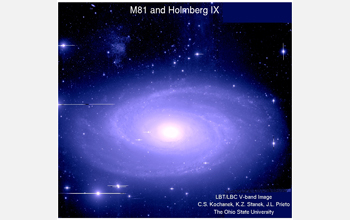 A deep V-band image of the nearby spiral
galaxy M81, taken using the Large Binocular Telescope (LBT) built from a series
of shorter images being used to identify variable stars, failed supernovae and
supernovae progenitor stars by monitoring the time variability of stars in the
galaxy.
A deep V-band image of the nearby spiral
galaxy M81, taken using the Large Binocular Telescope (LBT) built from a series
of shorter images being used to identify variable stars, failed supernovae and
supernovae progenitor stars by monitoring the time variability of stars in the
galaxy.


 Posts
Posts

