Showing posts with label georgia tech. Show all posts

Tuesday, August 28, 2012

Tongue Drive System to Help Disabled


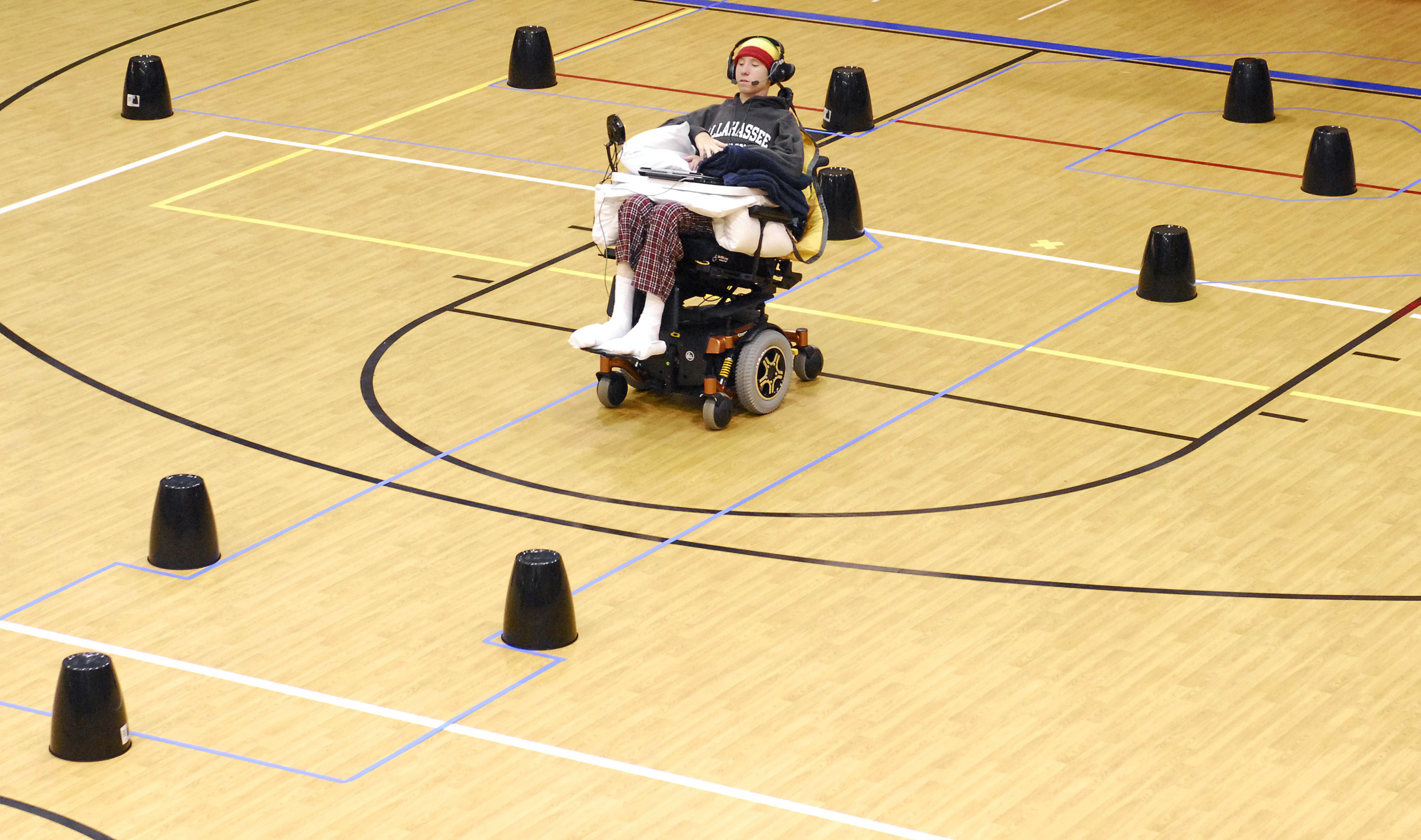
Image 1: Cruise Bogle participates in a clinical trial of the Tongue Drive system, an assistive technology that enables individuals to maneuver a powered wheelchair or control a mouse cursor using simple tongue movements. For the clinical trial, which took place at the Atlanta-based Shepherd Center, Bogle moved his tongue to direct the Tongue Drive system to move the powered wheelchair around an obstacle course. The clinical trials showed that the Tongue Drive system, which was developed by engineers at Georgia Tech, was intuitive and simple for individuals with high-level spinal cord injuries to use.
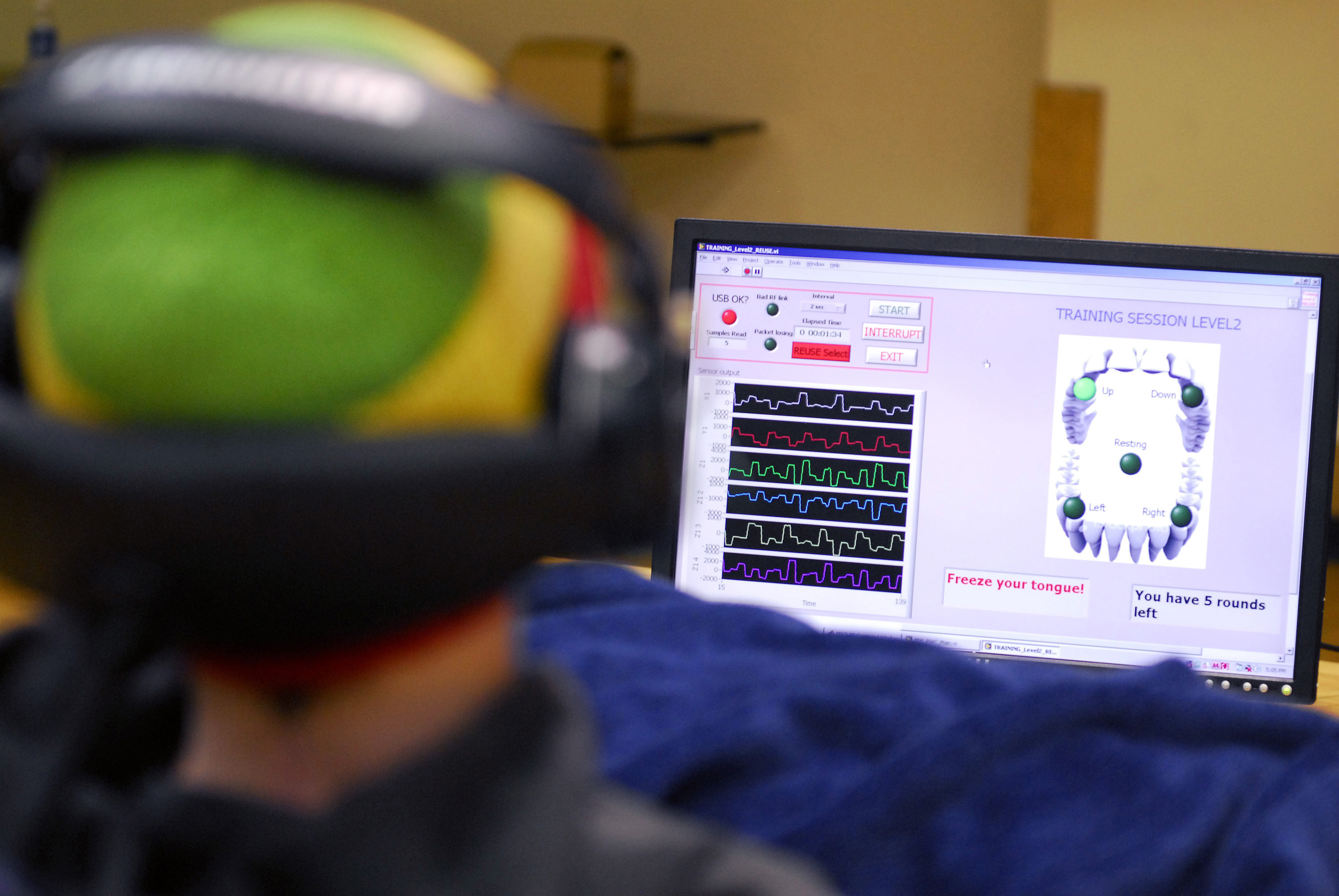
Image 2: Cruise Bogle, while participating in a clinical trial for the Tongue Drive system, trains the computer to understand how he will move his tongue to indicate the different commands necessary to operate the powered wheelchair forward, backward, right, left and stop. The Tongue Drive system is an assistive technology that enables individuals to maneuver a powered wheelchair or control a mouse cursor using simple tongue movements.

The clinical trials took place at the Atlanta-based Shepherd Center. Once the computer was ready, Bogle moved his tongue to direct the Tongue Drive system to move the powered wheelchair around an obstacle course. The clinical trials showed that the Tongue Drive system, which was developed by engineers at Georgia Tech, was intuitive and simple for individuals with high-level spinal cord injuries to use.

Image 3: Cruise Bogle, center, poses with the Georgia Tech researchers who developed the Tongue Drive system, an assistive technology that enables individuals to maneuver a powered wheelchair or control a mouse cursor using simple tongue movements. Cruise sticks out his tongue to show the small magnet that allows him to perform these tasks. Cruise participated in clinical trials for the system, which took place at the Atlanta-based Shepherd Center.

The research was funded by the National Science Foundation (grant IIS 08-03184) and the Christopher and Dana Reeve Foundation. To learn more, see the GA Tech Research News story Tongue Power: Clinical Trial Shows Quadriplegic Individuals Can Operate Powered Wheelchairs and Computers with Tongue Drive System. (Date of Image: June 2009)

Credit: Georgia Tech; photos by Gary Meek

Sunday, August 12, 2012

Measuring a Champion -- Science of the Summer Olympics


Timing is everything, especially at the 2012 Summer Olympics where even a millisecond could mean the difference between victory and defeat. Linda Milor, an electrical engineer at Georgia Institute of Technology, explains why Olympic timekeeping technology must be able to measure an athlete's performance with both accuracy and precision.

Credit: NBC Learn and the National Science Foundation

Wednesday, July 18, 2012

NSF I-Corps Celebrates First Year Bridging University Researchers with Entrepreneurs


Anniversary highlights accomplishments of nearly 100 teams and the announcement of the addition of two I-Corps National Innovation Network nodes

In July 2011, the National Science Foundation (NSF) launched the Innovation Corps (I-Corps), a program to broaden the impact of select, NSF-funded, basic-research projects by preparing scientists and engineers to extend their focus beyond the laboratory.

Leveraging experience and guidance from established entrepreneurs and a targeted curriculum, I-Corps grantees learn to identify valuable product opportunities that can emerge from academic research.

Now, one year into its three-year pilot phase, the I-Corps program has reached pivotal milestones. Several teams already are receiving public and private follow-on investment and participants have built a novel I-Corps Mentor Network that connects experts from the academic and entrepreneurial communities.

"NSF launched Innovation Corps to leverage productive public-private partnerships and extend the impact of fundamental research discoveries," says NSF Director Subra Suresh. "I-Corps has already had an impact beyond our initial expectations and inspired the research and business communities to collaborate in new ways. It is a model that can be transferred to other areas as well, and we are grateful to all the stakeholders for their support and participation."

Nearly 100 teams--composed of academic researchers, student entrepreneurs (undergraduates, graduate students and post-docs) and business mentors--participated in the six-month I-Corps program.

The curriculum is a hypothesis-based approach to assessing technological readiness that combines two, site-based short courses, extensive online coaching and hands-on outreach to potential customers. I-Corps merges the structured coursework with guidance from NSF program officers and leading entrepreneurs, who committed their time to the program.

Several I-Corps teams have received NSF Small Business Innovation Research (SBIR) grants, enabling them to develop companies based on what they have learned from the program. In the coming year, NSF hopes to expand I-Corps to an additional 200 teams of researchers and their business mentors.

"Academic researchers already have many skills valuable for success in business, such as critical thinking, teamwork and an ability to move in a new direction and learn when a hypothesis proves false," says Errol Arkilic, NSF program director for I-Corps. "The NSF I-Corps builds upon that expertise, introducing researchers to the business community and teaching them to seek, and speak to, the needs of potential customers."

As an extension of the I-Corps program's success and as a mechanism to broaden the geographic reach of the effort, NSF will expand the network of nodes that serve as teaching sites for the hands-on curriculum.

The I-Corps node at Stanford University now will join one at Georgia Tech and one at the University of Michigan. Additionally, NSF is now soliciting proposals for new nodes, all of which will serve their regional community as innovation supporting resources and act as focal points for expanding the national I-Corps network.

"I-Corps is an innovation model that demonstrates the continued strength of the American entrepreneurial spirit," says Dedric Carter, NSF senior advisor for Strategic Initiatives. "Building on NSF's 60-plus year legacy of investing in basic research and spawning innovation, I-Corps embodies many of the key elements for entrepreneurial achievement and illustrates why our nation is still the world-leader for start-up success."

The National Science Foundation, the Ewing Marion Kauffman Foundation and the Deshpande Foundation support the Innovation Corps. For more information, see NSF's I-Corps webpage.

-NSF-

Wednesday, July 11, 2012

Studying Jeweled Beetle's Iridescence (Images 3 and 4)


Image 3: Jung Ok Park, the principal research scientist in the lab of Mohan Srinivasarao, a professor at the School of Polymer, Textile and Fiber Engineering at the Georgia Institute of Technology, uses a microspectrophotometer to image the exocuticle of the jeweled beetle Chrysina gloriosa. The research team studied the surface structures on the beetle's shell and discovered that the iridescent colors are produced from liquid crystalline material that self-assembles into a complex arrangement of polygonal shapes.

Image 4:  Enlarged image showing jeweled beetle Chrysina gloriosa. Researchers from the Georgia Institute of Technology studied the surface structures on the beetle's shell and discovered that the iridescent colors are produced from liquid crystalline material that self-assembles into a complex arrangement of polygonal shapes.

More About This Image
Mohan Srinivasarao, a professor at the School of Polymer, Textile and Fiber Engineering at Georgia Tech, received a grant from the National Science Foundation (NSF) to study what gives the jeweled beetle's shell its iridescence. Iridescent beetles, butterflies, certain sea organisms and many birds get their unique colors from the interaction of light with physical structures on their external surfaces.

Srinivasarao worked with colleagues Vivek Sharma, Matija Crne and Jung Ok Park to study the surface structures on the shells. The team published a detailed analysis in Science magazine of how the jeweled beetle Chrysina gloriosa uses a helical structure that reflects light of two specific colors, and of only one polarization--left circular polarization, to create their striking colors. The reflecting structures used by the beetle consist predominately of three different polygonal shapes--primarily hexagons, pentagons and heptagons, each less than 10 microns in size--whose percentages vary with the curvature of the insect's shell.

"This is really a pattern formation issue," said Srinivasarao. "It is difficult to pack only hexagons onto a curved surface. On flat surfaces, there are fewer defects in the form of five- and seven-sided cells."

Srinivasarao believes the patterns are due to the nature of the cholesteric liquid crystal and because the liquid crystal phase structures itself at the interface between air and fluid. "We think these patterns result because the liquid crystal must have defects on the surface when exposed to air, and those defects create the patterns in the beetle's shell or exoskeleton," says Srinivasarao.

Studying these shimmery shells may lead to new insights into liquid crystal technology. "Understanding how these structures give rise to the stunning colors we see in nature could benefit the quest for miniature optical devices and photonics," said Srinivasarao. Liquid crystalline materials have many uses, from displays for laptop computers to portable music players and other devices to children's thermometers.

This information was taken from the Georgia Tech news release "Jeweled Beetles: Scientists Unlock Optical and Liquid Crystal Secrets of Iridescent Metallic Green Insects." The full story is available Here.

Or, to learn more, you can view the NSF presentation "Inside a Beetle's Iridescence." [Research supported by NSF grant DMR 07-06235.]

(Date of Image: July 2009)

Credit: Georgia Tech; photo by Gary Meek

Studying Jeweled Beetle's Iridescence (Images 1 and 2)


Image 1: Professor Mohan Srinivasarao holds a collection of beetles and points to the jeweled beetle Chrysina gloriosa. C. gloriosa was the subject of research by Srinivasarao and his team at the Georgia Institute of Technology in which they studied the surface structures on the beetles' shells and discovered that the iridescent colors are produced from liquid crystalline material that self-assembles into a complex arrangement of polygonal shapes.

Image 2: A jeweled beetle Chrysina gloriosa. The enlarged image in the background shows the insect's light-reflecting structures. Researchers from the Georgia Institute of Technology studied the surface structures on the beetle's shell and discovered that the iridescent colors are produced from liquid crystalline material that self-assembles into a complex arrangement of polygonal shapes.
 
More About These Images
 Mohan Srinivasarao, a professor at the School of Polymer, Textile and Fiber Engineering at Georgia Tech, received a grant from the National Science Foundation (NSF) to study what gives the jeweled beetle's shell its iridescence. It is the interaction of light with physical structures on their external surfaces that gives creatures like iridescent beetles, butterflies, certain sea organisms and many birds their unique colors.

Srinivasarao worked with colleagues Vivek Sharma, Matija Crne and Jung Ok Park to study the surface structures on the shells. The team published a detailed analysis in Science magazine of how the jeweled beetle Chrysina gloriosa uses a helical structure that reflects light of two specific colors, and of only one polarization--left circular polarization, to create their striking colors. The reflecting structures used by the beetle consist predominately of three different polygonal shapes--hexagons, pentagons and heptagons, each less than 10 microns in size--whose percentages vary with the curvature of the insect's shell.

"This is really a pattern formation issue," said Srinivasarao. "It is difficult to pack only hexagons onto a curved surface. On flat surfaces, there are fewer defects in the form of five- and seven-sided cells."

Srinivasarao believes the patterns are due to the nature of the cholesteric liquid crystal and because the liquid crystal phase structures itself at the interface between air and fluid. "We think these patterns result because the liquid crystal must have defects on the surface when exposed to air, and those defects create the patterns in the beetle's shell or exoskeleton," says Srinivasarao.

Studying these shimmery shells may lead to new insights into liquid crystal technology. "Understanding how these structures give rise to the stunning colors we see in nature could benefit the quest for miniature optical devices and photonics," said Srinivasarao. Liquid crystalline materials have many uses, from displays for laptop computers to portable music players and other devices to children's thermometers.

This information was taken from the Georgia Tech news release "Jeweled Beetles: Scientists Unlock Optical and Liquid Crystal Secrets of Iridescent Metallic Green Insects." The full story is available Here.

Or, to learn more, view the NSF presentation "Inside a Beetle's Iridescence." [Research supported by NSF grant DMR 07-06235.] (Date of Image: July 2009)

Credit: Georgia Tech; photo by Gary Meek

Monday, March 19, 2012

Sandfish Lizard Slithers Into Science Spotlight


Desert reptile inspires new robot for rescue and other missions

In less than a second, a sandfish lizard can dig its way into the sand and disappear. Blink and you miss it. The sandfish's slithering moves are inspiring new robotic moves that could one day help search-and-rescue crews find survivors in piles of rubble left from disasters like Hurricane Katrina.

"The sandfish is a little lizard that lives in the Sahara Desert," says Daniel Goldman, a physicist at Georgia Tech. Goldman is an assistant professor specializing in the biophysics of locomotion. "It manages to move around on the surface of sand using its limbs and, when startled, it dives into the sand using its body to propel itself forward."

With support from the National Science Foundation (NSF), Goldman and his team at Georgia Tech use x-rays to track the lizard's underground movements. They've also developed a robot to mimic the lizard's locomotion so they can study the way it moves in precise detail. Goldman says the sandfish tucks its limbs close to its body and swims through the sand much like an eel wiggles its way through water.

"The animal propagates a wave down its body from its head to its tail and the wave of the body pushes against the material and the material then pushes the animal forward," says Goldman.

"Part of the complexity of the problem addressed by Goldman stems from the interaction of the lizard with the sand," explains Krastan Blagoev, director of NSF's Physics of Living Systems program in the Division of Physics, which funded the research. "Sand by itself is a complex material with some properties of fluids and some properties of solids. These lizards have learned the laws governing the behavior of sand and use them to survive."

"The sandfish's body is very square-shaped," says Sarah Sharpe, a bioengineer working with research assistant Andrew Masse and Goldman to analyze the sandfish movements. They say the lizard's chiseled body and its shovel-shaped head are what help it to slice through sand like a knife through butter. It happens so fast that the sand around the lizard takes on the characteristics of a fluid and the sandfish literally swims through it.

"We've discovered the sandfish actually creates a fluid around it and swims through that fluid. The animal is essentially pushing off the fluid that it creates," explains Goldman.

Goldman says there are engineers working to incorporate the sandfish movement into deployable robots that could one day help canine search-and-rescue teams find survivors more quickly. "It would be nice to have a device like a sandfish robot that could swim around in rubble or debris after a landslide, an earthquake or any number of disasters--to get into small spaces to look for trapped people or hazardous chemicals," he says.

David Atkins with the DeKalb County Fire and Rescue Canine Unit in Georgia agrees. "Anything we can do to save lives is a good idea," he says. "You only have so much time to get those people out."

So while the little sandfish may not look like a hero, it is teaching us a lot about what it takes to worm through rugged terrain and debris. And that could one day save lives.

Miles O'Brien, Science Nation Correspondent
Ann Kellan, Science Nation Producer