Showing posts with label national academy of sciences. Show all posts
Showing posts with label national academy of sciences. Show all posts
Thursday, October 8, 2015
National Academy of Sciences Reports Progress in NIJ's Role in Forensic Science

Saturday, July 21, 2012
U.S. Antarctic Program's Blue Ribbon Panel Releases Report Findings on Logistical Improvements to Support the Advancement of Science
Blue
Ribbon Panel discusses report recommendations after reviewing Antarctic science
support operations
 The U.S. Antarctic Program's Blue Ribbon
Panel, established by the Office of Science and Technology Policy and the
National Science Foundation, hosts a press conference to discuss the results of
their report titled, "More and Better Science in Antarctica through
Increased Logistical Effectiveness." The report reviews U.S. science
support operations in Antarctica and discusses recommendations for increased
logistical effectiveness to support this important science research.
The U.S. Antarctic Program's Blue Ribbon
Panel, established by the Office of Science and Technology Policy and the
National Science Foundation, hosts a press conference to discuss the results of
their report titled, "More and Better Science in Antarctica through
Increased Logistical Effectiveness." The report reviews U.S. science
support operations in Antarctica and discusses recommendations for increased
logistical effectiveness to support this important science research.
What: News briefing to announce the
release of the U.S. Antarctic Program's Blue Ribbon Panel report that reviews
science-support operations on the continent of Antarctica and the Southern
Ocean.
Who (In Speaking Order):
Ralph Cicerone, President of the National
Academy of Sciences
John P. Holdren, Assistant to the
President for Science and Technology, Director of the White House Office of
Science and Technology Policy
Subra Suresh, Director of U.S. National
Science Foundation
Norm Augustine, Chair, U.S. Antarctic
Program Blue Ribbon Panel
Where: National Academy of Sciences
Lecture Room
2101 Constitution Ave., NW
Washington, DC
OR--Via webcast: To listen to the live
webcast news briefing in a "listen-only" mode, go to:
http://live.science360.gov/antarctica/
When: Monday, July 23, 2012
2 p.m. EDT (Please arrive by 1:30 p.m.
onsite for press check-in.)
RSVP: Please submit your name and press
credentials to Debbie Wing and to receive an EMBARGOED copy of the Executive
Summary of the U.S. Antarctic Program's Blue Ribbon Panel Report. The Executive
Summary and Full Report are embargoed until 2:00 p.m. EDT, July 23, 2012.
-NSF-
Tuesday, July 17, 2012
Thieving Rodents: Did They Save Tropical Trees?
Rodents
may have taken over seed-dispersal role of now-extinct mammals
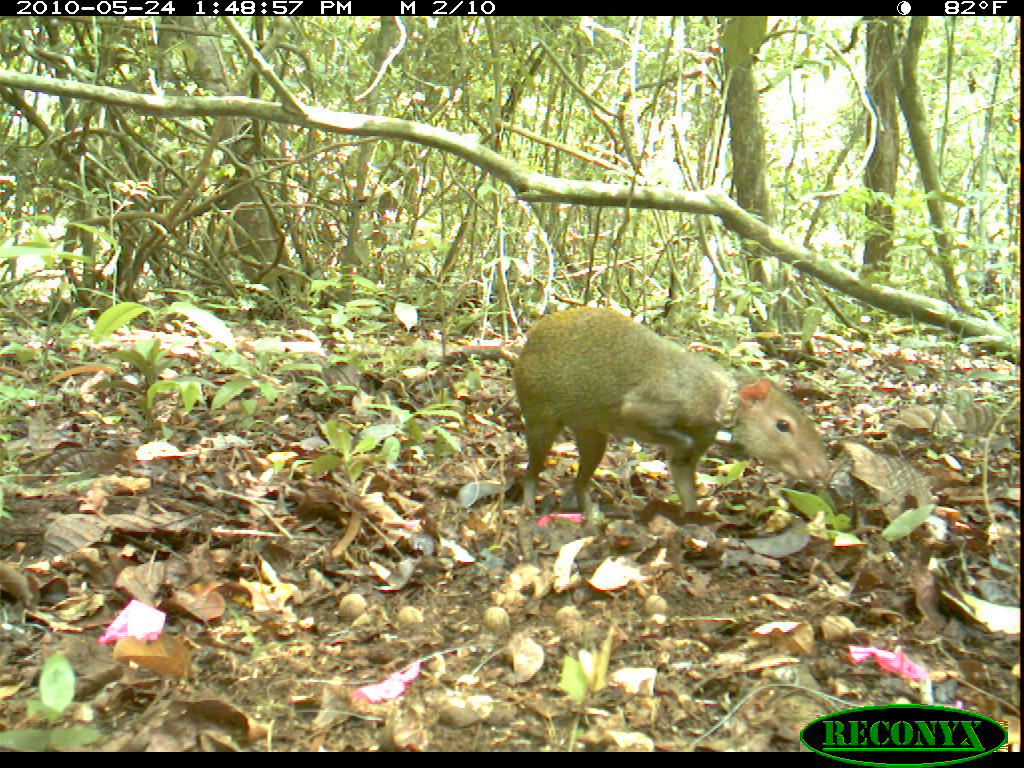 Big seeds produced by tropical trees
such as black palms were probably once ingested and then left whole by huge
mammals called gomphotheres.
Big seeds produced by tropical trees
such as black palms were probably once ingested and then left whole by huge
mammals called gomphotheres.
Gomphotheres weighed more than a ton and
dispersed the seeds over large distances.
But these Neotropical creatures
disappeared more than 10,000 years ago. So why aren't large-seeded plants also
extinct?
A paper published this week in the
journal Proceedings of the National Academy of Sciences (PNAS) suggests that
rodents may have taken over the seed-dispersal role of gomphotheres.
"The question has been: how did a
tree like the black palm manage to survive for 10,000 years, if its
seed-dispersers are extinct?" asks Roland Kays, co-author of the paper and
a zoologist at North Carolina State University and the North Carolina Museum of
Natural Sciences.
"This research solves a long
standing puzzle in ecology," says Alan Tessier, program director in the
National Science Foundation's (NSF) Division of Environmental Biology, which
funded the research.
"How did plant species that seem to
be dependent on Pleistocene megafauna for seed-dispersal survive the extinction
of that megafauna?"
Now, says Kays, scientists may have an
answer.
By attaching tiny radio transmitters to
more than 400 seeds, Patrick Jansen, a scientist at the Smithsonian Tropical
Research Institute (STRI) and Wageningen University and colleagues found that
85 percent of the seeds were buried in caches by agoutis, common rodents in
tropical lowlands.
Agoutis carry seeds around in their mouths
and bury them for times when food is scarce.
Radio-tracking revealed a surprising
finding: when the rodents dig up the seeds, they usually don't eat them, but
instead move them to a new site and bury them, often many times.
One seed in the study was moved 36
times.
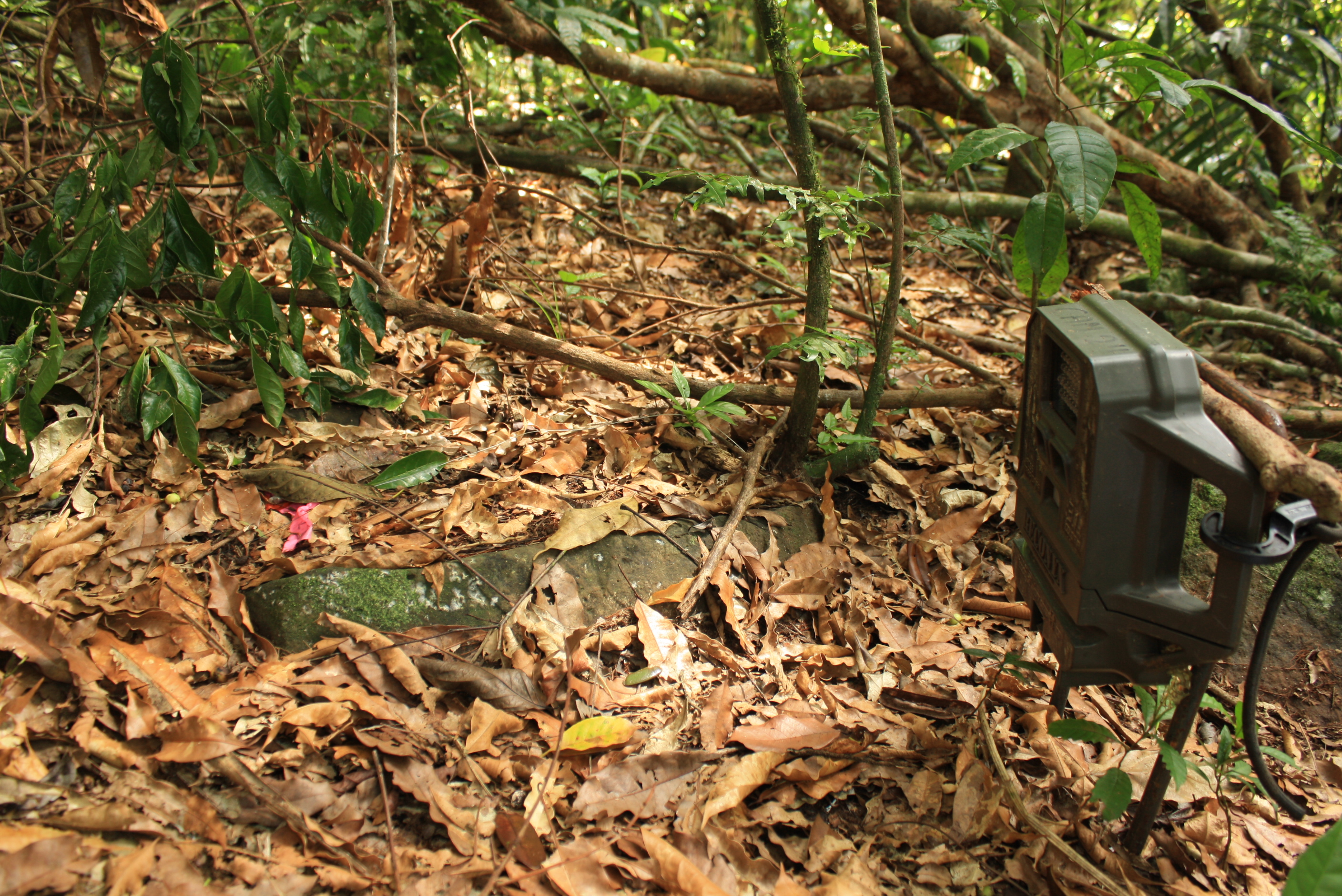 Researchers used remote cameras to catch
the animals digging up cached seeds. They discovered that frequent seed
movement primarily was caused by animals stealing seeds from one another.
Researchers used remote cameras to catch
the animals digging up cached seeds. They discovered that frequent seed
movement primarily was caused by animals stealing seeds from one another.
Ultimately, 35 percent of the seeds
ended up more than 100 meters from their origin. "Agoutis moved seeds at a
scale that none of us had ever imagined," says Jansen.
"We had observed seeds being moved
and buried up to five times, but in this system it seems that re-caching
behavior is 'on steroids,'" says Ben Hirsch of STRI and Ohio State
University.
"By radio-tagging the seeds, we
were able to track them as they were moved by agoutis, find out if they were
taken up into trees by squirrels, then discover the seeds inside spiny rat
burrows.
"That allowed us to gain a much
better understanding of how each rodent species affects seed dispersal and
survival."
By taking over the role of Pleistocene
mammals in dispersing large seeds, thieving, scatter-hoarding agoutis may have
saved several species of trees from extinction.
Other co-authors of the paper are
Willem-Jan Emsens of Wageningen University and the University of Antwerp;
Veronica Zamora-Gutierrez of Wageningen University and the University of
Cambridge; and Martin Wikelski of STRI and the Max Planck Institute for
Ornithology, as well as the University of Konstanz.
-NSF-
Sunday, May 6, 2012
USAID-NSF PEER Program Announces First Round of Awardees
PEER-funded
developing country researchers will use science and engineering to address
global development challenges
 The U.S. Agency for International
Development (USAID) has announced the first round of awards under a joint
National Science Foundation (NSF)-USAID program launched last summer.
Partnerships for Enhanced Engagement in Research (PEER) capitalizes on
competitively-awarded investments to build scientific and technical capacity in
the developing world.
The U.S. Agency for International
Development (USAID) has announced the first round of awards under a joint
National Science Foundation (NSF)-USAID program launched last summer.
Partnerships for Enhanced Engagement in Research (PEER) capitalizes on
competitively-awarded investments to build scientific and technical capacity in
the developing world.
"I am very pleased that nearly 500
scientists in developing countries submitted PEER proposals linked to awards
from every NSF research directorate, demonstrating robust international
interest and unmet potential at the interface of science and development,"
said DeAndra Beck, NSF program director for PEER.
"Through PEER, collaboration will
occur between scientists in developing countries and a variety of NSF awardees,
including small businesses, CAREER awardees, large NSF centers and
international consortia, as well as with single investigators. Each of these
collaborations will bridge a shared goal of advancing development with
science."
The USAID-funded PEER program,
administered by the National Academy of Sciences (NAS) in coordination with
USAID and NSF, convened review panels of topical experts and evaluated nearly
500 applications from 63 developing countries. Based on scientific merit,
projected development impact within country and the strength of collaboration
between developing country scientists and their American counterparts, 41
projects from 25 countries were selected for funding.
In the following examples, newly
PEER-funded proposals address important capacity needs by:
•Developing translation software to
convert spoken Arabic to Moroccan Sign Language in partnership with an
NSF-funded small business;
•Assessing ecological strategies to
assist with bird conservation in Kenya with NSF-funded students engaged in
international research collaboration;
•Monitoring air quality over the
Mongolian capital of Ulan Bator with an NSF-funded postdoctoral scientist;
•Studying marine biodiversity in
Indonesia and the Philippines in collaboration with an NSF-funded international
research and education consortium;
•Assessing landslide risk in Lebanon
with an NSF-funded engineer;
•Analyzing climate change impacts in
Colombia and Ecuador with NSF-funded climate researchers; and
•Incorporating Bali's Subak heritage
into primary and secondary education curriculum with an NSF-funded
anthropologist.
-NSF-
Subscribe to:
Posts (Atom)


 Posts
Posts

