Showing posts with label plant life. Show all posts

Monday, September 17, 2012

"DNA of Maple Seed Flight"


"DNA of Maple Seed Flight," by David Lentink, Wageningen University.

The autorotating flight path of a maple seed is visualized here in a composite, multiflash photo. The seed exhibits a DNA-like flight spiral.

In trying to determine how the seeds of maple trees descend so slowly, Lentink and colleagues found that by swirling, maple seeds generate a tornado-like vortex that sits atop the front leading edge of the seeds as they spin slowly to the ground. This leading-edge vortex lowers the air pressure over the upper surface of the maple seed, effectively sucking the wing upward to oppose gravity, giving it a boost. The vortex doubles the lift generated by the seeds compared to nonswirling seeds. Lentink's research was published in Science (June 12, 2009); this photo appeared on the cover.

This image was entered for judging in the Photography category of the 2009 International Science & Engineering Visualization Challenge (SciVis) competition, sponsored by the National Science Foundation and the journal Science. The competition is held each year to celebrate the grand tradition of science visualization and to encourage its continued growth. The spirit of the competition is to communicate science, engineering and technology for education and journalistic purposes. To learn more about the competition and view all the winning entries, see the NSF SciVis Special Report

This research was supported by a grant from the National Science Foundation (IBN 02-17229). For more information on Lentink's research related to this photo, see the Caltech news story Maple Seeds and Animals Exploit the Same Trick to Fly.

(Date of Image: May 2009)

Credit: David Lentink, Wageningen University

Tuesday, August 28, 2012

Epiphytic Fern Hymenophyllum jamesonii


Hymenophyllum jamesonii, an epiphytic fern of neotropical rain forests, has berry-like clusters of sporangia where reproductive spores are produced.

Eric Schuettpelz, a postdoctoral fellow in biology at the time, and Kathleen Pryer, an associate professor at Duke University, integrated genomic data from 400 living fern species with information from the fossil record to construct a time-calibrated family tree for ferns.

Schuettpelz and Pryer received support from the National Science Foundation. To learn more, see the Duke news story Ferns Took to the Tress and Thrived.

(Date of Image: 2008)

Credit: Courtesy Eric Schuettpelz, Duke University

Monday, August 6, 2012

Tale of Two Scientific Fields--Ecology and Phylogenetics--Offers New Views of Earth's Biodiversity


Scientists report new look at 'patterns in nature' in special issue of journal Ecology

Patterns in nature are in everything from ocean currents to a flower's petal.

Scientists are taking a new look at Earth patterns, studying the biodiversity of yard plants in the U.S. and that of desert mammals in Israel, studying where flowers and bees live on the Tibetan plateau and how willow trees in America's Midwest make use of water.

They're finding that ecology, the study of relationships between living organisms and their environment, and phylogenetics, research on evolutionary relationships among groups of organisms, are inextricably intertwined.

Results of this tale of two fields are highlighted in a special, August 2012 issue of the journal Ecology, published by the Ecological Society of America (ESA). Most of the results reported are funded by the National Science Foundation (NSF).

The issue will be released at the annual ESA meeting, held this year from August 5-10 in Portland, Ore.

Melding information from ecology and phylogenetics allows scientists to understand why plants and animals are distributed in certain patterns across landscapes, how these species adapt to changing environments across evolutionary time--and where their populations may be faltering.

"To understand the here and now, ecologists need more knowledge of the past," says Saran Twombly, program director in NSF's Division of Environmental Biology.  "Incorporating evolutionary history and phylogenies into studies of community ecology is revealing complex feedbacks between ecological and evolutionary processes."

Maureen Kearney, also a program director in NSF's Division of Environmental Biology adds, "Recent studies have demonstrated that species' evolutionary histories can have profound effects on the contemporary structure and composition of ecological communities."

In the face of rapid changes in Earth's biota, understanding the evolutionary processes that drive patterns of species diversity and coexistence in ecosystems has never been more pressing, write co-editors Jeannine Cavender-Bares of the University of Minnesota, David Ackerly of the University of California at Berkeley and Kenneth Kozak of the University of Minnesota.

"As human domination of our planet accelerates," says Cavender-Bares, "our best hope for restoring and sustaining the ‘environmental services' of the biological world is to understand how organisms assemble, persist and coexist in ecosystems across the globe."

Papers in the volume address subjects such as the vanishingly rare oak savanna ecosystem of U.S. northern tier states, revealing an ancient footprint of history on the savanna as well as how it has fared in a 40-year fire experiment.

Other results cover the influence of ecological and evolutionary factors on hummingbird populations; habitat specialization in willow tree communities; growth strategies in tropical tree lineages and their implications for biodiversity in the Amazon region; and the characteristics of common urban plants.

"The studies in this issue show that knowledge of how organisms evolve reveals new insights into the ecology and persistence of species," says Cavender-Bares.

Plants in urban yards, for example, are more closely related to each other--and live shorter lives--than do plants in rural areas, found Cavender-Bares and colleagues.

Their study compared plant diversity in private urban yards in the U.S. Midwest with that in the rural NSF Cedar Creek Long-Term Ecological Research site in Minnesota.

Cities are growing faster and faster, with unexpected effects, says Sonja Knapp of the Hemholtz Center for Environmental Research in Germany, lead author of the paper reporting the results.

"Understanding how urban gardening affects biodiversity is increasingly important," says Cavender-Bares.  "Urbanites should consider maintaining yards with a higher number of species."

In the special issue, researchers also look at topics such as what determines the number of coexisting species in local and regional communities of salamanders. Kenneth Kozak of the University of Minnesota and John Wiens of Stony Brook University report that variation in the amount of time salamanders occupy different climate zones is the primary factor.

Evolution of an herbaceous flower called goldfields, and how that led to the plant's affinity for certain habitats, is the subject of a paper by David Ackerly, Nancy Emery of Purdue University and colleagues. Emery is the paper's lead author.

In all, 17 papers combine ecology and phylogenetics to offer new answers to long-standing questions about the patterns and processes of biodiversity on Planet Earth.

Integrating Ecology and Phylogenetics
A special issue of the journal Ecology

Integrating ecology and phylogenetics: the footprint of history in modern-day communities
Jeannine Cavender-Bares, David D. Ackerly, Kenneth H. Kozak, Co-Editors

Synthesizing phylogenetic knowledge for ecological research
Jeremy M. Beaulieu, Richard H. Ree, Jeannine Cavender-Bares, Nicholas Deacon, George D. Weiblen, and Michael J. Donoghue

Assessing the effects of spatial contingency and environmental filtering on metacommunity phylogenetics
Pedro R. Peres-Neto, Mathew A. Leibold and Stephane Dray

Phylogenetic species-area curves
Matthew R. Helmus and Anthony R. Ives

Phylogenetic tree shape as a predictor of niche segregation
Jonathan Davies, Natalie Cooper, Jose Alexandre Felizola Diniz Filho, Gavin H. Thomas, Shai Meiri

Shocks to the system: Community assembly of the oak savanna in a 40-year fire frequency experiment
Jeannine Cavender-Bares and Peter B. Reich

Demographic drivers of successional changes in phylogenetic structure across life history stages in plant communities
Natalia Norden, Susan Letcher, Vanessa Boukili, Nathan Swenson, and Robin Chazdon

Phylogenetic and functional characteristics of household yard floras and their changes along an urbanization gradient
Sonja Knapp, Lucy Dinsmore, Cinzia Fissore, Sarah Hobbie, Ina Jakobsdottir, Jens Kattge, Jennifer King, Stefan Klotz, Daniel C. Laughlin, Joseph P. McFadden, and Jeannine Cavender-Bares

Untangling the influence of ecological and evolutionary factors on trait variation across hummingbird assemblages
Catherine H. Graham, Juan L. Parra, Boris A. Tinoco, F. Gary Stiles, Jim A. McGuire

Phylogenetic and functional alpha and beta diversity in temperate and tropical tree communities
Nathan G. Swenson, David L. Erickson, Xiangcheng Mi, Norman A. Bourg, Jimena Montana-Forero, Xuejun Ge, Robert Howe, Jeffrey K. Lake, Xiaojuan Liu, Keping Ma, Nancai Pei, Jill Thompson, Maria Uriarte, Amy Wolf, S. Joseph Wright, Wanhu Ye, Jinlong Zhang, Jess K. Zimmerman and W. John Kress

Phylogenetic signal and phenotypic plasticity in traits under variable competitive regimes
Jean H. Burns and Sharon Y. Strauss

Habitat specialization and the role of trait lability in structuring hyper-diverse willow communities
Jessica Savage and Jeannine Cavender-Bares

Niche evolution and habitat specialization in Lasthenia
Nancy C. Emery, Elisabeth J. Forrestel, Ginger Jui, Michael Park, Bruce G. Baldwin and David D. Ackerly

Phylogeny, ecology and the origins of climate-richness relationships
Kenneth H. Kozak and John J. Wiens

Floral diversity and community structure in Pedicularis (Orobanchaceae)
Deren A. R. Eaton, Charles B. Fenster, Joe Hereford, Shuang-Quan Huang, Richard H. Ree

Herbivory, growth strategies and habitat specialization in four tropical tree lineages: Implications for Amazonian Beta-Diversity
Greg P.A Lamarre, Christopher Baraloto, Claire Fortunel, Nallarett Davila, Italo Mesones, Julio Grandez Rios, Marcos Rios, Elvis Valderrama, Paul Fine

Predicting the impact of tropical rain forest conversion on insect herbivore abundance from plant traits and phylogeny
Timothy J. S. Whitfeld, Vojtech Novotny, Scott E. Miller, Jan Hrcek, Petr Klimes, and George D. Weiblen

Phylogenetic diversity promotes ecosystem stability
Marc W. Cadotte, Russell Dinnage, David Tilman

 -NSF-

Tuesday, July 17, 2012

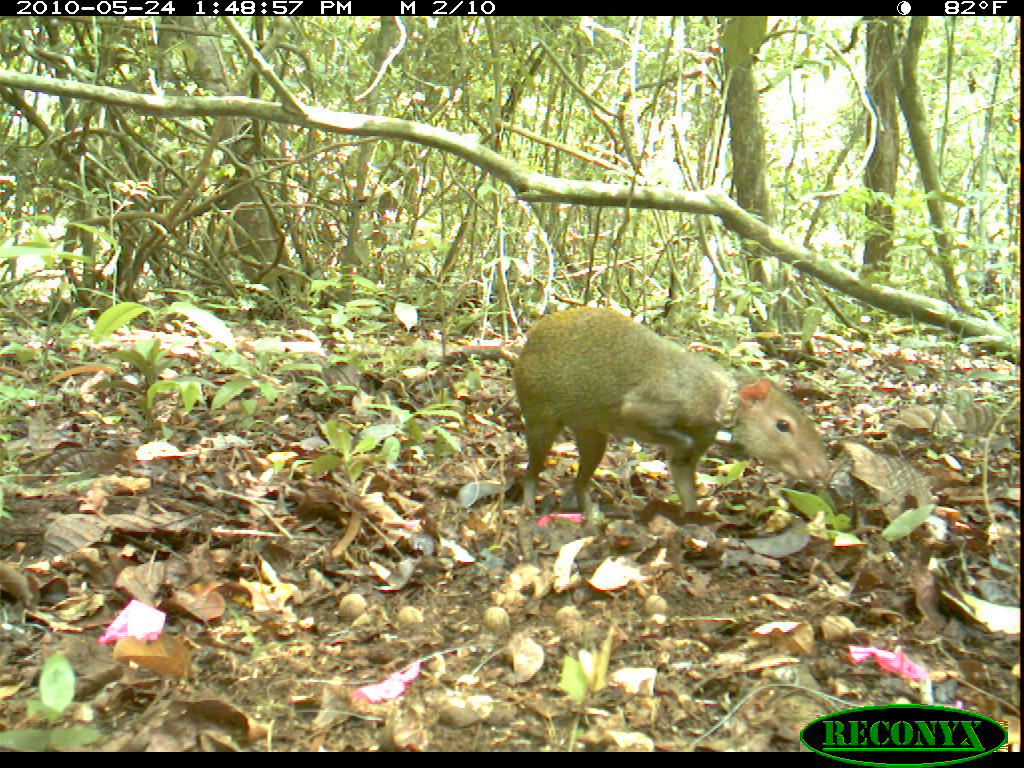
Thieving Rodents: Did They Save Tropical Trees?


Rodents may have taken over seed-dispersal role of now-extinct mammals

Big seeds produced by tropical trees such as black palms were probably once ingested and then left whole by huge mammals called gomphotheres.

Gomphotheres weighed more than a ton and dispersed the seeds over large distances.

But these Neotropical creatures disappeared more than 10,000 years ago. So why aren't large-seeded plants also extinct?

A paper published this week in the journal Proceedings of the National Academy of Sciences (PNAS) suggests that rodents may have taken over the seed-dispersal role of gomphotheres.

"The question has been: how did a tree like the black palm manage to survive for 10,000 years, if its seed-dispersers are extinct?" asks Roland Kays, co-author of the paper and a zoologist at North Carolina State University and the North Carolina Museum of Natural Sciences.

"This research solves a long standing puzzle in ecology," says Alan Tessier, program director in the National Science Foundation's (NSF) Division of Environmental Biology, which funded the research.

"How did plant species that seem to be dependent on Pleistocene megafauna for seed-dispersal survive the extinction of that megafauna?"

Now, says Kays, scientists may have an answer.

By attaching tiny radio transmitters to more than 400 seeds, Patrick Jansen, a scientist at the Smithsonian Tropical Research Institute (STRI) and Wageningen University and colleagues found that 85 percent of the seeds were buried in caches by agoutis, common rodents in tropical lowlands.

Agoutis carry seeds around in their mouths and bury them for times when food is scarce.

Radio-tracking revealed a surprising finding: when the rodents dig up the seeds, they usually don't eat them, but instead move them to a new site and bury them, often many times.

One seed in the study was moved 36 times.

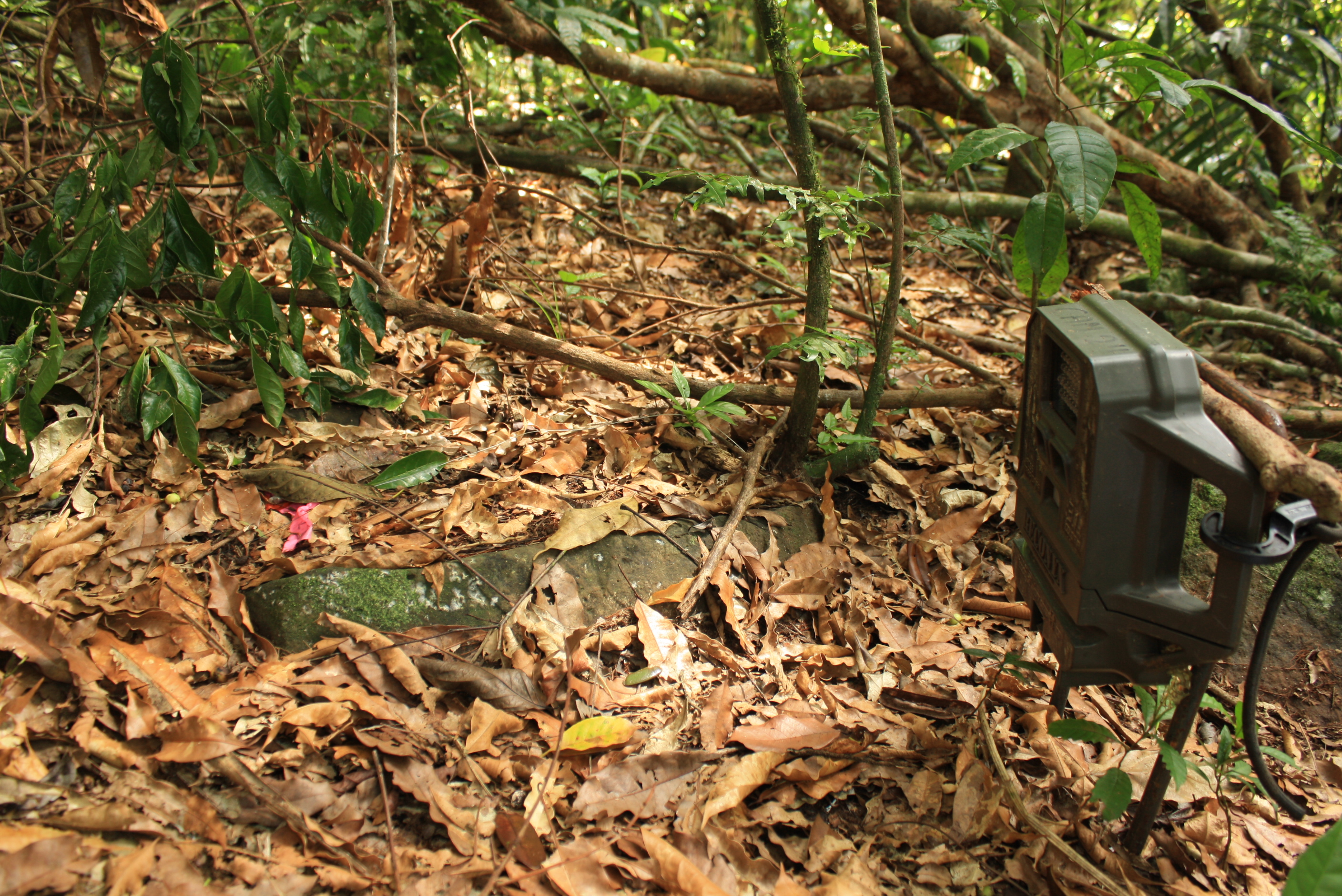
Researchers used remote cameras to catch the animals digging up cached seeds. They discovered that frequent seed movement primarily was caused by animals stealing seeds from one another.

Ultimately, 35 percent of the seeds ended up more than 100 meters from their origin. "Agoutis moved seeds at a scale that none of us had ever imagined," says Jansen.

"We had observed seeds being moved and buried up to five times, but in this system it seems that re-caching behavior is 'on steroids,'" says Ben Hirsch of STRI and Ohio State University.

"By radio-tagging the seeds, we were able to track them as they were moved by agoutis, find out if they were taken up into trees by squirrels, then discover the seeds inside spiny rat burrows.

"That allowed us to gain a much better understanding of how each rodent species affects seed dispersal and survival."

By taking over the role of Pleistocene mammals in dispersing large seeds, thieving, scatter-hoarding agoutis may have saved several species of trees from extinction.

Other co-authors of the paper are Willem-Jan Emsens of Wageningen University and the University of Antwerp; Veronica Zamora-Gutierrez of Wageningen University and the University of Cambridge; and Martin Wikelski of STRI and the Max Planck Institute for Ornithology, as well as the University of Konstanz.

 -NSF-

Sunday, July 15, 2012

Mosses Use Explosive Cannons to Spread Spores


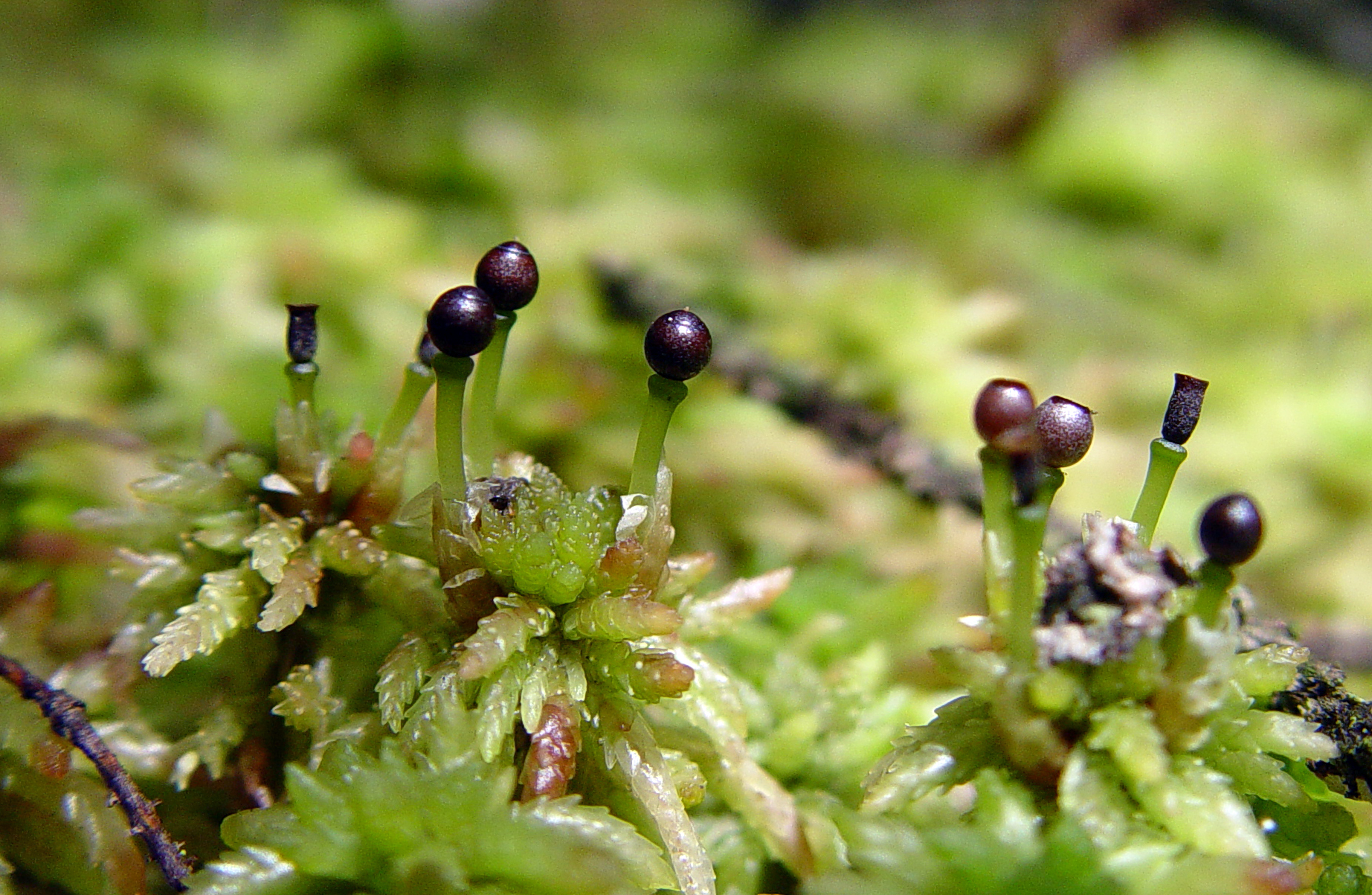
Image 1: A bed of sporulating Sphagnum moss. This moss reproduces by shooting spores out of a round capsule at the tip of their stalks. In this image, the tips of the stalks that are spherical have an intact cap and have yet to explode. The capsules that have already exploded are cylindrical or lack a cap.

Image 2: A still from a 9-frame series at 0.1 millisecond intervals showing a Sphagnum moss capsule explosion. Researchers used ultra high-speed cameras to reveal that each launch is accompanied by a miniature mushroom cloud, indicating the formation of a vortex ring. These rolling haloes of air give the spores the extra boost they need to get high enough off the ground to catch the wind currents that carry them long distances.

More About This Image
 To reproduce, Sphagnum, a type of peat moss, must disperse spores into the air that are carried by the wind over long distances. But Sphagnum live as a flat mat low to the ground. So how do they send their spores high enough into the air to what's called the "turbulent boundary layer" (a zone 10 centimeters off the ground), where swirls of air and sideways currents can carry the spores over long distances?

Researchers Dwight Whitaker of Pomona College and Joan Edwards of Williams College discovered that in order to accomplish this task, Sphagnum shoot spores out using their stalks as cannons. Anywhere from 20,000 to 30,000 spores are "loaded" into a round capsule at the tip of the stalk. On sunny days, the capsule dehydrates and collapses inward, transforming from a sphere into a cylinder and squashing the air inside it. After a while the pressure builds up until it is so great that the capsule blows its top, shooting out both spores and air like a cannon. The spores are ejected at around 30 miles per hour with around 32,000 times the force of gravity, allowing them to reach the turbulent boundary layer above the moss. The entire process takes less than a hundredth of a millisecond.

Whitaker and Edwards were awarded a National Science Foundation major research instrumentation grant (grant DBI 07-22532) for Williams College to establish a high-speed imaging facility. The facility enables researchers to view things in the natural world that occur in the blink of an eye, like the strike of a mantis shrimp or the sprint of a greyhound dog.

Whitaker and Edwards used the facility's ultra high-speed cameras--which shoot up to 100,000 frames per second--to film the firing of the spore cannons. They discovered that each launch is accompanied by a tiny mushroom cloud. The clouds are actually rolling haloes of air called vortex rings, that give the spores the extra boost they need to reach the turbulent boundary layer.

To learn more about this research, see the Discover Magazine story “Mosses use explosive cannons and mushroom clouds to spread their spores.”

(Date of Image: 2010)

Credit: Joan Edwards