Showing posts with label national guard. Show all posts

Tuesday, July 21, 2026

Large-Scale Cybersecurity Exercise Focuses on Operational Technology

This year's iteration of the War Department's longest-running unclassified cyber defense exercise is largely focused on operational technology, military cyber professionals said today during a virtual media roundtable.
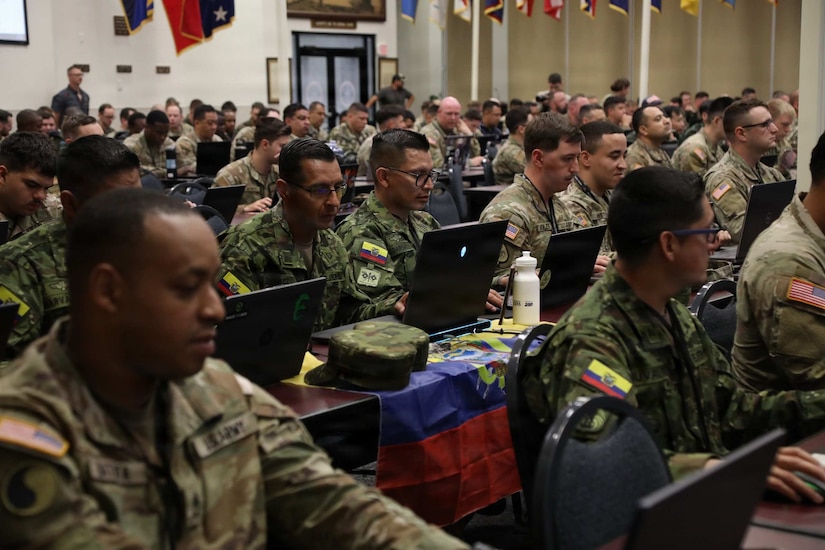
Dozens of people in various styles of camouflage military uniforms sit at tables in a large room working on computers.

Hosted by the National Guard Bureau, the roundtable was part of Cyber Shield 2026 — a training event that brings together more than 1,000 participants from 44 states and territories, as well as 23 countries, in Little Rock, Arkansas, July 12-25. It's designed to develop, train and exercise cyber forces in the areas of computer network internal defense measures and cyber incident response. 

Whereas information technology focuses on the management of data, networks and software, operational technology refers to the control and monitoring of physical machinery, industrial equipment and operational processes. 

One reason operational technology security has become increasingly important this year, and in recent years, is that remote work has become much more prevalent since the 2020 COVID-19 pandemic, said Army Brig. Gen. Russell E. McGuire, National Guard Bureau vice director of cyber operations. 
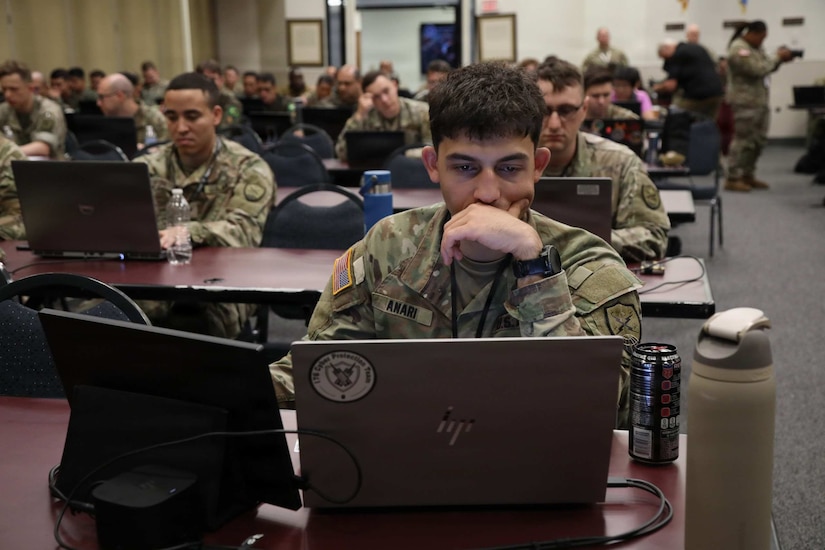
man wearing a camouflage military uniform sits at a table and looks at a computer. Numerous other men and women in similar attire do the same in the background.

"Pre-pandemic, most of our workforce went to office buildings. … As we transitioned to remote work, it created tremendous vulnerabilities," he said.  

Beyond IT professionals working remotely during the pandemic, McGuire said some critical infrastructure employees wanted remote access, which forced companies to connect IT systems to operational technology, thereby creating a new security risk. 

Each year, the exercise focuses on different areas of critical infrastructure, which often relies on operational technology; this year's focus is the electric grid. 

"As you look to sectors of target, there is a need to continue to come back to the electric sector, as attacks on the electric sector impact all sectors instantaneously," said Tim Conway, a fellow and technical director at the SANS Institute, which provides cybersecurity training, certifications and research to the War Department.   
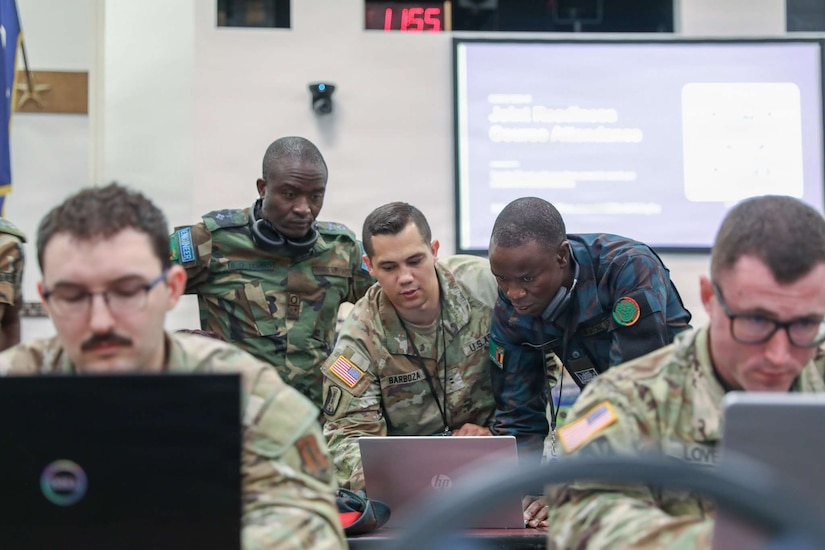
Three men wearing camouflage military uniforms stand and look at a computer in a large room.

One way the exercise combats threats to operational technology is by simulating real-world cyberattacks with SANS NetWars — a series of hands-on interactive learning exercises. 

Roughly 400 participants are taking part in this year's NetWars, contributing their own time during the weekends and in the evenings, McGuire said. 

"This is time they could be hanging out, catching a movie [or] relaxing, but the knowledge that they build just being in that room with these other experts, competing with each other is what makes this such a great exercise for them to take back to their units [and] their jobs, and that's why they keep coming back and growing each year," he added. 

Members of the Army and Air National Guard have participated in Cyber Shield annually since the event's inception in 2013.

Sunday, August 26, 2012

The Newest Thing In IED Defeating Technology


Military combat engineers and civilian technical experts gathered recently to conduct a series of experiments aimed at providing soldiers with new technology in the counter-improvised explosive device fight.

A diverse group of scientists, trainers and soldiers from across the country — including soldiers of 3rd Battalion (Engineer), 364th Regiment, 5th Armored Brigade,”Task Force Rampant,” Division West — spent five days testing and evaluating the HUSKY Vehicle Mounted Mine Detection Cause and Effect System trainer, known as the HMDS-CES.

The HMDS-CES was designed to replicate a critical detection capability currently used in the route clearance mission in Afghanistan.

Prior to the HMDS-CES, soldiers had to wait until they arrived in Afghanistan to train on this critical route clearance system. With the HMDS-CES, soldiers will be able to conduct highly realistic training before deploying overseas.

Once fielded, this advanced counter-improvised explosive device, or C-IED, trainer will be used by the 5th Armored Brigade to train Army Reserve and Army National Guard route clearance units.

“This new system will enhance the training we provide to soldiers as they train for deployment to Afghanistan,” said Master Sgt. Warner Stadler, a senior route clearance trainer in the 3rd Battalion (Engineer), 364th Regiment. “When they arrive in country and fall in on the live system, they will become ready to conduct the critically important route clearance mission in a short period of time with minimal additional training.”

With the trainer’s high-tech “cause-and-effect” system that simulates improvised explosive device, or IED, warnings, soldiers will be able to train in conditions that replicate the Afghanistan theater of operations without fear of damaging an expensive live system.

“The CES system has many of the same features as the live system,” said Staff Sgt. Johnathan Jacoba, an observer controller/trainer with 3rd Battalion (Engineer), 364th Regiment, and an experienced Sapper with recent combat experience in Afghanistan. “This system improves the operator’s field of vision and also aids in detecting threats near the vehicle.”

The new trainer also simulates explosions when operators fail to respond to critical warnings or indicators.

“This greatly enhances training and will save soldiers’ lives,” said Staff Sgt. Jeremiah Lindquist, a Task Force Rampant HUSKY operator and trainer. “The Cause and Effect trainer is a great improvement to the current surrogate trainer because it provides feedback similar to the live system.”

At the conclusion of the week-long experiment, Alfred Myers, the organizer and member of the Joint IED Test Board, thanked the scientists, engineers and soldiers who made the testing successful. “The support provided by Task Force Rampant and the soldiers at Fort Bliss (Texas) was outstanding,” he said.

Participants in the HMDS-CES evaluation also came from the Joint Improvised Explosive Device Defeat Organization, the Maneuver Support Center of Excellence, the Research and Development Command, Program Manager Explosive Ordnance Development and Counter-Mine, White Sands Missile Range, N.M., Program Executive Office — Simulations Training and Instrumentation, Army Test and Evaluation Command, and the United States Army Evaluation Center.

“This experiment was a great opportunity to bring all of the key stakeholders together to test and evaluate an important system,” Stadler said. “Developing training systems with soldier input is critical to getting first-hand experience into the hands of the developers.”

By Lt. Col. Aaron Dorf and Maj. Steve Bruner, 5th Armored Brigade, Division West
From www.army.mil

Friday, June 22, 2012

STARBASE Wisconsin seeks to build on early success


By 1st Sgt. Vaughn R. Larson
Wisconsin National Guard

Two months after the first class of Milwaukee fifth-grade students entered a hands-on environment for science, technology, engineering and math, officials cut the ribbon for the Department of Defense-funded education initiative, STARBASE Wisconsin.

Administered by the Wisconsin Air National Guard and based at the U.S. Army Reserve Center in Milwaukee, STARBASE Wisconsin provides 25 hours of interactive learning over the course of five weeks. Dr. Charisse Sekyi (pronounced SAYchee), STARBASE Wisconsin director, said the academic outreach program has exceeded her expectations.

"The activities are so engaging," Sekyi said. "It's such a rich curriculum, but it's very rigorous so there's some work that we have to do to meet the kids where they are and bring them up to where the curriculum is."

STARBASE is an acronym for Science and Technology Academies Reinforcing Basic Aviation and Space Exploration. The program began in Michigan - a collaboration between an elementary teacher and the Michigan National Guard - and was adopted by the Department of Defense to address the need to raise the interest and improve student knowledge and skill in science, technology, engineering and math. Sekyi said teachers and school principals have told her that no similar program is offered in Milwaukee schools.

"A lot of elementary science education is not hands-on - it's paper-pencil-book," she said. "To be able to bring this level of activity down to the elementary level is really phenomenal."

Reginald Lawrence of the Milwaukee Public School system said the district is excited to be part of STARBASE Wisconsin.

"In school, kids don't always get a chance to do hands-on activity," Lawrence explained. "This is going to be a great opportunity for them to experience science, technology, engineering and math in a fun, hands-on way."

Mary Staton, MPS science curriculum specialist, agreed.

"We in science education plan a curriculum from the textbook, identify the work that students will do in science, but one of the biggest pieces is having a community to support that work," Staton said. "The curriculum runs directly with the work we're doing in science. Our fifth-graders will be able to build on those concepts through STARBASE. They'll also be able to have an application of the science, which is sometimes something we miss in our classroom. We can do it here at STARBASE."

Brig. Gen. John McCoy, commander of the Wisconsin Air National Guard, said STARBASE Wisconsin has enjoyed early success.

"The buzz in the room when they're here is just so exciting to watch," McCoy said. "To actually be able to talk about something and then step aside and actually do it and see the results … that's what this is all about."

Maj. Gen. Don Dunbar, adjutant general of Wisconsin, joked that the purpose of this program was not to recruit fifth graders into the military. However, he noted that many people seeking to enter the Wisconsin National Guard today lack the skills and knowledge required, relaying that one of the program's goals is to help fire the imagination of young students and help them develop technical skills for civilian and military opportunities.

"Our standards are incredibly high," Dunbar said. "If you wear this uniform, you have to be somebody special. So a chance for us to do something in partnership with the Milwaukee School District and in partnership with the community here in Milwaukee, and we're very excited about it.

"We won't solve all the problems with this little class," Dunbar continued, but we're going to solve some."

Lt. Gov. Rebecca Kleefisch echoed Dunbar's sentiments.

"Wisconsin's economy is based on the bright young minds that we are raising up through programs like STARBASE," she said. "What you are doing here is raising our next generation of manufacturing leaders as well as military leaders. What you are doing here is assuring that Wisconsin's economy and the protection of our United States of America and the great state of Wisconsin will continue in the hands of today's youngsters." 

Students learn basic robotics programming, Newton's laws of motion, molecules, mapping and navigation with GPS, conduct physics experiments, work with 3-D computer-aided design software, and interact with civilian and military professionals. Since opening in April, STARBASE Wisconsin has worked with 146 students from seven schools. They will serve 1,500 students annually beginning this fall - a significant portion of the estimated 5,000 fifth-grade students in MPS. In addition, STARBASE Wisconsin's location puts the program in proximity to 17 elementary schools.

"We're a small program, but we have a huge mission," Sekyi said, "to motivate, inspire and nurture the intellectual capacity of our national treasure - our youth, Milwaukee's future innovators."

Areial Dubai, STARBASE Wisconsin office manager, said the program has made a positive impact on students.

"They love STARBASE - there's nothing boring about it," she said. "The teachers have said that kids who miss school never miss the day they have to go to STARBASE. They also get to school on time the day they have to go to STARBASE. The kids, to me, are little pieces of success."

Monday, May 21, 2012

Wisconsin Air Guard helps Milwaukee youth get excited about education


By Tech. Sgt. Jon LaDue
Wisconsin National Guard

The Wisconsin Air National Guard is helping Milwaukee students soar to new heights as part of a Department of Defense-sponsored program dubbed STARBASE - which aims at improving students skills and experience in science, technology, engineering and math. 
 
STARBASE Wisconsin, which serves Milwaukee's public and nonpublic schools, joins more than 30 states working to inspire and motivate students for careers in engineering and other science-related fields of study.

"Fifth grade is the first vulnerable point, from all the statistics, where children decide if they want to stay in school," said Col. John Puttre, STARBASE Wisconsin program manager. "It's just a fantastic opportunity for students to get excited about learning."

Students are taught through "hand-on, minds-on" training in a variety of topics - physics and chemistry, technology and engineering, and mathematics operation and applications. Throughout the 5-day program, the students learn core objectives through experiments, practical exercises and knowledge based learning that is aimed at being fun and educational.

One student summed it up when she said, "That's the hardest class I've ever taken, but I loved it."

In its first round of classes, the STARBASE Wisconsin program graduated more than 60 5th grade students from three Milwaukee schools - St. Marcus Lutheran School, Emmaus Lutheran School and Washington DuBois Christian Leadership Academy. The second group of classes includes students from Milwaukee's public school system.

Puttre has been working with other Wisconsin Guard leaders for more than a year to get the program up and running. He was more than pleased to speak to the first graduating class.

"Whatever it is you want to do in life - you know, after this, you can do it," he said. "You just have to put in a little effort and take small steps, and you can make or build whatever you want ... even your dreams."

The STARBASE Wisconsin staff is comprised of a director, two instructors and an administrative assistant, all of which are federally funded state employees or contract personnel. The program's director, Dr. Charisse Sekyi feels the sky is the limit for STARBASE Wisconsin students.

"We are so proud of the work that you have done while you are here. Looking at your faces while you worked in your teams and did experiments made all the hard work that it took to get this program up and running worthwhile," she said.

A recent evaluation study found that STARBASE students were exposed to sophisticated technology and through their exposure to the program helped them to greater understand the application of physics, computers and mathematics. These tangible metrics were also found to enhance the students' self-esteem and confidence, as well as their attitudes toward science and math, according to the study.

"That whole problem solving process ... is really pretty cool and we use it all the time," said Brig. Gen. John McCoy, commander of the Wisconsin Air National Guard, to the first graduating class. "So we want to make sure that you get through this program and maintain an interest in all of those things related to science, engineering and math."

The Wisconsin Air National Guard is currently in the process of hiring two additional instructors which would double the number of participants each year from 750 to 1,500 5th graders.

Thursday, April 5, 2012

Virtual wingman app makes smart choices easy for Airmen


By Air Force Maj. Rosaire Bushey
Air Education and Training Command

JOINT BASE SAN ANTONIO -- RANDOLPH, Texas  -- Air Education and Training Command unveiled a new mobile phone application that is designed to provide resiliency and safety information to Airmen. The app was shown at the Air Force Community Action Information Board meeting March 29.

Among the highlights of the app are features such as a local taxi finder and information on high-risk activities, according to Mr. Robbie Bogard, AETC ground safety manager.

“For people who live in the continental United States, the app will allow people to use GPS tracking to determine where you are and show phone numbers for local taxis,” he said. This makes it easier for people to make a smart decision when they find themselves without a designated driver in a strange place.

Other features include Airman-to-Airman videos, information on risk management, hazard reporting, motorcycle safety, crisis/distress support, sexual assault prevention/response, and more.

“The app is not meant to be a primary resiliency tool or replace face-to-face interaction with other Airmen,” Bogard said. “But, it does supplement this interaction when another Airman isn't available. Our goal in developing the “Virtual Wingman” was to provide information to all our Airmen through a readily available tool most Airmen have - a mobile phone.

“We hope that we provide all Airmen access to the wide variety of great safety and resiliency information available from various Air Force sources,” he said. “Often, this information is difficult to find, so we sought out pertinent information and consolidated it in one place for our Airmen. We are hoping this will prove to be a valuable tool for everyone.”

“While Air Education and Training Command is having a very good year as far as safety is concerned, we want to continue to innovate in how we reach our Airmen so we can drive our mishap rates down to historical lows,” said Air Force Master Sgt. Kyle Baum, AETC Ground Safety Division.

“Our Airmen will now have a series of tools they can access when they have concerns with risk management and safety. And we didn't limit it just to safety-related topics; we also included information on both suicide prevention and sexual assault prevention, areas of concern across our Air Force,” he said.

The application, which is not platform specific, will work on any mobile device with access to the internet, although some functionality may be lost on older devices, according to Carol Wall, the Air Force Virtual Wingman project manager.

“Any mobile user who has a mobile device capable of web browsing, can download the application for free and the app will work on a personal computer as well,” Wall said.

To view a video overview of the Virtual Wingman application, go to: http://youtube/l8Lzy6J7z2M.