Showing posts with label renewable energy. Show all posts

Thursday, September 27, 2012

Finding New Paths Forward for Sustainable Energy


NSF announces first round of awards for novel energy research program

In 2011, the National Science Foundation (NSF) created the Sustainable Energy Pathways (SEP) program to spark innovative energy solutions that meet societal needs without creating burdens for future generations.

NSF envisions such solutions being domestically generated, at a reasonable cost, and not dependent on rare resources--while avoiding adverse environmental or societal consequences, not contributing to greenhouse gas emissions and preserving essential ecosystems.

Following a peer review evaluation process, NSF has now selected 20 multi-disciplinary SEP teams that will carry out highly integrated basic science and engineering research to introduce new and sustainable energy solutions.

"SEP is the first NSF program to generate basic scientific research and innovation on sustainable energy in the context of environmental, economic and societal acceptance," says SEP co-Chair George Maracas. "This life cycle, or systems, approach is implemented by forming research teams with expertise in several disciplines that collaborate on a plan for sustainable energy.

"Critically, the basic science is coupled to knowledge of how the innovations can be developed, adopted, and possibly scaled up to be incorporated into society."

The SEP award portfolio is highly diverse. Its projects include: development of novel solar cells, such as those that replace rare earth elements with earth abundant elements; energy storage solutions including innovative battery technology; novel catalysis approaches to generate renewable fuels; wind turbine, wave and geothermal energy conversion technologies; and new approaches to building design and human behavior studies that will allow designers to maximize energy efficiency without significantly affecting comfort level.

Each of the SEP projects addresses three fundamental considerations: fundamental scientific knowledge; social, economic and environmental factors; and education and workforce development.

"The SEP program is unique in how it broadly crosses disciplines to find sustainable energy solutions," says Zeev Rosenzweig, SEP co-chair. "The projects bring together mathematicians; chemists and materials scientists; geoscientists; computer scientists; chemical, electrical, mechanical and bioengineers; and social, behavioral and economics scientists in unique combinations.

"Because of the program's emphasis on integrating the social sciences and education components, we are able to support teams that tackle not just scientific and technological challenges, but also address societal, economic, behavioral, and environmental factors. The SEP teams will also introduce novel public outreach approaches to inform the public why sustainable energy pathways are needed and train a new generation of students that will be better equipped to handle the complexity of sustainable energy systems."

The SEP teams are led by a diverse group of experienced and beginning investigators who are inspired by both the challenges of sustainable energy and the broadly cross-disciplinary approaches that those challenges require.

Reflecting the multidisciplinary nature of the effort, the grantees are supported by 17 NSF divisions, part of a broader portfolio of cross-cutting programs within the agency's Science, Engineering, and Education for Sustainability (SEES) initiative.

The grants collectively address several core goals: 

•Create fundamental knowledge to characterize and understand existing energy systems and their limitations and form a basis to imagine, invent and deploy novel energy systems;
•Explore alternative energy sources, technologies and systems that can sustain a high quality of life for Earth's inhabitants;
•Investigate novel pathways for human energy futures built on a comprehensive understanding of risks and stressors associated with environmental, biospheric and societal responses associated with new energy pathways;
•Develop human capital to address the trans-disciplinary challenge of building a sustainable energy future;
•Foster the critically important public understanding of sustainable energy.

"We are proud to offer our strong support for the launch of the SEP program, which epitomizes both NSF's commitment to funding transformative fundamental research and to meeting the global challenges of the 21st century," says Celeste Rohlfing, acting assistant director for NSF's Mathematical and Physical Sciences Directorate. "The program's strong educational component will ensure that the next generation of the scientific workforce is prepared to continue the work of building a sustainable energy future."

The projects each receive up to four years of NSF funding at a rate of up to $500,000 per year, for a total program allocation of $37,000,000.

- NSF -

Thursday, September 20, 2012

Biological Energy


Energy efficiency is the hottest trend these days.

Everyone wants to talk about it.  Do stuff about it.  Make changes to it.  Come up with alternatives to the sources we have.  Panic over the possibility that we might run out of it or not have enough of it.  Simply put, energy and the things we use to get it are loud, screaming issues for our society.

So it goes without saying (not really) that an alternative energy source of any sort might be of use to humanity.  Especially one that uses something we have a lot of, like say waste water or carbon dioxide.  Wouldn’t it be cool if we had a device that could take the muck we don’t want and convert it into energy that we need?  And wouldn’t it also be awesome if that device could potentially work forever without needing to be recharged?

I know you might be thinking, “But Jessica, you sly fox you, that’s just crazy science fiction talk that is”.  And while yes, I am a sly fox, this particular type of science is in no way fiction.  Not anymore.

Meet Dr. Lenny Tender.

Dr. Tender is a research chemist – and the branch head – at the center for bimolecular science and engineering at the Naval Research Laboratory in Washington D.C. where he has spent over a decade perfecting a science that uses benthic microbial fuel cells.  That’s a device that uses a method of extracting energy from the biological elements of sediment under water.

A device that uses the squishy sand at the beach to power stuff?  How does THAT work?

“Benthic microbial fuel cell is a device that extracts electricity from the sea floor,” Dr. Tender explains.  “That’s what benthic means; it’s the interface between the sediment on the bottom of a marine environment and the overlying water.  This technology being developed to persistently operate oceanographic sensors.  It’s able to generate electricity just like a windmill.”

Which means that the benthic microbial fuel cell is just that; an energy harvester.  Whoa.

But wait, this doesn’t mean we ought to take all of our alkaline batteries and just toss ‘em out.  Obviously there’s a process.

“At that at the bottom of the marine environment we have a sediment,” explains Dr. Tender, “and in the mud at the bottom of a harbor, river, lake or the ocean.  This sediment actually has quite a bit of fuel in it.”

Think of anything that has ever lived in the marine environment; phytoplankton, sea creatures, etc.  When they die they wind up settling down on the sea floor, just like leaves on the lawn.  So those creatures, as they start decomposing, represent a pretty potent fuel source.  Glucose for example.  That is the geological precursor for petroleum.

It’s also the sort of stuff that’s sitting there mixed into the sediment on the sea floor.

Well that’s a very useful fuel.  And by a fuel I mean that this is something that a microorganism can use to acquire energy from.  It’s also something that we can use to acquire energy from to operate marine devices.

“So what we do is come in and we put electrodes into this already made battery,” Dr. Tender says.  “We put an electrode into the mud, put an electrode just above in the overlying water and we connect them with a circuit and we can draw power pretty much indefinitely.”

Basically we’re utilizing the same type of process that biological organisms use to generate energy and we’re converting it to power.

It’s biological energy.

This type of science has a world of uses to the Department of Defense, not the least of which is assisting in maritime adventures.  Dr. Tender and his group have found ways of turning this kind of technology into a tool for the Navy.

“The Navy wants total awareness of what’s going on in the oceans,” Dr. Tender explains.  “One of the limitations to achieving that goal is power management.  If they’re all battery powered you can’t hope to keep thousands of sensors operating.  The logistics become huge, but if you can deploy them by extracting power off of the sea floor to operate the sensors then you remove the power management logistics problem.  If you utilize a sensor that is robust, something that can last for years in the ocean, it will run.  It won’t be limited by power.”

The benthic microbial fuel cells are the stepping stones to giving us sensor control over our waters.   And I don’t just mean the ones in the ocean.

“Waste water treatment and waste water conventionally requires a lot of energy,” Dr. Tender says.  “We’re right next door here to a massive waste water treatment facility.  It consumes 36 megawatts of electricity to treat that waste water.  But the inherent energy represented by the organic matter which is the fuel in the waste water can be used to generate electricity.”

There’s an opportunity to flip that equation upside down and to actually think of waste water treatment plants as power stations generating power.

“And that’s a concept that’s important for the nation because approximately 5% of our U.S. energy consumption goes to treating waste water,” says Dr. Tender.  “It’s a very important issue for the DOD because we have to treat waste water all around the world.”

But wait!  There’s more!  This technology doesn’t have to stay underwater.  Dr. Tender says there’s a possibility for using this kind of process to convert carbon dioxide to energy.

“One of the things that we’re pursuing now that I’m terribly excited about is the idea of using microorganisms as a catalyst on electrodes to take carbon dioxide to generate fuel,” Dr. Tender says.  “We actually have organisms that we’ve isolated from the benthic microbial fuel are very good at accepting the electrons from electrodes and reducing carbon dioxide.”

So what does that mean?

“You could actually have a large facility that would essentially suck the carbon dioxide out of the air, and at the end of it you might have a valve and out would come fuel that you could [use to] operate your car.  This is an opportunity to start drawing on the carbon dioxide that’s already in the atmosphere and then generating a fuel.”

Well, Los Angeles and Washington D.C. will not be for want of an energy source again.  Ever.

So how did the scientist who may effectively change the way we think about energy get started in this field?  “Totally accidental,” he says with a laugh.  “[For] most scientists – it’s like surfing the internet.  You don’t know where you’re going to wind up.”

I think I speak for humanity when I say it’s a good thing you ended up here, Dr. Tender.  Thanks for keeping us powered up.

Want to learn more about this science?

Jessica L. Tozer is a blogger for DoDLive and Armed With Science.  She is an Army veteran and an avid science fiction fan, both of which contribute to her enthusiasm for technology in the military.

Wednesday, August 8, 2012

A Tree Stands in the Sierra Nevada


A coniferous view of the link between snowmelt and water supplies in the U.S. West

The following is part two in a series on the National Science Foundation's Critical Zone Observatories (CZO).

White fir, ponderosa pine, Jeffrey pine. Sugar pine, incense cedar, red fir: These are conifers of the headwater ecosystems of California's Sierra Nevada.

If trees could talk, what tales they might tell of the health of the forests, of the winter snows that fall on their branches and of how much water they transpire to the atmosphere.

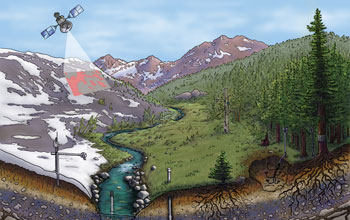
Now one tree may be poised to do just that, or at least to offer new insights into a place called the critical zone: the region where rock meets life between the top of the forest canopy and the base of weathered rock.

The Critical Zone Tree, this white fir is called. It's a scientific totem pole that stands tall in the forest of the Southern Sierra Critical Zone Observatory (CZO).

The Southern Sierra CZO is one of six such observatories supported by the National Science Foundation (NSF). Scientists there recently found that winter snow from Sierra blizzards foretells how much water will be at the base of the mountains during the summer.

This is important for people downstream who toil in California's multi-billion-dollar agricultural industry and depend on water from Sierra snowmelt. That water is the source of more than 60 percent of California's supply.

In addition, without torrents of melting snow cascading across hillsides, wildflowers won't bloom, and the birds and bees that need the flowers' nectar can't thrive.

But more and more, the rivers are running dry, running late or running early.

"NSF's CZOs are providing scientists with new knowledge of the critical zone and its response to climate and land use change," says Enriqueta Barrera, program director in NSF's Division of Earth Sciences, which funds the network of six CZOs.

"They're the first systems-based observatories dedicated to understanding how Earth's surface processes are coupled," says Barrera. "The results will help us predict how the critical zone will affect the ecosystem services on which society depends."

The water cycle; the breakdown of rocks and eventual formation of soil; the evolution of rivers and valleys; patterns of plant growth; and landforms we see all result from processes that take place in the critical zone.

"The CZOs are fostering an investigation of the critical zone as a holistic system," says Barrera.

NSF's CZOs are located in watersheds in the southern Sierra Nevada; Boulder Creek in the Colorado Rockies; Susquehanna Shale Hills in Pennsylvania; Christina River Basin on the border of Delaware and Pennsylvania; Luquillo riparian zone in Puerto Rico; and the Jemez River and Santa Catalina Mountains in New Mexico and Arizona.

At the Southern Sierra CZO, "we investigate how the water cycle drives critical zone processes," says lead scientist Roger Bales of the University of California, Merced. "Research focuses on water balance, nutrient cycling and weathering across the rain-snow transition line."

Society has long recognized the importance of water, soil, landforms and rivers to human welfare, says Bales, "but has only recently begun to look at their workings as a coupled system."

Water, vegetation and geochemistry are all interrelated, Bales and other scientists have found, with feedbacks from each influencing the others. But, how are they interrelated?

Enter the Critical Zone Tree--or trees. "In actuality," says Bales, "there are several of them."

The white fir and its coniferous relatives observe Sierra forests from the headwaters of the Providence Creek Basin. The trees and forest floor around them are covered with instruments that measure soil moisture, temperature, snow depth, solar radiation, sap flow and snowmelt patterns.

Beneath them are crisscrossing streams that course through a series of meadows. These rivers and creeks fan out across the mountains, carrying water across hill and dale--water that eventually sustains California's food-producing Central Valley.

The Critical Zone Trees play a starring role in the southern Sierra CZO story. They've become frontrunners for a series of wireless sensors that dot the forest like wildflowers in spring, transforming our understanding of the mountain water cycle.

The network of sensors tracks snowpack depth, water storage in soil, stream flow and water use by vegetation--information that's important for the wise use of water in the arid Mountain West.

"This type of wireless sensor network will revolutionize the way we understand our most important source of water in California--and far beyond," says Bales.

Natural resource managers often lack accurate estimates of precipitation, and the loss of water from the soil from direct evaporation and by transpiration from the surfaces of plants in the mountains. Therefore, they struggle to know how much water to retain in reservoirs, how much to release--and when.

In a future that holds even more uncertainty, the Southern Sierra CZO wireless sensor network will provide water officials with a way to better predict snowmelt runoff.

"This observation system is our window into the future of water availability in the southern Sierras," says Jun Abrajano, NSF acting deputy assistant director for Geosciences.

Climate warming means that more rain and less snow will fall in the Sierras and plant growth will change accordingly.  How long will we be able to rely on the Sierra snowpack as a "water tower"?

"An understanding of 'water balance,' made possible by the CZO, is what's needed to predict how whole-scale changes in vegetation cover will affect the future amount and timing of water availability in this region," says Abrajano.

Scientists at the Southern Sierra CZO are finding answers by teasing apart the interconnected strands of critical zone processes.  They're asking questions such as: how do variations in landscapes affect the way soil moisture, water use by vegetation, and stream flow respond to snowmelt and rainfall?

Bales and colleagues have found that small temperature differences between rain- and snow-dominated Sierra watersheds result in significantly different timing of runoff in the region's coniferous forests.

For every one degree Celsius increase in long-term average temperature, the scientists believe, runoff will happen seven to 10 days earlier in some locations.

"We've also found that across a broad range of elevations, forests transpire water year-round," says Bales, "with much higher water use than previously predicted." 

The results highlight a new link between climate and the deeper subsurface beneath trees.

Getting to the root of water availability, it turns out, may fall in the domain of not one Critical Zone Tree, but across--and under--a whole forest of them.

-- Cheryl Dybas, NSF (703) 292-7734 cdybas@nsf.gov

Can Marcellus Shale Gas Development and Healthy Waterways Sustainably Coexist?


National Science Foundation Sustainability Research Coordination Network is Providing Answers

The following is part one in a series on the National Science Foundation's Critical Zone Observatories (CZO)

Amity, Pennsylvania. Epicenter of the natural gas-containing geological formation known as the Marcellus Shale.

Amity lies in Washington County near Anawanna, Pa. Once, Native Americans lived there. They named it Anawanna, or "the path of the water," in recognition of its many rivers and streams.

Today the Native American Anawanna is but a whisper in tales of the past, but the path of the water for which it's named is making headlines.

The Marcellus Shale Formation underlies some 95,000 square miles of land, from upstate New York in the north to Virginia in the south to Ohio in the west.

The bull's-eye, however, is under Pennsylvania in places like Amity. There the gas-bearing thickness of the shale reaches 350 feet; it thins to less than 50 feet in other areas.

The Marcellus Shale gas reservoir may contain nearly 500 trillion cubic feet of technically-recoverable gas. At current use rates, that volume could meet the U.S. demand for natural gas for more than 20 years.

The shale's proximity to the heavily populated mid-Atlantic and Northeast makes its development economically advantageous. Already, more than 4,000 shale gas wells have been drilled in Pennsylvania.

But the Marcellus Shale has a bête noire. With such rapid development, gas exploitation is creating environmental challenges for Pennsylvania--and beyond.

Retrieving the Marcellus Shale's gas requires a process known as hydraulic fracturing, hydrofracking or simply fracking.

Fracking involves the use of large quantities of water, three to eight million gallons per well, mixed with additives, to break down the rocks and free up the gas. Some 10 to as much as 40 percent of this fluid returns to the surface as "flowback water" as the gas flows into a wellhead.

Once a well is in production and connected to a pipeline, it generates what's known as produced water. "Flowback and produced water," says Susan Brantley, a geoscientist at Penn State University, "contain fluid that was injected from surface reservoirs--and 'formation water' that was in the shale before drilling."

Enter the bête noire.

These flowback fluids carry high concentrations of salts, and of metals, radionuclides and methane. "Such chemicals," says Brantley, "can affect surface and groundwater quality if released to the environment without adequate treatment."

The rapid pace of Marcellus Shale drilling has outstripped Pennsylvania's ability to document pre-drilling water quality, even with some 580 organizations focused on monitoring the state's watersheds. More than 300 are community-based groups that take part in volunteer stream monitoring.

Pennsylvania has more miles of stream per unit land area than any other state in the United States. "It's overwhelming to keep track of," says Brantley. "These community organizations have identified a need for scientific and technical assistance to carry out accurate stream assessments."

Working through the National Science Foundation's (NSF) Susquehanna Shale Hills Critical Zone Observatory (CZO), one of six such observatories in the continental U.S. and Puerto Rico, Brantley studies the "critical zone" where water, atmosphere, ecosystems and soils interact.

Now, with a grant from NSF's Science, Engineering and Education for Sustainability (SEES) Research Coordination Networks (RCN) activity, Brantley is developing a Marcellus Shale Research Network.

The network will identify groups in Pennsylvania that are collecting water data in the Marcellus Shale region; create links among these organizations to meld the resulting data; and organize a water database through the NSF-funded Consortium of Universities for the Advancement of Hydrologic Sciences.

The database will be used to establish background concentrations of chemicals in streams and rivers, and ultimately to assess changes throughout the Marcellus Shale area.

The results, Brantley hopes, will help community groups evaluate hydrogeochemical data. The network will use geographic information systems that incorporate population and economic data to evaluate the potential for public health risks.

"An outcome of the NSF investment in the Susquehanna Shale Hills Critical Zone Observatory has been a better interpretation of the chemistry and flow of groundwater in shale," says Enriqueta Barrera, program director in NSF's Division of Earth Sciences, which funds the CZOs.

"The SEES-RCN project will use this information in assembling data collected by watershed associations, government agencies, and water scientists to further knowledge on the effect of hydrofracking on groundwater properties."

The Marcellus Shale RCN, says Brantley, "is designed to act as an 'honest broker' that collates datasets and teaches ways of synthesizing the data into useful knowledge. The approach stresses that volunteer data acts as a 'canary in a coal mine' to inform agencies about when and where they need to intensify water quality monitoring."

Of particular concern are concentrations of salts such as barium and strontium, high in some discharges as a result of the mixing of gas drilling fluids with naturally-occurring barium-strontium-containing waters.

"Barium can cause gastrointestinal problems and muscular weakness," says Brantley, "when people are exposed to it at levels above the EPA drinking water standards, even for relatively short periods of time.

"Animals [such as cows, pigs, sheep] that drink barium-laced waters over longer periods sustain damage to kidneys and have decreases in body weight, and may die of the effects."

The waterways of Pennsylvania have recorded many of the important human activities in the history of the United States, Brantley says. "It's expected that they will record the development of the Marcellus Shale gas as well."

The rise and fall of coal mining is found in concentrations of dissolved sulfates in the state's rivers. Pennsylvania's air, water and soils retain the signature of the steel industry and of coal-burning over the last century in their low-level manganese contamination.

Documenting the effects of shale gas extraction, says Brantley, requires extensive water sampling and a database of long-term records.

In the past, monitoring sometimes has not begun until after effects were noticed.  But times are changing. "In the future," says Brantley, "many monitoring networks of all kinds will need to include citizen scientists to keep costs down, and research scientists will need to learn to use such networks to the best outcome."

Can we have natural gas development and clean waterways?

The Marcellus Shale Research Network will provide much-needed answers, says Barrera. "Successfully developing new energy resources while maintaining healthy ecosystems," she says, "is the very heart of sustainability."

--Cheryl Dybas, NSF (703) 292-7734 cdybas@nsf.gov

Sunday, July 22, 2012

The Inevitable Demo Of The Great Green Fleet


In 2009, Secretary of the Navy (SECNAV) Ray Mabus announced five aggressive energy goals to reduce the Department of Navy’s (DON’s) consumption of energy, decrease its reliance on foreign sources of oil, and significantly increase its use of alternative energy.

The purpose of these energy goals is to improve our combat capability and to increase our energy security by addressing a significant military vulnerability: dependence on foreign oil.

One of the five energy goals is to demonstrate and then deploy a “Great Green Fleet,” a Carrier Strike Group fueled by alternative sources of energy, including nuclear power.

The Great Green Fleet is named in honor of President Theodore Roosevelt’s Great White Fleet, which helped usher in America as a global power on the world stage at the beginning of the 20th Century.

Prior to deploying the Great Green Fleet in 2016, the Navy conducted a demonstration during the 2012 Rim of the Pacific (RIMPAC) exercise, the world’s largest international maritime exercise.

The demonstration illustrated and evaluated the performance of “drop-in replacement” advanced biofuel blends and certain energy efficient technologies in an operational setting.


Advanced Biofuel Blends
The ships and aircraft will be powered by alternative fuel, either nuclear or advanced biofuel blends. The biofuel blends are 50-50 mixtures of biofuel (made from used cooking oil and algae) and petroleum-based marine diesel or aviation fuel.

Approximately 450,000 gallons of 100% “neat” biofuel were purchased in 2011 in preparation for the Great Green Fleet demonstration.

 ■Navy surface ships will be powered using 350,000 gallons of hydroprocessed renewable diesel (HRD-76) blended with an equal amount of marine diesel (F-76).
 ■Navy aircraft will burn 100,000 gallons of hydroprocessed renewable jet fuel (HRJ-5) blended with aviation fuel (JP-5).

Investments in an alternative to foreign sources of fuel will help the Navy and the nation become less dependent on foreign oil, and less subject to volatility in oil prices that can directly affect our readiness.

Energy Efficient Technologies
The Great Green Fleet demonstration will also include the following maritime efficiency measures:

 ■Solid State Lighting – Use of light-emitting diodes (LEDs) to save energy, especially when replacing incandescent fixtures or in colored lighting applications. LEDs also last longer than an incandescent or fluorescent fixture, reducing maintenance.
 ■Gas Turbine On-Line Water Wash – Allows compressors to be washed while the engine is running (normally, engines are shut down during this activity). This reduces maintenance, improves starter life, and reduces fuel consumption by keeping the compressor section of the gas turbine cleaner.
 ■Shipboard Energy Dashboard – Provides real-time situational awareness of energy demand associated with equipment. This allows the crew to minimize a ship’s energy consumption and increase its efficiency while meeting system performance and reliability requirements.
 ■Smart Voyage Planning Decision Aid – Sends messages to ships with optimized routing plans for both ship safety and fuel savings.
 ■Stern Flaps – Modifies the flow field under the hull to reduce drag, turbulence, and thus, reduce overall hull resistance.

Changing the Way We Think About Energy
As a Navy, we are grooming a new generation of ‘energy warriors’ through incentives and education.

As an example, the Incentivized Energy Conservation (i-ENCON) program encourages efficient ship operations during underway missions and supports the Secretary of the Navy’s efforts to reduce total energy consumption on Navy ships. In 2011, the i-ENCON program helped achieve over 1.1 million barrels of fuel in underburn, a cost avoidance of over 11% that would pay for an additional 56,500 steaming hours. The USS PRINCETON, USS CHAFEE and USS CHUNG HOON underburned enough fuel to win this prestigious award.

This program was so successful that the Navy recently launched its Aircraft Energy Conservation Program (known as Air-Encon) to optimize fuel consumption by the Navy’s 3,700 aircraft.

By changing the way we think about and use energy, we will continue to be the most formidable fighting force the world has ever known.

———-
Information for this story provided by greenfleet.dodlive.mil